
城市轨道交通

Search documents
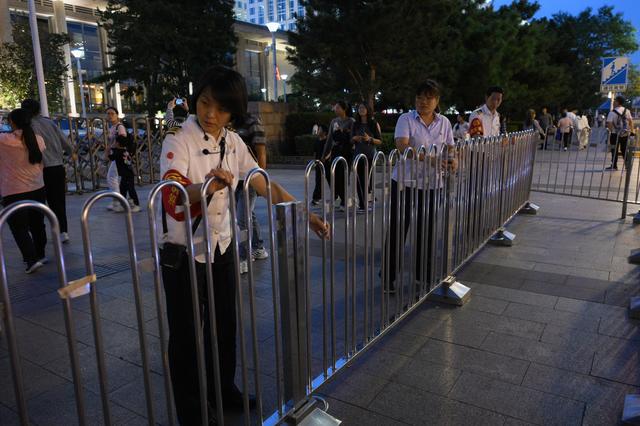
比去年增长25%!地铁王府井站假期首日迎客流高峰
Xin Lang Cai Jing· 2025-10-01 10:33
Core Points - The Beijing Wangfujing subway station is preparing for a significant increase in passenger flow during the National Day holiday, with an expected 25% rise compared to last year [3] - The station has implemented various measures, including the installation of 1,000 meters of mobile barriers and the adjustment of 29 automatic ticket machines to manage the flow of passengers effectively [3][5] - Additional train services have been scheduled to accommodate the increased passenger volume, with specific arrangements made for peak times [5] Group 1 - The Wangfujing station staff began preparations on September 4, focusing on designing flow lines and managing passenger entry and exit [3] - The station has deployed over 70 different types of loudspeakers to assist in crowd management, ensuring clear communication during peak hours [5][7] - The overall goal is to provide a safe and smooth travel experience for passengers during the holiday season [7]


广州地铁再开五线!流量担当,广深地铁装下全国两成客流量
Nan Fang Du Shi Bao· 2025-09-30 11:52
Core Insights - The article highlights the impressive performance of the Guangzhou and Shenzhen metro systems, showcasing their significant role in urban mobility and economic vitality in Guangdong province [1][2][3]. Group 1: Metro Performance - In August, the combined metro ridership of Guangzhou and Shenzhen reached 324 million, accounting for 19.6% of the national total, indicating that 1 in 5 metro riders in China is in these two cities [1]. - Guangzhou's metro recorded a total of 289 million passenger trips, while Shenzhen surpassed 300 million, together representing one-fifth of the national ridership [1]. - During the summer transport period, Guangzhou safely transported 601 million passengers, with a peak daily ridership of 11.057 million on August 8, marking a significant milestone [2]. Group 2: Economic Underpinnings - The robust metro ridership in Guangzhou is supported by over 4 million business entities, with a 57.3% year-on-year increase in new registrations from January to July [3]. - Guangzhou's express delivery volume reached 13.03 billion packages in the first seven months, significantly outpacing Shenzhen and Beijing, reflecting its strong economic base [3]. - Shenzhen's population growth, with an increase of 199,400 residents in 2024, contributes to a daily population exceeding 23 million, enhancing metro ridership [3]. Group 3: Regional Integration - The metro systems of Guangzhou and Shenzhen are interconnected with other cities and Hong Kong, forming a comprehensive transportation network that facilitates the flow of people, capital, and technology across the Greater Bay Area [4]. - The integration of metro services not only supports daily commuting but also plays a crucial role in reshaping industrial patterns and urban spaces, driving economic growth in the region [4].
今晚,地铁4号线延时运营,接送抵汉乘客
Chang Jiang Ri Bao· 2025-09-30 11:19
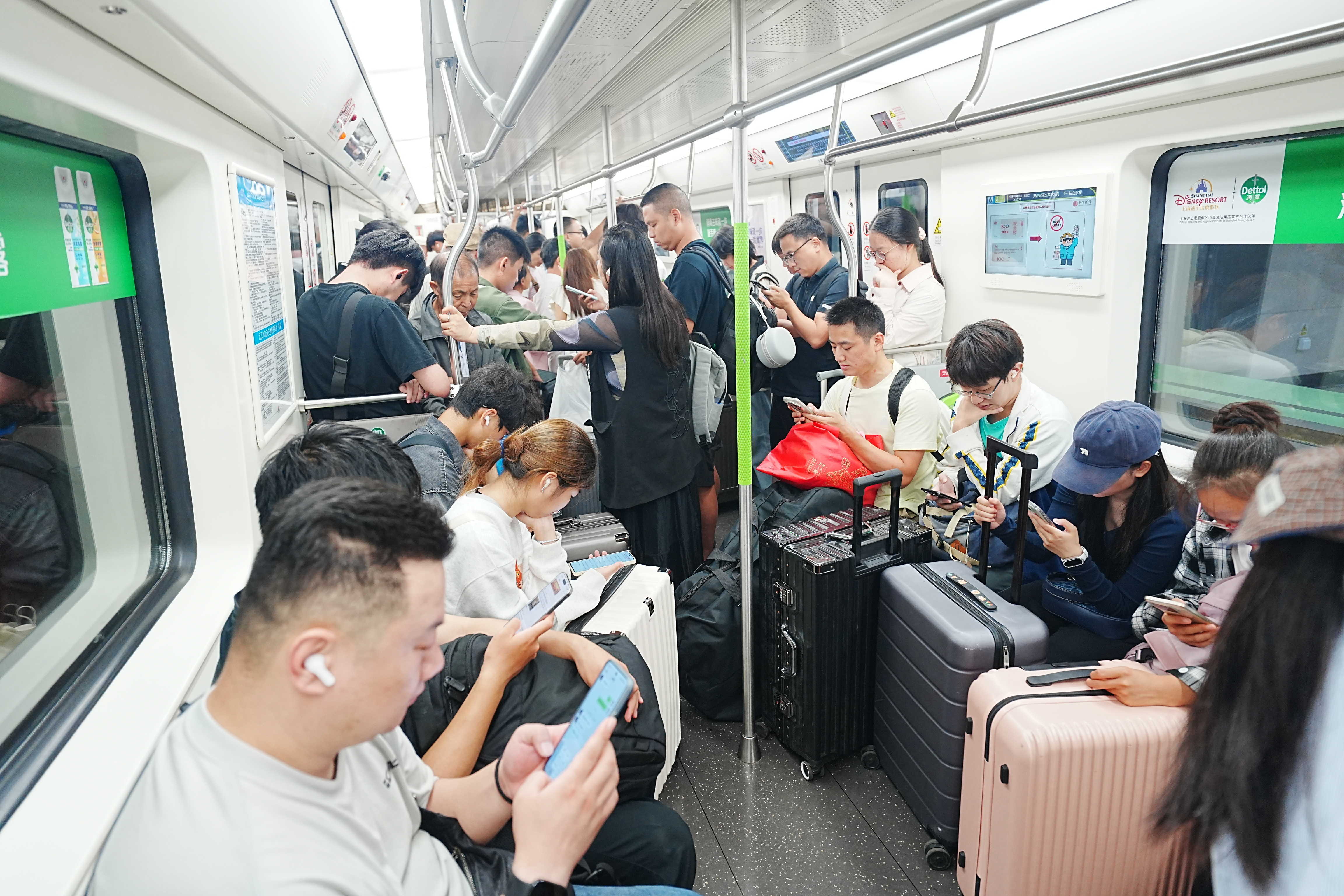
9月30日,为应对集中出行和返汉客流,武汉地铁中心城区线路提前上足晚高峰运力。 30日下午,地铁4号线列车内多为返程乘客。 为保障铁路夜间到达乘客出行需求,今日(9月30日),4号线武汉火车站往玉龙路方向末班车延时至23:40。 4号线23:00后开行大站快车临客,停靠站点如下:武汉火车站(末班车23:40)、铁机路、楚河汉街、武昌火车站(末班车次日 00:04)、复兴路、钟家村、王家湾、玉龙路。 市民乘客合理规划出行时间及路线,如需帮助可拨打武汉地铁服务热线027-96556或联系身边工作人员。 编辑:冯瀚莹 "我们根据客流情况及时启动大客流预案,在站厅、站台等处增设工作人员疏导,及时帮扶大件行李乘客。"4号线武汉火车站值班站长 王蒙介绍,到站方向站台拉起了伸缩栏杆,引导乘客按指定路线行进出站,站台至站厅的手扶电梯均设有专人值守确保安全乘梯。 30日下午,在地铁4号线武汉火车站,乘客有序出站。 30日下午3时起,武汉火车站附近3座车站随着铁路始发列车增加,相关地铁车站客流明显增大。其中,4号线武汉火车站小时客流超 过万人次,其中出站占比超过六成。 ...
5G专网重塑轨道交通新范式 助力城市动脉智能跃迁
Yang Guang Wang· 2025-09-30 04:56
Core Viewpoint - Shanghai Metro, in collaboration with China Mobile and Huawei, has established a 5G public-private network, enhancing operational efficiency and passenger experience in urban rail transit [1] Group 1: Infrastructure and Operations - Shanghai Metro has built 21 lines covering 517 stations, with over 7,000 trains and nearly 900 kilometers of operational mileage, serving over 10 million passengers daily [1] - The integration of 5G technology supports core operations such as scheduling, equipment maintenance, and safety management, enabling over 15,000 maintenance personnel to work efficiently [1] - The network must accommodate high-density passenger demands, especially during peak hours, requiring high capacity and low latency [4] Group 2: Technical Challenges - Urban rail transit networks face challenges such as limited construction time due to operational constraints, with only 3-4 hours available for network deployment at night [2] - Precise positioning is critical for safety operations, but underground environments hinder satellite signals, necessitating advanced base station positioning technologies [3] Group 3: Technological Innovations - Shanghai Metro has transitioned from a "communication pipeline" to a "digital artery," integrating various smart applications into the network to enhance safety, passenger experience, and management efficiency [5] - The use of the LampSite solution allows for rapid network upgrades by reusing existing fiber optics, while the EasyMacro solution simplifies tunnel construction and reduces costs by over 50% [6] Group 4: Positioning and Resource Management - Innovative positioning algorithms have been developed to achieve high-precision location tracking for people, vehicles, and objects, significantly improving inspection efficiency and reducing operational costs [7][8] - A multi-frequency collaborative network architecture has been implemented, achieving peak downlink speeds of 3 Gbps and uplink speeds of 500 Mbps, meeting high data transmission demands [9] Group 5: Operational Efficiency and Safety - The integration of 5G technology has led to a significant reduction in inspection times and enhanced emergency response capabilities, improving overall operational safety [10][11] - Data security measures have been established to ensure that operational data remains within the organization, enhancing privacy and information security [12] Group 6: Passenger Experience - The full 5G coverage has greatly improved passenger internet experience, with network congestion issues significantly alleviated, leading to over 90% growth in network traffic [13] - The upgraded Passenger Information System (PIS) provides real-time multimedia information, enhancing passenger service and increasing advertising value [13] Group 7: Global Impact and Standards - Shanghai Metro's 5G public-private network has influenced the establishment of national standards for urban rail transit, positioning it as a benchmark for global urban rail systems [14][15]

“英雄武汉”号地铁专列启程
Chang Jiang Ri Bao· 2025-09-30 00:41
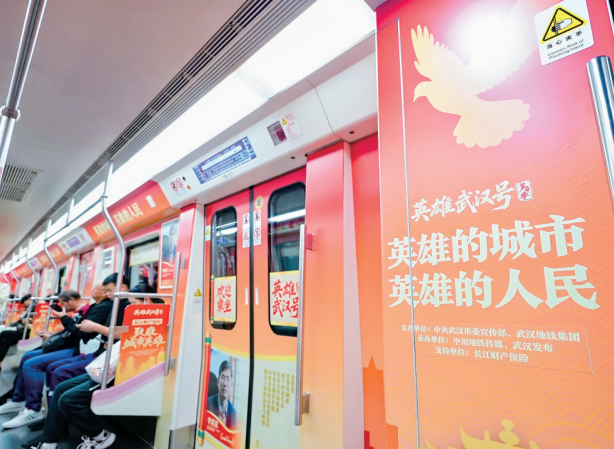
一张张英雄人物的照片与事迹介绍,车厢内是醒目的红色主题布置……9月29日上午, 不少搭乘武汉地铁2号线的乘客惊喜地发现自己走进了"英雄武汉"号主题专列,纷纷驻足拍 照打卡。 "英雄武汉"号主题地铁专列自2022年首次启动以来,已连续开展四年,成为展现新时代 英雄城市人物谱系的重要载体。从平凡善举到城市担当,专列持续讲述武汉人骨子里的英雄 气概,让市民在日常出行中看见英雄、致敬英雄、争做英雄。 走进主题车厢,5位代表与乘客现场交流。"看到人民安居乐业、脸上洋溢着幸福,我为 自己是中国人而自豪。"连续16年往返400公里义诊的"候鸟医生"、全国道德模范杜荣辉表 示,希望通过自己的专业能力持续为基层医疗和乡村振兴贡献力量。 编辑:胡之澜 身背AED(自动体外除颤器)时刻准备救人的外卖员张宝剑说:"作为一名普通外卖 员,能登上'英雄武汉'号让我倍感光荣。我会继续服务好每一位顾客,也欢迎大家国庆节来 武汉玩。我愿意做你们的旅游搭子,如果你们打不到车的话,我可以免费搭载你们!" 第四季"英雄武汉"号主题地铁专列车厢。 学院专业作家张执浩、阿毛等诗人参与,以英雄人物事迹为蓝本创作主题诗歌,进一步丰富 城市文化内涵,传递奋进 ...
【西安】地铁调整运营时间
Shan Xi Ri Bao· 2025-09-29 22:37
9月30日至10月8日,西安地铁2号线草滩站、常宁宫站末班车发车时间均调整至23∶55(西安北站往 城区方向的末班车发车时间为次日00∶00);3号线鱼化寨站、保税区站末班车发车时间分别调整至 23∶33、23∶08;4号线西安北站、航天新城站末班车发车时间均调整至23∶30;14号线机场西(T1、T2、 T3)站、贺韶站末班车发车时间分别调整至22∶50、23∶00;其余线路末班车发车时间保持不变。 国庆、中秋假期,西安地铁"Ai畅行"服务队将穿梭全线,为广大市民游客提供出行咨询、文明引 导、扶老携幼等服务。同时,西安地铁将充分发挥爱心服务台服务功能,及时向有需要的乘客提供出行 信息咨询、失物招领、爱心预约等服务。为确保乘客安全出行,西安地铁将根据客流情况,在重点大客 流站、换乘站、枢纽接驳车站等处适时采取客流控制等措施。(记者:杨光) 西安轨道交通集团运营分公司相关负责人表示,受通勤客流及节前外出客流的叠加影响,9月30 日,预计西安地铁线网客流在晚高峰期间持续处于高位,当天线网主要线路从13∶00起提前进入晚高峰 运营模式,晚高峰运营模式结束时间延长至22∶30左右。同时,西安地铁进一步提升假期主要线路 ...
国庆中秋长假,南京地铁多条线路延时运营
Yang Zi Wan Bao Wang· 2025-09-29 06:51
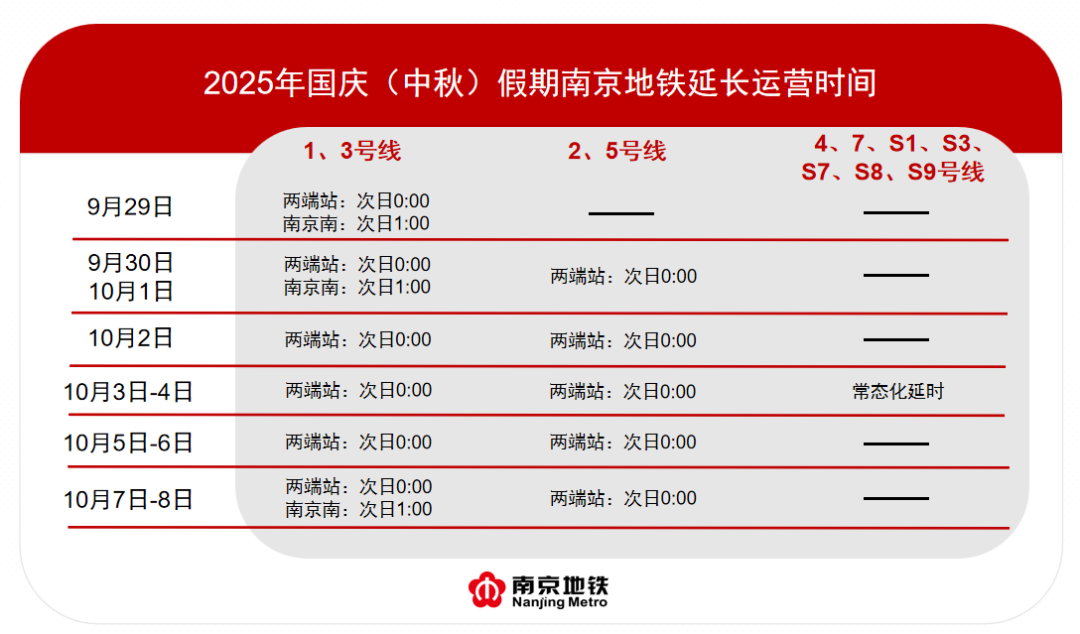
Core Points - Nanjing Metro has implemented a special transportation plan to enhance capacity and passenger organization for the upcoming National Day (Mid-Autumn) holiday, focusing on connecting major railway stations and facilitating evening travel for citizens [1] Group 1: Capacity Assurance - Nanjing Metro has prepared for peak travel demand by deploying maximum operational capacity on all lines starting September 30, with key lines like Line 1, 2, 3, S8, and S9 beginning to increase capacity from 1 PM to cover high-traffic areas [1][2] - During the holiday, special high-capacity operation schedules will be adopted for major commercial areas and tourist attractions, with an additional 1-2 backup trains added to each line to manage real-time passenger flow [1] Group 2: Extended Operating Hours - From September 30 to October 8, Lines 1, 2, 3, and 5 will operate until midnight, with the last train from both ends departing at 0:00 the next day; specifically, the last train from Nanjing South Station will be extended to 1:00 AM on certain dates [2][3] - On October 3 and 4, Lines 4, 7, S1, S3, S7, S8, and S9 will follow a regular extended schedule, while additional trains will be arranged on Lines S9 and S7 after the last train to ensure passengers reach Nanjing South Station [2][3] Group 3: Passenger Guidance - Nanjing Metro has issued reminders that if passenger flow exceeds capacity, temporary measures such as limiting entry and skipping stations may be implemented; passengers are advised to plan their travel times accordingly and follow staff instructions [4]
深圳地铁迈入600公里时代
Shen Zhen Shang Bao· 2025-09-29 00:31
Core Points - Shenzhen's metro system has expanded with the opening of the second phase of Line 16 and the second phase of Line 6, bringing the total operational length to 609.6 kilometers and 428 stations, maintaining the highest density among mainland cities in China [1][2] - The new lines are expected to significantly enhance regional connectivity and commuting efficiency, with peak daily ridership projected to reach 11 million [1][2] Group 1: New Line Details - Line 16 Phase II spans approximately 9.54 kilometers with 8 stations, enhancing connectivity between Longgang and Yuanshan, facilitating easier access for residents [2][3] - Line 6 Phase II covers about 4.95 kilometers with 3 stations, improving transfer efficiency between high-speed rail and metro, significantly reducing travel time between Guangming Science City and Futian [2][3] Group 2: Impact on Residents - The new metro lines are set to improve travel conditions for tens of thousands of residents, accelerating resource flow between Longgang, Guangming, and Shenzhen's core areas [3][4] - The aesthetic design of the new stations incorporates local cultural elements, enhancing the overall travel experience for commuters [3] Group 3: Future Developments - By the end of the year, four additional metro lines are expected to be operational, further increasing the coverage and efficiency of Shenzhen's metro network [4][5] - The new lines will contribute to the construction of a "city on rails," promoting transportation connectivity and economic collaboration within the Guangdong-Hong Kong-Macau Greater Bay Area [5]
多条新线开通 “流动的中国”添活力
Yang Shi Wang· 2025-09-28 17:07
Core Viewpoint - Recent advancements in major transportation projects across high-speed rail, subways, and air travel in China are enhancing the country's mobility and vitality [1] Group 1 - Multiple significant engineering projects in the transportation sector are progressing steadily [1]
2025年国庆暨中秋期间徐州地铁调整运营组织
Yang Zi Wan Bao Wang· 2025-09-28 13:34
Core Points - The Xuzhou Metro will extend its operating hours by 1.5 hours from September 29 to October 8, 2025, to accommodate increased passenger demand during the National Day and Mid-Autumn Festival [1] - The new operating hours will be from 6:00 AM to 12:00 AM, with a train interval of approximately 14 minutes during the extended hours [1] - The metro will adjust train schedules flexibly based on actual passenger flow to ensure operational safety and smooth travel during the adjustment period [1]