
能源行业

Search documents
鹏辉能源(300438.SZ)发预盈,预计2025年度归母净利润1.7亿元至2.3亿元,扭亏为盈
智通财经网· 2026-01-21 11:35
Core Viewpoint - Penghui Energy (300438.SZ) expects to achieve a net profit attributable to shareholders of 170 million to 230 million yuan for the fiscal year 2025, marking a turnaround from losses to profits [1] Group 1: Financial Performance - The company forecasts a net profit of 80 million to 110 million yuan after excluding non-recurring gains and losses [1] - The primary reason for the performance change is the favorable industry conditions, leading to increased product sales and a rise in sales orders [1]

鹏辉能源发预盈,预计2025年度归母净利润1.7亿元至2.3亿元,扭亏为盈
Zhi Tong Cai Jing· 2026-01-21 11:33
Group 1 - The company Penghui Energy (300438.SZ) forecasts a net profit attributable to shareholders of 170 million to 230 million yuan for the year 2025, marking a turnaround from losses to profits [1] - The net profit after deducting non-recurring gains and losses is expected to be between 80 million and 110 million yuan [1] - The main reasons for the performance change include an improving industry environment, strong product sales, and an increase in sales orders leading to revenue growth [1]
鹏辉能源:预计2025年净利润1.70亿元~2.30亿元 同比扭亏为盈
Mei Ri Jing Ji Xin Wen· 2026-01-21 10:53
Group 1 - The company, Penghui Energy, forecasts a net profit attributable to shareholders of 170 million to 230 million yuan for the year 2025, compared to a loss of 252.4557 million yuan in the same period last year [1] - The main reasons for the performance change include an improving industry environment, strong product sales, and an increase in sales orders leading to revenue growth [1]
广汇能源发预减,预计2025年度归母净利润同比下降50.03%至55.13%
Zhi Tong Cai Jing· 2026-01-21 09:42
Core Viewpoint - Guanghui Energy (600256.SH) forecasts a significant decline in net profit for 2025, projecting a range of 1.32 billion to 1.47 billion yuan, representing a year-on-year decrease of 50.03% to 55.13% due to a softening in energy product prices [1] Group 1: Financial Performance - The company expects a net profit attributable to shareholders of 1.32 billion to 1.47 billion yuan for 2025, marking a substantial decline compared to the previous year [1] - The decline in profit is primarily attributed to a decrease in prices of coal, liquefied natural gas (LNG), and coal chemical products, influenced by a relatively loose supply and demand in the energy market during the reporting period [1] Group 2: Asset and Tax Provisions - The company plans to make a significant asset impairment provision of approximately 350 million yuan, which will impact the net profit for the period [1] - Additional financial impacts include the payment of overdue taxes and penalties amounting to approximately 405.55 million yuan, as well as a water and soil conservation fee of about 965.93 million yuan [1]

中金 | 选举的另一面:行政干预、资本让利与政策风险
中金点睛· 2026-01-20 23:37
Core Viewpoint - The 2026 midterm elections are crucial for Trump and the Republican Party, with affordability becoming the central issue for voters, overshadowing traditional economic growth metrics [2][5][7]. Group 1: Political Context - The Republican Party holds a slim majority in the House of Representatives, and losing it could lead to a divided government, limiting Trump's ability to implement policies [5][6]. - Historical trends indicate that the party of the sitting president often loses seats in midterm elections, increasing the risk of impeachment for Trump if the Republicans fail [6][7]. Group 2: Affordability Crisis - High inflation has significantly impacted middle and low-income households, particularly in housing, where affordability has sharply declined since 2022 [2][12]. - The median income required to afford a typical home has increased by 43% compared to the median household income, exacerbated by rising mortgage rates [12][14]. - The burden of debt repayment is rising, with delinquency rates on credit cards and loans nearing previous highs, indicating increased financial stress among households [13][18]. Group 3: Policy Implications - As affordability becomes a primary goal, policy measures may shift towards more direct interventions in pricing and corporate behavior, moving away from traditional macroeconomic policies [3][22]. - Recent actions by Trump include proposals to limit credit card interest rates and push for legislative changes in housing, reflecting a focus on alleviating cost pressures for voters [24][25]. Group 4: Market Impact - The focus on affordability may limit the expansion of index valuations and increase market volatility, as the government prioritizes voter concerns over asset price growth [32]. - Sectors with strong pricing power and high profit margins may face increased policy risks, while cost-benefit industries could become more favorable for investment [32][33]. - Historical examples suggest that aggressive policy interventions can lead to market disruptions, as seen in the 1970s, raising caution among investors regarding potential policy risks [30][31].


韩元跌幅收窄,报道:韩国拟暂缓200亿美元赴美投资,以缓解本币贬值压力
Hua Er Jie Jian Wen· 2026-01-20 12:03
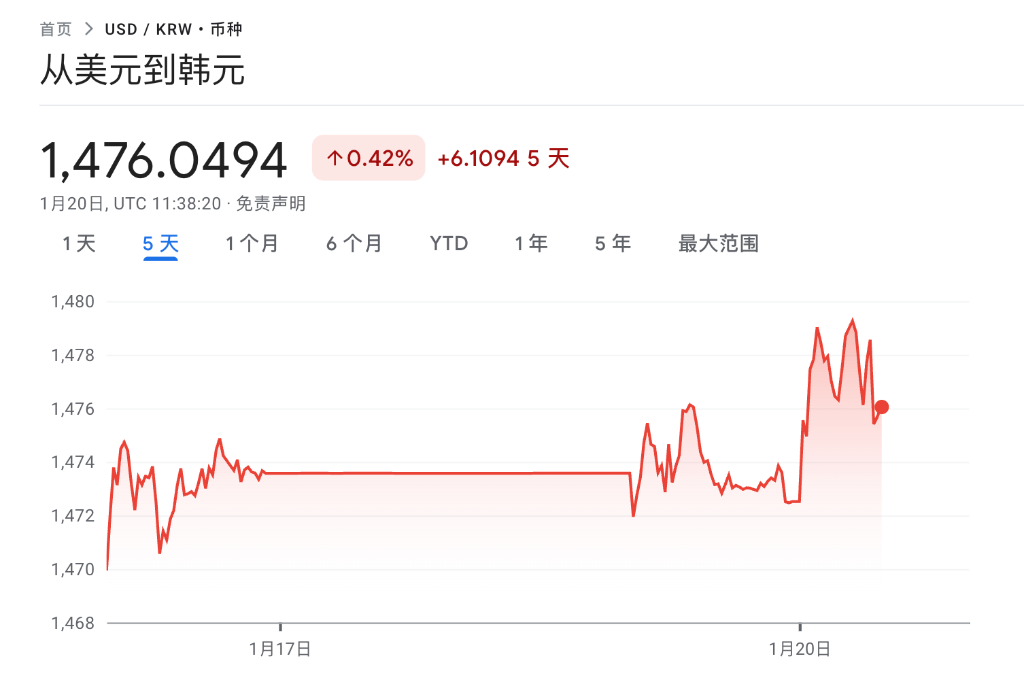
Core Viewpoint - South Korea has decided to postpone its commitment to invest up to $20 billion in the U.S. due to ongoing depreciation pressure on the Korean won, with plans to proceed once the foreign exchange market stabilizes [1] Group 1: Investment Commitment - The investment commitment was originally part of a trade agreement totaling $350 billion, with $150 billion allocated for the shipbuilding industry and $200 billion for sectors such as energy, semiconductors, pharmaceuticals, critical minerals, and artificial intelligence [4] - The agreement includes a key restriction that South Korea's annual capital outflow to the U.S. cannot exceed $20 billion, allowing for flexible adjustments in response to market instability [4] Group 2: Currency Performance - Since the second half of 2025, the Korean won has depreciated over 8% against the U.S. dollar, reaching its lowest level since the global financial crisis despite government interventions [1] - Following the announcement of the investment delay, the depreciation of the won against the dollar has slowed, with the exchange rate reported at 1476.05 [2] Group 3: Market Sentiment - Despite U.S. Treasury Secretary Scott Basset's comments suggesting that the won's weakness does not align with South Korea's strong economic fundamentals, market sentiment remains cautious, leading to fluctuations in the currency's value [5][6]
重塑能源再跌超4% 股价再创上市新低 拟折让约18%配股集资2.65亿港元
Zhi Tong Cai Jing· 2026-01-20 06:21
Group 1 - The core viewpoint of the article highlights that Reshape Energy (02570) has seen a significant decline in its stock price, dropping over 4% and reaching a new low of 57.4 HKD since its listing, with the stock price halving since early December 2025 [1] - As of the report, the stock is down 4.47%, trading at 57.65 HKD, with a trading volume of 68.83 million HKD [1] - Reshape Energy announced the placement of 4.536 million new shares, which represents a 7.3% increase in the enlarged H-share capital, with a placement price of 58.38 HKD, reflecting an 18.01% discount compared to the closing price on January 16 [1] Group 2 - The total amount raised from the share placement is 265 million HKD, with a net amount of 258 million HKD, of which 50% is intended for repaying bank loans and lease liabilities, while the remainder will be used for general corporate purposes [1] - It is noteworthy that on December 8 of the previous year, Reshape Energy marked its one-year anniversary since listing, coinciding with the unlocking of shares [1] - Data indicates that a total of 55 shareholders experienced the unlocking of shares, with a cumulative number of 54.2136 million shares being unlocked [1]
能源价格对消费者支出的长期影响(英)2025
Shi Jie Yin Hang· 2026-01-20 02:50
Investment Rating - The report does not explicitly provide an investment rating for the industry. Core Insights - Understanding the long-term impact of energy price changes on consumer spending is crucial, as energy prices significantly influence household and business expenditures [20][41] - The analysis utilizes national energy cost shares, a practical indicator measuring the ratio of energy costs to GDP, covering data from 142 countries over 40 years [21][43] - The report highlights a long-term decline in energy cost shares despite rising energy prices, attributed to systematic reductions in energy intensity due to technological advancements and energy efficiency policies [22][23] - Economic growth is associated with a decrease in energy cost shares, with energy prices having a more significant impact on these shares than GDP changes [23][24] - The short-term response to energy price increases is more pronounced, with a 10% rise in energy prices correlating to an approximate 8% increase in energy cost shares in the same year, which eventually stabilizes at around 4.8% [25][26] - The median adjustment period for economies to absorb price increases is about 18 years, indicating a slow adjustment process [26] - Countries exhibit varying capacities to adapt to energy price increases, with high-income nations showing lower long-term price elasticity, suggesting a stronger ability to absorb price shocks [27][28] - Energy efficiency policies play a critical role in mitigating the impact of price increases on cost shares, emphasizing the need for comprehensive energy efficiency frameworks [28][29] Summary by Sections Introduction - The report aims to explore how energy cost shares evolve with changes in energy prices and economic activity, addressing the limited understanding of these dynamics in existing literature [40][41] Dataset Overview - The analysis is based on a comprehensive dataset that includes energy consumption and price data across various sectors and countries, providing a robust foundation for the econometric analysis [51][54] Evolution of Energy Cost Shares - The report presents empirical observations indicating a strong short-term correlation between energy prices and cost shares, which diminishes over time [68][69] - The relationship between energy cost shares and prices varies significantly across different income groups, with lower-income countries showing a more pronounced correlation [74][78] Policy Implications - The findings suggest that targeted energy efficiency policies and fiscal measures can enhance economic resilience to energy price fluctuations, highlighting the importance of tailored reform strategies [29][33][36]
国家统计局:2025年非化石能源超过石油成为第二大能源类型
Xin Lang Cai Jing· 2026-01-19 04:46
格隆汇1月19日|国家统计局能源统计司司长胡汉舟发文表示,"双碳"目标下,我国积极推进能源绿色 低碳转型,煤炭消费比重持续下降,清洁能源消费占比稳步攀升,消费结构进一步优化。2025年,非化 石能源占能源消费总量比重比上年提高约2个百分点,超过石油成为第二大能源类型,成为能源增量主 体。 初步测算,2025年全社会能源消费总量比上年增长3.5%,扣除原料用能和非化石能源消费量后, 单位GDP能耗比上年降低5%以上。规模以上工业单位增加值能耗连续两年保持下降,工业节能降耗取 得新成效。 ...
广汇能源:2026年2月3日召开2026年第一次临时股东会
Zheng Quan Ri Bao Wang· 2026-01-16 15:11
证券日报网讯1月16日,广汇能源(600256)发布公告称,公司将于2026年2月3日16:30召开2026年第 一次临时股东会。 ...