ETF

Search documents
Should Motley Fool 100 Index ETF (TMFC) Be on Your Investing Radar?
ZACKS· 2025-08-12 11:21
Core Insights - The Motley Fool 100 Index ETF (TMFC) is a passively managed ETF launched on January 30, 2018, with assets exceeding $1.59 billion, targeting the Large Cap Growth segment of the US equity market [1][10]. Group 1: Large Cap Growth Overview - Large cap companies typically have a market capitalization above $10 billion, offering stability and more reliable cash flows compared to mid and small cap companies [2]. - Growth stocks are characterized by higher sales and earnings growth rates, but they also come with higher valuations and volatility [3]. Group 2: Costs and Performance - The ETF has an annual operating expense ratio of 0.5% and a 12-month trailing dividend yield of 0.36% [4]. - TMFC has achieved a return of approximately 11.14% year-to-date and 29.34% over the past year, with a trading range between $49.85 and $66.92 in the last 52 weeks [8]. Group 3: Sector Exposure and Holdings - The ETF's largest allocation is to the Information Technology sector, comprising about 42.9% of the portfolio, followed by Telecom and Consumer Discretionary [5]. - Nvidia Corp (NVDA) represents about 10.18% of total assets, with the top 10 holdings accounting for approximately 59.27% of total assets under management [6]. Group 4: Index and Risk - TMFC aims to replicate the performance of the Motley Fool 100 Index, which includes the 100 largest US companies by market cap, reconstituted quarterly [7]. - The ETF has a beta of 1.13 and a standard deviation of 19.92% over the trailing three-year period, indicating effective diversification with about 104 holdings [8]. Group 5: Alternatives - Other ETFs in the same space include the Vanguard Growth ETF (VUG) and Invesco QQQ (QQQ), with VUG having $184.51 billion in assets and an expense ratio of 0.04%, while QQQ has $363.71 billion and charges 0.2% [11]. Group 6: Bottom-Line - Passively managed ETFs like TMFC are increasingly popular due to their low costs, transparency, flexibility, and tax efficiency, making them suitable for long-term investors [12].


ETF及指数产品网格策略周报-20250812
HWABAO SECURITIES· 2025-08-12 08:07
Group 1 - The report outlines a grid trading strategy that focuses on capitalizing on price fluctuations rather than predicting market trends, making it suitable for volatile markets [3][13] - Characteristics of suitable grid trading targets include being exchange-traded, having stable long-term trends, low transaction costs, good liquidity, and high volatility, with equity ETFs being particularly appropriate [3][13] - The report highlights specific ETFs for grid trading, including the China Concept Internet ETF, which aims to reduce vicious competition costs and promote technological innovation in the internet sector [4][14] Group 2 - The Hang Seng Technology ETF benefits from improved liquidity in the Hong Kong market and the return of quality listed companies, making it a cost-effective investment tool in a low-interest-rate environment [4][17] - The Software ETF is positioned to leverage opportunities in AI development, with significant policy support encouraging the integration of AI technologies across various sectors [6][20] - The Chip ETF reflects a short-term easing of overseas pressures while emphasizing the long-term trend of domestic substitution in the semiconductor industry, supported by substantial investments in domestic chip manufacturing [7][21]
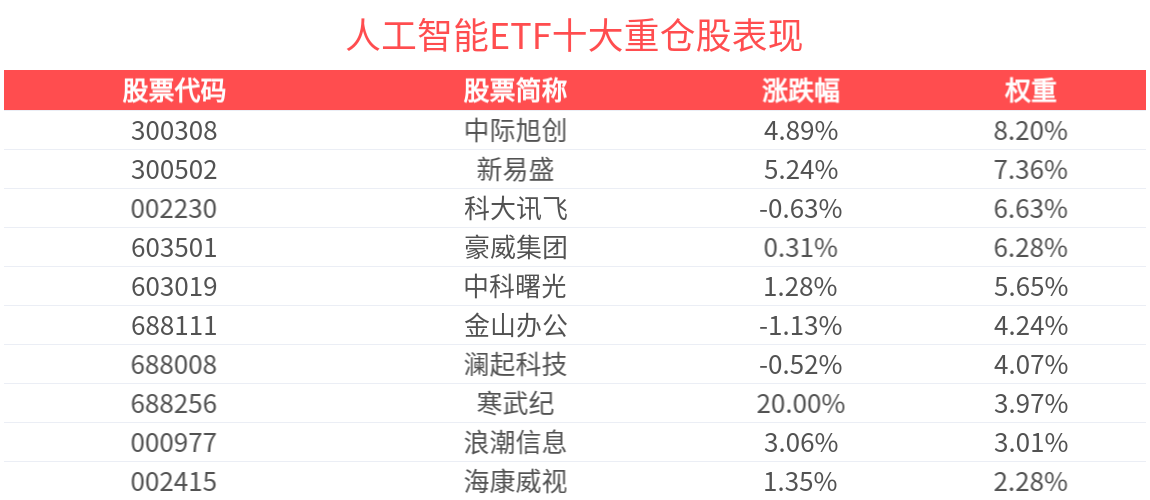
寒武纪20cm涨停市值突破3500亿元!AI小宽基人工智能ETF(515980)涨超3%,成分股德赛西威、新易盛跟涨
Sou Hu Cai Jing· 2025-08-12 06:52
Core Viewpoint - The artificial intelligence (AI) sector is experiencing significant growth, as evidenced by the strong performance of the China Securities Artificial Intelligence Industry Index and related ETFs, indicating a robust investment opportunity in this field [1][2]. Group 1: Market Performance - As of August 12, 2025, the China Securities Artificial Intelligence Industry Index (931071) surged by 3.42%, with key stocks like Cambricon (688256) hitting a 20% limit up, pushing its market capitalization above 350 billion yuan [1]. - The AI ETF (515980) rose by 3.20%, with a trading volume of 286 million yuan and a turnover rate of 8.58% [1]. - Over the past week, the AI ETF has averaged daily trading of 237 million yuan, with its total size reaching 3.269 billion yuan [1]. Group 2: Fund Flows and Investment Strategy - The AI ETF has seen continuous net inflows over the past three days, with a peak single-day net inflow of 89.9845 million yuan, totaling 121 million yuan [1]. - The AI ETF uniquely tracks the artificial intelligence industry index and is the only small-cap ETF in the AI sector that adjusts quarterly, providing a balanced exposure to the market [5][6]. Group 3: Sector Composition and Trends - The index includes 50 stocks with high AI revenue proportions and growth potential, focusing on both infrastructure (like optical modules and ASIC chips) and application layers (such as office automation, media, autonomous driving, and robotics) [2][6]. - The current market conditions suggest a potential upward cycle in the semiconductor sector, driven by AI computing demand, which may enhance the overall market sentiment and demand limits [3].

量子科技未来产业发展论坛在深圳举办,大湾区ETF备受关注
Sou Hu Cai Jing· 2025-08-12 06:43
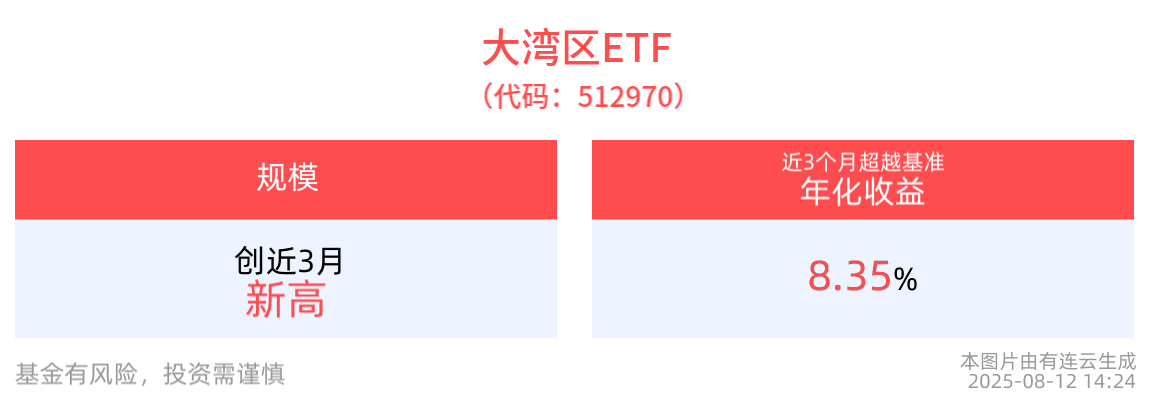
Core Viewpoint - The Greater Bay Area (GBA) ETF has shown positive performance, with a recent increase in value and significant returns over the past year, reflecting the growth potential of companies benefiting from the GBA development theme [2][3]. Market Performance - As of August 12, 2025, the GBA development theme index rose by 0.55%, with notable increases in constituent stocks such as Invec (up 8.71%) and China Great Wall (up 7.86%) [2]. - The GBA ETF (512970) increased by 0.84%, reaching a latest price of 1.32 yuan, and has accumulated a 1.87% increase over the past week [2]. - The GBA ETF's net value rose by 34.51% over the past year, with a maximum monthly return of 21.99% since its inception [3]. Trading and Liquidity - The GBA ETF had a turnover rate of 0.12% during the trading session, with a transaction volume of 87,500 yuan [2]. - The average daily trading volume over the past year was 258,900 yuan [3]. Fund Size and Fees - The GBA ETF's latest size reached 74.79 million yuan, marking a three-month high [2]. - The management fee for the GBA ETF is 0.15%, and the custody fee is 0.05% [3]. Index Composition - The GBA ETF closely tracks the performance of the GBA development theme index, which includes a selection of companies from the Hong Kong, Shanghai, and Shenzhen markets that benefit from the GBA's development [4]. - As of July 31, 2025, the top ten weighted stocks in the index accounted for 50.37% of the total weight, including major companies like Ping An Insurance and BYD [4][6].
Is John Hancock Multifactor Small Cap ETF (JHSC) a Strong ETF Right Now?
ZACKS· 2025-08-11 11:21
Core Insights - The John Hancock Multifactor Small Cap ETF (JHSC) offers investors exposure to the Style Box - Small Cap Blend category, having debuted on November 8, 2017 [1] - Smart beta ETFs, like JHSC, aim to outperform traditional market cap weighted indexes by selecting stocks based on specific fundamental characteristics [3][4] - JHSC is managed by John Hancock and has accumulated over $566.07 million in assets, positioning it as an average-sized ETF in its category [5] Fund Details - JHSC seeks to match the performance of the JOHN HANCOCK DIMENSIONAL SMALL CAP INDEX, which includes U.S. companies with market capitalizations smaller than the 750th largest, excluding the smallest 4% [6] - The fund has an annual operating expense ratio of 0.42% and a 12-month trailing dividend yield of 1.06% [7] - The fund's largest sector allocation is in Industrials at approximately 22.8%, followed by Financials and Consumer Discretionary [8] Holdings and Performance - JHSC's top holdings include Nextracker Inc Cl A (0.55% of total assets), Commvault Systems Inc, and Planet Fitness Inc Cl A, with the top 10 holdings accounting for about 5.11% of total assets [9] - As of August 11, 2025, JHSC has experienced a year-to-date loss of -0.01% and a one-year gain of 6.96%, with a trading range between $32.47 and $43.65 over the past 52 weeks [11] Alternatives - Other ETFs in the small-cap space include Vanguard Small-Cap ETF (VB) and iShares Core S&P Small-Cap ETF (IJR), which have significantly larger assets and lower expense ratios of 0.05% and 0.06%, respectively [13]

Should JPMorgan Diversified Return U.S. Mid Cap Equity ETF (JPME) Be on Your Investing Radar?
ZACKS· 2025-08-11 11:21
Core Viewpoint - The JPMorgan Diversified Return U.S. Mid Cap Equity ETF (JPME) offers broad exposure to the Mid Cap Blend segment of the US equity market, with a focus on balancing growth potential and stability [1][2]. Group 1: Fund Overview - JPME is a passively managed ETF launched on May 11, 2016, and has accumulated assets exceeding $357.39 million, categorizing it as an average-sized ETF in its segment [1]. - The fund targets mid cap companies with market capitalizations between $2 billion and $10 billion, which typically exhibit higher growth prospects compared to large cap companies while being less volatile than small cap companies [2]. Group 2: Costs and Performance - The ETF has an annual operating expense ratio of 0.24%, which is competitive within its peer group, and a 12-month trailing dividend yield of 1.93% [3]. - As of August 11, 2025, JPME has returned approximately 2.8% year-to-date and 8.78% over the past year, with a trading range between $89.28 and $110.92 in the last 52 weeks [7]. Group 3: Sector Exposure and Holdings - The ETF's largest allocation is to the Industrials sector, comprising about 12% of the portfolio, followed by Healthcare and Consumer Staples [4]. - The top 10 holdings account for approximately 4.67% of total assets, with Jpmorgan Us Govt Mmkt Fun, Jabil Inc Common Stock (JBL), and Hewlett Packard (HPE) being notable individual holdings [5]. Group 4: Investment Strategy - JPME aims to replicate the performance of the Russell Midcap Diversified Factor Index using a rules-based approach that incorporates risk-based portfolio construction and multi-factor security selection, including value, quality, and momentum factors [6]. Group 5: Alternatives - Other ETFs in the Mid Cap Blend space include the Vanguard Mid-Cap ETF (VO) and the iShares Core S&P Mid-Cap ETF (IJH), which have significantly larger asset bases of $85.49 billion and $95.63 billion, respectively, and lower expense ratios of 0.04% and 0.05% [9].

Is Invesco RAFI Emerging Markets ETF (PXH) a Strong ETF Right Now?
ZACKS· 2025-08-11 11:21
Core Insights - The Invesco RAFI Emerging Markets ETF (PXH) is a smart beta ETF that debuted on September 27, 2007, providing broad exposure to the emerging markets category [1] - PXH is managed by Invesco and has accumulated over $1.54 billion in assets, making it one of the larger ETFs in the Broad Emerging Market ETFs segment [5] - The fund aims to match the performance of the FTSE RAFI Emerging Markets Index, which selects equities based on fundamental measures such as book value, cash flow, sales, and dividends [6] Fund Characteristics - The ETF has an annual operating expense ratio of 0.47%, which is competitive within its peer group, and a 12-month trailing dividend yield of 3.40% [7] - The top holdings include Taiwan Semiconductor Manufacturing Co Ltd (6.04% of total assets), Alibaba Group Holding Ltd, and China Construction Bank Corp, with the top 10 holdings accounting for approximately 29.85% of total assets [8][9] Performance Metrics - Year-to-date, PXH has increased by about 19.06%, and it was up approximately 25.26% over the last 12 months as of August 11, 2025 [10] - The ETF has a beta of 0.57 and a standard deviation of 17.81% over the trailing three-year period, indicating a medium risk profile [11] Alternatives in the Market - Other ETFs in the emerging markets space include Vanguard FTSE Emerging Markets ETF (VWO) with $94.77 billion in assets and iShares Core MSCI Emerging Markets ETF (IEMG) with $100.39 billion in assets, both of which have lower expense ratios of 0.07% and 0.09% respectively [13]
Should Schwab U.S. Small-Cap ETF (SCHA) Be on Your Investing Radar?
ZACKS· 2025-08-11 11:21
Core Insights - The Schwab U.S. Small-Cap ETF (SCHA) is a passively managed fund launched on November 3, 2009, with over $17.74 billion in assets, making it one of the largest ETFs in the Small Cap Blend segment of the U.S. equity market [1] Costs - The ETF has an annual operating expense ratio of 0.04%, positioning it as one of the least expensive options in its category, with a 12-month trailing dividend yield of 1.53% [3] Sector Exposure and Top Holdings - The ETF has a significant allocation to the Industrials sector at approximately 19.6%, followed by Financials and Information Technology [4] - Affirm Holdings Inc Class A (AFRM) constitutes about 0.47% of total assets, with the top 10 holdings accounting for around 3.73% of total assets under management [5] Performance and Risk - SCHA aims to match the performance of the Dow Jones U.S. Small-Cap Total Stock Market Index, having increased by about 0.19% year-to-date and 8.93% over the past year as of August 11, 2025 [6] - The ETF has a beta of 1.11 and a standard deviation of 21.62% over the trailing three-year period, indicating a medium risk profile with 1714 holdings for diversification [7] Alternatives - SCHA holds a Zacks ETF Rank of 2 (Buy), indicating strong potential based on expected returns, expense ratio, and momentum, making it a favorable choice for investors in the Small Cap Blend segment [8] - Other comparable ETFs include the Vanguard Small-Cap ETF (VB) with $63.12 billion in assets and an expense ratio of 0.05%, and the iShares Core S&P Small-Cap ETF (IJR) with $80.47 billion in assets and a 0.06% expense ratio [9] Bottom-Line - Passively managed ETFs like SCHA are favored by both institutional and retail investors due to their low costs, transparency, flexibility, and tax efficiency, making them suitable for long-term investment strategies [10]

Should Schwab U.S. Dividend Equity ETF (SCHD) Be on Your Investing Radar?
ZACKS· 2025-08-11 11:21
Core Viewpoint - The Schwab U.S. Dividend Equity ETF (SCHD) is a leading investment option for exposure to the Large Cap Value segment of the U.S. equity market, with significant assets and low expense ratios, making it attractive for long-term investors [1][4][10]. Group 1: ETF Overview - SCHD is a passively managed ETF launched on October 20, 2011, and is sponsored by Charles Schwab, with assets exceeding $69.99 billion [1]. - The ETF aims to match the performance of the Dow Jones U.S. Dividend 100 Index, which focuses on high dividend yielding stocks with a strong record of dividend payments [7]. Group 2: Investment Characteristics - Large cap companies, defined as those with market capitalizations above $10 billion, are generally more stable and exhibit predictable cash flows compared to mid and small cap companies [2]. - Value stocks, which typically have lower price-to-earnings and price-to-book ratios, have historically outperformed growth stocks in long-term performance, although growth stocks may excel in strong bull markets [3]. Group 3: Costs and Performance - SCHD has an annual operating expense ratio of 0.06%, positioning it among the least expensive ETFs in its category, and it offers a 12-month trailing dividend yield of 3.81% [4]. - As of August 11, 2025, SCHD has gained approximately 0.25% year-to-date and 4.36% over the past year, with a trading range between $24.32 and $29.53 in the last 52 weeks [8]. Group 4: Sector Exposure and Holdings - The ETF has a significant allocation to the Consumer Staples sector, comprising about 19.8% of the portfolio, followed by Energy and Healthcare [5]. - Texas Instruments Inc (TXN) is the largest holding at approximately 4.33% of total assets, with the top 10 holdings accounting for about 40.3% of total assets under management [6]. Group 5: Alternatives and Market Position - SCHD holds a Zacks ETF Rank of 2 (Buy), indicating strong expected returns based on various factors, making it a compelling choice for investors interested in the Large Cap Value segment [10]. - Other comparable ETFs include the Vanguard High Dividend Yield ETF (VYM) and the Vanguard Value ETF (VTV), with VYM having $62.20 billion in assets and VTV at $139.70 billion, both with competitive expense ratios [11].
Should Vanguard Mid-Cap ETF (VO) Be on Your Investing Radar?
ZACKS· 2025-08-11 11:21
Core Insights - The Vanguard Mid-Cap ETF (VO) is a passively managed fund launched on January 26, 2004, with assets exceeding $85.49 billion, making it one of the largest ETFs in the Mid Cap Blend segment of the US equity market [1] Group 1: Mid Cap Blend Characteristics - Mid cap companies have market capitalizations between $2 billion and $10 billion, offering a balance of stability and growth potential compared to large and small cap companies [2] - Blend ETFs typically hold a mix of growth and value stocks, as well as stocks exhibiting both characteristics [2] Group 2: Cost Structure - The ETF has an annual operating expense ratio of 0.04%, positioning it as one of the least expensive options in the market [3] - It offers a 12-month trailing dividend yield of 1.51% [3] Group 3: Sector Exposure and Holdings - The ETF's largest allocation is to the Industrials sector, comprising approximately 17.7% of the portfolio, followed by Financials and Information Technology [4] - Constellation Energy Corp (CEG) represents about 1.16% of total assets, with the top 10 holdings accounting for roughly 5.78% of total assets under management [5] Group 4: Performance Metrics - The ETF aims to match the performance of the CRSP US Mid Cap Index, which includes U.S. companies in the top 70%-85% of investable market capitalization [6] - Year-to-date, the ETF has increased by about 8.2% and has risen approximately 17.93% over the past year as of August 11, 2025 [6] - The ETF has traded between $228.54 and $289.77 in the past 52 weeks [6] Group 5: Risk Assessment - The ETF has a beta of 1.02 and a standard deviation of 17.15% over the trailing three-year period, categorizing it as a medium risk investment [7] - With around 304 holdings, it effectively diversifies company-specific risk [7] Group 6: Alternatives - The Vanguard Mid-Cap ETF holds a Zacks ETF Rank of 2 (Buy), indicating strong expected returns and favorable metrics [8] - Other alternatives include the iShares Russell Mid-Cap ETF (IWR) with $42.76 billion in assets and an expense ratio of 0.19%, and the iShares Core S&P Mid-Cap ETF (IJH) with $95.63 billion in assets and an expense ratio of 0.05% [9] Group 7: Conclusion - Passively managed ETFs like VO are favored by both institutional and retail investors due to their low costs, transparency, flexibility, and tax efficiency [10]