
城市轨道交通

Search documents
7月我国城市轨道交通客运量超29亿人次
Shen Zhen Shang Bao· 2025-08-11 22:44
Core Viewpoint - The article discusses the recent financial performance and strategic developments of a specific company, highlighting its growth trajectory and market positioning in the industry [2] Financial Performance - The company reported a revenue increase of 15% year-over-year, reaching a total of 5 billion in the last quarter [2] - Net profit rose by 20%, amounting to 1 billion, indicating strong operational efficiency and cost management [2] Strategic Developments - The company has announced plans to expand its product line, aiming to capture a larger market share in emerging sectors [2] - A new partnership with a leading technology firm is expected to enhance the company's innovation capabilities and drive future growth [2] Market Positioning - The company currently holds a 25% market share in its primary sector, positioning it as a key player among competitors [2] - Recent market analysis indicates a growing demand for the company's products, with projections suggesting a potential market growth of 30% over the next three years [2]

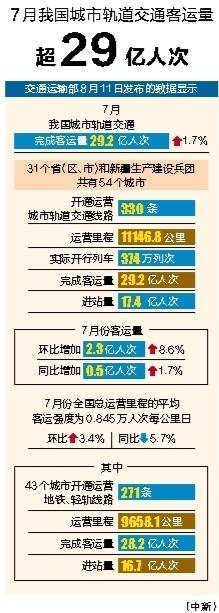
7月中国城市轨道交通客运量超29亿人次
Zhong Guo Xin Wen Wang· 2025-08-11 16:38
Core Insights - In July, China's urban rail transit achieved a passenger volume of 2.92 billion trips, marking a year-on-year increase of 1.7% [1] Summary by Categories Passenger Volume - The passenger volume in July increased by 230 million trips compared to the previous month, representing a growth of 8.6% [1] - Year-on-year, the passenger volume rose by 50 million trips, equivalent to a growth of 1.7% [1] Operational Data - A total of 54 cities across 31 provinces (autonomous regions, municipalities) and Xinjiang Production and Construction Corps operated 330 urban rail transit lines with a total operational mileage of 11,146.8 kilometers [1] - The actual number of train operations reached 3.74 million trips [1] Specific Transit Types - Among the cities, 43 operated metro and light rail lines totaling 271 lines and 9,658.1 kilometers, with a passenger volume of 2.82 billion trips [1] - 16 cities operated monorail, maglev, and regional rapid transit lines totaling 25 lines and 970.7 kilometers, achieving a passenger volume of 83.14 million trips [1] - 18 cities operated trams and automated guided rail lines totaling 34 lines and 518 kilometers, with a passenger volume of 10.98 million trips [1] Passenger Intensity - The average passenger intensity for the total operational mileage in July was 0.845 million trips per kilometer per day, which is a month-on-month increase of 3.4% but a year-on-year decrease of 5.7% [1]
7月全国城轨客运量增长1.7% 多地暑运客流创新高
Zhong Guo Jing Ying Bao· 2025-08-11 15:41
Group 1 - The core viewpoint of the articles highlights the significant increase in urban rail transit passenger volumes across various cities in China during July 2025, driven by the summer travel season and the opening of new lines [1][2][3] - In July 2025, the total passenger volume for urban rail transit in 54 cities reached 2.92 billion trips, marking a month-on-month increase of 230 million trips (8.6%) and a year-on-year increase of 50 million trips (1.7%) [1] - The average passenger intensity for the national rail transit network was 0.845 million trips per kilometer per day, reflecting a month-on-month increase of 3.4% but a year-on-year decrease of 5.7% [1] Group 2 - Cities with the highest growth in urban rail passenger volumes in July included Tianshui, Taiyuan, and Nantong, with increases of 775.28%, 131.34%, and 22.74% respectively, largely due to the opening of new rail lines [1] - Shenzhen's metro system reported an average daily passenger volume of 9.646 million in July, surpassing the previous record of 9.3 million set in the same month last year [1] - Beijing's rail transit network achieved a single-day passenger volume of 12.5034 million on July 11, setting a new high for the year, while Qingdao's metro recorded 2.1078 million on July 18, marking a historical record for non-holiday periods [2]
济南地铁4号线启动全线动车调试
Qi Lu Wan Bao Wang· 2025-08-11 13:32
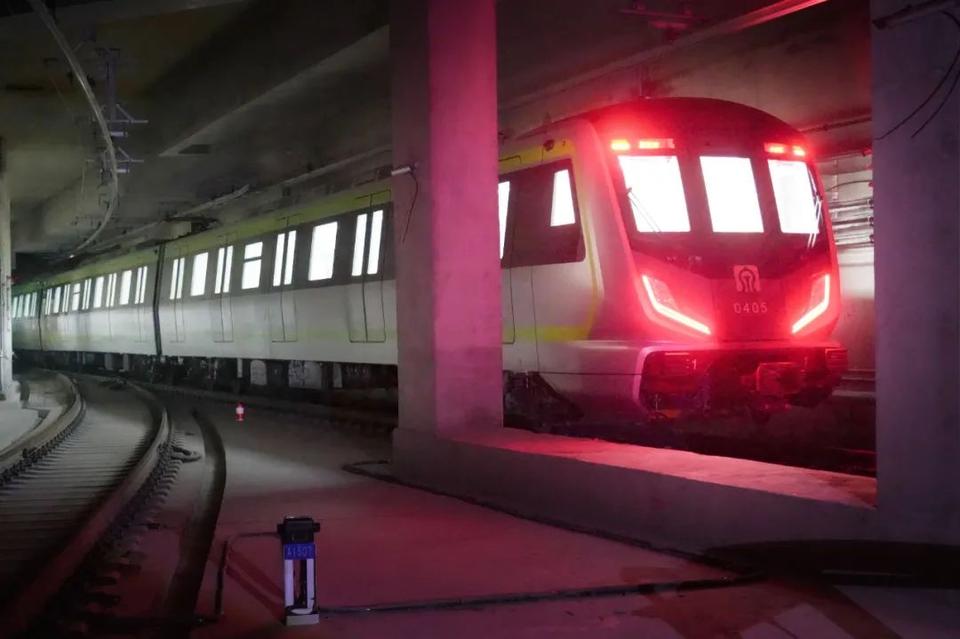
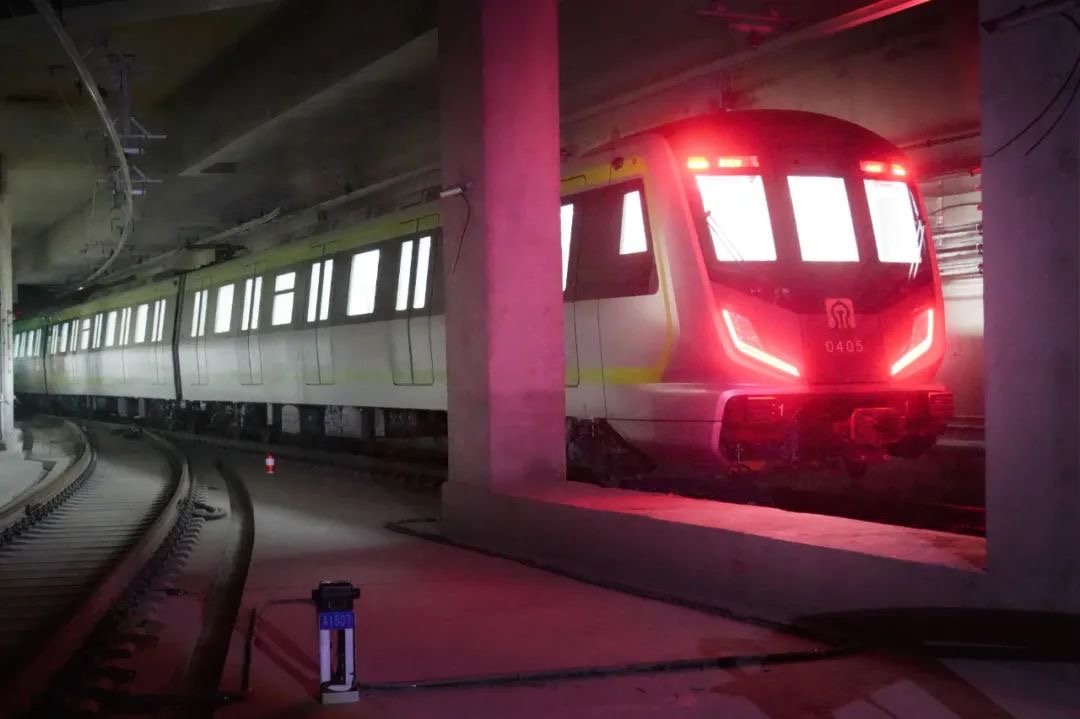
Group 1 - The core point of the news is that the comprehensive dynamic debugging of Jinan Metro Line 4 has officially started, marking a significant milestone in the construction process, with basic functions already achieved to support full automatic operation after debugging [2] - Dynamic debugging is described as the final checkpoint before trial operation, involving deep collaborative testing of over ten systems, ensuring precise coordination among all components [3] - To mitigate the impact of adverse weather conditions on debugging progress, the Jinan Rail Transit Group has organized a special task force to provide comprehensive support, ensuring timely response and resolution of issues [5] Group 2 - As of now, all 33 stations of Line 4 have completed the main structural topping out and have entered the post-station construction phase, with installation of electromechanical equipment and station decoration underway [6] - The construction is being accelerated while ensuring safety and quality, aiming for the line to be operational by the end of the year [6]
壹探轨道| 济南地铁4号线启动全线动车调试
Qi Lu Wan Bao· 2025-08-11 12:56
Group 1 - The core point of the article is the significant progress in the construction of Jinan Metro Line 4, with the full-scale dynamic debugging of the line now underway, paving the way for its automatic operation after testing completion [2][3]. - Dynamic debugging is described as the final critical step before trial operation, involving deep coordination testing of over ten systems, ensuring precise collaboration among all components [3]. - The line incorporates advanced technologies such as self-learning parking precision and automatic adjustment of operational levels, enhancing the line's sophistication and setting higher standards for debugging [3]. Group 2 - As of now, all 33 stations of Line 4 have completed the main structural capping and have entered the post-station construction phase, with comprehensive installation of electromechanical equipment and station decoration underway [5]. - The construction team is actively working on removing barriers and restoring roads and greenery in phases, aiming to accelerate the construction progress while ensuring safety and quality [5]. - The goal is to achieve operational readiness by the end of the year, with ongoing efforts to maintain construction momentum [5].
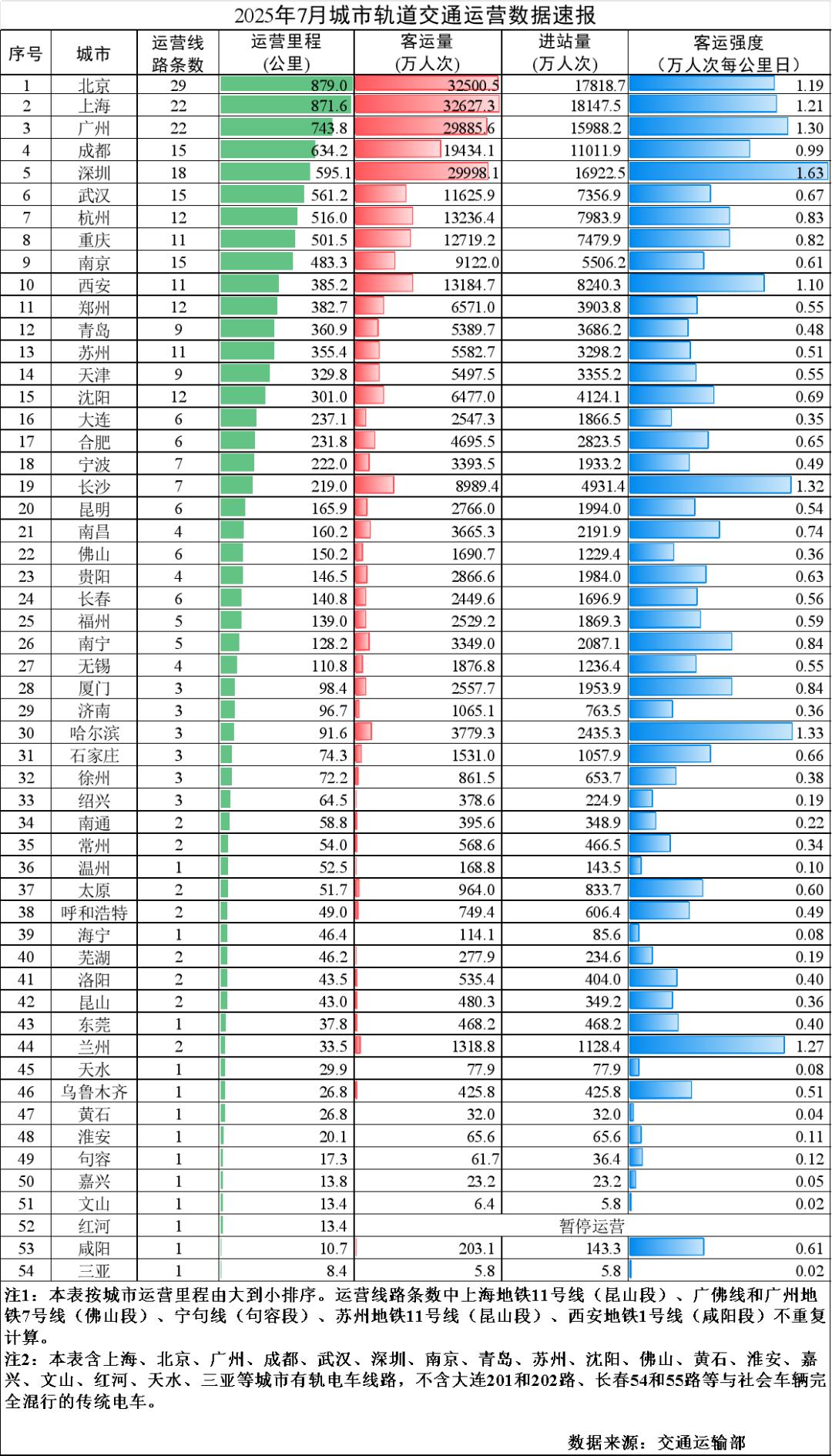
交通运输部:7月我国城市轨道交通完成客运量29.2亿人次
Di Yi Cai Jing· 2025-08-11 09:53
Core Insights - By July 2025, a total of 54 cities across 31 provinces (including autonomous regions and municipalities) and the Xinjiang Production and Construction Corps will have operational urban rail transit lines totaling 330, with a combined operational mileage of 11,146.8 kilometers [1] - In July, the actual number of train operations reached 3.74 million, with a completed passenger volume of 2.92 billion and an entry volume of 1.74 billion [1] - The passenger volume in July increased by 230 million from the previous month, representing a growth of 8.6%, and a year-on-year increase of 50 million, or 1.7% [1] - The average passenger intensity for the total operational mileage nationwide in July was 0.845 million passengers per kilometer per day, showing a month-on-month increase of 3.4% but a year-on-year decrease of 5.7% [1]
交通运输部:7月份我国城市轨道交通完成客运量29.2亿人次
智通财经网· 2025-08-11 09:39
Core Insights - The Ministry of Transport reported that in July 2025, 54 cities in China operated 330 urban rail transit lines, with a total operational mileage of 11,146.8 kilometers, and a passenger volume of 2.92 billion trips, marking an increase of 8.6% month-on-month and 1.7% year-on-year [1] Summary by Category Operational Data - In July 2025, the total operational mileage of urban rail transit reached 11,146.8 kilometers, with 330 lines in operation across 54 cities [1] - The actual number of train operations was 3.74 million, with a passenger volume of 2.92 billion trips and an entry volume of 1.74 billion [1] Passenger Volume - The passenger volume increased by 230 million trips month-on-month, representing an 8.6% growth, and a year-on-year increase of 50 million trips, or 1.7% [1] - The average passenger intensity for the total operational mileage was 0.845 million trips per kilometer per day, showing a month-on-month increase of 3.4% but a year-on-year decrease of 5.7% [1] City-Specific Data - Among the 54 cities, 43 cities operated metro and light rail lines totaling 271 lines and 9,658.1 kilometers, with a passenger volume of 2.82 billion trips [1] - 16 cities operated monorail, maglev, and regional rapid transit lines totaling 25 lines and 970.7 kilometers, with a passenger volume of 83.14 million trips [1] - 18 cities operated trams and automated guided rail systems totaling 34 lines and 518 kilometers, with a passenger volume of 10.98 million trips [1] New Additions - In July, there was an addition of 19.9 kilometers of operational mileage with one new operational section, specifically the northern section of Tianjin Metro Line 4 [1] - There was a reduction of 0.7 kilometers in operational mileage due to the cancellation of a section of the Guangzhou Haizhu Tram Line [1]
地铁票价有点费解?官方来解答
Guang Zhou Ri Bao· 2025-08-11 02:00
票价按照最短乘车路径计算 未必是时间最短的出行路径 也就是说,系统会根据乘客进闸和出闸的站点,自动计算出在地铁线网中两个站之间最短乘车路径的轨道里 程,然后按如下规则计费:0~4公里,2元;4~12公里,每增加4公里加1元;12~24公里,每增加6公里加1 元;24公里以上,每增加8公里加1元;最高票价20元。另外,珠江新城旅客自动输送系统(APM线)实行票 价2元的单一票制。 从计费规则可以看出,里程在8—12公里之间票价都是4元,也就是说,只要起点站和终点站之间的"最短乘车 路径的轨道里程"在这区间内,无论多少个站,票价都是4元。 可是,明明赤沙是沙河与燕岗之间的中间站,里程应该也仅有一半,为什么沙河到燕岗、沙河到赤沙、赤沙 到燕岗票价是一样的呢?如果沙河到赤沙、赤沙到燕岗票价是4元,那从沙河到燕岗,票价应该在5元以上才 对。 说到这里,可能大家忽略了一开始说的一个重要的知识点,就是票价是按"最短乘车路径的轨道里程"来算 的。由于最短乘车路径只计算列车运行的里程,而实际上乘车还要加上换乘等车的时间,加上之后,最短乘 车路径就未必是时间最短的出行路径了。 沙河到燕岗的最短乘车距离,是从沙河搭乘六号线到东湖, ...
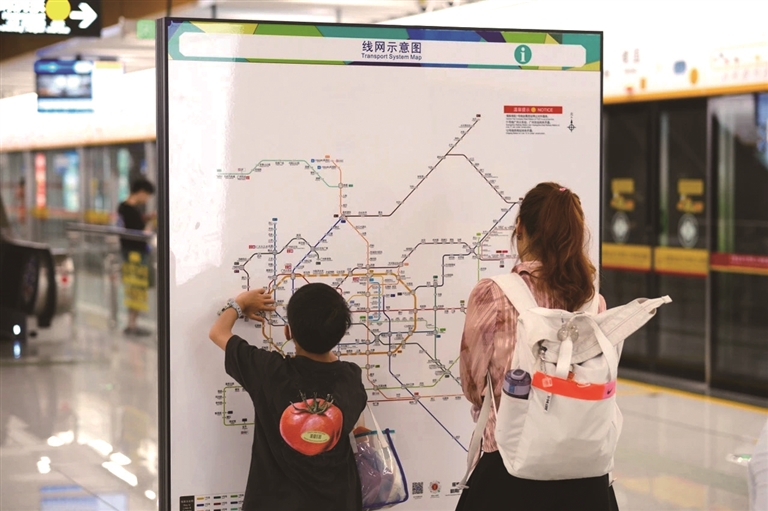
一条新线贯南北 激发文商旅新活力
Nan Jing Ri Bao· 2025-08-10 23:01
Core Insights - The opening of Nanjing Metro Line 5 has significantly increased passenger flow, with over 1.525 million trips recorded in the first week, indicating strong public interest and usage of the new line [1][2][3] Group 1: Impact on Tourism and Culture - Line 5 connects key cultural and tourist attractions, enhancing accessibility for both residents and visitors, and has become a popular choice for exploring Nanjing [1][2] - The preservation of historical artifacts within the metro stations, such as ancient road relics, adds cultural value and attracts tourists [2] - Local businesses, such as photography studios, have reported increased customer traffic due to the convenience of the new metro line, with some seeing a rise in daily orders from 30 to 50 [2][3] Group 2: Commercial Development - The new metro line has improved access to various commercial districts, leading to increased foot traffic in shopping centers and restaurants [4][5] - Residents have expressed satisfaction with the reduced travel time to commercial areas, with some reporting a time savings of up to 50% compared to previous routes [5] - The integration of Line 5 into the existing metro network is expected to enhance the commercial landscape of Nanjing, providing more diverse shopping and dining experiences [5][6] Group 3: Transportation Infrastructure - Line 5 spans 37.4 kilometers with 30 stations, including 8 transfer stations, effectively connecting major districts such as Gulou, Qinhuai, and Jiangning [7] - The line creates a "golden diagonal" in Nanjing's transportation map, improving north-south connectivity and filling gaps in the existing transit network [7] - Future expansions, including the planned Line 10, are anticipated to further enhance the city's transportation efficiency and urban development [6][7]
城建设计发盈警 预计中期净利润同比下降约31%至41%
Zhi Tong Cai Jing· 2025-08-08 09:11
Core Viewpoint - The company anticipates a decline in revenue and net profit for the first half of 2025 compared to the same period in 2024, primarily due to macroeconomic factors and changes in industry policies [1] Revenue Forecast - The company expects revenue for the first half of 2025 to be between approximately RMB 3.385 billion and RMB 3.803 billion, representing a decrease of about 9% to 19% compared to approximately RMB 4.179 billion in the first half of 2024 [1] Net Profit Forecast - The projected net profit for the first half of 2025 is expected to be between approximately RMB 219 million and RMB 256 million, which indicates a decline of about 31% to 41% from approximately RMB 371 million in the first half of 2024 [1] Reasons for Decline - The board attributes the decline in revenue and net profit to several factors: 1. Reduced conversion rate of new rail construction projects due to macroeconomic conditions [1] 2. Adjustments in government policies affecting the number of approved urban rail transit lines, leading to a decrease in the scale of the company's design business [1] 3. The Chongqing Yuxi West Line construction project has entered the operational phase, resulting in a corresponding decrease in construction revenue [1]