消费金融

Search documents
李波正式出任京东消金董事长,助贷合作名单曝光链接多家头部流量平台
Sou Hu Cai Jing· 2025-10-11 07:28
Core Viewpoint - JD Finance has officially transformed from Jiexin Consumer Finance to JD Consumer Finance, marking a significant step in its strategic expansion in the consumer finance sector with the appointment of Li Bo as chairman [1][5]. Group 1: Leadership and Management - Li Bo, born in 1975, has over 20 years of experience in the financial industry and previously served as the deputy branch manager of ICBC in Hunan Province. He joined JD Group in March 2021 and has held key positions in financial technology [3]. - The approval of Li Bo's appointment as chairman by the Tianjin Financial Supervision Administration signifies a new leadership era for JD Consumer Finance [1][5]. Group 2: Company Background and Strategic Moves - JD Consumer Finance, established in 2010, was one of the first four pilot consumer finance companies. JD Group acquired a 65% stake in Jiexin Consumer Finance in December 2024, becoming the controlling shareholder [3][5]. - Following the name change, JD Consumer Finance has solidified its independent identity and further enhanced JD's strategic landscape in consumer finance [5]. Group 3: Operational Plans and Focus Areas - JD Consumer Finance plans to establish a team of around 200 people in Tianjin to build an operation center, data center, risk control center, and research center. The company aims to focus on high-quality development, consumer support, financial ecosystem construction, and regional industrial chain collaboration [5]. - The company intends to leverage its consumer finance license to enhance the regional consumption environment and support the development of Tianjin as an international consumption center [5]. Group 4: Collaboration and Partnerships - JD Consumer Finance has begun testing offline consumer credit services in Tianjin, integrating into the JD ecosystem. Consumers can use the JD App for interest-free installment payments at JD malls [6]. - The company has disclosed a list of five internet loan partners and three post-loan partners, including companies associated with major internet platforms and JD Group subsidiaries [8][10][13].


京东消金落子关键一步!75后金融“老将”李波任董事长
Nan Fang Du Shi Bao· 2025-10-11 05:16
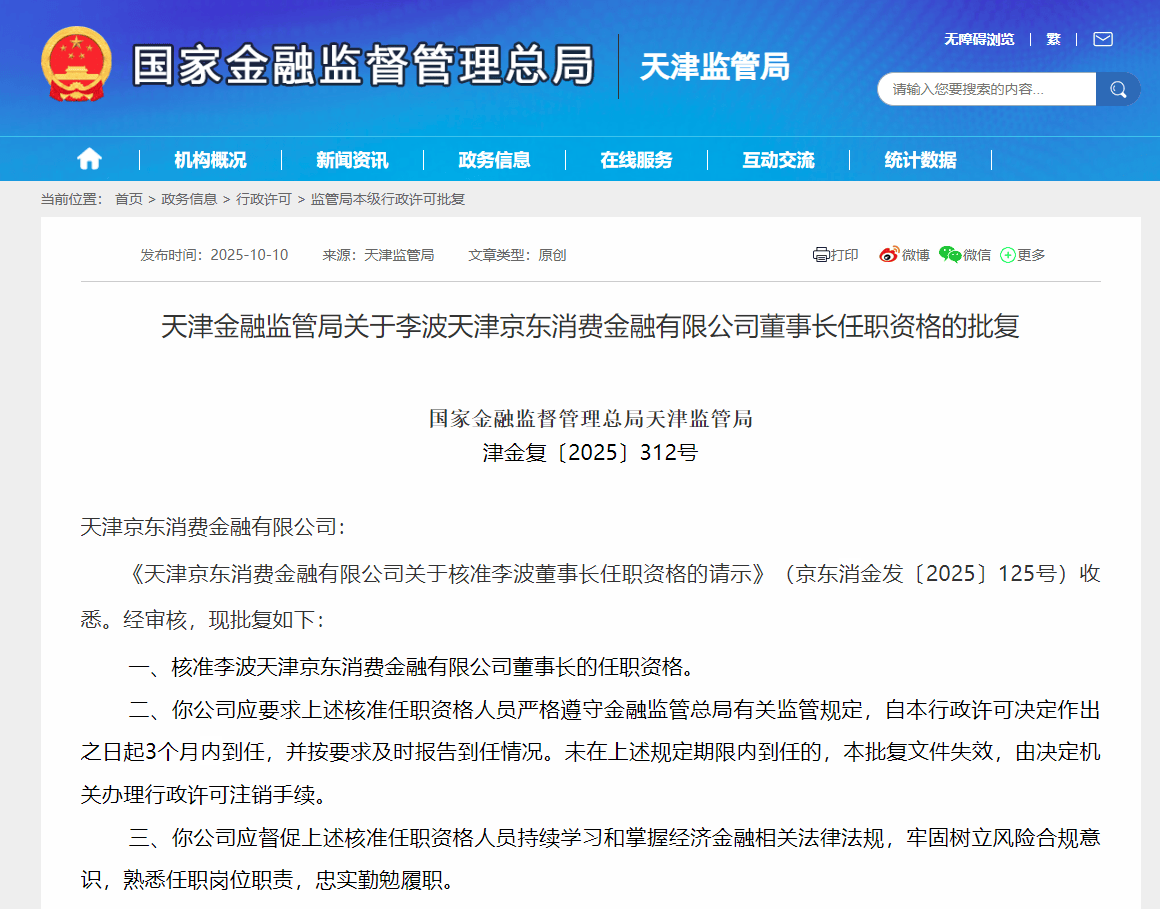
互联网巨头旗下消金公司终于迎来新"掌舵人"。 10月10日,天津金融监督管理局发布批复公告称,核准李波天津京东消费金融有限公司(下称"京东消 金")董事长的任职资格。 "75后"金融老将掌舵京东消金 公告显示,核准李波天津京东消金董事长的任职资格,要求其严格遵守金融监管总局有关监管规定,自 本行政许可决定作出之日起3个月内到任,并按要求及时报告到任情况。 公开资料显示,李波出生于1975年,为金融行业"老将",有超过20年的金融从业经验,此前曾担任工商 银行湖南省分行副行长。于2021年3月加入京东集团后,李波一直担任金融科技群要职,今年以来曾多 次以京东集团副总裁、京东科技金融科技事业群总裁参与活动。 9月26日,在2025·青岛创投风投大会上,李波出席并发表主题演讲,他表示,金融在这几年一直在持续 探索大模型技术和金融业务的结合点,经过多年时间已经从技术验证逐步走向了场景新增,覆盖场景从 用户交互到体验创新到目前智能风控智能决策效率在提升。 "科技是手段,普惠才是目的。AI驱动的重构之路,最终还是要落在普惠上,做好科技金融、绿色金 融、普惠金融、养老金融、数字金融五章大文章,让供应链金融科技广泛汇集每一个 ...

李波获批任京东消费金融董事长
Bei Jing Shang Bao· 2025-10-10 12:26
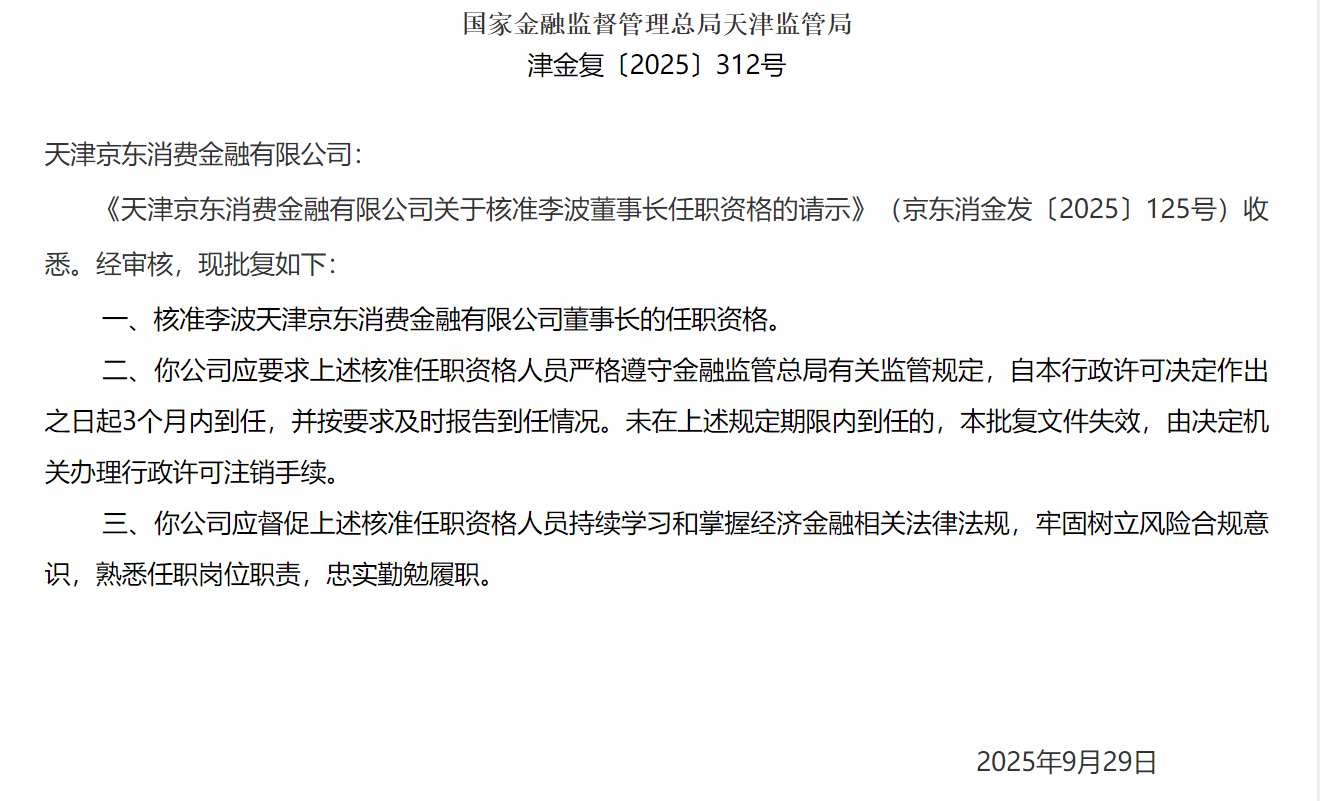
北京商报讯(记者 廖蒙)10月10日,天津金融监管局发布关于李波天津京东消费金融有限公司(以下简 称"京东消金")董事长任职资格的批复,核准李波任京东消金董事长。批复指出,京东消金应要求上述 核准任职资格人员严格遵守金融监管总局有关监管规定,自该行政许可决定作出之日起3个月内到任, 并按要求及时报告到任情况。未在上述规定期限内到任的,该批复文件失效,由决定机关办理行政许可 注销手续。 ...
京东消金董事长正式获批,李波挂帅
Sou Hu Cai Jing· 2025-10-10 11:34
Core Insights - Li Bo has over 20 years of experience in the financial industry and has a deep understanding of the strategic and business layout of JD Group [2] - JD Group has successfully restructured its consumer finance business, now named Tianjin JD Consumer Finance Co., Ltd., after acquiring a controlling stake in the former Jiexin Consumer Finance Co., Ltd. [2][3] Group 1 - Li Bo joined JD in 2021 as the head of the financial technology group, succeeding Xu Ling, and reports to JD Technology CEO Li Yawen [2] - JD Group's consumer finance license acquisition allows it to leverage the offline channel resources of the former Jiexin Consumer Finance, enhancing its market competitiveness [3] - The restructuring involved a capital reduction of Jiexin Consumer Finance from 7 billion to 5 billion yuan and a change in its shareholding structure [2][3] Group 2 - The current shareholding structure of JD Consumer Finance includes Guangzhou Jingdong Trading Co., Ltd. as the largest shareholder with 50%, followed by Wangyin Online (Beijing) Business Service Co., Ltd. with 15% [3] - The restructuring and renaming of the consumer finance company were officially announced across all customer channels, including the official app and WeChat mini-programs [2][3] - JD's long-standing efforts in the consumer finance sector are now bolstered by the successful acquisition of the consumer finance license [3]
李波获批担任京东消金董事长!
Sou Hu Cai Jing· 2025-10-10 11:28
Core Viewpoint - The Tianjin Financial Regulatory Bureau has approved Li Bo as the new chairman of JD Consumer Finance Co., Ltd. (JD Finance) [1] Group 1: Leadership Changes - Li Bo is currently the Vice President of JD Group and has over 20 years of experience in the financial industry, having joined JD in 2021 [2] - Prior to his appointment as chairman, Li Bo was approved as a director of JD Finance in early September [4] - JD Finance has also approved six other directors alongside Li Bo [5] Group 2: Company Developments - JD Finance underwent a restructuring process involving multiple institutions, including Tianjin Bank and China Foreign Trade Trust, in December of last year [5] - The shareholding structure of JD Finance was officially approved in January 2025, with a registered capital of 5 billion yuan [6] - JD Finance was officially renamed from Jiexin Consumer Finance in May [8] Group 3: Operational Expansion - JD Finance launched its operations in the Tianjin Economic Development Zone, planning to establish a team of around 200 people and various operational centers [9] - The company has integrated its services with the JD ecosystem, including the JD White Bar payment service, and is also collaborating with external platforms for loan assistance [10][11] - JD has been an early player in the consumer finance sector, launching JD White Bar in 2014 and expanding its financial product offerings [12]
李波获批担任天津京东消费金融有限公司董事长
Xin Lang Cai Jing· 2025-10-10 11:11
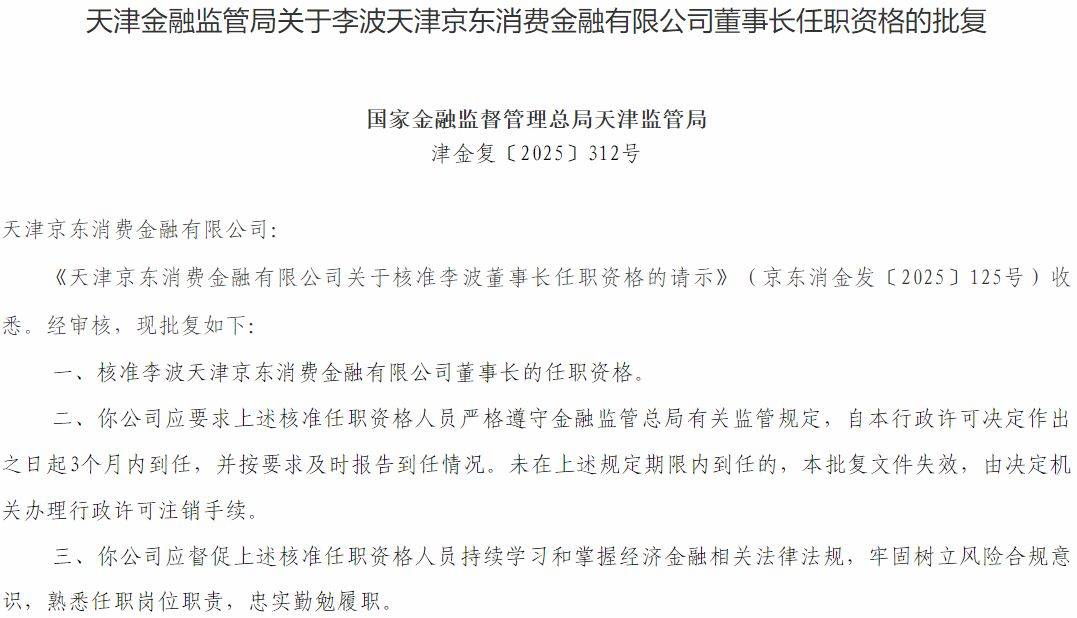
10月10日,天津金融监管局网站发布批复,核准李波天津京东消费金融有限公司董事长的任职资格。公 司应要求上述核准任职资格人员严格遵守金融监管总局有关监管规定,自本行政许可决定作出之日起3 个月内到任,并按要求及时报告到任情况。未在上述规定期限内到任的,本批复文件失效,由决定机关 办理行政许可注销手续。 ...
京东消金董事长李波,任职资格获批
Zhong Guo Ji Jin Bao· 2025-10-10 11:09
【导读】京东消金董事长李波任职资格获批,曾任工行湖南分行副行长 中国基金报记者 马嘉昕 10月10日,天津金融监管局批复公告称,核准李波天津京东消费金融有限公司(以下简称京东消金)董事长的任职资格。 李波董事长任职资格获批 天津金融监管局公告显示,核准李波京东消金董事长任职资格,要求其严格遵守金融监管总局有关监管规定,并自行政许可决定作出之日起3个月内到 任,并按要求及时报告到任情况。 填补京东消金领域牌照空白 据悉,京东消金的前身为捷信消费金融有限公司(以下简称捷信消金),2025年5月,捷信消金获天津金融监管局批复,同意其更名为京东消金。同时, 捷信消金成立于2010年,是国内首批四家消费金融试点公司之一,在全国范围内开展个人消费信贷业务。 目前,京东消金注册资本为50亿元,位居行业第六位,仅次于蚂蚁消金(230亿元)、招联金融(100亿元)、建信消金(72亿元)、兴业消金(53.2亿 元)和南银法巴消金(52.15亿元)。 在股权结构方面,京东消金的股东目前包括广州晶东贸易有限公司、网银在线(北京)商务服务有限公司、中国对外经济贸易信托有限公司等多方机构。 其中,京东集团合计持有京东消金的65%股权,成 ...

京东消金董事长李波,任职资格获批
中国基金报· 2025-10-10 11:02
李波董事长任职资格获批 天津金融监管局公告显示,核准李波京东消金董事长任职资格,要求其严格遵守金融监管总 局有关监管规定,并自行政许可决定作出之日起3个月内到任,并按要求及时报告到任情况。 【 导读 】 京东消金董事长李波任职资格获批,曾任工行湖南分行副行长 中国基金报记者 马嘉昕 10月10日,天津金融监管局批复公告称,核准李波天津京东消费金融有限公司(以下简称京 东消金)董事长的任职资格。 据悉,李波于2021年3月加入京东集团,一直担任金融科技群要职,包括企业金融业务部机 构负责人,此前其曾任职工商银行湖南省分行副行长,拥有超过20年的金融从业经验。此 外,其还担任京东科技旗下京东未来数字科技有限公司的法人,并在朴道征信担任董事。 据悉,京东消金的前身为捷信消费金融有限公司(以下简称捷信消金),2025年5月,捷信 消金获天津金融监管局批复,同意其更名为京东消金。同时,捷信消金成立于2010年,是国 内首批四家消费金融试点公司之一,在全国范围内开展个人消费信贷业务。 目前,京东消金注册资本为50亿元,位居行业第六位,仅次于蚂蚁消金(230亿元)、招联 金融(100亿元)、建信消金(72亿元)、兴业消金( ...

巨头新动作 京东消金董事长获批
Zhong Guo Jing Ying Bao· 2025-10-10 09:55
Core Insights - JD Group's consumer finance subsidiary, JD Consumer Finance, has received approval for its chairman's qualification from the Tianjin Regulatory Bureau of the National Financial Supervision Administration, marking a significant move in the consumer finance sector [1] - JD Group becomes the first platform enterprise to enter the market through equity restructuring after the implementation of the "Administrative Measures for Consumer Finance Companies" on April 18, 2024, and is the second institution in the industry to obtain a consumer finance license via this method [1] - JD Finance App has accumulated 420 million transaction users, collaborating with nearly a thousand financial institutions including banks, insurance companies, and fund companies to provide personal financial services [1] Industry Developments - The industry is closely watching the collaborative pathways between JD Consumer Finance and existing JD Finance operations, particularly in areas such as business division, resource integration, and brand synergy [1]
建信消金迎来第二任总裁,上半年净利润下降超95%
Sou Hu Cai Jing· 2025-10-09 23:48
总裁一职空缺8月有余的建信消金,迎来新的继任者。 国庆节前,国家金融监督管理总局北京监管局网站发布了一则批复,该局核准宫永媛建信消金董事、总裁的任职资格。 公开信息显示,宫永媛于2001年7月加入建设银行,先后在总行个人银行业务部、个人金融部、个人存款与投资部任职,2015年11月任个人存款与投资部 资深副总经理;2018年6月任建信基金管理公司纪委书记、党委委员,后先后担任建信基金副总裁,兼任财务负责人、首席信息官。 上任后,宫永媛将成为建信消金第二任总裁。 2025年1月,建信消金原总裁李建峰升任董事长,此后总裁一职空缺至今。深耕个人金融条线超过17年的宫永媛继任,能否拯救建信消金当下的业绩困境 成为关注的焦点。 半年报显示,截至2025年6月末,建信消金资产总额126.71亿元,较去年末增长0.78%;上半年净利润0.03亿元,同比下降95.24%。 迎第二任总裁 北京金融监管局发出的批复显示,宫永媛任职资格于9月26日获批。 当然,亦有不同的声音:宫永媛虽有17年个人金融条线经验但在公募基金行业,与消费金融行业存差异,前者侧重资产管理与净值波动,后者聚焦场景获 客与风险定价,跨领域经验能否直接复用存疑 ...