
白条

Search documents
牧原股份(02714) - 海外监管公告 - 2025年年度报告摘要及全文、2025牧原绿色低碳行动...
2026-03-29 10:07
香港交易及結算所有限公司及香港聯合交易所有限公司對本公告的內容概不負責,對其 準確性或完整性亦不發表任何聲明,並明確表示概不就因本公告全部或任何部分內容而 產生或因依賴該等內容而引致的任何損失承擔任何責任。 MUYUAN FOODS CO., LTD. 牧 原 食 品 股 份 有 限 公 司 (於中華人民共和國註冊成立的股份有限公司) (股份代號: 2714) 海外監管公告 本公告乃根據香港聯合交易所有限公司證券上市規則第13.10B條刊發。 根據中華人民共和國的有關法例規定,牧原食品股份有限公司(「本公司」)在巨 潮資訊網(www.cninfo.com.cn)刊發了以下公告。茲載列如下,僅供參閱。 承董事會命 牧原食品股份有限公司 董事長兼總裁 秦英林先生 中國,河南省南陽市,2026年3月27日 於本公告日期,本公司董事會成員包括:(i)執行董事秦英林先生、曹治年先生及楊瑞華 女士;(ii)非執行董事錢瑛女士及蘇黨林先生;及(iii)獨立非執行董事周明笙先生、閻磊 先生及馮根福先生。 牧原食品股份有限公司 2025 年年度报告摘要 | 证券代码:002714 | 证券简称:牧原股份 | 公告编号:2026 ...
消金行业多措并举 促进消费者尽享贴息政策红利
Xin Lang Cai Jing· 2026-01-25 23:32
Core Viewpoint - The recent notification from the Ministry of Finance, the People's Bank of China, and the National Financial Regulatory Administration aims to optimize personal consumption loan subsidy policies, reducing credit costs and enhancing consumer willingness to spend [1][6]. Group 1: Policy Implementation - The notification supports innovation in consumer finance, extends policy duration, expands support scope, and increases the number of implementing institutions [1][6]. - Major platforms like Ant Group, JD.com, and Du Xiaoman have quickly launched measures to translate policy benefits into consumer services [1][6]. Group 2: Company Responses - Ant Group has extended the subsidy policy until the end of 2026, removed the 500 yuan cap on single transactions, and lifted previous restrictions on consumption areas [2][7]. - JD.com has fully adopted the new policy, ensuring rapid delivery of benefits to users, and has expanded the scope of its subsidy services [2][7]. - Du Xiaoman focuses on enhancing service experience and financial accessibility, introducing a "credit limit increase and interest reduction" service to support service consumption [2][7]. Group 3: Impact on Consumer Finance - Zhongyuan Consumer Finance has combined subsidy and rights protection strategies, benefiting over 3.46 million people and providing discounts exceeding 52.46 million yuan [3][8]. - Haier Consumer Finance has launched a "Smart Home Installment" service, covering 501 products, effectively stimulating demand in the home appliance sector [3][9]. Group 4: Market Trends and Insights - The implementation of the subsidy policy has led to a "precise drip irrigation" effect, boosting sales for merchants and providing discounts for consumers [4][10]. - Ant Group reported an 18% increase in average installment consumption during the 2025 Double 11 shopping festival compared to September 2025 [4][10]. - JD.com's subsidy service has covered over 100 million products, with a nearly 20% increase in average transaction amounts since the policy's implementation [4][10]. Group 5: Recommendations for Financial Institutions - Financial institutions are encouraged to deepen integration with high-frequency consumption scenarios and optimize product designs to meet diverse customer needs [5][10]. - Institutions should leverage technology to enhance risk management and automate approval processes, thereby reducing operational costs and improving coverage [5][10]. - Regional financial institutions not included in the national subsidy program are advised to pursue local consumption subsidy policies and enhance credit card marketing efforts [11].

消金行业多措并举促进消费者尽享贴息政策红利
Zheng Quan Ri Bao Zhi Sheng· 2026-01-25 17:12
Core Viewpoint - The joint announcement by the Ministry of Finance, the People's Bank of China, and the National Financial Regulatory Administration aims to optimize personal consumption loan subsidy policies, thereby reducing credit costs for consumers and enhancing their willingness to spend [1] Group 1: Policy Implementation - The new policy includes support for financial innovation, extension of policy duration, expansion of support scope, and enhancement of subsidy areas and processing institutions [1] - Major platforms like Ant Group, JD.com, and Du Xiaoman have quickly introduced measures to translate policy benefits into consumer services [2] Group 2: Company Responses - Ant Group has extended the subsidy policy until the end of 2026, removed the previous limit of 500 yuan on subsidies for single transactions, and lifted restrictions on consumption areas [2] - JD.com has fully adopted the new policy, ensuring rapid delivery of benefits to users, and has expanded the scope of its subsidy services [2] - Du Xiaoman focuses on optimizing service experience and enhancing financial accessibility, launching a "credit limit increase and interest reduction" service [2] Group 3: Market Impact - Zhongyuan Consumer Finance has combined subsidies with rights protection, benefiting over 3.46 million people and providing discounts exceeding 52.46 million yuan [3] - Haier Consumer Finance has launched a "Smart Home Installment" service, leading to an average sales increase of about 30% in retail stores [5] - The policy has resulted in a "precise drip irrigation" of consumer subsidies, boosting sales for platform merchants and providing discounts to consumers [4] Group 4: Future Directions - Financial institutions are encouraged to deepen integration with high-frequency consumption scenarios and optimize product designs to meet diverse customer needs [5] - There is a recommendation for regional financial institutions not included in the national subsidy program to actively pursue local consumption subsidy policies [5]
从“跑马圈地”到“精耕细作”:信用卡行业以创新发展破局
Zhong Guo Jin Rong Xin Xi Wang· 2025-11-14 08:18
Core Insights - The credit card industry in China is undergoing a transformation from rapid expansion to a focus on refinement and optimization of user experience, with a significant reduction in the number of credit cards issued over the past three years [1][4]. Industry Overview - The number of credit cards in China has decreased by over 90 million in recent years, with the total number standing at 715 million as of June 2023, marking a decline for 11 consecutive quarters [4]. - Major banks have reported declines in credit card loan balances and transaction volumes, indicating a broader trend of contraction within the industry [4]. Factors Driving Transformation - Regulatory policies have been implemented to guide the credit card business, including restrictions on issuing cards based solely on quantity and limiting the proportion of inactive cards [8]. - The rise of alternative payment methods, such as Huabei and Bai Tiao, has diverted users away from traditional credit cards, particularly among younger consumers [9]. - Changing consumer demands have led to a preference for fewer, more useful credit cards, resulting in cancellations of less utilized cards [9]. - Banks have been reducing cardholder benefits to manage operational costs, which has contributed to the decline in card ownership [10]. Strategic Adjustments - Despite the overall contraction, credit cards continue to play a vital role in facilitating payments and consumer spending [11]. - Banks are shifting their focus from quantity to quality, emphasizing product innovation and deeper integration with consumer spending habits [11]. - Various banks are adapting their strategies to target specific consumer segments, such as the elderly and young people, and are exploring partnerships with e-commerce platforms [12]. - Regulatory adjustments are being made to foster innovation in the credit card sector, including the exploration of online account opening and activation processes [13]. Future Outlook - The credit card industry is expected to maintain a positive growth trajectory, with banks encouraged to adopt differentiated services and leverage digital technologies for product innovation [15].


国家贴息活动再升级 京东白条撬动近亿级商品为用户提供至高24期免息
Zhong Jin Zai Xian· 2025-10-15 08:43
Group 1 - The core idea of the news is that JD.com is enhancing its consumer financing options through the upgraded "White Bar" interest-free installment plan during the 2025 Double 11 shopping festival, making it more attractive for cost-conscious consumers [1][2] - JD.com is collaborating with over 50 brands, including Xiaomi, Apple, and Haier, to launch a "Super Brand White Bar Interest-Free Day," allowing consumers to purchase premium brands at better financing terms [1] - Consumers can combine national subsidies with the White Bar interest-free benefits on eligible products, further stimulating consumer spending [1] Group 2 - JD Finance is introducing interactive user engagement activities, such as the "White Bar Tie Tie Festival," where users can collect rewards and participate in a chance to win significant prizes, including a year of free household services [2] - The White Bar program is also providing exclusive benefits to participating merchants, such as up to 18 days of zero interest fees and cash incentive packages, which help reduce operational pressures for businesses [2] - As the first internet credit consumption product in China, the White Bar has served nearly 300 million consumers and connected over 2 million merchants and 100+ financial institutions, continuously enhancing its services to boost consumer activity and industry growth [2]
李波掌舵京东消金,高管团队就位
Bei Jing Shang Bao· 2025-10-12 11:09
Core Viewpoint - The recent approval of Li Bo as the chairman of JD Consumer Finance marks a significant step in the company's restructuring and strategic direction in the consumer finance sector [1][4]. Group 1: Leadership and Management - Li Bo has extensive experience in traditional banking and fintech, having previously held positions at ICBC and JD Technology, which positions him well to lead JD Consumer Finance [3]. - His understanding of technology in financial services and the application of AI in transforming financial services is expected to drive innovation within the company [3][5]. Group 2: Company Development and Strategy - JD Consumer Finance emerged from the restructuring of Jiexin Consumer Finance, with its official name change occurring in May 2025, and it aims to serve the national market with a new identity [4]. - The company is leveraging JD Group's vast ecosystem, including its supply chain, logistics, and data resources, to enhance its consumer finance offerings [5]. - Since its launch, JD Consumer Finance has partnered with JD MALL in Tianjin to provide offline consumer credit services, indicating a strategy to integrate online and offline channels [5]. Group 3: Market Position and Future Outlook - JD Consumer Finance fills a gap in JD's consumer finance licensing and complements its financial ecosystem, which is crucial for its competitive positioning in the market [4][5]. - The company is expected to explore more innovative marketing and customer operations by utilizing JD's accumulated data resources and technology [5]. - The current market environment presents challenges such as regulatory compliance and competition, which JD Consumer Finance must navigate to ensure sustainable growth [6].
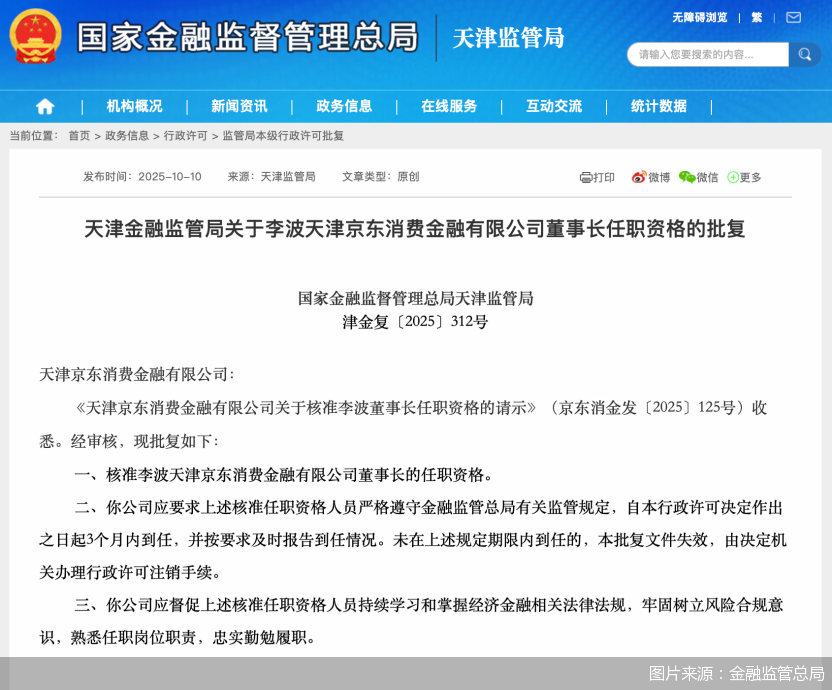
李波正式出任京东消金董事长,助贷合作名单曝光链接多家头部流量平台
Sou Hu Cai Jing· 2025-10-11 07:28
Core Viewpoint - JD Finance has officially transformed from Jiexin Consumer Finance to JD Consumer Finance, marking a significant step in its strategic expansion in the consumer finance sector with the appointment of Li Bo as chairman [1][5]. Group 1: Leadership and Management - Li Bo, born in 1975, has over 20 years of experience in the financial industry and previously served as the deputy branch manager of ICBC in Hunan Province. He joined JD Group in March 2021 and has held key positions in financial technology [3]. - The approval of Li Bo's appointment as chairman by the Tianjin Financial Supervision Administration signifies a new leadership era for JD Consumer Finance [1][5]. Group 2: Company Background and Strategic Moves - JD Consumer Finance, established in 2010, was one of the first four pilot consumer finance companies. JD Group acquired a 65% stake in Jiexin Consumer Finance in December 2024, becoming the controlling shareholder [3][5]. - Following the name change, JD Consumer Finance has solidified its independent identity and further enhanced JD's strategic landscape in consumer finance [5]. Group 3: Operational Plans and Focus Areas - JD Consumer Finance plans to establish a team of around 200 people in Tianjin to build an operation center, data center, risk control center, and research center. The company aims to focus on high-quality development, consumer support, financial ecosystem construction, and regional industrial chain collaboration [5]. - The company intends to leverage its consumer finance license to enhance the regional consumption environment and support the development of Tianjin as an international consumption center [5]. Group 4: Collaboration and Partnerships - JD Consumer Finance has begun testing offline consumer credit services in Tianjin, integrating into the JD ecosystem. Consumers can use the JD App for interest-free installment payments at JD malls [6]. - The company has disclosed a list of five internet loan partners and three post-loan partners, including companies associated with major internet platforms and JD Group subsidiaries [8][10][13].
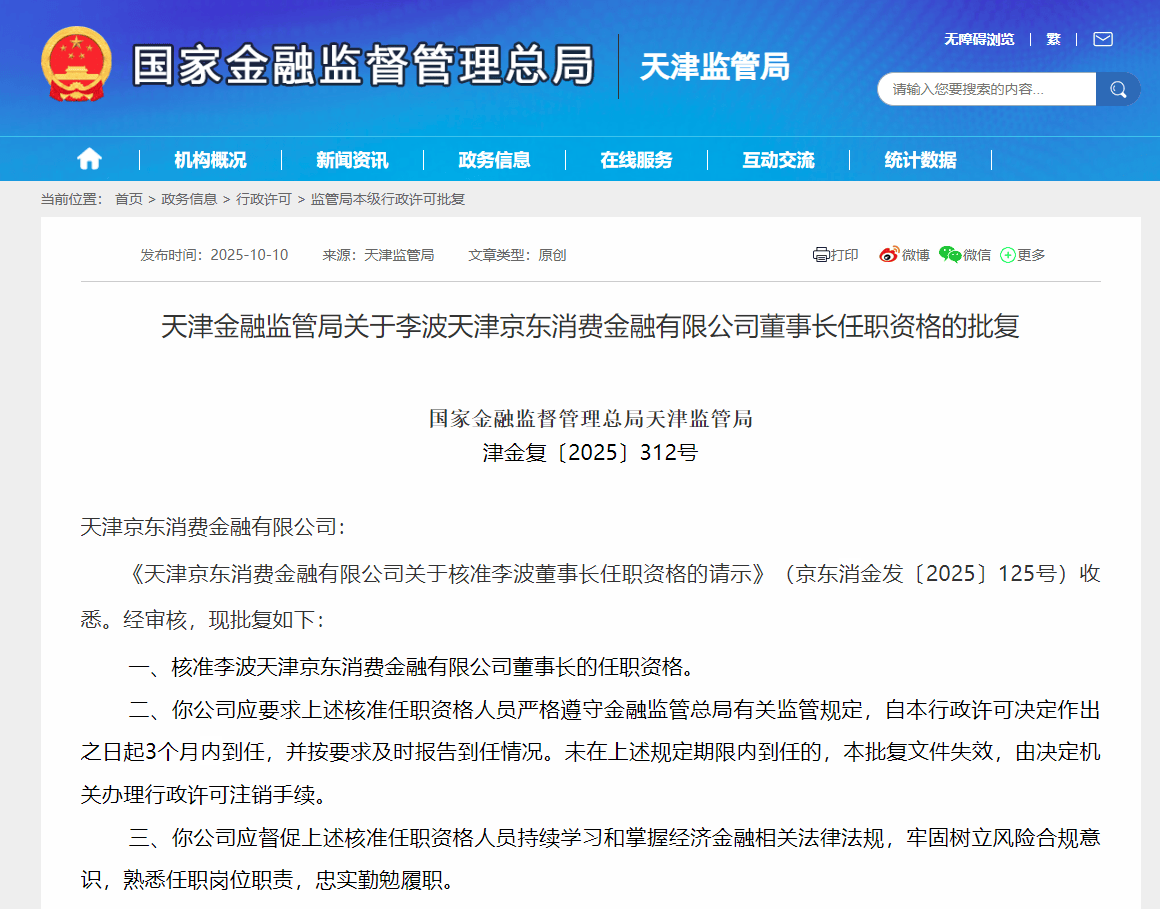
巨头新动作 京东消金董事长获批
Zhong Guo Jing Ying Bao· 2025-10-10 09:55
Core Insights - JD Group's consumer finance subsidiary, JD Consumer Finance, has received approval for its chairman's qualification from the Tianjin Regulatory Bureau of the National Financial Supervision Administration, marking a significant move in the consumer finance sector [1] - JD Group becomes the first platform enterprise to enter the market through equity restructuring after the implementation of the "Administrative Measures for Consumer Finance Companies" on April 18, 2024, and is the second institution in the industry to obtain a consumer finance license via this method [1] - JD Finance App has accumulated 420 million transaction users, collaborating with nearly a thousand financial institutions including banks, insurance companies, and fund companies to provide personal financial services [1] Industry Developments - The industry is closely watching the collaborative pathways between JD Consumer Finance and existing JD Finance operations, particularly in areas such as business division, resource integration, and brand synergy [1]
政策红利叠加科技赋能 京东科技“三个融合”助力普惠金融落地
Sou Hu Cai Jing· 2025-09-26 00:54
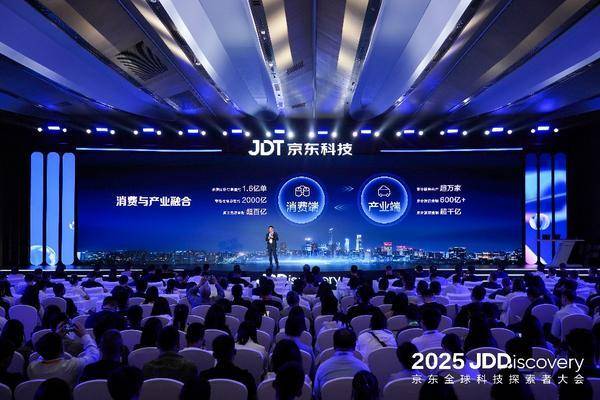
Group 1 - The core viewpoint of the articles highlights the synergy between policy benefits and technological empowerment in driving new momentum in the consumer market, particularly through JD Technology's initiatives [1][5] - JD Technology has adopted a "three integrations" development path: integration of consumption and industry, integration of innovation and scenarios, and integration of internal and external circulation [1][5] - As of September 2023, JD Technology has facilitated nearly 160 million orders under the national subsidy program for replacing old consumer goods, significantly boosting retail sales [2][5] Group 2 - The "old-for-new" policy has expanded from home appliances to 3C digital products, with related sales exceeding 1.9 trillion yuan, benefiting over 320 million people [2] - JD Technology has linked consumer demand with supply chain financing, providing flexible financing products to support the industry and accelerate capital turnover [2][3] - The company has introduced innovative services such as "national subsidy + bank subsidy" and "national subsidy + interest-free installment" to maximize consumer potential [2][3] Group 3 - JD Technology's supply chain financial services provide annual financing of 500 billion yuan, serving over 3,000 large enterprises and 2 million small and micro enterprises [4] - The "Enterprise Treasury" platform connects liability and asset needs, allowing over 60,000 enterprise clients to manage funds effectively while facilitating operational expenditures [4] - The company is enhancing its cross-border payment and financing services to support brands going global, including offering multi-currency accounts and quick payment solutions [4][5]
普惠金融精准滴灌实体经济 京东科技服务超200万中小企业发展
Zhong Guo Jin Rong Xin Xi Wang· 2025-09-25 10:46
Core Insights - The article highlights the synergy between policy incentives and technological empowerment in driving new momentum in the consumer market, as demonstrated by JD Technology's initiatives in supply chain finance and consumer goods recycling programs [1][2]. Group 1: Consumer and Industry Integration - JD Technology has facilitated nearly 160 million national subsidy orders for consumer goods as of September this year, significantly boosting retail sales to over 200 billion yuan [2]. - The company has implemented various financing products to support the supply chain, benefiting over 3,000 large enterprises and 2 million small and micro enterprises [1][3]. Group 2: Innovation and Scenario Integration - JD Technology continuously innovates its supply chain financial products, enhancing user experience with services like interest-free installments and flexible payment options for various consumer scenarios [3][4]. - The "Enterprise Treasury" platform connects liability and asset needs, serving over 60,000 enterprise clients and facilitating automatic fund transfers for operational expenses [4]. Group 3: Internal and External Circulation Integration - JD Technology is expanding its cross-border payment and financing services to support brands going global, providing comprehensive financial services for cross-border e-commerce [5]. - The company has introduced products like cross-border logistics financing to address the capital occupation issues faced by distributors [5][6].