
煤炭开采

Search documents
煤炭开采行业跟踪周报:库存持续上涨,煤价延续下行走势-20251228
Soochow Securities· 2025-12-28 05:58
Investment Rating - The industry investment rating is maintained as "Add" [1] Core Insights - The report indicates that the port thermal coal spot price has decreased by 31 CNY/ton week-on-week, closing at 672 CNY/ton. The average daily inflow to the four ports in the Bohai Rim region is 1.6071 million tons, a decrease of 30,000 tons or 1.83% from the previous week. Meanwhile, the average daily outflow has increased by 64,600 tons or 4.22% to 1.5963 million tons. The inventory at the ports has risen to 29.872 million tons, an increase of 220,000 tons or 0.74% from the previous week. The overall inventory trend is upward, with limited demand release leading to a decline in coal prices [1][2][27][32]. Summary by Sections 1. Weekly Market Review - The Shanghai Composite Index closed at 3,963.68 points, up 46 points or 1.18% week-on-week. The coal sector index closed at 2,772.29 points, down 29 points or 1.03% with a trading volume of 37.2 billion CNY, a decrease of 5.6 billion CNY or 13% from the previous week [10]. 2. Domestic Coal Prices - As of December 26, the price of 5500 kcal thermal coal in Datong remained stable at 550 CNY/ton, while the price in Inner Mongolia was stable at 430 CNY/ton. The price of 6000 kcal thermal block coal in Yanzhou increased by 130 CNY/ton to 1,110 CNY/ton. The port thermal coal price has decreased by 31 CNY/ton to 672 CNY/ton [16][19]. 3. Inventory and Shipping - The average daily inflow to the Bohai Rim ports has decreased, while the outflow has increased. The average daily outflow is 1.5963 million tons, up 4.22%, and the average daily inflow is 1.6071 million tons, down 1.83%. The total inventory at the ports has increased to 29.872 million tons, up 0.74% [27][32]. 4. Recommendations - The report suggests focusing on insurance capital inflows and maintaining positive growth in premium income, with a preference for resource stocks. It recommends specific thermal coal stocks such as Haohua Energy and Guanghui Energy due to their low valuations and elastic performance [2][37].
力量发展公司深度报告: 动力煤价值标杆, 深耕本土, 拓疆全球
Sou Hu Wang· 2025-12-28 02:19
Company Overview - Strength Development Group Limited (1277.HK) is a comprehensive private coal enterprise with a business spanning the entire coal industry chain, including production, washing, loading, transportation, and trading of coal, while actively expanding into non-coal businesses such as agriculture, real estate, and property management [1] - Coal mining and sales remain the primary revenue source, accounting for over 90% of operating income from 2019 to H1 2025 [1] Financial Performance - In H1 2025, the company's coal business revenue decreased by 7.09% year-on-year to 177.79 million, primarily due to market pressure on coal prices, with the average price of Qinhuangdao Q5000 coal down by 22.94% [2] - Overall revenue slightly declined by 0.90% to 2509.52 million, while net profit attributable to shareholders fell by 48.73% to 561.59 million, despite a relatively high sales net profit margin of 22.24% [2] Profitability and Dividends - The company has maintained a high return on equity (ROE) from 2018 to 2024, averaging 36.97%, significantly higher than the 5%-20% range of major thermal coal enterprises [1] - The dividend payout ratio is projected to rise to 56.57% from 2022 to 2024, with a total dividend of 657.68 million announced for H1 2025, resulting in a dividend yield of 6.56% based on market capitalization [3] Growth Potential - The company currently operates the Dafenpu coal mine with a production capacity of 6.5 million tons and is developing two additional mines, Yong'an and Weiyi, expected to contribute to production by 2026 and 2027, respectively [3] - The acquisition of a 51% stake in the MC Mining project in South Africa for $90 million aims to enhance coal production capacity, particularly in higher-value coking coal [4] Stock Incentives - As of H1 2025, the company has granted 263.50 million shares under its 2023 share incentive plan, which is expected to align the interests of management and shareholders, thereby reducing agency costs [4] Investment Outlook - Projected revenues for 2025-2027 are 5406.45 million, 6118.27 million, and 6815.50 million, with net profits of 1288.04 million, 1879.75 million, and 2143.48 million, indicating a potential recovery and growth trajectory [5] - The company is rated as a "buy" due to its strong profitability, high dividend payout, and growth potential from new mining projects and acquisitions, with a current low valuation [5]
青海木里矿区非法采矿案涉及赔偿约50.56亿元,系全国生态环境损害赔偿金额最高案件
Xin Lang Cai Jing· 2025-12-27 01:14
Core Viewpoint - The case of illegal mining in the Muli mining area of Qinghai Province has been identified as the highest ecological environment damage compensation case in China, with a compensation amount of approximately 5.056 billion yuan, highlighting the severe ecological damage and the complexity of the case [1][2][3] Group 1: Case Details - The illegal mining activities in the Muli mining area have resulted in significant ecological destruction, affecting a wide area and involving multiple responsible parties [1][3] - A total of 11 companies were identified as responsible for the ecological damage, leading to the formation of large mining pits and waste hills, severely impacting the original ecological environment [1][2] - The assessment revealed that 5,527.6 hectares of alpine meadow soil were completely destroyed, and 53.3 hectares of vegetation were damaged due to illegal mining activities [1] Group 2: Compensation and Remediation Efforts - From 2021 to 2024, negotiations were held between the governments of Haixi and Haibei states and the 11 involved companies, resulting in compensation agreements with 7 companies totaling 2.475 billion yuan, with 1.759 billion yuan already received by October 2025 [2] - Due to the complexity of the case and the harsh natural conditions, the Qinghai provincial government decided to advance funds for integrated remediation efforts, including filling in mining pits and restoring vegetation [2][3] - A total of 58.9795 million cubic meters of earth and stone were utilized for remediation, restoring 9,784.2 acres of wetlands and 36,042.53 acres of grassland, achieving the remediation goals for the mining pits and waste hills [2]
9家上市公司暴露环境风险 鹏鹞环保控股公司被罚50万元
Mei Ri Jing Ji Xin Wen· 2025-12-27 00:46
Core Viewpoint - Environmental risks are increasingly becoming a significant operational risk for listed companies, impacting both their development and corporate image [2] Group 1: Environmental Violations and Penalties - Pengyao Environmental received a fine of 500,000 yuan due to the abnormal operation of pollution prevention facilities [5][6] - Sileck Holdings was fined 300,000 yuan for failing to meet requirements for discharging industrial wastewater into centralized sewage treatment facilities [3][4] - Lanhua Kecai's subsidiary, Shanxi Lanhua Baisheng Coal Industry, was fined 280,000 yuan for exceeding wastewater discharge standards [3][4] Group 2: Regulatory Framework and Public Disclosure - The penalties were issued based on violations of the Water Pollution Prevention Law and the Air Pollution Prevention Law [6][4] - The increasing emphasis on ESG (Environmental, Social, and Governance) investment principles highlights the importance of companies' sustainable development capabilities [6] - The public's right to access environmental information and participate in environmental protection is supported by legal frameworks, ensuring transparency in environmental data [7]



国资央企市值管理 步入价值创造新阶段
Zhong Guo Zheng Quan Bao· 2025-12-26 22:13
日前召开的中央企业负责人会议明确,2026年要加强上市公司质量和市值管理。这一表态恰逢国资委 《关于改进和加强中央企业控股上市公司市值管理工作的若干意见》印发满一年之际。 一年来,在政策持续催化下,央企市值管理正加速从监管要求转化为企业的系统性行动与真金白银的市 场承诺。业内人士认为,随着制度体系不断完善,回购增持等举措密集落地,市值管理已日益成为衡量 国企改革成效、提升国有资本效能、稳定资本市场预期的重要综合尺度,以提升价值创造能力为核心的 国企改革新图景正加速铺展。 央企市值管理步入常态化 地方国资发力市值管理 增持方面,新集能源公告称,截至9月末控股股东中国中煤持股比例由30.31%增至31.72%,目前增持计 划正在实施中。 更多央企将市值管理纳入系统性工程。中国石化集团近期启动"中国石化上市公司市值提升专项行动", 着力提升投资价值,增强股东回报;大秦铁路、招商南油等公司陆续制定并实施市值管理制度和股份回 购方案,以真金白银向市场传递发展信心。 国资委数据显示,目前,央企控股上市公司市值超过22万亿元,较"十三五"末增长了近50%,"十四 五"以来,累计实施现金分红2.5万亿元,成为维护资本市场平稳 ...
A股绿色周报|9家上市公司暴露环境风险 鹏鹞环保控股公司被罚50万元
Mei Ri Jing Ji Xin Wen· 2025-12-26 16:45
Core Viewpoint - The article highlights the environmental risks faced by nine listed companies in China, emphasizing the increasing importance of environmental responsibility in corporate governance and investment decisions [6][9]. Group 1: Environmental Violations and Penalties - Nine listed companies have recently been exposed to environmental risks, with a total penalty amounting to 1.06 million yuan (approximately 0.15 million USD) [4][6]. - Sleck Holdings was fined 300,000 yuan for failing to meet requirements for discharging industrial wastewater into centralized treatment facilities [9][10]. - Pengyao Environmental Holdings was penalized 500,000 yuan due to the improper operation of pollution control facilities [11]. Group 2: Company Specifics - Sleck Holdings has a market capitalization of 10.2 billion yuan [4]. - Pengyao Environmental Holdings has a market capitalization of 4.1 billion yuan [4]. - Lanhua Kecai was fined 280,000 yuan for exceeding wastewater discharge standards [10]. Group 3: Regulatory Context - The article references the legal framework governing environmental protection, including the Water Pollution Prevention and Control Law and the Air Pollution Prevention and Control Law, which impose penalties for non-compliance [9][11]. - The increasing emphasis on ESG (Environmental, Social, and Governance) factors is noted, indicating a shift in investor focus towards sustainable development [11]. Group 4: Data Collection and Reporting - The "A-share Green Weekly Report" is a collaborative effort between Daily Economic News and the Public Environmental Research Center (IPE), collecting data from various government sources to enhance transparency in corporate environmental practices [6][12]. - The report aims to provide insights into the environmental responsibilities of listed companies, reflecting the growing demand for accountability in environmental performance [12].


煤炭开采板块12月26日涨0.1%,华阳股份领涨,主力资金净流出9221.66万元
Zheng Xing Xing Ye Ri Bao· 2025-12-26 09:14
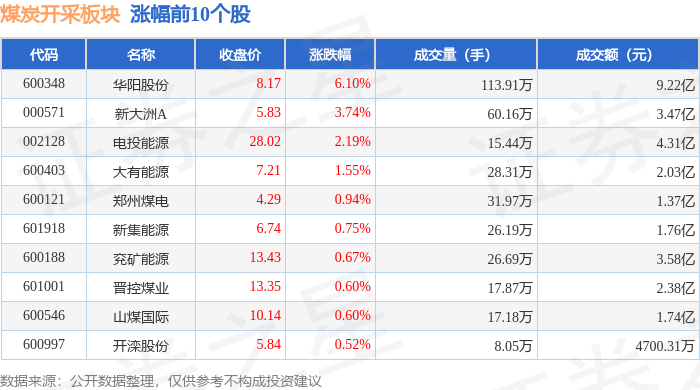
Group 1 - The coal mining sector experienced a slight increase of 0.1% on December 26, with Huayang Co. leading the gains [1] - The Shanghai Composite Index closed at 3963.68, up 0.1%, while the Shenzhen Component Index closed at 13603.89, up 0.54% [1] - Key stocks in the coal mining sector showed varied performance, with Huayang Co. rising by 6.10% to a closing price of 8.17 [1] Group 2 - The coal mining sector saw a net outflow of 92.22 million yuan from major funds, while retail investors contributed a net inflow of 180 million yuan [2] - Notable stocks with significant net inflows from retail investors included Xinda Zhou A, which had a net inflow of 42.99 million yuan [3] - The overall trading volume and turnover in the coal mining sector reflected active participation, with Xinda Zhou A achieving a trading volume of 601,600 shares [1][2]


国新证券每日晨报-20251226
Guoxin Securities Co., Ltd· 2025-12-26 05:42
Market Overview - The domestic market experienced a rise in both volume and price, with the Shanghai Composite Index closing at 3959.62 points, up 0.47%, and the Shenzhen Component Index closing at 13531.41 points, up 0.33% [4][8] - A total of 26 out of 30 sectors in the CITIC first-level industry index saw gains, with notable increases in defense, comprehensive finance, and machinery, while non-ferrous metals, consumer services, and coal experienced declines [4][8] - The total trading volume for the entire A-share market was 19439 billion, showing a slight decrease compared to the previous day [4][8] Key Drivers - The Central Political Bureau of the Communist Party held a meeting to discuss the construction of party conduct and anti-corruption work for 2026, emphasizing the importance of institutional oversight and accountability [9][10] - On the same day, 3773 stocks rose, 1473 fell, and 208 remained unchanged, indicating a strong market sentiment with 283 stocks rising over 5% and 96 hitting the daily limit up [9] - The offshore RMB exchange rate broke the 7.0 mark, which is expected to boost market enthusiasm for buying [9]
电投能源涨2.01%,成交额1.80亿元,主力资金净流出895.63万元
Xin Lang Zheng Quan· 2025-12-26 03:19
Core Viewpoint - The stock of Electric Power Investment Energy has shown a significant increase in price and trading activity, reflecting positive market sentiment despite a slight decline in net profit year-on-year [1][2]. Group 1: Stock Performance - As of December 26, Electric Power Investment Energy's stock price increased by 2.01% to 27.97 CNY per share, with a trading volume of 1.80 billion CNY and a market capitalization of 626.97 billion CNY [1]. - The stock has risen by 48.94% year-to-date, with a 2.57% increase over the last five trading days, 7.45% over the last twenty days, and 25.26% over the last sixty days [1]. Group 2: Financial Performance - For the period from January to September 2025, Electric Power Investment Energy reported a revenue of 22.403 billion CNY, representing a year-on-year growth of 2.72%, while the net profit attributable to shareholders was 4.118 billion CNY, a decrease of 6.40% year-on-year [2]. - The company has distributed a total of 11.815 billion CNY in dividends since its A-share listing, with 4.550 billion CNY distributed over the last three years [3]. Group 3: Shareholder Information - As of September 30, 2025, the number of shareholders for Electric Power Investment Energy was 27,100, a decrease of 11.29% from the previous period, while the average number of circulating shares per person increased by 12.72% to 82,831 shares [2]. - Among the top ten circulating shareholders, Hong Kong Central Clearing Limited holds 47.2447 million shares, an increase of 18.5055 million shares compared to the previous period [3].
2026:信用债投资的风险边界与机会展望
2025-12-26 02:12
Summary of Key Points from the Conference Call Industry Overview - The conference call primarily discusses the credit bond market, focusing on the outlook for 2026 and the performance of various sectors within the industry, including local government financing platforms (城投) and non-bank financial institutions. Core Insights and Arguments 1. **2025 Credit Bond Market Performance**: The credit bond market in 2025 is expected to be stable, with coupon yields providing solid returns, particularly during the March allocation window. However, long-term credit bonds face challenges as the credit spread for long-term bonds is expected to widen, making trading more difficult [3][5]. 2. **Investment Opportunities in 2026**: The focus for 2026 will be on the value of coupon yields in a volatile market, with attention on the transformation of local government financing platforms, risks in financial and industrial bonds, and opportunities arising from the expansion of southbound investment channels [6][11]. 3. **Risks in a Low-Interest Environment**: There is a need to be cautious of tail risks in the current low-interest environment, emphasizing the importance of fundamental research to understand valuation fluctuations and liquidity loss [7][49]. 4. **Transformation of Local Government Financing Platforms**: The transformation of local government financing platforms is accelerating, which will significantly impact local government construction. The focus will be on policy guidance to ensure the successful resolution of hidden debt issues [8][9][12]. 5. **Regional Disparities**: Investment demand is increasing in coastal regions and first-tier cities, while some southwestern and northern regions face significant debt pressure and limited financing support [2][14]. 6. **Institutional Behavior Impact**: The expansion of wealth management scale has increased demand for short-term credit bonds, while the decline in fund sizes has reduced allocations for medium to long-term bonds. This shift in institutional behavior significantly affects pricing and demand structures [10][11]. 7. **Future of Local Government Financing**: Local government financing platforms are expected to gradually de-platform, no longer assuming debt responsibilities, yet they will remain crucial for local government operations in the next 5-10 years [12][13]. 8. **Policy Adjustments**: Recent policy adjustments have aimed to alleviate fiscal pressures, including the resumption of issuing special bonds and flexible adjustments in their usage [16]. 9. **Credit Risk in Non-Bank Financial Institutions**: Non-bank financial institutions face various risks, including market, liquidity, credit, and refinancing risks. The central bank's new liquidity support mechanism aims to prevent individual liquidity issues from escalating into systemic risks [4][27][29]. 10. **Investment Strategy for 2026**: The investment strategy should focus on identifying coupon yield opportunities, recognizing credit risks based on fundamentals, and observing structural changes and opportunities from the product and institutional behavior perspectives [11][60]. Other Important but Potentially Overlooked Content - The credit bond market is expected to face a significant gap in high-yield assets in 2026, with a large volume of high-yield deposits maturing, which could push credit spreads and yields higher [47][48]. - The performance of the real estate sector remains uncertain, with ongoing liquidity and credit risk issues, particularly highlighted by the Vanke incident, which has affected overall market sentiment [40][43]. - The future of the credit bond market will likely see a rise in credit risk premiums due to potential unexpected risk events, necessitating careful monitoring and strategic adjustments [52][68]. This summary encapsulates the key points discussed in the conference call, providing insights into the credit bond market's current state and future outlook, as well as the implications for investment strategies.