资源回收

Search documents
中国环境资源发盈警 预期年度综合亏损同比减少不少于35%
Zhi Tong Cai Jing· 2025-09-16 10:12
Core Viewpoint - China Environment Resources (01130) expects a significant reduction in consolidated losses for the fiscal year ending June 30, 2025, by at least 35% compared to the loss of approximately HKD 72.1 million in 2024 [1] Financial Performance - The anticipated loss reduction is attributed to several factors, including a decrease in revenue from recycled metal due to lower demand, resulting in estimated revenue of approximately HKD 60.7 million and a gross profit of about HKD 13.3 million [1] - Other income, revenue, and losses are expected to decrease to around HKD 1.6 million [1] - Administrative and operational expenses are projected to decline to approximately HKD 35.7 million [1] Asset Valuation - Fair value losses on investment properties are expected to decrease to about HKD 15.7 million [1] - Losses from changes in the fair value of biological assets are anticipated to reduce to approximately HKD 5.4 million [1] - Net gains from fair value changes of investments measured at fair value through profit or loss are expected to increase to around HKD 5.7 million [1] Provisions and Costs - Provisions for receivables impairment losses are projected to increase to about HKD 3 million [1] - Financing costs are expected to decrease to approximately HKD 6 million [1] - Tax credits are anticipated to decrease to around HKD 2.3 million [1]
中国环境资源(01130.HK)预期年度综合亏损同比收窄不少于35%
Ge Long Hui· 2025-09-16 10:11
Core Viewpoint - China Environment Resources (01130.HK) expects a significant reduction in consolidated losses for the year ending June 30, 2025, by at least 35% compared to a loss of approximately HKD 72.1 million for the same period in 2024 [1] Financial Performance Summary - The anticipated loss reduction is attributed to several factors, including: - Revenue decline to approximately HKD 60.7 million due to decreased demand for recycled metals and reduced sales of automobiles and auto parts, leading to a gross profit decrease to about HKD 13.3 million [1] - Other income, revenue, and losses reduced to around HKD 1.6 million [1] - Administrative and operational expenses decreased to approximately HKD 35.7 million [1] - Fair value losses on investment properties reduced to about HKD 15.7 million [1] - Losses from biological asset fair value changes decreased to around HKD 5.4 million [1] - Net gains from fair value changes on investments accounted for at fair value increased to approximately HKD 5.7 million [1] - Provision for impairment losses on receivables increased to about HKD 3 million [1] - Financing costs decreased to approximately HKD 6 million [1] - Tax credits reduced to about HKD 2.3 million [1]
中国环境资源(01130)发盈警 预期年度综合亏损同比减少不少于35%
智通财经网· 2025-09-16 10:09
Core Viewpoint - China Environment Resources (01130) expects a significant reduction in consolidated losses for the fiscal year ending June 30, 2025, with a decrease of no less than 35% compared to the loss of approximately HKD 72.1 million in the same period of 2024 [1] Summary by Relevant Categories Financial Performance - The anticipated consolidated loss for the fiscal year ending June 30, 2025, is projected to be less than HKD 46.8 million, reflecting a substantial improvement [1] - Revenue is expected to decline to approximately HKD 60.7 million due to decreased demand for recycled metals and reduced sales of automobiles and auto parts [1] - Gross profit is projected to decrease to around HKD 13.3 million [1] Income and Expenses - Other income, revenue, and losses are expected to decrease to approximately HKD 1.6 million [1] - Administrative and operating expenses are anticipated to reduce to about HKD 35.7 million [1] - Financing costs are expected to decrease to approximately HKD 6 million [1] Asset Valuation - Fair value losses on investment properties are projected to decrease to around HKD 15.7 million [1] - Losses from changes in the fair value of biological assets are expected to reduce to about HKD 5.4 million [1] - Net gains from fair value changes of investments measured at fair value through profit or loss are expected to increase to approximately HKD 5.7 million [1] Provisions and Taxation - Provisions for impairment losses on receivables are expected to increase to about HKD 3 million [1] - Tax credits are anticipated to decrease to approximately HKD 2.3 million [1]
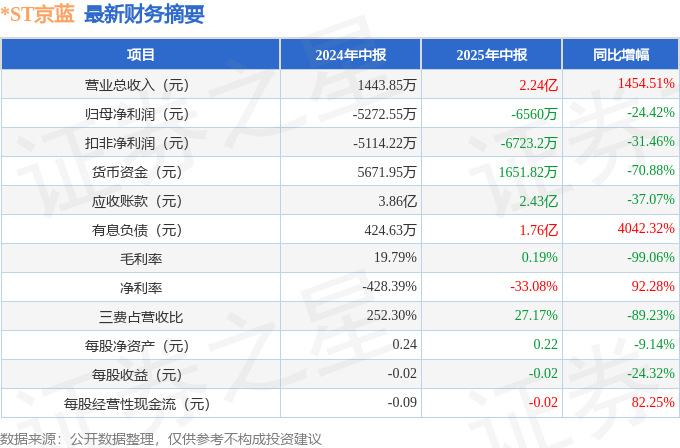
*ST京蓝2025年中报简析:增收不增利,公司应收账款体量较大
Zheng Quan Zhi Xing· 2025-08-27 22:29
Core Viewpoint - *ST Jinglan (000711) reported a significant increase in revenue but continued to face net losses, indicating potential operational challenges despite revenue growth [1][3]. Financial Performance Summary - Total revenue for the first half of 2025 reached 224 million yuan, a year-on-year increase of 1454.51% compared to 14.44 million yuan in 2024 [1]. - The net profit attributable to shareholders was -65.6 million yuan, a decrease of 24.42% from -52.73 million yuan in the previous year [1]. - The gross profit margin dropped to 0.19%, a decline of 99.06% from 19.79% in the previous year [1]. - The net profit margin improved to -33.08%, an increase of 92.28% from -428.39% in the previous year [1]. - Total receivables accounted for 64.28% of total revenue, indicating a high level of outstanding payments [1]. Cash Flow and Investment Summary - The net cash flow from operating activities increased by 82.25%, attributed to significant sales collections from the resource recovery and comprehensive utilization business [4]. - The net cash flow from investing activities rose by 95.24%, due to large investment payments in the previous year [4]. - The net cash flow from financing activities surged by 381.63%, reflecting new borrowings of 54.85 million yuan [4]. Cost and Expense Analysis - Sales expenses decreased by 41.2%, linked to a decline in sales activities and workforce reduction at a subsidiary [3]. - Management expenses increased by 77.29%, driven by higher stock incentive costs and employee compensation [3]. - Research and development expenses fell by 44.23%, due to reduced projects at a subsidiary [3]. Historical Performance Insights - The company has a historical median Return on Invested Capital (ROIC) of -4.06% over the past decade, with a particularly poor ROIC of -40.95% in 2022 [4]. - The company has reported losses in 8 out of 27 annual reports since its listing, indicating a challenging financial history [4].


漫资源回收企业“反向开票”
蓝色柳林财税室· 2025-08-26 00:44
Group 1 - The implementation of "reverse invoicing" for resource recovery enterprises aims to enhance the convenience of obtaining invoices when purchasing scrapped products from individuals [3] - "Scrapped products" are defined as products that have lost all or part of their original utility value due to social production and consumption [3] - "Sellers" refer to individuals selling their used scrapped products or those purchased for resale, with cumulative sales not exceeding 5 million yuan (excluding VAT) within a continuous period of 12 months [3] Group 2 - Resource recovery enterprises must meet specific conditions, such as obtaining the hazardous waste operation license for hazardous waste collection [3] - For scrapped vehicle recovery, enterprises must comply with national regulations and obtain the qualification certificate for scrapped vehicle recovery and dismantling [3] - Other resource recovery enterprises must register as business entities and complete the filing with the Ministry of Commerce according to national regulations [3] Group 3 - Resource recovery enterprises can be either units or individual businesses when implementing "reverse invoicing" [3] - When resource recovery enterprises issue "reverse invoices" to sellers, they are also required to handle VAT and additional tax fees on behalf of the sellers [3]
税务部门“反向开票”,支持废旧物资的资源化利用和无害化处理
Jing Ji Ri Bao· 2025-08-17 23:05
Group 1 - The "reverse invoicing" policy is implemented to facilitate resource recovery enterprises in issuing invoices to individuals when purchasing scrapped products, effectively addressing the long-standing issue of "missing source invoices" in the industry [1][2] - As of June 2023, 13,300 resource recovery enterprises have issued invoices amounting to 515.2 billion yuan, with 5.11 million invoices issued to 1.67 million individuals [1] - The policy is expected to significantly increase the volume of scrapped vehicle dismantling, with one company anticipating a 100% increase in dismantled vehicles to 20,000 units this year [1][3] Group 2 - The promotion of the "reverse invoicing" policy enhances compliance awareness among individuals and enterprises in the resource recovery sector, encouraging more participation in waste recycling [2] - The policy has reduced intermediate costs and information barriers, leading to more efficient cooperation along the industry chain [2] - The implementation of the policy has resulted in a 40% increase in the volume of waste materials sold by individual recyclers [3] Group 3 - The "reverse invoicing" policy supports the resource utilization and harmless treatment of waste materials, with one company issuing invoices totaling over 56 million yuan since the policy's implementation [3] - The recovery system in China is becoming increasingly robust, with significant growth in the recycling of scrapped vehicles and electronic products, including a 65% year-on-year increase in scrapped vehicle recovery [3]
“反向开票”政策效应持续释放 仅上半年开票金额就达到5152亿元
Sou Hu Cai Jing· 2025-08-12 10:16
Core Insights - The "reverse invoicing" policy has significantly impacted the resource recovery industry, facilitating compliance and promoting the circular economy [1][3] - As of June 30, 2023, 13,300 resource recovery enterprises issued reverse invoices amounting to 515.2 billion yuan, with 5.11 million invoices issued [1] Group 1: Policy Implementation and Impact - The "reverse invoicing" policy was implemented to enhance the convenience for resource recovery companies in obtaining invoices when purchasing scrap products from individuals [1] - The policy has led to increased awareness of compliance among individuals and enterprises in the resource recovery sector [1][2] - Companies like Guangxi Fangsheng Paper Industry have benefited from reduced costs and minimized tax risks due to the elimination of intermediaries [2] Group 2: Industry Response and Adaptation - The policy has improved the efficiency of the supply chain by allowing direct transactions between enterprises and individual sellers, reducing costs and information barriers [2] - Tax authorities have increased efforts to educate individual sellers about the invoicing process, addressing initial concerns regarding complexity and personal information security [2] Group 3: Economic Benefits and Growth - Ningbo Supply and Marketing Recycled Resources Technology Co., Ltd. reported a 58% year-on-year increase in sales of recycled materials since the policy's implementation [3] - The smooth operation of the recycling chain has enhanced the resource utilization rate of construction waste and reduced reliance on natural resources, contributing to lower carbon emissions [3] - The promotion of the "reverse invoicing" policy addresses long-standing issues in the industry, encouraging more participation in waste recovery and supporting the implementation of new policies [3]
中国“反向开票”助力“两新”落地,促进循环经济
Zhong Guo Xin Wen Wang· 2025-08-12 00:54
Core Points - The "reverse invoicing" policy has been implemented to support the recycling industry and promote the circular economy in China, with significant positive effects being observed [1][2][3] Group 1: Policy Impact - As of June 30, 2023, 13,300 resource recovery companies issued reverse invoices amounting to 515.2 billion RMB, benefiting 1.67 million individuals [1] - The policy addresses the long-standing issue of "missing source invoices" in the recycling industry, facilitating smoother operations for resource recovery companies [2][3] - The implementation of the policy has led to a significant increase in the volume of recycled materials, with a reported 65% year-on-year increase in the recovery of scrapped vehicles [4] Group 2: Company Experiences - A scrapped vehicle recycling company reported issuing reverse invoices to over 4,000 individuals, with an invoicing amount nearing 8 million RMB, and expects a 100% increase in scrapped vehicle processing this year [2] - A construction waste processing company noted a 58% year-on-year increase in sales of recycled materials, enhancing the resource utilization rate and promoting collaboration across the supply chain [3] - A company specializing in the recycling of old appliances achieved a 98% utilization rate of recyclable materials, with reduced financial costs allowing for investment in deeper resource processing [3] Group 3: Industry Growth - The recycling system in China is becoming increasingly robust, with significant growth in various sectors, including a 25% increase in the recovery of old household appliances [4] - The recycling of discarded electrical and electronic products has seen a leading industry growth rate of 70% year-on-year [4]
助力“两新”政策落地,截至6月底1.33万户资源回收企业实现“反向开票”
Ren Min Ri Bao· 2025-08-12 00:09
Core Insights - The latest statistics from the National Taxation Administration indicate that as of the end of June this year, there are 13,300 resource recovery enterprises issuing "reverse invoices" to 1.67 million individuals, with a total invoice amount of 515.2 billion yuan and 5.11 million invoices issued [1] Group 1: Policy Impact - Starting from April 29, 2024, the tax authorities will implement a "reverse invoicing" policy in the resource recovery industry to facilitate the acquisition of invoices when recovering scrapped products from individuals, promoting a new round of large-scale equipment updates and the exchange of old consumer goods for new ones [1] - Over the past year, the "reverse invoicing" policy has positively impacted the implementation of the "two new" policies, regulated industry order, and promoted the development of the circular economy [1] Group 2: Industry Growth - Under the guidance of policy and market forces, the waste recovery, dismantling, and recycling industry chain has improved significantly [1] - In the first four months of this year, the domestic scrap vehicle recovery volume reached 2.767 million units, a year-on-year increase of 65% [1] - The number of standardized dismantled old household appliances exceeded 7 million units, reflecting a year-on-year growth of 25% [1] - The recovery volume of discarded electrical and electronic products led the industry with a year-on-year growth rate of 70% [1]
1.33万户资源回收企业实现“反向开票”
Ren Min Ri Bao· 2025-08-11 22:01
Core Insights - The latest statistics from the National Taxation Administration indicate that as of the end of June this year, 13,300 resource recovery enterprises issued "reverse invoices" to 1.67 million individuals, with a total invoicing amount of 515.2 billion yuan and 5.11 million invoices issued [1]. Group 1: Policy Impact - The "reverse invoicing" policy was implemented on April 29, 2024, to facilitate the large-scale equipment renewal and the trade-in of consumer goods, enhancing the convenience for resource recovery enterprises to obtain invoices when purchasing scrapped products from individuals [1]. - Over the past year, the "reverse invoicing" policy has positively contributed to the implementation of the "two new" policies, standardizing industry order, and promoting the development of the circular economy [1]. Group 2: Industry Performance - Under the influence of policy guidance and market promotion, the waste recovery, dismantling, and recycling industry chain has improved significantly [1]. - In the first four months of this year, the domestic scrapped automobile recovery volume reached 2.767 million units, representing a year-on-year increase of 65% [1]. - The number of standardized dismantled old household appliances exceeded 7 million units, with a year-on-year growth of 25% [1]. - The recovery volume of discarded electrical and electronic products led the industry with a year-on-year growth rate of 70% [1].