Display Panels

Search documents
印刷OLED突围,中国屏的新路径
21世纪经济报道· 2025-11-21 02:36
Core Viewpoint - The global display industry is undergoing a new round of technological iteration, with OLED technology's penetration rate increasing, particularly in the context of printed OLED technology being led by Chinese companies [1][2]. Group 1: Industry Trends - The display industry is moving towards high resolution, low power consumption, and wide color gamut, with printed OLED technology emerging as a key player [1]. - China’s share of the global OLED market has surpassed 46%, with predictions indicating it will exceed 50% by 2027-2028 as three major companies launch high-generation OLED lines [2]. Group 2: Competitive Landscape - Four panel manufacturers, including TCL Huaxing, BOE, Visionox, and Samsung Display, are investing in high-generation OLED production lines, with total investments nearing 170 billion yuan [5]. - The competition in high-generation OLED technology is intensifying, with TCL Huaxing focusing on maintaining competitiveness in its 8.6-generation printed OLED production line [5][6]. Group 3: Key Decisions by TCL Huaxing - TCL Huaxing made four critical decisions in the development of printed OLED technology, including choosing the printed OLED route, shifting application focus to mid-size displays, relocating JOLED's production line to China, and initiating the Guangzhou T8 project for large-scale commercialization [8][9][10]. - The decision to focus on mid-size applications was driven by the performance and cost advantages of printed OLED technology [8]. Group 4: Challenges and Future Directions - Key challenges for TCL Huaxing include improving power consumption, achieving high yield rates, and addressing material performance issues [11][12]. - The company aims to enhance the efficiency of its printed OLED technology to meet the stringent requirements of top-tier customers while ensuring compatibility with existing OLED materials [12]. - The future strategy involves building an open, autonomous, and collaborative industry ecosystem to enhance global competitiveness [13].


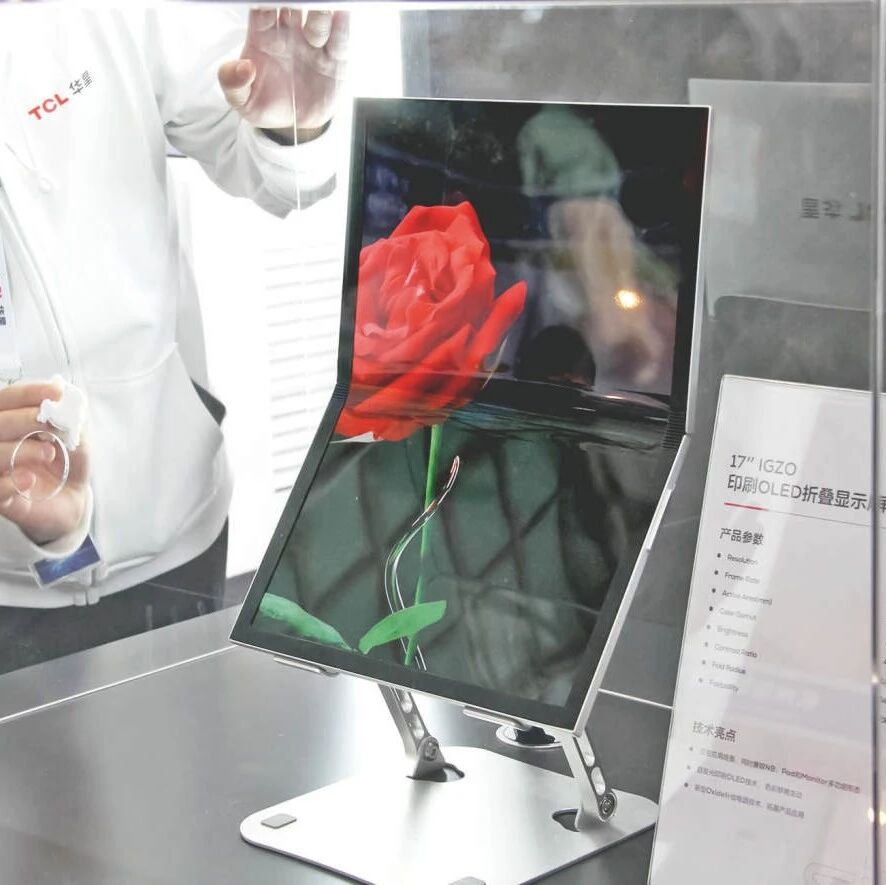
面板企业竞相布局OLED显示技术
Zhong Guo Jing Ji Wang· 2025-11-18 11:25
Group 1 - TCL Huaxing showcased multiple display solutions at the DTC2025 conference, including Real Stripe RGB OLED mobile displays and Micro LED displays, highlighting its comprehensive technology layout in the semiconductor display industry [1] - The Real Stripe RGB OLED mobile display utilizes high-precision OLED printing technology, offering enhanced visual effects and contributing to the high-quality development of the semiconductor display industry [1] - The printed OLED production line is designed to save 300 to 400 million kilowatt-hours of electricity annually by significantly reducing vacuum processes, demonstrating its advantages in green manufacturing [1] Group 2 - Domestic OLED production capacity has surpassed 46% of the global total in the first half of this year, marking a transition from a "chip shortage" to a "strong screen and strong chain" development phase in China's display industry [2] - TCL Huaxing aims to improve resolution, material performance, and product yield while reducing costs and enhancing image quality, providing more options for terminal manufacturers [2] - The company released the "Visual Health White Paper 2.0" in collaboration with partners, detailing research on natural light display technology and its six key characteristics [2] Group 3 - After 12 years of investment and research, TCL Huaxing has established a leading advantage in key technologies within the printed OLED field and seeks to collaborate with more partners to promote its application [3]
维信诺(002387.SZ):“红旗·维信诺联合创新实验室”首个合作成果已落地
Ge Long Hui· 2025-11-14 01:17
格隆汇11月14日丨维信诺(002387.SZ)在投资者互动平台表示,"红旗·维信诺联合创新实验室"首个合作 成果已落地,全球首款14.2英寸车载滑移卷曲AMOLED屏幕量产应用于"红旗·国雅"高端行政轿车的中 控屏。 ...

韩媒:京东方8.6代OLED产线首批面板将供货华硕
WitsView睿智显示· 2025-11-13 09:12
Core Viewpoint - BOE's 8.6-generation OLED panel production line (B16) is set to supply ASUS for 14-inch laptops and OPPO for smartphones, with an expected contract production volume of approximately 10 million panels [1][3]. Group 1: BOE's Production and Plans - The first batch of panels from BOE's B16 line will be supplied to ASUS, primarily for OLED screens in laptops [1]. - BOE plans to hold a lighting ceremony for the B16 factory in December 2023, indicating that all core processes are ready [1]. - BOE announced an investment in the 8.6-generation AMOLED production line project in November 2023, targeting high-end touch OLED displays for laptops and tablets, with mass production expected in the second half of 2026 [1]. Group 2: Competitors and Market Dynamics - Other Chinese panel manufacturers are accelerating investments in 8.6-generation OLED production lines, aiming for a broader market in laptops and mobile devices [3]. - The Hefei Guoxian 8.6-generation AMOLED production line, backed by Visionox and Hefei's investment platform, is the world's first high-generation AMOLED line using the no-FMM technology, with a total investment of 55 billion yuan and a design capacity of 32,000 glass substrates per month [3]. - TCL Huaxing's T8 project, the world's first large-scale G8.6 generation inkjet printing OLED production line, has a total investment of 29.5 billion yuan and a design capacity of approximately 22,500 glass substrates per month, covering various applications [3]. Group 3: Competitive Landscape - Industry insiders suggest that despite starting a year later than Samsung Display, BOE's B16 line may achieve mass production ahead of Samsung [4]. - Samsung Display is constructing an 8.6-generation OLED panel production line (A2) in Korea, with a monthly capacity of 16,000 panels, exclusively for Apple's next-generation MacBook series [4]. - Samsung has indicated plans to start mass production of the second A2 line in the second quarter to third quarter of 2026 [4].


Omdia:预计2026年全球显示面板面积需求同比增长6% 出货量将下降2%
智通财经网· 2025-11-13 01:33
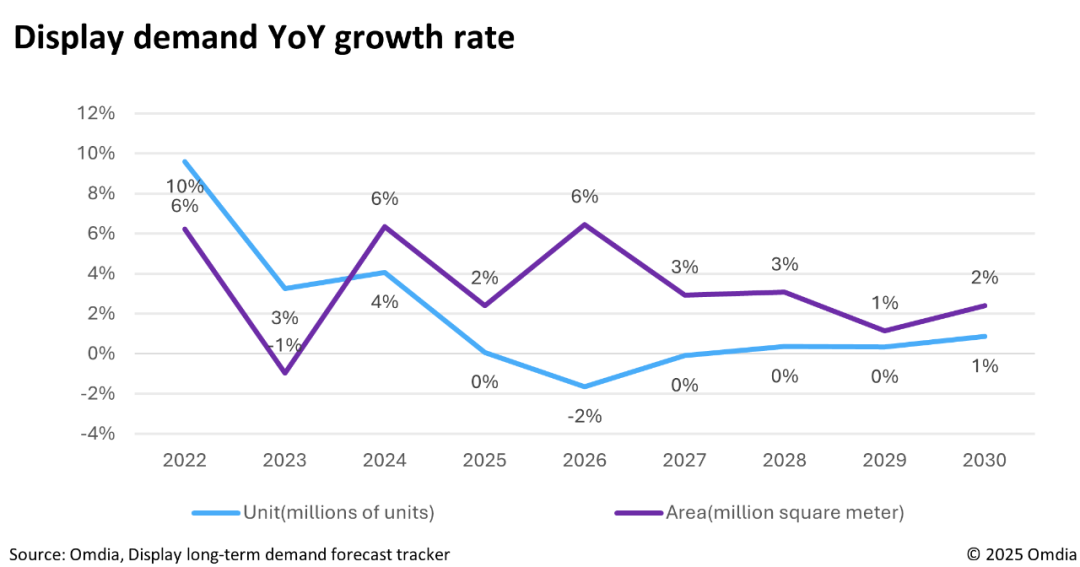
Core Insights - The global display panel area demand is expected to grow by 6% year-on-year in 2026, despite a projected 2% decline in shipment volume due to uncertainties in U.S. import tariffs and economic slowdown [1][4] - The demand for large-sized display panels is driving overall area demand, with significant growth anticipated in ultra-large televisions (70 inches and above) and large gaming monitors [4] Group 1 - Omdia forecasts a mere 2% growth in display panel market area demand for 2025, lower than in 2024, primarily due to supply chain changes from U.S. tariff policies and weak consumer demand [4] - The acceleration of large-size televisions and desktop monitors is expected to be the main growth driver, as consumer preference shifts towards larger screens [4] - The reduction in production costs, particularly with the depreciation of 10.5-generation LCD and 8.5-generation OLED factories, is anticipated to lower television prices and enhance consumer purchasing willingness [4] Group 2 - The demand for new technology products, such as foldable smartphones and the rise in AI-driven mobile PC demand, is also expected to significantly contribute to the growth in display panel area demand [4] - Panel suppliers are likely to maximize the utilization of existing 8th and 10th generation factory capacities, benefiting from increased demand for large-sized display panels [4]
全球第一!京东方Q3手机面板出货1.45亿片
WitsView睿智显示· 2025-11-10 09:46
Core Insights - The global smartphone panel shipment is projected to reach 586 million units in Q3 2025, with a quarter-on-quarter increase of 8.1% and a year-on-year increase of 5.3% driven by the iPhone 17 series and other major brands' new releases [2] - The total smartphone panel shipment for 2025 is expected to be 2.243 billion units, marking a year-on-year growth of 3.4%, representing a recent peak [2] AMOLED Panel Insights - Q3 2025 AMOLED smartphone panel shipments reached 246 million units, reflecting a quarter-on-quarter increase of 9.9% [3] - The increasing adoption of AMOLED panels in mid-range models is expected to enhance overall penetration rates [3] - Samsung Display maintains a 40% market share in the high-end segment, while BOE continues to supply iPhone and other major brands [4] LCD Panel Insights - Q3 2025 LCD smartphone panel shipments increased by 6.9% to 340 million units [4] - BOE leads the market with over 30% shipment share, while HKC and TCL Huaxing are also increasing their a-Si LCD shipments [4] - The low-end a-Si LCD market is supported by cost advantages and demand from the after-sales repair market, while LTPS LCD demand continues to decline [4] Market Trends and Future Outlook - The growth momentum for the smartphone panel market in 2025 is primarily driven by the rising penetration of AMOLED technology and close collaboration between Chinese panel manufacturers and brands [6] - Despite limited overall smartphone demand growth, AMOLED panels are expected to expand steadily due to technological upgrades and cost reductions, while LCD will continue to support the entry-level market [6] - By 2026, it is anticipated that AMOLED panel shipments will exceed 45% of the market, with LCD maintaining around 55% [6]

研报 | 新机带动需求回温,2025年第三季度全球智能手机面板出货量季增8.1%
TrendForce集邦· 2025-11-10 07:09
Core Insights - The global smartphone panel shipment reached 586 million units in Q3 2025, with a quarter-on-quarter increase of 8.1% and a year-on-year increase of 5.3%, driven mainly by the iPhone 17 series and new releases from other major brands [2] - The total smartphone panel shipment for 2025 is projected to be 2.243 billion units, representing a year-on-year growth of 3.4%, marking a recent peak [2] AMOLED Panel Performance - AMOLED panel shipments in Q3 2025 reached 246 million units, with a quarter-on-quarter increase of 9.9%, benefiting from increased adoption in mid-range models [5] - SDC maintained a dominant position in the mid-to-high-end market with a 40% shipment share, while BOE continued to supply iPhones and other major brands [5] - Visionox expanded its market share by leveraging cost advantages [5] LCD Panel Performance - LCD panel shipments increased by 6.9% quarter-on-quarter to 340 million units in Q3 2025, with BOE accounting for over 30% of shipments [6] - The demand for low-end a-Si LCD panels remains stable due to cost advantages and after-sales market needs, while LTPS LCD demand continues to decline [6] - The overall smartphone panel market is expected to be dominated by AMOLED and a-Si LCD technologies moving forward [6] Market Outlook - The growth momentum for the smartphone panel market in 2025 is primarily driven by the rising penetration of AMOLED technology and close collaboration between Chinese panel manufacturers and brands [6] - By 2026, it is anticipated that AMOLED panel shipments will exceed 45% of the market, while LCD panels will maintain around 55% [6] - Korean suppliers will continue to dominate the high-end market, while Chinese manufacturers will accelerate their penetration into the mid-to-high-end market through cost and brand collaboration advantages [6]

CINNO Research:短期内外需求同步走弱 预计11月面板价格将开启下行通道
智通财经网· 2025-11-07 05:52
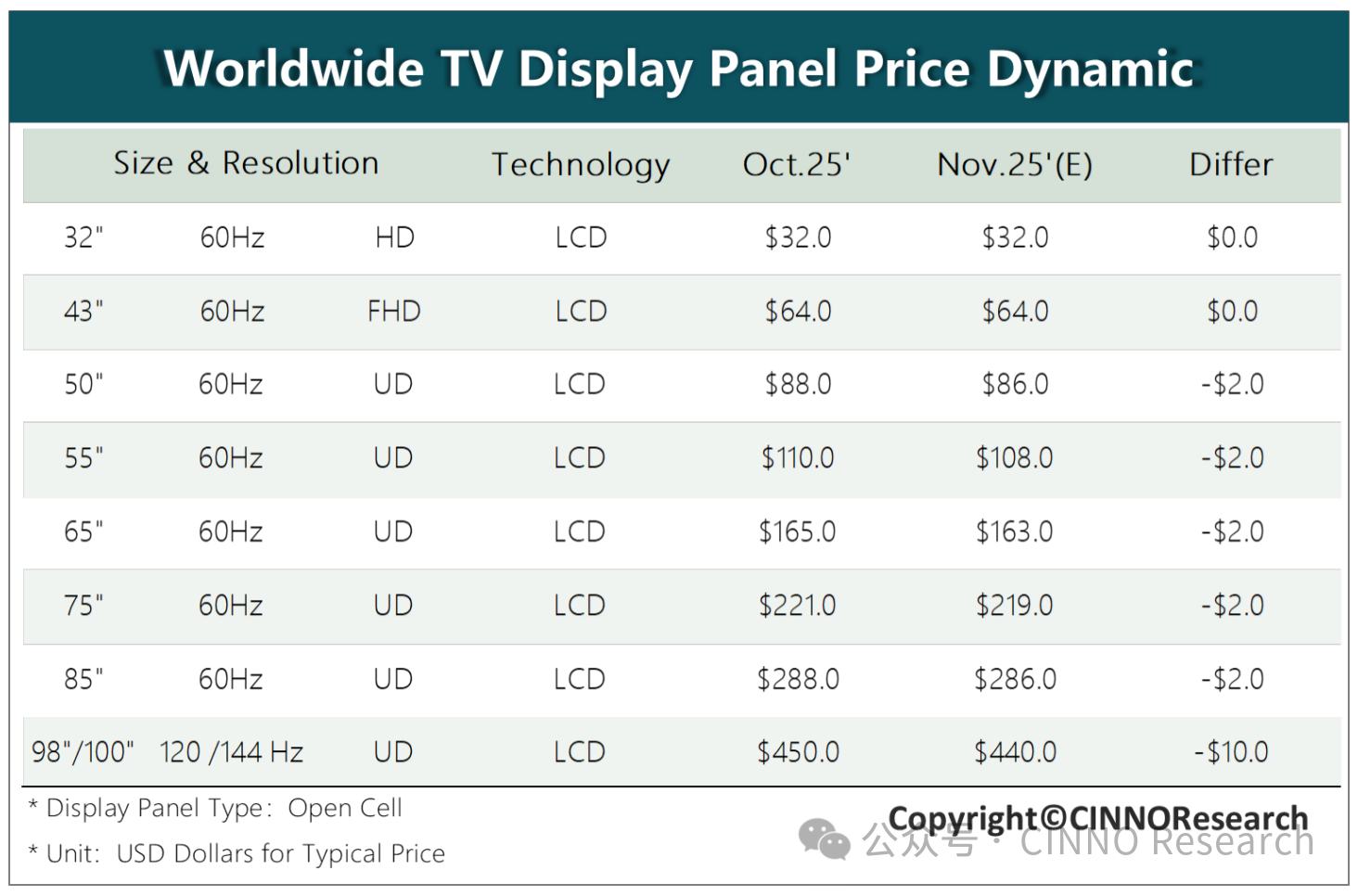
Group 1 - The overall demand for panels is expected to decline in Q4, with manufacturers stabilizing mainstream size prices through coordinated production control [1] - The impact of domestic subsidy policies on the market is limited, and the easing of US-China tariff tensions may slow down the pre-stocking pace, leading to further weakening of short-term demand [1] - Panel prices are anticipated to enter a downward channel in November due to multiple factors, including the inability to maintain a unified production control rhythm among manufacturers [1] Group 2 - In October, as pre-stocking neared completion, order volumes gradually decreased, resulting in a 7.8% month-on-month decline in LCD TV panel shipments [2] - Major panel manufacturers responded quickly by controlling production capacity, maintaining an average utilization rate of around 75% for high-generation lines [2] - The average utilization rate is expected to remain around 80% in Q4, leading to ongoing supply-demand dynamics despite efforts to stabilize prices [2] Group 3 - In November, the overall demand for LCD TV panels is expected to weaken, with most panel sizes entering a general price decline [2] - Specific price forecasts for November indicate that 32" and 43" panel prices are expected to remain stable at $32 and $64 respectively, while mainstream sizes from 50" to 85" are projected to decline by $2 [2] - Ultra-large size panels (98"/100") are expected to see significant price drops, projected to decrease by $10 to around $440 [2][3]
11月电视面板行情: 短期需求走弱,多规格LCD TV面板价格普降
CINNO Research· 2025-11-07 05:17
Core Viewpoint - The demand for LCD TV panels is expected to weaken in November due to limited impact from domestic subsidy policies and a calming of the US-China tariff situation, leading to a downward trend in panel prices [1][2][3]. Demand Analysis - Overall demand for panels is declining in Q4, with manufacturers stabilizing mainstream size prices through coordinated production control. As of November, brand stocking has nearly concluded, shifting procurement from urgent to cautious [2][3]. - The domestic "trade-in" policy is also nearing its end, and while there may be some pre-stocking for the 2026 World Cup, the easing of US-China trade tensions has reduced the urgency for stocking [3]. - The comprehensive tariff on Chinese TV exports to the US has decreased to approximately 31.4%, further diminishing the need for urgent stocking [3]. Supply Analysis - As stocking winds down, order volumes are decreasing, prompting leading panel manufacturers to adjust production capacity, maintaining an average utilization rate of around 75% [4]. - The G8.5 and G10.5 production lines are primarily responsible for production control, with significant reductions in utilization rates, which has helped stabilize prices for sizes ranging from 32" to 75" [4]. - However, the G8.6 production line has seen weaker production control, leading to continued price declines for larger panels (85" and above) [4]. Price Forecast - In November, the overall demand for LCD TV panels is expected to weaken, with most panel sizes entering a general price decline. Specifically, prices for 32" and 43" panels are projected to remain stable at $32 and $64, respectively, while prices for sizes from 50" to 85" are expected to drop by $2 each [5]. - The largest panels (98"/100") are anticipated to see a more significant price drop of $10, bringing their price down to $440 [5].

面板价格观察 |11月电视面板价格预测将全面下调,笔电面板价格谨慎微调
TrendForce集邦· 2025-11-06 06:36
Core Viewpoint - TrendForce predicts a comprehensive decline in TV panel prices for November 2025, while monitor panel prices are expected to remain stable compared to the previous month, with slight decreases anticipated for some laptop panels [4][5][6]. TV Panel Prices - TV panel demand has slightly weakened, but some brands are still willing to place orders. Panel manufacturers are making minor adjustments to production rates while accommodating brand demands. As the year-end approaches, most brand clients and panel manufacturers are beginning to observe panel prices [4]. - The forecast for November indicates a decrease of $1 for 32-inch and 43-inch panels, $2 for 50-inch and 55-inch panels, and $3 for 65-inch and 75-inch panels [5]. Monitor Panel Prices - Demand for monitor panels has significantly weakened entering the fourth quarter, but manufacturers are cautious in adjusting prices, leading to continued losses. Consequently, a consensus has been reached between buyers and sellers to maintain stable prices for monitor panels [6]. - The only expected price drop is for the 23.8-inch VA Open Cell panel, which may decrease by $0.1, while other mainstream sizes are anticipated to remain stable [6]. Laptop Panel Prices - Despite entering the traditional off-season, demand for laptop panels is slightly stronger than expected, with some brand clients willing to increase their purchase volumes. Panel manufacturers are adopting a more flexible pricing strategy to maintain customer relationships, leading to minor price concessions [7]. - The forecast for November suggests that TN panel prices will remain stable, while IPS panel prices are expected to decrease by $0.1 across the board [7].