Internet Services

Search documents
Can Trade Desk's OpenAds Make Media Supply Chains Healthier?
ZACKS· 2026-01-08 14:06
Core Insights - The Trade Desk, Inc. has launched OpenAds, a new auction environment aimed at providing publishers and sellers with a transparent and high-integrity alternative for programmatic advertising, supported by major publishing partners [1][9] Group 1: OpenAds Initiative - OpenAds is designed to enhance transparency, visibility, and signal in programmatic advertising, addressing advertiser concerns by delivering a cleaner auction framework [2] - The initiative reflects a shift towards cleaner auction mechanics, enabling advertisers to better understand their purchases and audience reach [3] - Key elements of OpenAds will be open-sourced, allowing for industry review and participation from other buyers and DSPs [4] Group 2: Complementary Tools - OpenAds complements Trade Desk's existing initiatives like OpenPath and PubDesk, which aim to improve efficiency and trust between buyers and sellers [5] - These tools are focused on aligning incentives around quality rather than volume, enhancing the overall media supply chain dynamics [5] Group 3: Future Development - The company anticipates that OpenAds will continue to develop actively and expand through 2026, with plans for additional publisher integrations [6] - Management believes that a healthier auction environment will improve outcomes for both advertisers and publishers, reinforcing the competitiveness of the open Internet [6] Group 4: Competitive Landscape - Amazon's advertising business is rapidly expanding, leveraging consumer data and partnerships to enhance its advertising reach, including collaborations with platforms like Netflix and Spotify [7] - PubMatic has launched AgenticOS, an AI-powered system for programmatic advertising, and is focusing on diversifying its DSP mix to reduce reliance on legacy buyers [8][10]





ClearBridge Large Cap Growth Strategy’s Views on Alphabet (GOOG)
Yahoo Finance· 2026-01-08 13:20
Core Insights - ClearBridge Investments released its fourth-quarter 2025 investor letter for the ClearBridge Large Cap Growth Strategy, emphasizing an investment philosophy focused on undervalued leading companies with growth potential [1] - Large-cap stocks showed strength in the quarter, driven by strong earnings from mega-cap companies and enthusiasm for generative AI, although the ClearBridge strategy underperformed the Russell 1000 Growth Index by approximately 900 basis points for the year [1] - The underperformance was attributed to underweight exposure to mega-cap AI beneficiaries and lower-quality AI-related names [1] Company Highlights - Alphabet Inc. (NASDAQ:GOOG) was highlighted as a key stock, with a market capitalization of $3.89 trillion and a one-month return of 2.78%, while shares gained 65.02% over the last 52 weeks [2] - The company achieved its first-ever $100 billion in revenue in the third quarter of 2025, indicating strong financial performance [4] - ClearBridge noted that it did not increase its positions in Alphabet Inc. enough, despite its strong performance driven by the success of the Google Gemini chatbot and TPU chips for AI workloads, which boosted shares by more than 60% for 2025 [3] Investment Strategy - ClearBridge acknowledged the potential of Alphabet Inc. as an investment but suggested that certain AI stocks may offer greater upside potential with less downside risk [4] - The firm expressed regret for not scaling up its positions in Alphabet Inc. after the conclusion of the DOJ antitrust case, which resulted in less severe penalties than anticipated [3]

AI搜索战局生变:Gemini 12月流量环比激增24%,ChatGPT下降9%
Hua Er Jie Jian Wen· 2026-01-08 12:06
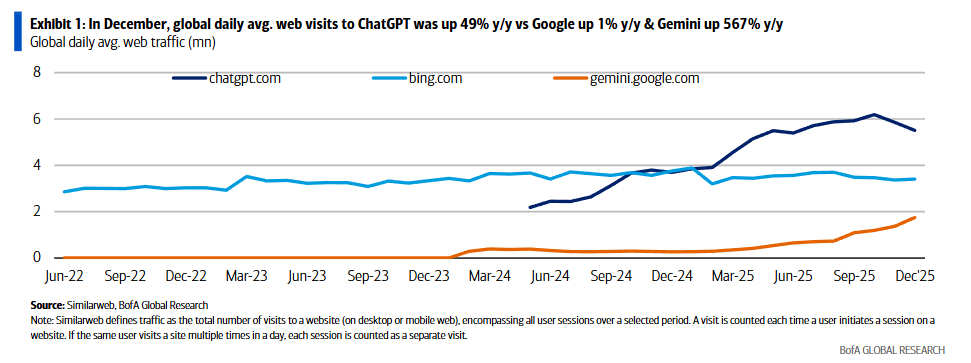
Core Insights - The AI search market is experiencing significant changes, with Gemini's daily web traffic increasing by 24% month-over-month, while ChatGPT's traffic decreased by 9% [1][2][6] - Analysts suggest that the slowdown in ChatGPT's growth may be linked to Google's introduction of the "AI Overviews" feature and the rising popularity of Gemini, leading to an underestimation of Google's search business potential by Wall Street [1][11] Traffic Analysis - In December, Gemini's global daily traffic surged by 567% year-over-year to 56 million, while ChatGPT's traffic grew by 49% to 178 million [2] - Month-over-month, Google experienced a 1% decline in traffic, ChatGPT saw a 9% decrease, and Bing dropped by 9%, whereas Gemini's traffic rose by 24.2% [6] - In the U.S. market, ChatGPT's year-over-year growth was 86%, reaching 31 million daily users, which is 6% of Google's traffic [6] Mobile User Engagement - According to Sensor Tower, Gemini's mobile daily active users increased by 351% year-over-year to 62 million, with a month-over-month growth of 17% [7] - ChatGPT's mobile daily active users grew by 262% year-over-year to 39.2 million, with a modest month-over-month increase of 2% [7] - Despite the rise of AI applications, Google's core search market position remains strong, with its global search market share increasing to 90.8% [7] Emerging AI Platforms - Other emerging large language model platforms, while growing rapidly, still have relatively small user bases compared to Google [8][10] - Perplexity.ai's traffic grew by 92% year-over-year to 6 million, but saw an 8% month-over-month decline [8] - Grok, associated with Elon Musk, showed a month-over-month increase of 11% to 9 million users [8] Investment Outlook - Bank of America maintains a "Buy" rating on Alphabet, setting a target price of $335, citing the ongoing appeal of Gemini 3.0 and its potential to drive traffic and app downloads [11] - The report indicates that the increasing share of AI-native formats in Google search could enhance user engagement and conversion rates, potentially exceeding market expectations by 2026 [11] - Alphabet's current trading price is approximately 24 times the estimated GAAP EPS for 2027, which is considered reasonable given its expected double-digit revenue growth and strong AI assets [11]
Stock market today: Nifty50 opens in red; BSE Sensex below 84,950
The Times Of India· 2026-01-08 03:50
Stock market today (AI image)Indian equity markets are expected to stay range-bound in the near term, with analysts pointing to profit-taking at elevated levels even as stock-specific action continues on the back of third-quarter business updates.Global cues remained mixed overnight. In the United States, the S&P 500 closed lower on Wednesday as losses in financial heavyweights such as JPMorgan and Blackstone weighed on the index. However, gains in Nvidia and Alphabet helped the Nasdaq end higher, reflectin ...

Google parent hits $3.88 trillion m-cap, edges past Apple to become second most valued co
The Economic Times· 2026-01-08 02:42
Core Insights - Alphabet Inc. has surpassed Apple Inc. to become the world's second most valuable company by market capitalization for the first time since 2019, with a market capitalization of $3.88 trillion [4] - Alphabet's Class A shares (GOOGL) closed at $322.04, reflecting a 2.45% increase on the day, and a remarkable 64.73% return over the past year [4] - Apple Inc. currently holds the third position with a market capitalization of $3.84 trillion, with its stock (AAPL) declining by 0.76% to close at $260.36, and a 1-year performance of 7.49% [4] - Nvidia Corporation remains the leader in market valuation with a capitalization of $4.59 trillion, driven by strong demand for its GPUs amid the AI boom [4] - Alphabet's growth in market value is supported by the increasing adoption of its generative AI platform, Gemini, and its ownership of Waymo, a key player in the U.S. robotaxi market [4] Company Performance - Alphabet's market capitalization is $3.88 trillion, with 12.07 billion shares outstanding [4] - The stock performance of Alphabet has significantly outperformed many peers, achieving a 64.73% return over the past year [4] - Apple has 14.78 billion shares outstanding, with a 1-year stock performance of 7.49% [4] - Nvidia has 24.3 billion shares outstanding, with a stock increase of 25.32% over the past year [4] Market Dynamics - The tech industry's valuation leaderboard has seen a major reshuffle, with Alphabet overtaking Apple [4] - The rise in Alphabet's market value is attributed to the success of its generative AI platform and its commercial robotaxi services through Waymo [4] - Nvidia's strong market position is fueled by the demand for GPUs, particularly in the context of the AI boom [4]



GIFT Nifty down 40 points; here's the trading setup for today's session
The Economic Times· 2026-01-08 01:14
STATE OF THE MARKETSGIFT Nifty (Earlier SGX Nifty) signals a negative startGIFT Nifty on the NSE IX traded lower by 40 points, or 0.15 per cent, at 26,186.50, signaling that Dalal Street was headed for a negative start on Thursday.Tech View: In the near term, the trend is likely to remain sluggish, with the range placed between 26000 and 26300. Any decisive fall below 26000 may trigger further weakness. On the other hand, a decisive move above 26300 would require for a directional upmove in the Nifty.India ...
Financials droop as Wall Street investors return to AI
Business News· 2026-01-08 00:12
The S&P 500 has ended lower, pulled down by declines in JPMorgan, Blackstone and other financials, while Nvidia and Alphabet lifted the Nasdaq as investors shifted towards AI-related stocks. ...
Investing Legend Warren Buffett Made This Surprising Buy Before Retiring. Is This Stock Right for You?
The Motley Fool· 2026-01-07 23:15
Core Insights - Warren Buffett has directed Berkshire Hathaway's investments for 60 years, achieving a compounded annual gain of nearly 20%, significantly outperforming the S&P 500's 10% over the same period [1] - Buffett's recent investment in Alphabet marks a notable shift, as he typically avoids technology stocks, indicating a strategic move into a sector he usually does not engage with [2][5] Investment Strategy - Buffett's purchase of 17,846,142 shares of Alphabet represents 1.6% of his portfolio, making it the 10th largest position [5] - The investment aligns with Buffett's strategy of acquiring quality stocks at bargain prices, as Alphabet was the cheapest among the leading tech stocks during the third quarter [6] - Alphabet's strong competitive advantage, particularly through Google Search, which holds approximately 90% market share, reinforces its leadership position [9] Financial Performance - Alphabet's revenue is primarily driven by its advertising platform, contributing to a consistent growth trajectory [10] - Google Cloud's revenue surged by 34% to over $15 billion in the latest quarter, with overall revenue exceeding $100 billion for the first time [12] - The current valuation of Alphabet stands at 28 times forward earnings estimates, indicating a reasonable investment opportunity despite recent price increases [14] Future Prospects - Alphabet is well-positioned to capitalize on the burgeoning AI market, with its internal development of the Gemini language model enhancing its advertising and cloud services [12][13] - The combination of a solid business foundation and growth potential in AI makes Alphabet an attractive option for both cautious and aggressive investors [13][14]

Alphabet Trades Near Highs as Earnings Power and AI Spend Justify a Premium
Investing· 2026-01-07 19:34
Core Insights - Alphabet Inc is trading near its 52-week high with a market value of approximately $3.87 trillion, reflecting strong financial performance with Q3 2025 revenue of $102.35 billion, a 15.95% year-over-year increase, and net income of $34.98 billion, up 32.99% year-over-year [1][17] - The company is diversifying its revenue streams beyond advertising, with significant growth in Google Cloud and subscription services, indicating a more balanced business model [2][10] Financial Performance - Q3 2025 revenue reached $102.35 billion, up 15.95% YoY, with a net income of $34.98 billion, reflecting a 32.99% YoY increase and a net margin of 34.18% [1][17] - Operating cash flow for the quarter was $48.41 billion, up 57.71%, and free cash flow was approximately $14.02 billion, up 8.67% [1] - Alphabet holds $98.50 billion in cash and short-term investments against total liabilities of $149.60 billion and total assets of $536.47 billion [1][11] Revenue Streams - Google Search generated about $56.6 billion in Q3, up 15% YoY, while YouTube contributed roughly $10.3 billion, up 16% YoY [2] - Google Cloud revenue was $15.2 billion, reflecting a strong 34% YoY growth, indicating its increasing importance in Alphabet's overall strategy [10] - Subscriptions, Platforms & Devices brought in $12.9 billion, growing 21% YoY, showcasing diversification beyond traditional ad revenue [2] Strategic Initiatives - The TorchTPU initiative aims to position Alphabet as a competitor to Nvidia by enhancing its Tensor Processing Units and integrating them with the PyTorch framework [3] - Collaboration with Meta Platforms on TPU services is expected to lower inference costs and create a recurring TPU workload, validating Alphabet's strategy [4] - The acquisition of Intersect aims to secure energy resources for data centers, with projects expected to provide around 10.8 gigawatts of power capacity by 2028 [5] AI and Product Development - The Gemini 3 model has gained traction, with deployments in sensitive workflows for the U.S. defense establishment and integration into Apple's Siri, enhancing its commercial validation [6][7] - Waymo's robotaxi service has expanded significantly, reporting around 14 million rides year-to-date, indicating progress in commercial scale [8] Market Position and Valuation - Alphabet maintains a ~90% share of the global search market, with ad revenue growth of 15% in Search and 16% in YouTube, countering narratives of decline [9][14] - The current P/E ratio is around 32x, with expectations for EPS growth driven by AI monetization and cloud expansion, justifying the premium valuation [12][16]

微信公众平台助手小程序将停止提供服务
新华网财经· 2026-01-07 14:16
关注" 新华网财经 "视频号 更多财经资讯等你来看 往期推荐 雷军回应"丢轮保车" 豆包否认AI眼镜将出货 日前,腾讯微信"公众平台助手"小程序发布公告, 宣布自2026年3月2日起,公众平台助手小程序将停止提供服务。 自2026年3月2日起,公众平台助手小程序将 停止提供服务。如需继续在手机上管理公众 号,可前往应用市场下载「公众号助手」, 或在「微信」-「公众号 - 消息 ... " 留言 +7条 > 赞赏 大 通知 公开信息显示,腾讯公众平台助手小程序可帮助公众号运营方快捷查看每天最新消息、留言、赞赏信息及官方通知信息等。 来源: 南京日报、微信公众平台助手 官方表示,如果用户需继续在手机上管理公众号,可前往应用市场下载「公众号助手」,或在「微信」—「公众号」进行管理。 ...