氢能

Search documents
中国旭阳集团(01907)旗下旭阳氢能连续三年通过国家清洁氢认证 氢气产销量再创新高
Zhi Tong Cai Jing· 2025-12-15 09:16
Core Viewpoint - Xuyang Group has achieved significant milestones in its hydrogen energy business, including record-breaking hydrogen production and sales, establishing its leading position in the hydrogen market, particularly in the Beijing-Tianjin-Hebei region [1] Group 1: Hydrogen Production and Sales - Xuyang Group's hydrogen production and sales exceeded 285 million standard cubic meters in November 2025, setting a new historical record [1] - The company has consistently achieved daily hydrogen sales surpassing 90,000 standard cubic meters for several consecutive days [1] Group 2: Certification and Standards - Xuyang Hydrogen Energy has been certified as a high-purity hydrogen supplier for three consecutive years by the National Hydrogen Energy and Fuel Cell Vehicle Demonstration Evaluation Platform, with a carbon emission of only 0.49 kg CO₂e/kg H₂, which is 90% lower than the national clean hydrogen certification standard [2] - The certification aligns with the EU's Carbon Border Adjustment Mechanism (CBAM), indicating that Xuyang's hydrogen products meet the highest global standards for carbon emissions [2] Group 3: Low-Carbon Technology - The company has developed advanced hydrogen production processes and a comprehensive carbon management system, achieving a hydrogen purity of 99.999% [3] - Xuyang has participated in drafting national hydrogen energy standards and has developed key technologies, laying a solid technical foundation for becoming a clean low-carbon energy supplier [3] Group 4: Industrial Applications - Xuyang Group, as the world's largest independent coke producer, has a hydrogen resource capacity of 5.3 billion cubic meters per year and has established four high-purity hydrogen production bases [4] - The company has become the second-largest high-purity hydrogen supplier in China and the largest in the Beijing-Tianjin-Hebei region, contributing to a reduction of 58,000 tons of carbon dioxide emissions annually [4] Group 5: Future Development - Xuyang Group aims to leverage its hydrogen energy supply chain advantages to build a diversified hydrogen energy ecosystem, focusing on increasing high-purity hydrogen production capacity and expanding its network [5] - The company is working on projects such as the long-distance hydrogen pipeline and hydrogen blending in natural gas pipelines to enhance hydrogen supply capabilities [5] Group 6: Integrated Hydrogen Applications - Xuyang is constructing China's first integrated liquid hydrogen "production-storage-transportation-application" demonstration project, which will expand the hydrogen supply radius and promote liquid hydrogen in various sectors [6] - The company plans to enter green hydrogen and related fields to optimize and upgrade the energy structure [6] Group 7: Competitive Advantage - Xuyang Group is committed to creating a unique business model and service model in the hydrogen energy sector, aiming to establish a differentiated competitive advantage and contribute to the global green energy revolution [7]
产业周跟踪:英伟达电力短缺会议下周召开,经济工作会议要求推动全面绿色转型
Huafu Securities· 2025-12-15 08:23
Investment Rating - The report maintains an "Outperform" rating for the industry [7] Core Views - The report highlights the ongoing trends in various sectors, including lithium batteries, photovoltaic, wind energy, nuclear fusion, energy storage, electric power equipment, industrial control, and hydrogen energy [2][4][5][6][34][41][46][59][66] Summary by Sections Lithium Battery Sector - The State Administration for Market Regulation is proposing to standardize pricing behaviors in the automotive industry, with major battery cell companies announcing price increases due to rising raw material costs [10][11] - Companies like CATL and others with cost advantages are expected to widen their competitive gap [12] Photovoltaic Sector - A new "silicon material storage platform" has been established to stabilize silicon prices above 60,000 yuan/ton and facilitate the exit of outdated production capacity [18] - The central economic work conference emphasizes the need to address "involution" in competition, marking a shift towards government-led market consolidation [18] Wind Energy Sector - The central economic work conference stresses the importance of the "dual carbon" strategy and promotes a comprehensive green transition [34] - A project to develop a 25MW offshore wind turbine has been initiated, focusing on technological advancements for deep-sea wind energy [35] Nuclear Fusion Sector - The Tokamak fusion smart digital power station project has been launched, marking a significant step towards commercializing fusion energy in China [41] - The project aims to create a digital twin model for fusion reactors, enhancing the integration of technology and capital [42] Energy Storage Sector - The AIDC energy storage market is projected to experience explosive growth, with lithium battery shipments expected to reach 300GWh by 2030 [46] - Leading companies are accelerating their layouts in the AIDC sector, with significant collaborations underway [47][48] Electric Power Equipment Sector - NVIDIA is set to hold a closed-door summit to address power shortages in the AI era, indicating a proactive approach to energy solutions [59] - The Zhejiang power "big ring" project is expected to be completed by 2029, which will be the first provincial ultra-high voltage AC ring network in the country [60] Industrial Control and Robotics Sector - Chery's Mocha robot is set to deliver its 1,000th unit by 2025, indicating growth in the robotics market [66] - SoftBank is reportedly negotiating a significant investment in Skild AI, highlighting the increasing interest in AI-driven robotics [68]
东方锅炉、中石化销售公司等成立氢能公司
Xin Lang Cai Jing· 2025-12-15 07:17
Group 1 - The establishment of Dongfang Electric Petrochemical Hydrogen Energy (Zigong) Co., Ltd. has been officially registered with a capital of 87.8 million RMB [1] - The legal representative of the new company is Zhang Zhang, indicating a structured leadership [1] - The company's business scope includes gas operation, food sales, solar power technology services, emerging energy technology research and development, and sales of hydrogen refueling and storage facilities [1] Group 2 - The shareholders of the company include Dongfang Electric Group Dongfang Boiler Co., Ltd., Sinopec Sales Co., Ltd., and Zigong Waterless Port Investment Development Co., Ltd., reflecting a collaboration among major industry players [1]
硬科技浪潮涌动大湾区:电子科大校友企业路演展现新质生产力
Quan Jing Wang· 2025-12-15 05:16
Core Insights - The event showcased 14 selected alumni companies from the University of Electronic Science and Technology, focusing on innovative technologies across various sectors including AI, integrated circuits, aerospace, hydrogen energy, and pet technology [1][5][34] - The event attracted nearly 100 investment institutions and industry representatives, highlighting the strong momentum of technology-driven industrial upgrades by alumni [1][34] Group 1: Event Overview - The event was held on December 10, 2025, in Shenzhen, organized by the alumni venture capital club of the University of Electronic Science and Technology, along with several financial institutions [1][35] - The format included both online screening and offline presentations, selecting 14 high-quality alumni enterprises from 39 applicants [1][34] Group 2: Key Participants - Notable attendees included leaders from the alumni venture capital club, representatives from financial institutions, and key figures in academia and industry [2][3][5] Group 3: Company Highlights - Chengdu Tereis Technology Co., Ltd. focuses on AI-driven chip design, offering comprehensive solutions for various smart devices [7] - Shenzhen PetLink Technology Co., Ltd. has developed the first AI health ecosystem for pets, integrating IoT and AI technologies [9] - New Communications Technology specializes in lightweight 5G communication technology and is among the top four global suppliers of commercial 5G Redcap terminal baseband SoC chips [10] - Beijing Aichi Dongfang Hydrogen Energy Co., Ltd. leads in solid oxide fuel cell technology, achieving high efficiency in energy generation [12] - Xiangmai Technology Co., Ltd. utilizes IoT devices to enhance retail operations, significantly improving product availability and market monitoring [14] - Shenzhen Taiji Health Technology Co., Ltd. combines AI with traditional Chinese medicine to provide comprehensive healthcare solutions [16] - Shenzhen Aerospace Satellite Technology Co., Ltd. focuses on satellite communication and has developed a complete satellite communication industry system [18][19] - Saifeier Technology Group specializes in intelligent warehousing and logistics equipment, with projected revenues of 200-250 million in 2025 [21] - Shenzhen Beteng Technology Co., Ltd. innovates in high-quality drying technology for industrial applications, with over 100 patents [23] - Shenzhen Weishi Optoelectronics Technology Co., Ltd. operates in the medical endoscope display sector, with significant revenue growth expected [25] - Shanghai Penghe Intelligent Technology Co., Ltd. provides smart grid solutions, with products certified by authoritative laboratories [27] - Suzhou Yuguang Technology Co., Ltd. specializes in optical interconnect products for industrial and medical applications [29] - A company focused on AI and RF chip technology aims to revolutionize chip design with automated systems, projecting significant revenue growth [30] - Shenzhen Yitu Visual Automation Technology Co., Ltd. develops automation equipment for the semiconductor industry, with expected revenue doubling by 2026 [32] Group 4: Future Outlook - The event exemplified the strong alumni network and its role in fostering innovation and collaboration between academia and industry [34] - The alumni venture capital club plans to continue hosting similar events to connect alumni wisdom with industry capital, supporting the growth of technology enterprises [34]


港股异动 国富氢能(02582)再涨超7% 公司拟斥最多5000万港元回购 氢能顶层关注度提升
Jin Rong Jie· 2025-12-15 05:01
Group 1 - The core viewpoint of the article highlights the significant rise in the stock price of Guofu Hydrogen Energy (02582), which increased by over 7% and is currently trading at 29.26 HKD with a transaction volume of 82.42 million HKD [1] - Guofu Hydrogen Energy's board has decided to repurchase its H-shares in the open market, with a total repurchase cap of 50 million HKD, depending on market conditions and the regulations of the repurchase authorization [1] - The company is collaborating with BTE and Hylium to explore new opportunities in the global hydrogen-powered data center sector [1] Group 2 - According to a report from Guojin Securities, there is an increasing focus on hydrogen energy at the national level, with frequent policy updates and a high-level commitment [1] - The key difference in hydrogen energy policies between the 14th and 15th Five-Year Plans is the urgency of the policies and the improved infrastructure, indicating a significant opportunity for development in the industry [1] - The hydrogen and ammonia sector is seen as an essential energy carrier in the energy revolution's second phase, particularly in the non-electricity decarbonization efforts, with the overall industry still in its early commercialization stage driven by policy support [1]
中电丰业:年订单超100MW,海外业务占比达60% | 势银调研
Xin Lang Cai Jing· 2025-12-15 04:09
Core Insights - TrendBank's recent research highlights Beijing SinoHy's leadership in water electrolysis hydrogen production equipment and comprehensive hydrogen energy solutions [1][3] Company Overview - Beijing SinoHy has over 18 years of industry experience and covers three major water electrolysis technologies: ALK, PEM, and AEM, all of which are commercially applied [3][9] - The company has delivered over 300 sets of equipment across 30 countries, showcasing its strong technical capabilities and extensive project experience [3][9] International Expansion - In 2025, Beijing SinoHy will establish a joint venture in Saudi Arabia with the Green Electrode Industrial Alliance (GECI), supporting Saudi Arabia's Vision 2030 and the region's hydrogen development strategy [3][9] - The newly formed Middle East Electrolyzer Company will focus on technology transfer, R&D center establishment, and local talent cultivation in Saudi Arabia [10] Latin America Initiatives - The company is making significant progress in Latin America, particularly in Chile, which is recognized for its potential in low-cost green hydrogen production [11] - The Biobio green hydrogen plant project aims to reduce transportation costs and is supported by the Chilean Economic Development Agency (Corfo) [11][12] Technological Innovations - Beijing SinoHy is at the forefront of technological innovation, with a recent project on a 500KW AEM electrolyzer selected as a key case for Sino-European energy cooperation [12] - The AEM technology enhances hydrogen production efficiency and reduces reliance on precious metals, paving the way for large-scale green hydrogen production [12] Market Performance - The company has exceeded 100MW in order volume this year, with 60% of projects being international [14] - Alkaline electrolyzers currently dominate sales at 90%, while PEM and AEM technologies are gradually expanding [14] - The company’s production capacity in Shandong is currently 2GW, with plans for further expansion and additional production lines in Chile, India, Saudi Arabia, and Portugal, totaling approximately 5GW [14] Future Outlook - Beijing SinoHy aims to continue driving rapid development in the green hydrogen industry through technological innovation and global collaboration [15]
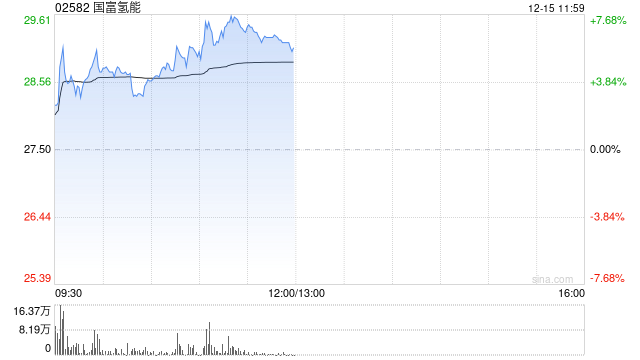
国富氢能午前涨逾6% 公司拟斥最多5000万港元回购
Xin Lang Cai Jing· 2025-12-15 04:03
Core Viewpoint - Guofu Hydrogen Energy (02582) has announced a share buyback plan and is exploring new opportunities in the hydrogen energy sector for data centers, which has positively impacted its stock price. Group 1: Stock Performance - Guofu Hydrogen Energy's stock price increased by over 7% during trading, with a midday rise of 5.82%, closing at HKD 29.10, and a trading volume of HKD 83.28 million [1]. Group 2: Share Buyback Announcement - The board of Guofu Hydrogen Energy has decided to repurchase its H shares in the open market, with a total buyback limit of HKD 50 million, depending on market conditions and the regulations of the buyback authorization [4]. Group 3: Strategic Partnerships - Guofu Hydrogen Energy is collaborating with BTE and Hylium to explore new opportunities in hydrogen power supply for global data centers [4].
国富氢能再涨超7% 公司拟斥最多5000万港元回购 氢能顶层关注度提升
Zhi Tong Cai Jing· 2025-12-15 03:51
Core Viewpoint - Guofu Hydrogen Energy (02582) has seen a significant increase in stock price, rising over 7% and currently trading at 29.26 HKD with a transaction volume of 82.42 million HKD. The company announced a share buyback program with a total cap of 50 million HKD, indicating confidence in its market position and future prospects [1][1][1]. Company Summary - The board of Guofu Hydrogen Energy has decided to repurchase H-shares in the open market, subject to market conditions and regulations, with a total buyback limit set at 50 million HKD [1][1]. - The company is collaborating with BTE and Hylium to explore new opportunities in the global hydrogen-powered data center sector, indicating a strategic expansion into emerging markets [1][1]. Industry Summary - According to Guojin Securities, the focus on hydrogen energy is increasing at the national level, with frequent policy updates and a high-level commitment. The difference between the 14th and 15th Five-Year Plans is characterized by a greater urgency in policy and improved infrastructure [1][1]. - The hydrogen industry is still in its early commercialization phase, primarily driven by policy support. The focus is on domestic and international synergies, with strong demand certainty and flexibility, presenting significant growth opportunities for the entire industry chain [1][1].
港股异动 | 国富氢能(02582)再涨超7% 公司拟斥最多5000万港元回购 氢能顶层关注度提升
智通财经网· 2025-12-15 03:46
Group 1 - The core viewpoint of the article highlights that Guofu Hydrogen Energy (02582) has seen a significant stock price increase, rising over 7% and currently trading at 29.26 HKD with a transaction volume of 82.42 million HKD [1] - Guofu Hydrogen Energy's board has decided to repurchase H-shares in the open market, with a total repurchase cap of 50 million HKD, depending on market conditions and the regulations of the general repurchase authorization [1] - The company is collaborating with BTE and Hylium to explore new opportunities in the global data center hydrogen power supply sector [1] Group 2 - According to Guojin Securities, the attention on hydrogen energy is increasing at the national level, with frequent policy updates and a high-level direction set for 2025 [1] - The key difference in hydrogen energy policies between the 14th and 15th Five-Year Plans is the urgency of the policies and the improved infrastructure readiness, indicating a significant opportunity for development in the industry [1] - The hydrogen and ammonia sector is seen as an essential energy carrier in the second half of the energy revolution, with the overall industry poised for growth driven by policy support and strong demand [1]
中电丰业:年订单超100MW,海外业务占比达60% | 势银调研
势银能链· 2025-12-15 03:32
Core Viewpoint - The article highlights the advancements and strategic initiatives of Beijing SinoHy Energy Co., also known as Zhongdian Fengye, in the green hydrogen sector, emphasizing its international expansion and technological innovations in electrolysis technology [4][6][11]. Group 1: Company Overview - Zhongdian Fengye has over 18 years of industry experience and has delivered more than 300 sets of equipment across 30 countries, showcasing its strong technical capabilities and project experience [7]. - The company is focusing on the development of green hydrogen technologies, including alkaline (ALK), proton exchange membrane (PEM), and anion exchange membrane (AEM) electrolysis, with commercial applications already in place [7][11]. Group 2: International Expansion - In 2025, Zhongdian Fengye will establish a joint venture in Saudi Arabia to support the region's hydrogen development strategy, aligning with Saudi Arabia's Vision 2030 [6][7]. - The company is also making significant progress in Latin America, particularly in Chile, where it plans to build a green hydrogen plant supported by the Chilean Economic Development Agency [8][11]. Group 3: Technological Innovations - Zhongdian Fengye has developed a 500KW AEM electrolysis technology in collaboration with a Spanish partner, which has been recognized as a model case for Sino-European energy cooperation [9]. - The AEM technology is noted for its efficiency and reduced reliance on precious metals, paving the way for large-scale hydrogen production [9]. Group 4: Market Performance - The company has secured over 100MW in orders this year, with 60% of its projects located internationally, indicating strong growth in the global market [11]. - Alkaline electrolysis remains the dominant technology, accounting for 90% of sales, while PEM and AEM technologies are gradually expanding their market share [11]. Group 5: Future Outlook - Zhongdian Fengye aims to enhance its production capacity, with existing facilities in Shandong reaching 2GW and plans for additional production lines in Chile, India, Saudi Arabia, and Portugal, totaling approximately 5GW of capacity [12]. - The company emphasizes continued technological innovation and global collaboration as key drivers for the rapid development of the green hydrogen industry [12].