通信和其他电子设备制造业

Search documents
江西磐盟半导体科技有限公司获“A+轮”融资,金额超亿人民币
Sou Hu Cai Jing· 2025-12-18 02:52
通过天眼查大数据分析,江西磐盟半导体科技有限公司共对外投资了6家企业,知识产权方面有商标信 息12条,专利信息12条,此外企业还拥有行政许可3个。 天眼查信息显示,江西磐盟半导体科技有限公司的股东为:范桂林、景德镇望陶投资合伙企业(有限合 伙)、景德镇千丁半导体合伙企业(有限合伙)、浙江银河国科消费健康股权投资基金合伙企业(有限 合伙)、景德镇晶一半导体合伙企业(有限合伙)。 12月18日,天眼查融资历程显示,江西磐盟半导体科技有限公司近日获得"A+轮"融资,涉及融资金额 超亿人民币,投资机构为熙诚金睿,金桥基金。 资料显示,江西磐盟半导体科技有限公司法定代表人为范桂林,成立于2021年,位于景德镇市,是一家 以从事计算机、通信和其他电子设备制造业为主的企业。企业注册资本2348.146万人民币,并已于2025 年完成了A+轮,交易金额超亿人民币。 来源:市场资讯 ...
世界银行前经济学家姆旺吉·瓦奇拉接受《环球时报》专访:“十五五”蓝图为中外合作提供新机遇
Huan Qiu Shi Bao· 2025-12-17 22:57
Core Insights - The article emphasizes China's economic resilience and strong innovation capabilities, highlighting the significance of the "15th Five-Year Plan" in guiding future economic and social development [1][9]. Group 1: Economic Strategy - The "14th Five-Year Plan" focused on consolidating export-driven growth while stimulating domestic consumption and promoting green development, shifting the growth engine towards domestic consumers [2]. - The "15th Five-Year Plan" emphasizes "self-reliance in technology," aiming to develop key sectors such as energy, food, medicine, semiconductors, and shipping to reduce dependency risks [2][6]. - The plan aims to enhance the resilience and security of China's economic system through a dual circulation strategy, promoting domestic and international interactions [2][6]. Group 2: Innovation and Growth - Research indicates that various industries in China are prioritizing the cultivation of new productive forces, with R&D investment serving as a key indicator of policy and industry priorities [3]. - The top five industries for R&D investment in 2024 include computer, communication, and electronic equipment manufacturing, electrical machinery, automotive manufacturing, specialized equipment manufacturing, and general equipment manufacturing, reflecting a strong emphasis on innovation [3]. - China's innovation capabilities are increasingly recognized as original breakthroughs rather than mere imitation, challenging the Western narrative of China's technological development [4]. Group 3: Global Implications - The "15th Five-Year Plan" is expected to shift the focus from labor-intensive growth to high-quality development, emphasizing innovation, green transformation, and social inclusivity [9][10]. - This transition is anticipated to create new opportunities for collaboration between China and other Global South countries in industrialization, digitalization, and green development [11]. - The article raises questions about whether other Global South countries can replicate China's leap to high-tech and high-value production without going through labor-intensive growth stages [10].
厦门优迅芯片股份有限公司首次公开发行股票科创板上市公告书提示性公告
Shang Hai Zheng Quan Bao· 2025-12-17 18:27
一、上市概况 登录新浪财经APP 搜索【信披】查看更多考评等级 本公司及全体董事、高级管理人员保证信息披露的内容真实、准确、完整、及时,没有虚假记载、误导 性陈述或重大遗漏。 经上海证券交易所审核同意,厦门优迅芯片股份有限公司(以下简称"优迅股份"、"公司"、"本公 司"或"发行人")发行的人民币普通股股票将于2025年12月19日在上海证券交易所科创板上市,上市公 告书全文和首次公开发行股票的招股说明书在上海证券交易所网站(http://www.sse.com.cn)和符合中 国证监会规定条件网站(上海证券报:https://www.cnstock.com;中国证券报:https://www.cs.com.cn/; 证券日报:http://www.zqrb.cn;证券时报:https://www.stcn.com;经济参考网:http://www.jjckb.cn;中 国日报网:https://cn.chinadaily.com.cn;中国金融新闻网:www.financialnews.com.cn)披露,并置备于 发行人、上交所、本次发行保荐人(主承销商)中信证券股份有限公司的住所,供公众查阅。 (五)本 ...
优迅股份(688807) - 优迅股份首次公开发行股票科创板上市公告书提示性公告
2025-12-17 11:17
厦门优迅芯片股份有限公司 首次公开发行股票科创板 上市公告书提示性公告 保荐人(主承销商):中信证券股份有限公司 扫描二维码查阅公告全文 本公司及全体董事、高级管理人员保证信息披露的内容真实、准确、完整、 及时,没有虚假记载、误导性陈述或重大遗漏。 经上海证券交易所审核同意,厦门优迅芯片股份有限公司(以下简称"优迅 股份"、"公司"、"本公司"或"发行人")发行的人民币普通股股票将于 2025 年 12 月 19 日在上海证券交易所科创板上市,上市公告书全文和首次公开发行股 票的招股说明书在上海证券交易所网站(http://www.sse.com.cn)和符合中国证 监会规定条件网站(上海证券报:https://www.cnstock.com;中国证券报: https://www.cs.com.cn/ ; 证 券 日 报 : http://www.zqrb.cn ; 证 券 时 报 : https://www.stcn.com ; 经 济 参 考 网 : http://www.jjckb.cn ; 中 国 日 报 网 : https://cn.chinadaily.com.cn;中国金融新闻网:www.fin ...
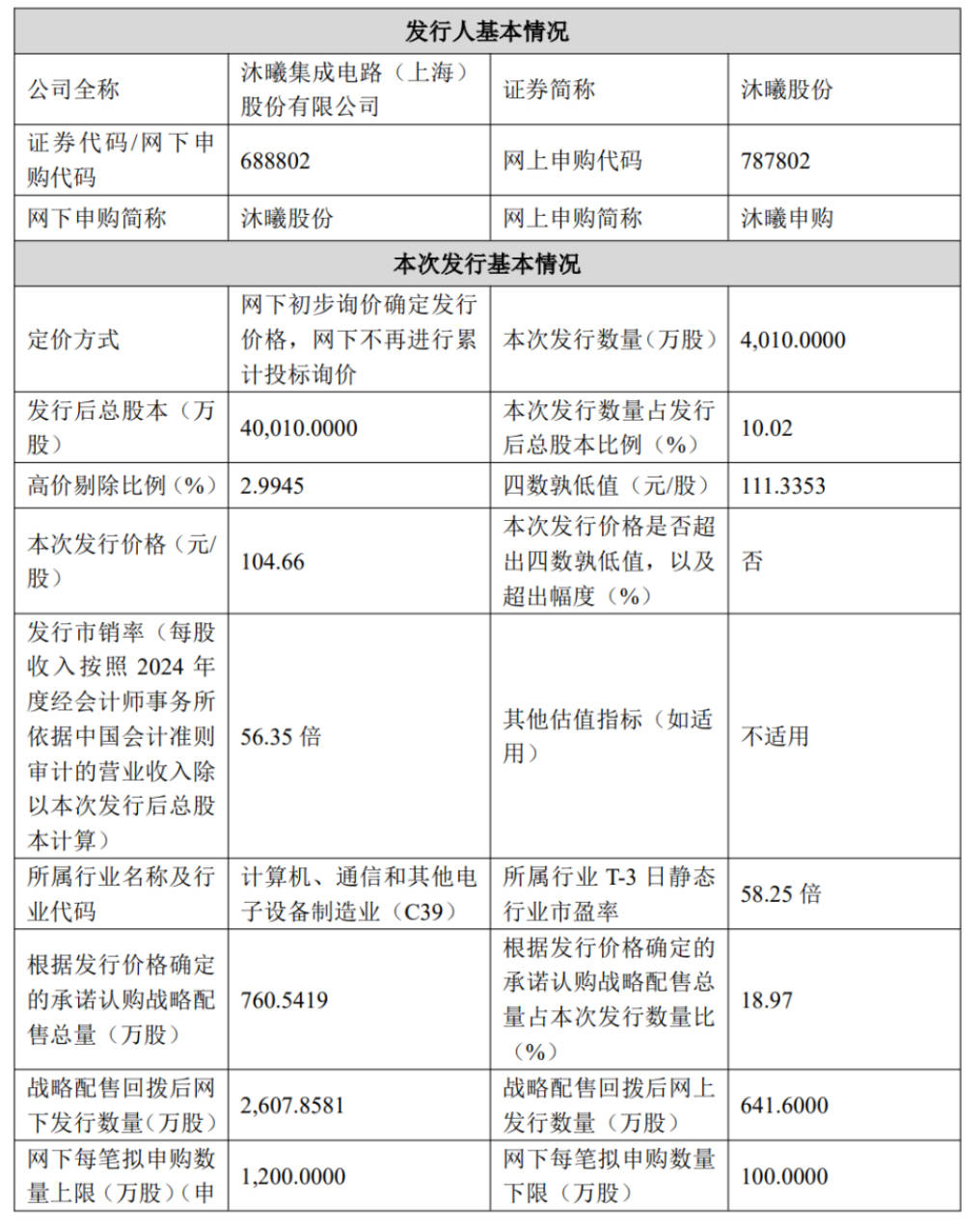
山东上榜10家!CCM发布2025中国上市企业国际化百强榜单
Da Zhong Ri Bao· 2025-12-17 07:02
Group 1 - The "2025 China Private Enterprises Internationalization Top 100 List" was released at a forum in Hangzhou, highlighting the globalization progress of Chinese private enterprises [1] - The list is based on a quantitative indicator system assessing "internationalization scale, organization, innovation, and influence," showing that the manufacturing sector remains the main force in internationalization with 61 companies in the top 100 [1] - The Yangtze River Delta region leads in representation, with active participation from companies in Guangdong, Zhejiang, Beijing, Shandong, Jiangsu, and Shanghai [1] Group 2 - The top 100 internationalized enterprises generated a total of 6.02 trillion yuan in overseas revenue, accounting for 16.2% of total revenue, with an average overseas revenue of 602.1 million yuan per company [4] - The entry threshold for the list was set at 1.859 billion yuan, indicating a significant increase in both the scale and quality of internationalization among Chinese enterprises [4] - Shandong province had 10 companies on the list, showcasing its international competitiveness in sectors like non-ferrous metal processing and high-end chemical new materials [4][6] Group 3 - Notable companies from Shandong include GoerTek (4th), Sailun Group (14th), and Zhongji Xuchuang (20th), reflecting the region's diverse industrial strengths [4] - Haier Smart Home ranked among the top companies with overseas revenue of 142.9 billion yuan and 6,406 patents, indicating its strong innovation capabilities [4] - The province's economic structure is characterized by both state-owned enterprises and private enterprises, with the latter driving innovation in precision manufacturing and smart hardware [6][7]




祝贺!“国产GPU第二股”今日上市!
Sou Hu Cai Jing· 2025-12-17 04:34
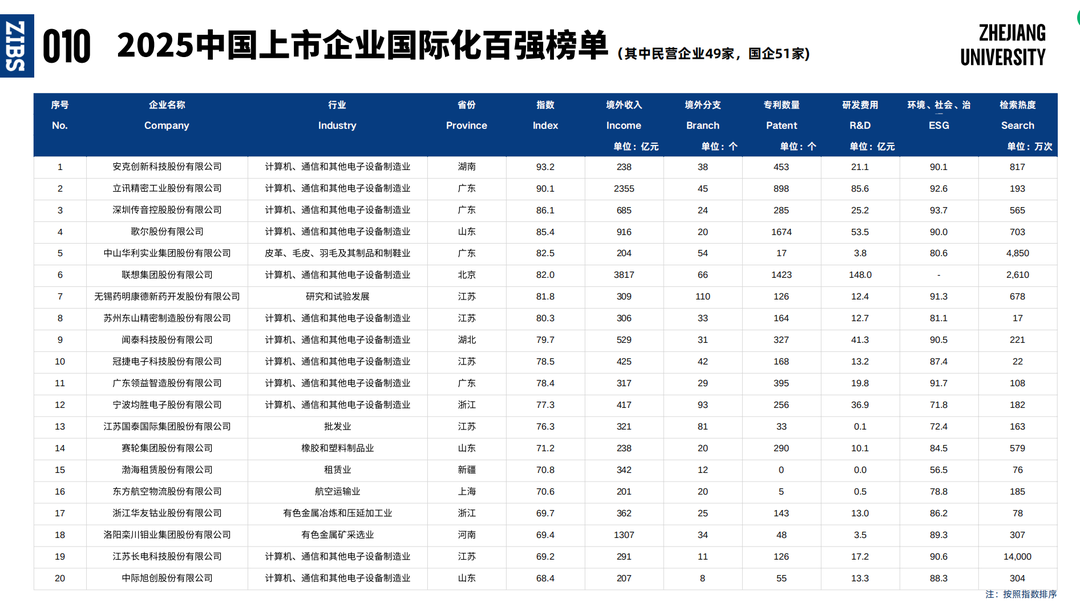
Group 1 - The core message is the successful listing of Muxi Co., Ltd., referred to as the "second domestic GPU stock," on the Sci-Tech Innovation Board, following the previous success of Moore Threads [1][3] - Muxi Co., Ltd. is a leading enterprise in the domestic high-performance general-purpose GPU sector, established in September 2020, focusing on the independent research and development of high-performance GPU chips and computing platforms [5] - The company's products are primarily applied in three core areas: artificial intelligence (AI) training and inference, general computing, and graphics rendering [5] Group 2 - Muxi Co., Ltd. reported projected revenues of CNY 0.53 billion in 2023 and CNY 7.43 billion in 2024, with a forecasted revenue of CNY 15.00 billion to CNY 19.80 billion in 2025, representing a year-on-year growth of 101.86% to 166.46% [5] - The company has been focusing on technological innovation and iterative upgrades of GPU products, establishing a unique GPU product system and an open-source software ecosystem [5] - Muxi Co., Ltd. has formed significant partnerships in the AI field, including a collaboration with Wuxi-based Langxin Technology Group to launch the Langxin Jiugong AI Energy Integrated Machine, which utilizes Muxi's high-efficiency computing power [7]
“国产GPU第二股”今日上市
Xin Lang Cai Jing· 2025-12-17 01:40
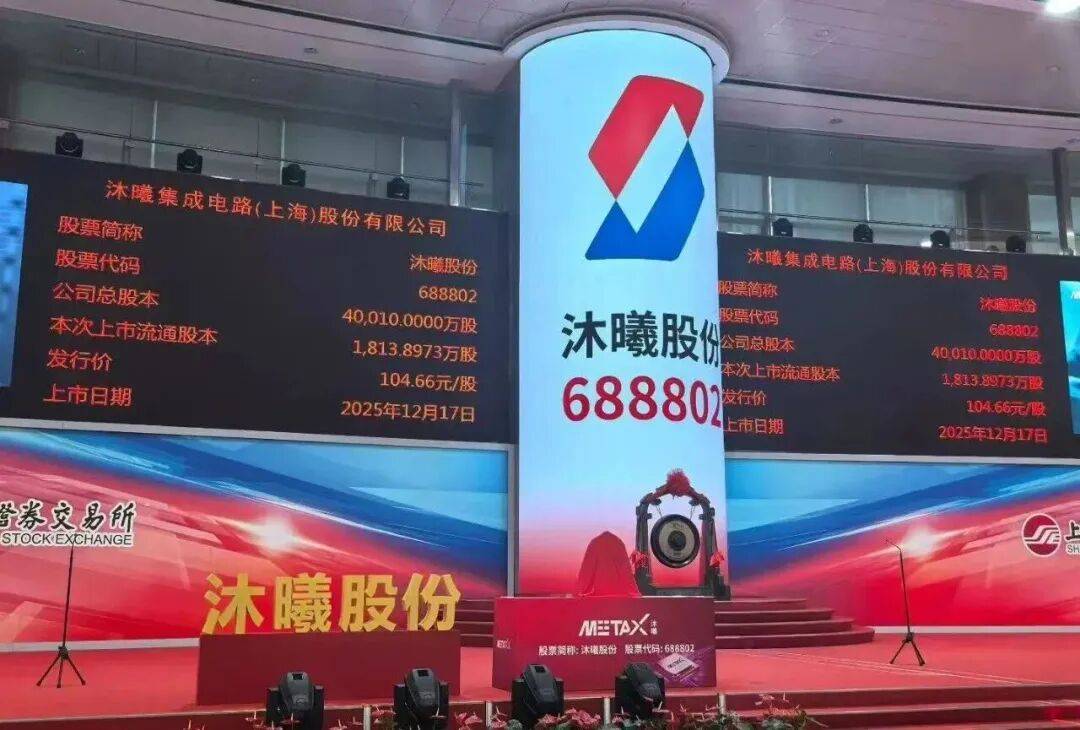
Group 1 - The core viewpoint of the article is the listing of Muxi Co., Ltd. on the Sci-Tech Innovation Board, marking its entry into the high-performance GPU market [1][2]. - Muxi Co., Ltd. was established in September 2020 and focuses on the independent research and development of high-performance GPU chips and computing platforms, with applications in AI training, inference, general computing, and graphics rendering [2]. - The company reported revenues of 0.4264 million yuan in 2022, projected to grow to 7.43 billion yuan by 2024, with a forecasted revenue of 1.5 billion to 1.98 billion yuan for 2025, indicating a year-on-year growth of 101.86% to 166.46% [2]. Group 2 - The company is listed under the computer, communication, and other electronic equipment manufacturing industry, with an issue price of 104.66 yuan and a public offering median price of 111.48 yuan [3]. - The main underwriter for the IPO is Huatai United Securities, with a subscription limit of 6,000 shares and a total market value of 41.874 billion yuan [3]. - Comparable companies in the industry include Cambrian, with a market value of 251.08 billion yuan, Haiguang Information at 175.75 billion yuan, and Jingjiawei at -411.99 billion yuan [3].
“国产GPU第二股”今日上市
财联社· 2025-12-17 01:07
Core Viewpoint - The article discusses the IPO of Muxi Technology, a leading company in the high-performance general GPU sector in China, highlighting its financial projections and market positioning [2][3]. Group 1: Company Overview - Muxi Technology was established in September 2020 and focuses on the independent research and development of high-performance GPU chips and computing platforms [2]. - The company's products are primarily used in three core areas: artificial intelligence (AI) training and inference, general computing, and graphics rendering [2]. Group 2: Financial Performance - Muxi Technology's projected revenues for 2022, 2023, and 2024 are 0.4264 billion, 0.53 billion, and 0.743 billion respectively, with net profits expected to be -0.777 billion, -0.871 billion, and -1.409 billion [2]. - For 2025, the company anticipates revenues between 1.5 billion and 1.98 billion, representing a year-on-year growth of 101.86% to 166.46%, with net profits projected to be between -0.763 billion and -0.527 billion [2]. Group 3: IPO Details - Muxi Technology's IPO price is set at 104.66 yuan, with a total market value of 41.874 billion yuan [3]. - The company is categorized under the computer, communication, and other electronic equipment manufacturing industry, with a comparable company being Cambrian, which has a market value of 25.108 billion [3]. - The underwriter for the IPO is Huatai United Securities, with a subscription limit of 6,000 shares [3].

国内GPU巨头沐曦股份今日上市,会重演摩尔线程的炒作行情吗?
Sou Hu Cai Jing· 2025-12-17 00:11
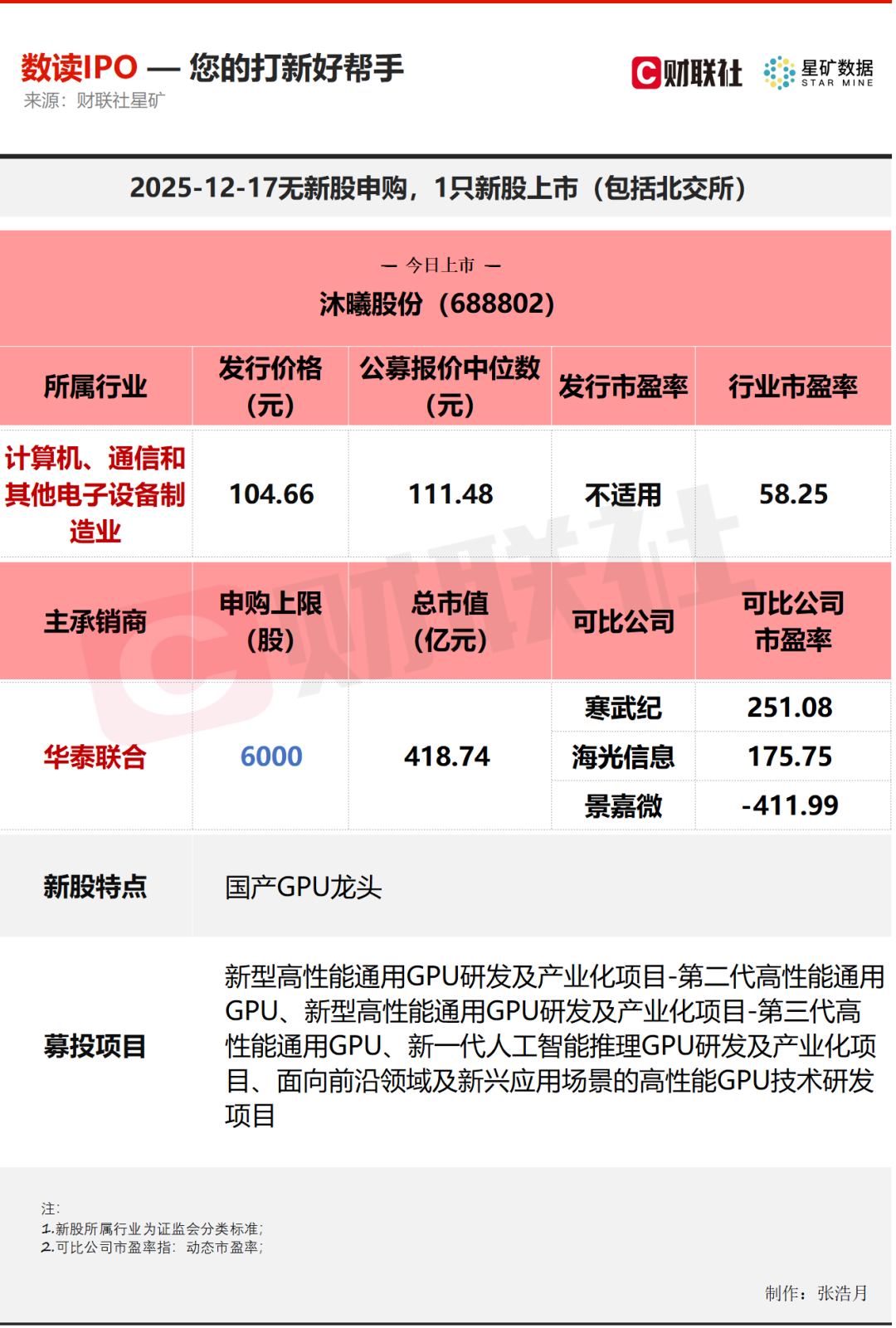
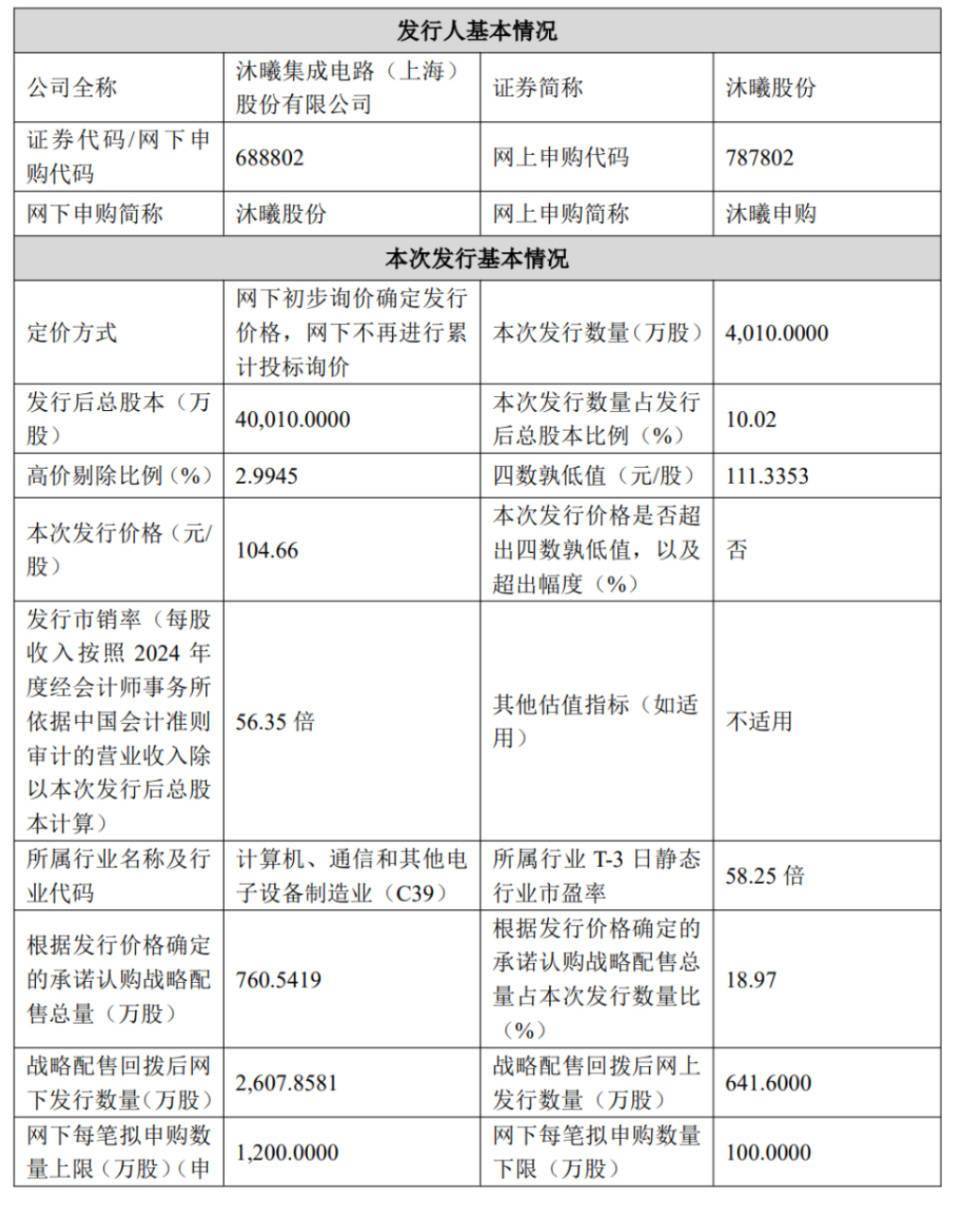
摩尔线程在12月5日正式登陆科创板市场,上市首日股价大涨了425%,随后继续冲高至每股941.08元。在短短一周时间内,摩尔线程从 114.28元的发行价格大幅飙升至941.08元的历史新高,累计涨幅巨大。 继摩尔线程之后,又一家国产GPU巨头 沐曦股份正式上市,此时距离摩尔线程上市只有12天时间,沐曦股份的上市会重演摩尔线程的炒 作行情吗? 其中,最重要的是市场环境变化。在高度活跃的市场氛围下,新股更容易获得市场资金的炒作,在牛市行情下,新股获得的估值溢价往 往远高于熊市或震荡市场。 | 发行人基本情况 | | | | | --- | --- | --- | --- | | 公司全称 | 沐曦集成电路(上海) | 证券简称 | 沐曦股份 | | 股份有限公司 | | | | | 证券代码/网下申 | 688802 | 网上申购代码 | 787802 | | 购代码 | | | | | 网下申购简称 | 沐曦股份 | 网上申购简称 | 沐曦申购 | | 本次发行基本情况 | | | | | 定价方式 | 网下初步询价确定发行 价格,网下不再进行累 | 本次发行数量(万股) | 4.010.0000 | | 计 ...
国内GPU巨头沐曦股份正式上市,会重演摩尔线程的炒作行情吗?
Sou Hu Cai Jing· 2025-12-16 23:25
| 发行人基本情况 | | | | | --- | --- | --- | --- | | 公司全称 | 沐曦集成电路(上海) | 证券简称 | 沐曦股份 | | 股份有限公司 | | | | | 证券代码/网下申 | 688802 | 网上申购代码 | 787802 | | 购代码 | | | | | 网下申购简称 | 沐曦股份 | 网上申购简称 | 沐曦申购 | | 本次发行基本情况 | | | | | 定价方式 | 网下初步询价确定发行 价格,网下不再进行累 | 本次发行数量(万股) | 4,010.0000 | | 计投标询价 | | | | | 发行后总股本(万 | 40,010.0000 | 本次发行数量占发行 | 10.02 | | 股) | | 后总股本比例(%) | | | 高价剔除比例(%) | 2.9945 | 四数孰低值(元/股) | 111.3353 | | 本次发行价格(元/ | 104.66 | 本次发行价格是否超 出四数孰低值,以及 | 合 | | 股) | | | | | 发行市销率(每股 | | 超出幅度(%) | | | 收入按照 2024 年 | | | | | 度经会 ...