
采矿业

Search documents
2025年1-8月采矿业企业有12732个,同比增长1.32%
Chan Ye Xin Xi Wang· 2025-10-17 03:13
上市公司:甘肃能化(000552),新大洲A(000571),冀中能源(000937),蓝焰控股(000968), 山西焦煤(000983),电投能源(002128),首华燃气(300483),郑州煤电(600121),兰花科创 (600123),兖矿能源(600188),晋控煤业(601001),中国神华(601088),昊华能源 (601101),陕西煤业(601225) 2019-2025年1-8月采矿业企业数统计图 数据来源:国家统计局,智研咨询整理 相关报告:智研咨询发布的《2025-2031年中国采矿业市场竞争态势及投资方向分析报告》 2025年1-8月,采矿业企业数(以下数据涉及的企业,均为规模以上工业企业,从2011年起,规模以上 工业企业起点标准由原来的年主营业务收入500万元提高到年主营业务收入2000万元)为12732个,和上 年同期相比,增加了166个,同比增长1.32%,占工业总企业的比重为2.44%。 知前沿,问智研。智研咨询是中国一流产业咨询机构,十数年持续深耕产业研究领域,提供深度产业研 究报告、商业计划书、可行性研究报告及定制服务等一站式产业咨询服务。专业的角度、品质化的服 ...


智汇矿业港股IPO招股书失效
Zhi Tong Cai Jing· 2025-10-16 23:44
Core Insights - Zhihui Mining Co., Ltd. submitted its Hong Kong IPO prospectus on April 17, which became invalid after six months on October 17, with Guotai Junan Securities (Hong Kong) and Maishi Capital as joint sponsors [1] Company Overview - Zhihui Mining is a mining company focused on the exploration, mining, production, and sales of zinc, lead, and copper in Tibet, China [2] - The company ranks second, third, and fifth in average annual production of zinc, lead, and copper concentrates in Tibet from 2022 to 2024, respectively [2] - Mining operations are located in the Rongduo Township of Jiali County, Naqu City, Tibet [2] Mining Projects - The company's Mengya Mine includes an open-pit mine that has been in commercial operation since 2007 and an underground mining project expected to commence commercial operations in the second half of 2025 [2] - The mining operations are situated within a nationally designated exploration area, with elevations ranging from 5,000.0 meters to 5,300.0 meters, where rich mineral resources have been discovered [2] - Zhihui Mining holds exploration rights over an area of approximately 58.5 square kilometers and mining rights over an area of approximately 4.5 square kilometers [2]

新股消息 | 智汇矿业港股IPO招股书失效
智通财经网· 2025-10-16 23:44
Core Viewpoint - Zhihui Mining is a mining company focused on the exploration, mining, and production of zinc, lead, and copper in Tibet, China, with its Hong Kong IPO application expiring after six months [1][2]. Company Overview - Zhihui Mining specializes in the exploration, mining, and sales of zinc, lead, and copper in Tibet, ranking second, third, and fifth in average annual production of zinc, lead, and copper concentrates respectively from 2022 to 2024 [2]. - The company's mining operations are located in the Nagqu region of Tibet, specifically in the Rongduo Township of Jiali County [2]. - The company operates the Mengya Mine, which includes an open-pit mine that has been in commercial operation since 2007 and an underground mining project expected to commence commercial operations in the second half of 2025 [2]. Mining Rights and Resources - Zhihui Mining holds exploration rights covering approximately 58.5 square kilometers and mining rights covering about 4.5 square kilometers in a designated mineral exploration area [2]. - The mining operations are situated at altitudes between 5,000.0 meters and 5,300.0 meters, where rich mineral resources have been discovered [2].

重要成果!发现大型金矿!
新浪财经· 2025-10-16 23:39
Core Insights - A new gold mineralization belt has been discovered in Gansu's Yumen City, measuring approximately 14 kilometers in length and 10 to 100 meters in width, with an additional gold resource of over 40 tons, equivalent to two large gold mines [2] - The discovery of the Qianhongquan gold mine is significant for guiding the search for gold mines related to ductile shear zones in Gansu's North Mountain South Belt, particularly in terms of exploration methods and strategies [4] - China's total gold resource amount reached 3203.77 tons as of 2023, with recent discoveries adding significant new resources [5] Industry Trends - International gold prices have reached record highs, with London spot gold closing at $4206.58 per ounce and New York futures at $4224.9 per ounce as of October 15 [5] - Investment demand for gold is increasing, leading to a structural supply shortage, prompting Bank of America to raise its 2026 gold price target to $5000 per ounce and silver to $65 per ounce [5] - Despite the bullish long-term outlook for gold, analysts caution investors about potential short-term technical corrections and emphasize the importance of risk management [5]

苏丹1-9月黄金产量达53吨
Shang Wu Bu Wang Zhan· 2025-10-16 15:54
(原标题:苏丹1-9月黄金产量达53吨) 10月13日,苏丹现场网报道,苏丹矿产资源公司近期发布的报告显示,2025年1月至9月,苏丹黄金产量 大幅增长,达到53吨,出口总额超过9.09亿美元。而2024年全年约64吨。 ...
宝鼎科技:关于全资子公司扩建项目通过安全设施竣工验收并换发安全生产许可证的公告
Zheng Quan Ri Bao Zhi Sheng· 2025-10-16 12:40
(编辑 楚丽君) 证券日报网讯 10月16日晚间,宝鼎科技发布公告称,近日,公司全资子公司招远市河西金矿有限公 司"河西矿区资源整合开发工程(一期)项目"完成竣工验收,并收到山东省应急管理厅核发的年产30万 吨的《安全生产许可证》。 ...

广东明珠股价跌5.15%,华夏基金旗下1只基金位居十大流通股东,持有459.69万股浮亏损失170.08万元
Xin Lang Cai Jing· 2025-10-16 05:38
Core Points - Guangdong Mingzhu's stock price dropped by 5.15%, reaching 6.82 CNY per share, with a trading volume of 202 million CNY and a turnover rate of 4.21%, resulting in a total market capitalization of 4.736 billion CNY [1] Group 1: Company Overview - Guangdong Mingzhu Group Co., Ltd. is located at No. 99, Guanshan Road, Xingning City, Guangdong Province, established on April 21, 1994, and listed on January 18, 2001 [1] - The company's main business involves iron ore mining and the production and sale of iron concentrate [1] Group 2: Shareholder Information - Among the top ten circulating shareholders of Guangdong Mingzhu, one fund under Huaxia Fund ranks as a significant shareholder. The Huaxia CSI 500 Index Enhanced A (007994) entered the top ten circulating shareholders in the second quarter, holding 4.5969 million shares, which accounts for 0.66% of the circulating shares [2] - The estimated floating loss for the fund today is approximately 1.7008 million CNY [2] - The Huaxia CSI 500 Index Enhanced A fund was established on March 25, 2020, with a latest scale of 3.135 billion CNY, achieving a year-to-date return of 25.79% and a one-year return of 32.56% [2] - The fund manager, Sun Meng, has a cumulative tenure of 5 years and 215 days, with the fund's total asset scale at 10.461 billion CNY, achieving the best return of 129.7% and the worst return of 20.19% during his tenure [2]

苏丹矿业部开会研究保障采矿业安全和打击走私
Shang Wu Bu Wang Zhan· 2025-10-16 04:58
10月11日,苏丹通讯社报道,矿业部长努尔达伊姆主持召开协调会议,讨论保障采矿业安全和打击走私 的计划。财政部长吉布里勒、通信和数字化转型部长甘杜尔、中央银行行长巴莱、红海州州长穆斯塔法 以及代表内政部长的海关总监萨拉赫等出席。 ...
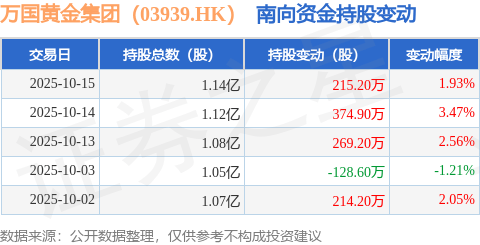
万国黄金集团(03939.HK):10月15日南向资金增持215.2万股
Sou Hu Cai Jing· 2025-10-15 19:29
Core Insights - Southbound funds increased their holdings in WanGuo Gold Group (03939.HK) by 2.152 million shares on October 15, 2025, marking a 1.93% increase [1] - Over the past five trading days, there have been four days of net increases in holdings, totaling 9.449 million shares [1] - In the last 20 trading days, there were 15 days of net increases, amounting to 24.197 million shares [1] - As of now, southbound funds hold 114 million shares of WanGuo Gold Group, representing 10.29% of the company's total issued ordinary shares [1] Summary by Category Trading Activity - On October 15, 2025, total shares held reached 114 million, with a change of 2.152 million shares [2] - On October 14, 2025, total shares held were 112 million, with a change of 3.749 million shares [2] - On October 13, 2025, total shares held were 108 million, with a change of 2.692 million shares [2] - On October 3, 2025, total shares held were 105 million, with a decrease of 1.286 million shares [2] - On October 2, 2025, total shares held were 107 million, with a change of 2.142 million shares [2] Company Overview - WanGuo Gold Group, formerly known as WanGuo International Mining Group, is primarily engaged in mining, ore processing, and the sale of refined mineral and gold products [2] - The company operates through two segments: the Yifeng project segment, which processes and sells metal concentrates, and the Solomon project segment, which processes and sells gold concentrates and gold bars [2] - The company's product offerings include copper concentrates, iron concentrates, zinc concentrates, sulfur concentrates, lead concentrates, gold bars, gold concentrates, and by-products of gold and silver [2]
一年里会计师事务所换了又换!*ST新潮新聘的中审众环,能否收拾“烂摊子”?
Mei Ri Jing Ji Xin Wen· 2025-10-15 15:18
Core Viewpoint - The company *ST Xinchao (New Tide Energy) is undergoing significant changes in its auditing arrangements, having recently appointed Zhongshun Zhonghuan as its new auditor after a tumultuous relationship with previous firms, which has implications for its financial reporting and compliance status [1][2][8]. Group 1: Auditing Changes - *ST Xinchao has appointed Zhongshun Zhonghuan as its auditing firm for the 2025 fiscal year, marking the second change in auditors within the year [1]. - The company previously terminated its relationship with Lixin Accounting Firm after it issued an "unable to express opinion" audit report for the 2024 financial statements [3][4]. - Prior to Lixin, *ST Xinchao had engaged Zhongrui Cheng Accounting Firm, which resigned due to the complexity of the audit work exceeding initial expectations [1][3]. Group 2: Legal Disputes - The conflict with Lixin escalated to legal action, with *ST Xinchao suing for the return of 3.5 million yuan in audit fees, claiming negligence in the audit process [5][6]. - The lawsuit includes demands for Lixin to retract its audit reports and issue new ones, alongside compensation for legal fees [5]. Group 3: Financial and Operational Context - The company is facing significant challenges, including a risk of delisting, as indicated by its recent "ST" designation due to the audit issues [4][9]. - The recent resolution of three lawsuits in the U.S. related to its oil and gas assets may alleviate some operational pressures, but internal governance and achieving a standard audit opinion remain critical for the company's future [9]. Group 4: New Auditor's Profile - Zhongshun Zhonghuan, established in 1987, has a strong background in auditing, with 21.72 billion yuan in total revenue for 2024, including 5.84 billion yuan from securities-related services [8]. - The firm has experience in the mining sector, which is relevant to *ST Xinchao's operations, having audited six other companies in the same industry [8]. - However, Zhongshun Zhonghuan has faced administrative penalties in the past three years, raising concerns about its reliability [8].
