
软件和信息技术服务业

Search documents
威士顿(301315.SZ):公司主营业务不涉及自动驾驶方向
Ge Long Hui· 2026-01-14 13:26
Core Viewpoint - The company has participated in the construction of the world's first automated container yard logistics warehouse, providing a multi-technology integrated positioning and navigation system based on the Apollo platform for the heavy-duty AGV in the port industry [1] Group 1: Company Developments - The company has leveraged its technological accumulation in the AI field to advance the digital transformation and domestic substitution of heavy-duty AGVs and ASCs [1] - The company has achieved significant progress from a "zero start" to enabling cross-transport vehicles to complete various movement paths, including straight movement, right-angle turns, and crab walking [1] Group 2: Business Focus - Currently, the company's main business does not involve autonomous driving [1]
久远银海:关于控股子公司通过高新技术企业重新认定的公告
Zheng Quan Ri Bao· 2026-01-14 12:36
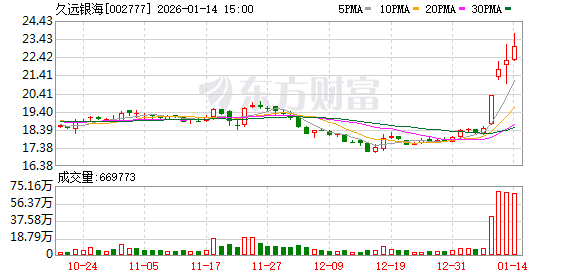
Group 1 - The company Jiuyuan Yinhai announced that its subsidiaries Sichuan Xingzheng Information Technology Co., Ltd. and Hangzhou Hailiang Information Technology Co., Ltd. have been recognized as high-tech enterprises [2] - The recognition of Sichuan Xingzheng and Hangzhou Hailiang is a re-certification following the expiration of their previous certificates [2]


金桥信息:股票交易异常波动
2 1 Shi Ji Jing Ji Bao Dao· 2026-01-14 10:13
Core Viewpoint - The stock of Jinqiao Information has experienced a significant price increase, with a cumulative rise of 41.30% from January 5 to January 14, 2026, leading to a trading suspension due to abnormal fluctuations [1] Company Performance - The company confirmed that there are no undisclosed significant information affecting its operations as of the announcement date [1] - The production and operational conditions of the company remain normal, with no major changes in the internal and external business environment [1] AI Business Segment - The company has noted increased market attention on "AI applications," but its AI-related judicial business is not a core segment, contributing a low percentage to overall revenue [1] - The AI-related business does not have a significant impact on the company's overall operating performance [1] Stock Trading Activity - The stock has shown a high turnover rate of 25.78% on January 14, indicating potential volatility and risk of price decline in the near future [1] - The company reported a net profit attributable to shareholders of -59.63 million yuan for the first three quarters of 2025, indicating significant pressure on annual performance [1]

浩瀚深度:股价异常波动,2025年前三季度营收降21.51%
Ge Long Hui A P P· 2026-01-14 09:57
Core Viewpoint - The company announced that its stock experienced an abnormal fluctuation, with a cumulative price increase exceeding 30% over three consecutive trading days from January 12 to 14, 2026, and confirmed no undisclosed significant matters as of the announcement date [1] Financial Performance - For the first three quarters of 2025, the company's revenue was 248.62 million, representing a year-on-year decline of 21.51% [1] - The net profit for the same period was -9.18 million, reflecting a year-on-year decrease of 124.88% [1] Business Development - The company's AI application business in the financial sector has not yet generated revenue [1] - The acquisition of Yunbian Cloud Technology is in the process of being finalized, with related business still in its early stages, leading to uncertain impacts on performance [1]


浩瀚深度:股价异常波动,25年前三季度营收降21.51%
Xin Lang Cai Jing· 2026-01-14 09:57
Core Viewpoint - The company announced that its stock price experienced an abnormal fluctuation, with a cumulative increase of over 30% during three consecutive trading days from January 12 to 14, 2026, and confirmed no undisclosed significant matters as of the announcement date [1] Financial Performance - For the first three quarters of 2025, the company's revenue was 248.6174 million, representing a year-on-year decline of 21.51% [1] - The net profit for the same period was -9.1819 million, indicating a year-on-year decrease of 124.88% [1] Business Development - The AI application business in the financial sector has not generated any revenue yet [1] - The acquisition of Yunbian Cloud Technology is in the process of being finalized, with related business still in its early stages, leading to uncertain impacts on performance [1]
机构席位买入719.96万 北交所上市公司联迪信息登龙虎榜
Sou Hu Cai Jing· 2026-01-14 09:38
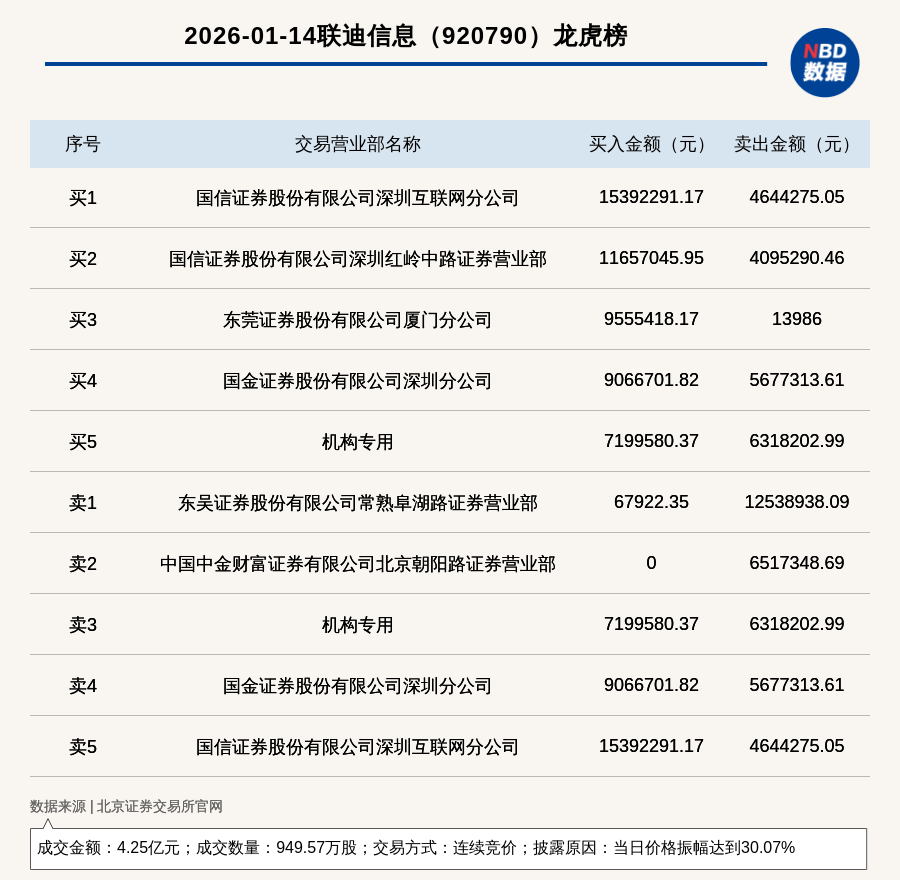
Group 1 - The core point of the article is that LianDi Information (stock code: 920790) experienced significant trading activity on January 14, 2026, with a price fluctuation of 30.07% and a trading volume of 9.4957 million shares, amounting to a total transaction value of 425 million yuan [1][2][3] Group 2 - The top buying seat was from Guosen Securities Co., Ltd. Shenzhen Internet Branch, which purchased shares worth approximately 15.39 million yuan [1][2] - The top selling seat was from Dongwu Securities Co., Ltd. Changshu Fuhulu Road Securities Business Department, which sold shares worth approximately 12.54 million yuan [1][2] - Other notable buying and selling activities included multiple branches of Guosen Securities and institutional investors, indicating a diverse trading interest in LianDi Information [2]
高伟达(300465.SZ)拟推2026年股票期权激励计划
智通财经网· 2026-01-14 09:09
Group 1 - The core point of the article is that Gaweida (300465.SZ) has announced a stock option incentive plan for 2026, proposing to grant up to 4.98 million stock options, which represents approximately 1.12% of the company's total share capital at the time of the announcement [1] - The plan includes an initial grant of 4.78 million stock options, with an additional 200,000 options reserved [1] - The exercise price for the stock options is set at 21.68 yuan per share [1]

佳讯飞鸿:子公司中标东莞空港中心项目
Zheng Quan Shi Bao Wang· 2026-01-14 08:48
Group 1 - The core point of the article is that the company, Jiexin Feihong, through its wholly-owned subsidiary Shenzhen Hangtong Intelligent Technology Co., Ltd., has won a bid for the Dongguan Airport Center project at Hong Kong International Airport [1] - The project encompasses the entire scope of Phase I of the airport center, which includes the terminal, air cargo station, freight forwarding warehouse, comprehensive building, and customs office [1] - The aim of the project is to design and construct a multi-dimensional intelligent system that integrates customs supervision, park operations, and logistics scheduling [1]

中科通达股价跌5.09%,汇泉基金旗下1只基金重仓,持有4000股浮亏损失4640元
Xin Lang Cai Jing· 2026-01-14 05:28
Group 1 - Zhongke Tongda experienced a decline of 5.09% on January 14, with a stock price of 21.63 yuan per share, a trading volume of 194 million yuan, a turnover rate of 7.54%, and a total market capitalization of 2.517 billion yuan [1] - The company, Wuhan Zhongke Tongda High-tech Co., Ltd., was established on June 8, 2007, and went public on July 13, 2021. Its main business involves providing professional information technology services for urban public safety management [1] - The revenue composition of Zhongke Tongda includes: 68.19% from information system development and construction, 17.21% from information system operation and maintenance, 8.87% from software development and sales, 5.67% from product sales and others, and 0.06% from other supplementary services [1] Group 2 - Huiquan Fund holds a significant position in Zhongke Tongda, with its Huiquan Qiyuan Future Mixed Initiation A Fund (014827) owning 4,000 shares, representing 0.56% of the fund's net value, making it the sixth-largest holding [2] - The Huiquan Qiyuan Future Mixed Initiation A Fund was established on September 5, 2023, with a latest scale of 12.9989 million yuan. It has achieved a year-to-date return of 5.51%, ranking 2474 out of 8838 in its category, and a one-year return of 54.48%, ranking 1928 out of 8089 [2] - The fund manager, Shen Xin, has been in the position for 1 year and 302 days, with the fund's total asset size at 976 million yuan. The best return during Shen's tenure is 57.11%, while the worst return is -1.14% [3]

天亿马:公司数字孪生技术主要围绕实景三维、BIM、CIM等多源数据融合的数字孪生场景展开
Mei Ri Jing Ji Xin Wen· 2026-01-14 05:13
Core Viewpoint - Siemens and NVIDIA's collaboration on digital twin factories can enhance production efficiency by 40%, indicating a significant advancement towards achieving ultimate "physical AI" [1] Company Summary - Tianyi Ma (301178.SZ) has stated that its digital twin technology focuses on integrating multi-source data such as real scene 3D, BIM, and CIM [1] - The company is actively exploring the application of its digital twin technology in complex scenarios, keeping pace with industry developments [1]