显示面板

Search documents
京东方:TV价格有些压力 将根据需求情况考虑做适当岁修计划
Xin Lang Cai Jing· 2025-09-11 11:53
Core Viewpoint - BOE Technology Group indicated that since June, there has been pressure on LCD prices, particularly for TVs, which may lead to adjustments in production plans [1] Group 1: Market Conditions - LCD prices, especially for TVs, have faced some pressure since June [1] - Some competitors have announced production adjustments, indicating a broader trend in the industry [1] Group 2: Company Strategy - BOE will consider implementing appropriate production adjustments based on its own demand situation [1] - The adjustments aim to complete internal factory restructuring while ensuring relative market stability [1]

维信诺:已经与较多上游供应商建立了友好的合作关系
Zheng Quan Ri Bao Zhi Sheng· 2025-09-11 11:44
Group 1 - The company has established good cooperative relationships with multiple upstream suppliers, accumulating high-quality supplier resources [1] - The company maintains and seeks long-term deep collaboration with suppliers, supporting and encouraging the coordinated development of local suppliers [1] - The company is promoting the localization process of the industry chain [1]

京东方A(000725) - 023-2025年9月11日投资者关系活动记录表
2025-09-11 10:57
Business Performance - The company achieved a steady growth in overall performance, with LCD business maintaining the highest global shipment volume in five mainstream application products [1][2] - LCD revenue share increased from 73% in 2024 to 76% in 2025, with IT products being the highest category [2] - OLED shipments exceeded 71 million units in the first half of 2025, marking a 7.5% year-on-year growth [2][31] Financial Highlights - The company reported a significant increase in net profit, with the Hefei G8.5 line and Chongqing G8.5 line net profits growing by 82% and 33% respectively [4] - Operating cash flow remained strong, estimated at approximately 50 to 60 billion RMB annually [12] - The company plans to maintain a cash dividend of no less than 35% of the net profit attributable to the parent company [41][43] Strategic Developments - The company is transitioning from large-scale capacity construction to high-quality operational development, focusing on technology value and efficiency improvement [4] - The "Screen IoT" strategy is being implemented to integrate display technology with IoT innovations, leading to significant revenue growth in related sectors [2] - The company is advancing its glass-based packaging substrate technology, with ongoing collaborations and product testing [23] Market Challenges - The company faces significant challenges in the OLED market due to increased international competition and changes in domestic market demand structures [31][39] - The overall industry growth rate is low, with the OLED market growing only 4% compared to the company's 7.5% growth [31] Future Outlook - The company aims to achieve an OLED shipment target of 170 million units for the year, although this goal is under pressure from market conditions [10][31] - The LCD market is expected to stabilize and potentially transition to a mild upward cycle by 2027, with a projected balance in supply and demand [21][22] R&D and Innovation - The company continues to invest heavily in R&D, with a focus on OLED and other advanced display technologies [4][8] - The development of the 8.6 generation OLED line is on track, with production expected to start in late 2025 [18][20]
9.11犀牛财经晚报:部分淘宝商家暂停黄金回购 星巴克员工曝月饼卖不掉垫钱自购
Xi Niu Cai Jing· 2025-09-11 10:16
Group 1: Natural Resources and Land Use - The Ministry of Natural Resources encourages market-oriented methods to revitalize idle land and improve efficient land use [1] Group 2: Automotive Industry - In the first eight months of this year, China's automobile production and sales both exceeded 20 million units for the first time, with production at 21.05 million and sales at 21.12 million, reflecting year-on-year growth of 12.7% and 12.6% respectively [2] - New energy vehicle production and sales reached 9.63 million units, accounting for 45.5% of total new car sales, with year-on-year growth of 37.3% and 36.7% [2] - Exports of automobiles reached 4.29 million units, a year-on-year increase of 13.7%, with new energy vehicle exports at 1.53 million units, up 87.3% [2] Group 3: Silicon Industry - TrendForce reports that despite high inventory levels of approximately 400,000 tons, expectations of production cuts in October due to dry weather in Sichuan and Yunnan are driving up multi-crystalline silicon prices [3] - The market focus has shifted from current inventory levels to future supply shortages, with downstream manufacturers actively purchasing [3] Group 4: Display Panel Market - The market for power management chips for large-sized display panels in mainland China is projected to grow to approximately 2.72 billion yuan by 2025, with a demand for about 1.13 billion units [4] Group 5: Healthcare and Technology - Researchers have developed a "nano-marking robot" for cancer immunotherapy, which shows promising results in tumor models and may lead to more effective next-generation therapies [5] - Alipay launched the first "AI payment" service in China, allowing users to place orders and make payments through an AI assistant [6] Group 6: Corporate Developments - Huang Junhong has resigned as the executive director of Huya, with Li Ping taking over [7] - Wanda Group has been executed for over 400 million yuan by the Beijing Financial Court [8] - CITIC Securities has received approval to publicly issue bonds totaling up to 60 billion yuan [9] - Chengdi Xiangjiang received a warning from the Shanghai Securities Regulatory Commission for inaccurate financial disclosures [10] - Western Gold's subsidiary will undergo maintenance, affecting production timelines [11] - Anhui Construction has won multiple major project bids totaling over 18.85 billion yuan [12][13] - Qinglong Pipe Industry has secured a project worth 87.34 million yuan [14] - Wuzhou Special Paper plans to increase capital by 780 million yuan for its subsidiary [15] - Changjiang Materials is set to invest up to 130 million yuan in oil and gas exploration [16] - Huakang Clean has won a hospital procurement project worth 50.07 million yuan [17] - Jilin Expressway's subsidiary has won a highway construction project worth 9.592 billion yuan [18] Group 7: Market Performance - The market saw a strong rebound with the ChiNext Index rising over 5%, marking a new high for the year, with over 4,200 stocks increasing in value [19]



京东方:上半年合肥G8.5代线净利润同比增长82%
WitsView睿智显示· 2025-09-11 10:08
Core Viewpoint - BOE's revenue and net profit for the first half of the year have increased year-on-year, with significant improvements in operational efficiency for certain production lines, particularly in Hefei and Chongqing [2]. Group 1: Financial Performance - In the first half of the year, BOE's operating revenue and net profit attributable to shareholders have shown year-on-year growth [2]. - The net profit for the Hefei G8.5 line increased by 82%, while the Chongqing G8.5 line saw a 33% increase [2]. Group 2: LCD and OLED Business - The LCD revenue proportion increased from 73% in 2024 to 76% in 2025, driven by national subsidy policies and demand shifts, with IT products being the largest category [2]. - BOE shipped over 71 million OLED products in the first half of the year, marking a 7.5% year-on-year growth [2]. Group 3: Technology and Production Lines - The chairman of BOE, Chen Yanshun, discussed the trends in OLED technology, noting that the 6th generation lines predominantly use LTPO+LTPS processes, while the 8.x generation lines show some divergence [4]. - The 8.6 generation OLED production line is expected to produce products by October 2026, primarily targeting medium-sized panels while being compatible with smaller sizes [4]. Group 4: Capital Expenditure and Depreciation - The CFO of BOE, Yang Xiaoping, indicated that there will be no significant capital expenditure in the LCD sector, and limited expansion in OLED production is anticipated [7]. - The depreciation related to LCD is nearing completion, with a peak expected in 2025, after which depreciation will significantly decrease [7].

500亿!5000亿!京东方董事长透露这个大动作
Di Yi Cai Jing· 2025-09-11 05:36
京东方董事长陈炎顺9月11日在京东方全球创新伙伴大会上透露,未来三年京东方将投入研发资金500亿 元、采购资金5000亿元,支持产业链技术突破和产业升级。京东方将在全球多个地方设立营销和研发机 构,并强化海外工厂布局,完善生态体系。京东方还将把营收中的0.5%用于AI研发,促进AI对制造、 产品、运营的赋能。此外,京东方已组建机器人团队,将围绕工厂场景来做机器人的制造与研发。(第 一财经记者 王珍) ...
500亿!5000亿!京东方董事长透露这个大动作
第一财经· 2025-09-11 05:29
Core Viewpoint - BOE Technology Group plans to invest 50 billion yuan in R&D and 500 billion yuan in procurement over the next three years to support technological breakthroughs and industrial upgrades [1] Group 1 - BOE will establish marketing and R&D institutions globally and strengthen its overseas factory layout to enhance its ecosystem [1] - The company will allocate 0.5% of its revenue for AI research and development to promote AI empowerment in manufacturing, products, and operations [1] - BOE has formed a robotics team focused on the manufacturing and R&D of robots tailored for factory scenarios [1]
京东方:未来三年投入研发资金500亿元、采购资金5000亿元 支持产业链技术突破和产业升级
Xin Lang Cai Jing· 2025-09-11 05:21
【京东方:未来三年投入研发资金500亿元、采购资金5000亿元 支持产业链技术突破和产业升级】智通 财经9月11日电,京东方董事长陈炎顺9月11日在京东方全球创新伙伴大会上透露,未来三年京东方将投 入研发资金500亿元、采购资金5000亿元,支持产业链技术突破和产业升级。京东方将在全球多个地方 设立营销和研发机构,并强化海外工厂布局,完善生态体系。京东方还将把营收中的0.5%用于AI研 发,促进AI对制造、产品、运营的赋能。此外,京东方已组建机器人团队,将围绕工厂场景来做机器 人的制造与研发。(第一财经) 转自:智通财经 ...
深天马A(000050) - 2025年9月10日投资者关系活动记录表
2025-09-10 14:24
Group 1: Automotive Display Business - The company has maintained the global leading position in automotive display shipments for five consecutive years since 2020, achieving the highest shipment volume of automotive TFT-LCD and automotive instrument displays globally [1] - In the first half of this year, the automotive display business revenue grew approximately 27% year-on-year, with sales to international leading automakers increasing over 70% [1][2] - The LTPS automotive display segment saw a shipment increase of over 76% year-on-year, driven by the demand for upgraded screen specifications [2] Group 2: Automotive Electronics - The automotive electronics business began bulk deliveries to international leading clients in 2023, with sales growth exceeding 70% year-on-year in the first half of 2025 [3] - This segment is expected to enter a rapid growth phase alongside the development of client projects, becoming a new growth engine for the company's automotive display business [3] Group 3: Micro-LED Development - The Micro-LED production line was lit in 2024, achieving small batch shipments of standardized display modules in 2025, marking a significant advancement in the company's Micro-LED capabilities [4] Group 4: AMOLED Mobile Business - In the first half of 2025, the flexible AMOLED mobile business saw profitability improve by over 50% year-on-year, supported by enhanced production capacity and product structure optimization [5][6] - The TM18 production line's output increased, focusing on high-specification products and covering flagship models across major domestic brands [6] Group 5: Foldable Screen Technology - The company has developed multiple foldable screen technologies and successfully mass-produced various foldable products, including left-right and up-down folding screens [7] Group 6: Chip Business and M&A Plans - The company focuses on display technology and does not engage in semiconductor chip development, but is exploring non-display applications based on panel technology [8] - The company adheres to a "2+1+N" strategy, seeking suitable investment targets for potential mergers and acquisitions to strengthen its competitive position in key areas of the industry chain [9] Group 7: Depreciation and Share Buyback - The company anticipates that depreciation in 2025 will not differ significantly from 2024, remaining at a peak level, with a gradual decrease expected in the absence of new line investments [11] - The current share buyback is aimed at canceling the repurchased shares and reducing registered capital, with the process progressing steadily [11]

大陆OLED面板全球市占攀升 京东方、维信诺、华星光电等合计攻下38%
Jing Ji Ri Bao· 2025-09-07 23:36
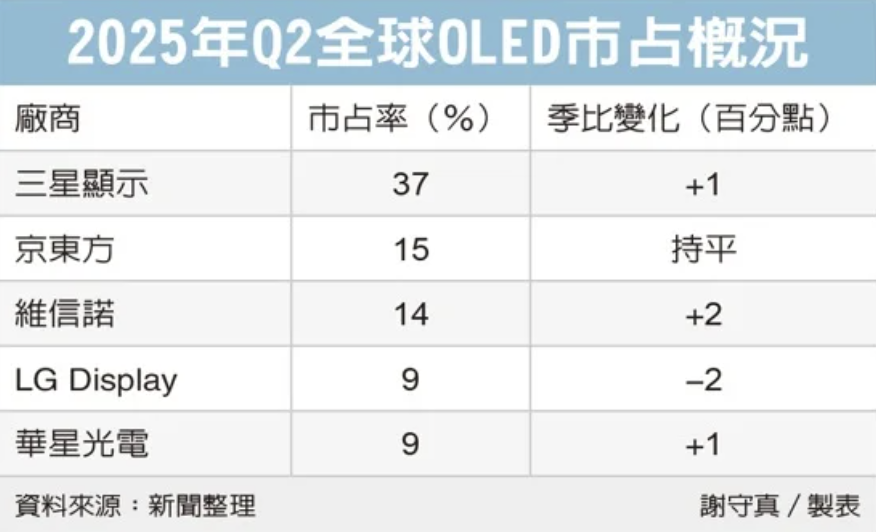
Core Insights - The report from Counterpoint Research highlights the rapid penetration of domestic OLED panels in the global market, driven by the maturity of the supply chain and cost advantages in mainland China [1] - OLED technology is gradually replacing traditional LCD technology, becoming a significant development direction in the global display industry [1] Market Performance - In Q2 2025, global OLED panel shipments are expected to increase by 5% quarter-on-quarter but decrease by 2% year-on-year [1] - The demand for high-end IT products is driving double-digit growth in monitors and laptops, while smartphone and TV demand remains stable but weak compared to the previous year [1][3] Vendor Market Share - Samsung Display (SDC) maintains the leading position with a market share of 37%, up 1 percentage point from the previous quarter [2] - BOE holds a 15% market share, ranking second, while Visionox's market share increased from 12% to 14%, ranking third [2] - LG Display's market share decreased from 11% to 9%, placing it fourth, while CSOT's market share remained at 9%, increasing by 1 percentage point [2] Growth Drivers - The shift in demand focus is evident, with IT applications becoming a new growth engine for OLED panels, supported by increased supply capacity and broader OEM adoption [3] - The gaming industry is identified as a key driver for the growth in OLED display demand, due to its advantages over LCD displays, such as high contrast and fast response times [3]