
渔业

Search documents
授人以渔 共享发展(国际观澜)
Ren Min Ri Bao· 2025-11-17 22:02
(文章来源:人民日报) 大家一起发展才是真发展,可持续发展才是好发展。中国的渔业援外培训,坚持以受援国的资源禀赋为 出发点,充分尊重各国文化传统与发展需求。从编写《柬埔寨王国渔业和水产养殖发展规划》,到绘制 《塞拉利昂海域主要渔业资源原色图集》,再到澜湄各国联合执法与增殖放流活动,中国推动的渔业合 作项目正成为"可复制、可持续"的国际典范。它不仅输出技术,更输出治理经验与合作机制。 消除贫困是各国人民梦寐以求的共同理想。面对全球渔业资源管理、生态保护与民生改善的共同挑战, 中国将自身发展经验与全球南方国家的实际需求相结合,通过技术交流、联合科研、产学研合作等多种 形式,开展渔业援外培训,促进国际减贫合作,与各国携手探索蓝色增长之路,努力实现渔业发展、生 态保护与民生改善的有机统一。 中国渔业援外培训立足于技术赋能,是一套涵盖水产育种、健康养殖、病害防治、水产品加工、渔业资 源管理的全产业链技术学习体系。乌干达、埃及等非洲国家学员将中国罗非鱼苗种繁育技术带回国,成 功将苗种成活率提高30%;柬埔寨、老挝等东盟国家学员在当地应用中国的稻田养鱼技术,在水稻不减 产的基础上,不仅为市场增加了水产品供给,还帮助示范农户 ...
开展渔业合作 促进国际减贫
Ren Min Ri Bao· 2025-11-17 21:58
Group 1 - The article highlights China's international training and exchange activities in fisheries education, promoting sustainable development and technology sharing with countries like Indonesia, Ghana, and Laos [1][6] - The "New Quality Craftsman" vocational skills training program in Dalian focuses on sustainable marine fisheries, offering courses in marine aquaculture and fishery management to Indonesian participants [2][5] - The training program includes practical experiences, allowing participants to learn about China's fishery systems and policies, enhancing their ability to apply this knowledge back in their home countries [2][3] Group 2 - The article discusses the advanced cold storage technology in Chinese fishing vessels, which can reach temperatures of -40 degrees Celsius, significantly better than Indonesia's typical -20 degrees Celsius, thus improving fish preservation [4] - The training experience has inspired participants like Muhammad Romi Fazi to promote collaboration with Chinese companies to adopt advanced technologies in Indonesia's fisheries [4][5] - The article emphasizes the importance of the collaboration between government, universities, and enterprises in China, which serves as a model for Indonesia to enhance its fishery sector [5] Group 3 - The article mentions Ghana's efforts to learn from China's experience in marine ecological farming and port economic zones to improve local fisheries and reduce poverty [6] - Grace Afumwa Buma, a lecturer from Ghana, highlights her experiences in China and the importance of applying learned knowledge to enhance local aquaculture practices [6][7] - The article illustrates the close relationship between research institutions and industry in China, which allows for timely application of research outcomes in aquaculture [7] Group 4 - The article describes the international training program in Laos, focusing on fishery resource conservation and aquaculture technology, attended by over 50 participants from various countries [8][9] - The training addresses challenges faced by Laotian fish farmers, such as lack of scientific management and equipment, and promotes the adoption of new techniques [9][10] - The article highlights successful collaborative projects between China and Laos, including fish species release initiatives that enhance local aquatic biodiversity and benefit local fishermen [9][10]
股市必读:开创国际11月17日涨停收盘,收盘价13.29元
Sou Hu Cai Jing· 2025-11-17 16:48
Trading Information - On November 17, 2025, Kaichuang International (600097) closed at 13.29 yuan, reaching the daily limit with a 10.02% increase, a turnover rate of 9.61%, a trading volume of 231,500 hands, and a transaction value of 307 million yuan [1] - The stock hit the daily limit at 9:30 AM, opened three times during the day, and closed with a sealed order amounting to 10.21 million yuan, representing 0.32% of its circulating market value [1] Capital Flow - On November 17, the net inflow of main funds was 57.94 million yuan, accounting for 18.87% of the total transaction value; meanwhile, retail funds experienced a net outflow of 19.80 million yuan, representing 6.45% of the total transaction value [2] Shareholder Changes - On November 17, Kaichuang International announced that shareholders including Beijing Sena Investment Development Co., Ltd., and others collectively reduced their holdings by 2.9321 million shares, which is 1.2169% of the company's total share capital, during the period from November 7 to November 17, while the stock price increased by 14.67% [3] - Following this reduction, the shareholding ratio of major shareholder Xiaojian Technology and its concerted actors decreased from 8.9598% to 7.7428% [3] - The reduction was conducted through centralized bidding and did not result in a change of control or affect the company's governance structure and ongoing operations [3][4]

大湖股份:截至2025年第三季度报告期末,公司普通股股东总数为 42071户
Zheng Quan Ri Bao Wang· 2025-11-17 14:13
证券日报网讯大湖股份(600257)11月17日在互动平台回答投资者提问时表示,截至2025年第三季度报 告期末,公司普通股股东总数为42,071户。 ...

揭秘涨停丨股价8连板,公司提示交易风险
Zheng Quan Shi Bao Wang· 2025-11-17 11:44
(原标题:揭秘涨停丨股价8连板,公司提示交易风险) 今日32股封单资金超过1亿元。 涨停战场:这只个股封单量逾190万手 据证券时报·数据宝统计,今日(11月17日),从收盘涨停板封单量来看,华夏幸福遥遥领先,封单量高达190.1万手;龙洲股份、胜利股份、孚日 股份、平潭发展、航天发展封单量均在50万手以上,依次为74.90万手、67.73万手、61.33万手、61.25万手、53.21万手。 从连续涨停天数来看,孚日股份、*ST绿康斩获8连板;三木集团7连板;人民同泰6连板;胜利股份、安泰集团5连板;ST中珠、九牧王、*ST正 平、真爱美家实现4连板。 以封单金额计算,今日32股封单资金超过1亿元。其中,孚日股份、平潭发展分列第一、第二名,金额依次为7.8亿元、7.33亿元;华夏幸福、长城 军工、航天发展、龙洲股份等股紧随其后,封单金额均在5亿元以上。 孚日股份收获8连板,61.33万手封单,区间累计涨幅高达114.5%。公司发布股价异常波动公告,目前公司股价波动异常,可能存在非理性炒作, 交易风险大,存在短期下跌的风险。请广大投资者注意交易风险。 2025年前三季度,公司营业收入38.41亿元,同比下降4 ...


水产种苗“供给重镇”,佛山的产业底气在哪儿?
Nan Fang Nong Cun Bao· 2025-11-17 11:34
Core Viewpoint - Foshan is emerging as a significant hub for aquatic seedling supply, leveraging modern agricultural biotechnology and healthy breeding techniques to enhance the entire aquaculture industry chain, achieving high-quality development in modern fisheries [2][3][6]. Industry Overview - Foshan produces over 3.686 billion freshwater fish seedlings annually, accounting for 47% of the province's and 24% of the nation's total, showcasing its scale advantage driven by continuous breakthroughs in breeding technology [15][16][17]. - The city has transitioned from traditional breeding methods to modern biotechnological breeding, with new varieties like "Youlu 3" and "Dinggui 1" improving growth rates and disease resistance, significantly benefiting local farmers [19][20][21]. Technological Advancements - The integration of advanced technologies such as genetic sequencing and artificial selection has stabilized the inheritance of superior breeds, moving away from reliance on experience and visual selection [12][13]. - Innovative farming practices have emerged, including precise water quality monitoring and the use of traditional Chinese medicine for disease prevention, leading to healthier fish and higher market prices [24][25][26]. Economic Impact - The total output of aquatic products in Foshan reached 827,000 tons, representing 18.35% of the province's total, indicating explosive growth in quantity and quality due to advancements in breeding technology [31][32]. - The aquaculture industry contributes 21 billion yuan to the city's agricultural output, accounting for 44% of the total, positioning it as a crucial pillar for rural revitalization [35][36]. Collaborative Efforts - The collaboration between research institutions and enterprises has facilitated the application of innovative technologies in aquaculture, enhancing productivity and sustainability [49][50][51]. - The establishment of a comprehensive ecosystem from seedling cultivation to consumer markets has strengthened Foshan's position as a national distribution center for quality freshwater fish [33][34][48]. Future Directions - Continued emphasis on agricultural biotechnology and innovation is expected to drive the transformation of traditional industries, with a focus on sustainable practices and smart aquaculture systems [66][70][72].

好当家:截至2025年10月31日收盘,公司股东总数为65494户
Zheng Quan Ri Bao· 2025-11-17 11:07
(文章来源:证券日报) 证券日报网讯好当家11月17日在互动平台回答投资者提问时表示,截至2025年10月31日收盘,公司股东 总数为65494户。 ...


开创国际:持股5%以上股东及其一致行动人减持1.2170%股份
Xin Lang Cai Jing· 2025-11-17 09:40
Core Viewpoint - The company announced that a major shareholder, Xiaojian Technology, will reduce its stake by selling 2.9321 million shares, representing 1.2170% of the total share capital, between November 7 and November 17, 2025, at a price range of 11.77 to 13.29 CNY per share [1] Shareholder Activity - Xiaojian Technology and its concerted parties will decrease their combined shareholding from 8.9598% to 7.7428% following the sale [1] - The reduction in shareholding will not lead to any changes in the company's controlling shareholder or actual controller, nor will it affect the company's governance structure or ongoing operations [1]
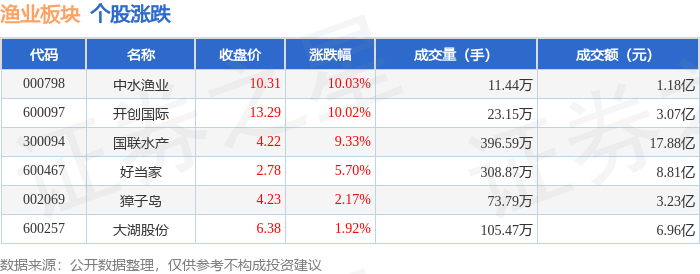
渔业板块11月17日涨6.74%,中水渔业领涨,主力资金净流入3.25亿元
Zheng Xing Xing Ye Ri Bao· 2025-11-17 08:41
Core Insights - The fishery sector experienced a significant increase of 6.74% on November 17, with Zhongshui Fishery leading the gains [1] - The Shanghai Composite Index closed at 3972.03, down 0.46%, while the Shenzhen Component Index closed at 13202.0, down 0.11% [1] Stock Performance - Zhongshui Fishery (000798) closed at 10.31, up 10.03% with a trading volume of 114,400 shares and a transaction value of 118 million [1] - Kaichuang International (600097) closed at 13.29, up 10.02% with a trading volume of 231,500 shares and a transaction value of 307 million [1] - Guolian Aquatic Products (300094) closed at 4.22, up 9.33% with a trading volume of 3.9659 million shares and a transaction value of 1.788 billion [1] - Haodangjia (600467) closed at 2.78, up 5.70% with a trading volume of 3.0887 million shares and a transaction value of 881 million [1] - Zhangzidao (002069) closed at 4.23, up 2.17% with a trading volume of 737,900 shares and a transaction value of 323 million [1] - Dahuhua (600257) closed at 6.38, up 1.92% with a trading volume of 1.0547 million shares and a transaction value of 696 million [1] Capital Flow - The fishery sector saw a net inflow of 325 million from main funds, while retail funds experienced a net outflow of 150 million and 175 million respectively [1] - Guolian Aquatic Products had a main fund net inflow of 112 million, while retail funds saw a net outflow of 12.2 million [2] - Haodangjia recorded a main fund net inflow of 67.7 million, with retail funds experiencing a net outflow of 38.8 million [2] - Zhongshui Fishery had a main fund net inflow of 39.6 million, while retail funds saw a net outflow of 20.5 million [2] - Dahuhua had a main fund net inflow of 30.3 million, with retail funds experiencing a net outflow of 64.6 million [2] - Zhangzidao recorded a main fund net inflow of 17.9 million, while retail funds saw a net outflow of 41.8 million [2]


午间涨跌停股分析:79只涨停股、5只跌停股,水产概念活跃,中水渔业2连板,开创国际涨停
Xin Lang Cai Jing· 2025-11-17 03:53
11月17日午间,A股半日下来共有79只涨停股、5只跌停股。水产概念活跃,中水渔业2连板,开创国际 涨停;锂矿概念走强,*ST正平9连板,国城矿业6天4板,大中矿业3连板,盛新锂能、融捷股份3天2 板。 连板股方面,孚日股份、*ST绿康8连板,三木集团7连板,人民同泰6连板,胜利股份5连板,ST瑞和5 天4板,九牧王、真爱美家等4连板,大有能源5天3板,平潭发展、华夏幸福等3连板,中国武夷3天2 板,盈新发展、航天发展等2连板,三六零、长城军工等涨停。 *ST原尚连续2日跌停,*ST美谷、奥特迅等跌停。 ...