私募基金

Search documents
荣膺深交所2024年度债券交易百强机构
Xin Hua Ri Bao· 2025-08-19 06:34
Core Viewpoint - Jiangsu Lianhai Land Bridge Private Equity Fund Management Co., Ltd. has been awarded the title of "Top 100 Bond Trading Institutions of Shenzhen Stock Exchange for 2024," recognizing its strong performance in the bond market and professional management capabilities [1] Group 1: Recognition and Achievements - The award aims to honor institutions that actively participate in enhancing liquidity in the Shenzhen bond market and promote the development of a multi-tiered market [1] - Lianhai Land Bridge is one of only two private equity fund management companies included in the top 100 list, highlighting its market influence in the fixed income sector [1] Group 2: Operational Excellence - The recognition reflects the company's bond trading capabilities, risk management standards, and contributions to the market [1] - The fixed income team has years of experience, relying on a rigorous credit research system and flexible trading strategies to optimize investment portfolios in a complex capital market environment [1] Group 3: Future Directions - The company aims to strengthen its buyer perspective and actively participate in the innovative construction of the bond market in Shanghai and Shenzhen [1] - Lianhai Land Bridge will use this award as a new starting point, adhering to its operational philosophy of "stability, innovation, collaboration, and win-win" [1] - The company plans to closely align with the overall development strategy of Lianyungang Financial Holding Group, leveraging its professional advantages to build a healthy and orderly financial ecosystem [1]
文化筑基与策略精进的共生之道——专访灵均投资蔡枚杰、马志宇
Zheng Quan Ri Bao Wang· 2025-08-19 06:18
Core Insights - Lingjun Investment has undergone a significant transformation from a low point to recovery, focusing on corporate culture, governance structure, and compliance risk control after facing regulatory scrutiny in early 2024 [1][2] - The company has successfully improved its product performance, with several strategies ranking among the industry's top performers [2] Group 1: Company Transformation - Lingjun Investment implemented a "co-management + specialization" model to ensure seamless integration of research and operations, promoting alignment in philosophy and management [2] - The company upgraded its compliance risk control system, embedding regulatory rules into its trading strategies to enhance stability and avoid past mistakes [2] - A shift towards short-cycle signal prediction has been made, increasing the weight of short-term strategies to adapt better to market volatility [2] Group 2: Client Engagement and Education - The company has focused on differentiated service through extensive investor education efforts, conducting over a thousand roadshows to simplify complex strategies for clients [2] - This educational approach has led to increased client trust, as evidenced by a higher tolerance for drawdowns when the company's products reopened for subscription in 2025 [2] Group 3: Industry Perspective - The head of Lingjun Investment emphasized the importance of solid institutions in the face of increasing regulatory pressure, advocating for long-termism and strict adherence to trading regulations [3] - The company aims to be a respected entity in the eyes of clients, with aspirations to expand globally while creating unique value in its services [3]
【私募调研记录】汐泰投资调研北信源
Zheng Quan Zhi Xing· 2025-08-19 00:14
Group 1 - The company has become one of the leaders in its sector, offering basic subscription services and financial value-added services with fees ranging from 0.5% to 1% [1] - The market space for the company's services is estimated to be in the trillion-level, with financial connection service fees in the hundred billion range [1] - The company is recognized as a leading provider of network and information security in China, with nearly thirty years of technological accumulation [1] Group 2 - The company has received positive customer feedback, with products helping to save time and effort, especially in remote areas [1] - The company is advancing its pledge and bulk matching platform, with the first test version scheduled for public experience [1] - Shanghai Xitai Investment Management Co., Ltd. was established in July 2014, focusing on secondary market investment management and providing customized product services for investors with different risk preferences [2]

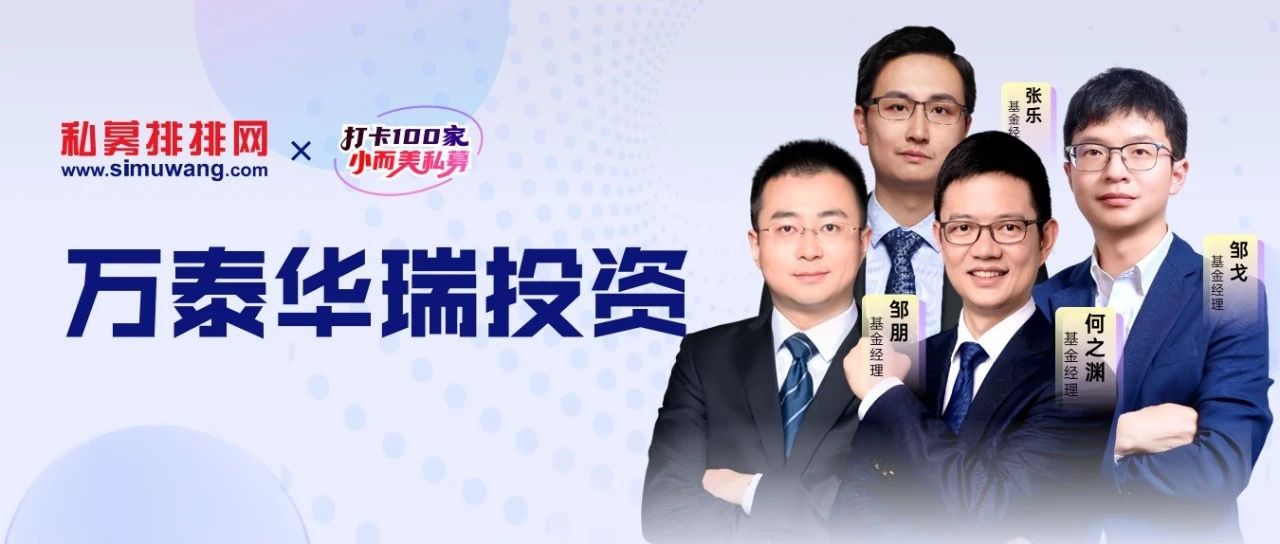
万泰华瑞投资:16年深耕,把重投资者回报落到实处 | 打卡100家小而美私募
私募排排网· 2025-08-19 00:06
Company Overview - Hunan Wantai Huari Investment Management Co., Ltd. was established in March 2009, with a registered capital of 10 million yuan and a current management scale exceeding 1.4 billion yuan [4][6] - The company combines value investing and trend investing tailored to the Chinese capital market, focusing on risk control and sustainable long-term returns, with over 90% of clients achieving positive returns [4][13] Development History - The company launched its first trust asset management product in 2009 and became a member of the China Securities Association in 2013 [5] - It obtained private securities fund management qualifications in 2014 and became a member of the Asset Management Association of China in 2017 [5][6] Core Team - The core team consists of members from leading firms such as CICC, GF Securities, and Zhuque Fund, each with over 16 years of experience in their respective research fields [6][12] - The investment and research teams work closely together, ensuring efficient transformation of research into actionable investment strategies [10][12] Investment Philosophy & Strategies - The investment philosophy emphasizes risk control, with a focus on macroeconomic and policy analysis to identify growth sectors while maintaining a balanced approach to risk and return [9][10] - Key strategies include careful stock selection based on growth trajectories and intrinsic value assessments, with a focus on long-term sustainable growth [9][10] Market Outlook - The company is optimistic about a slow bull market characterized by a decline in domestic risk-free rates and a favorable environment for equities [12][14] - The anticipated return of capital to A-shares due to U.S. interest rate cuts and a weaker dollar is expected to drive market growth [12][14] - The economic landscape is shifting from a "negative beta" to a "zero beta" environment, indicating potential for structural market growth despite overall economic weakness [14][15] Core Advantages - The company prioritizes client interests and adopts a long-term investment approach, ensuring a high degree of alignment between management and investor interests [13] - A stable team structure and effective internal collaboration enhance research capabilities and investment decision-making efficiency [13][12]

基金经理年内最新10强揭晓!陆航、李剑飞、翟敬勇位居前列
Sou Hu Cai Jing· 2025-08-18 06:55
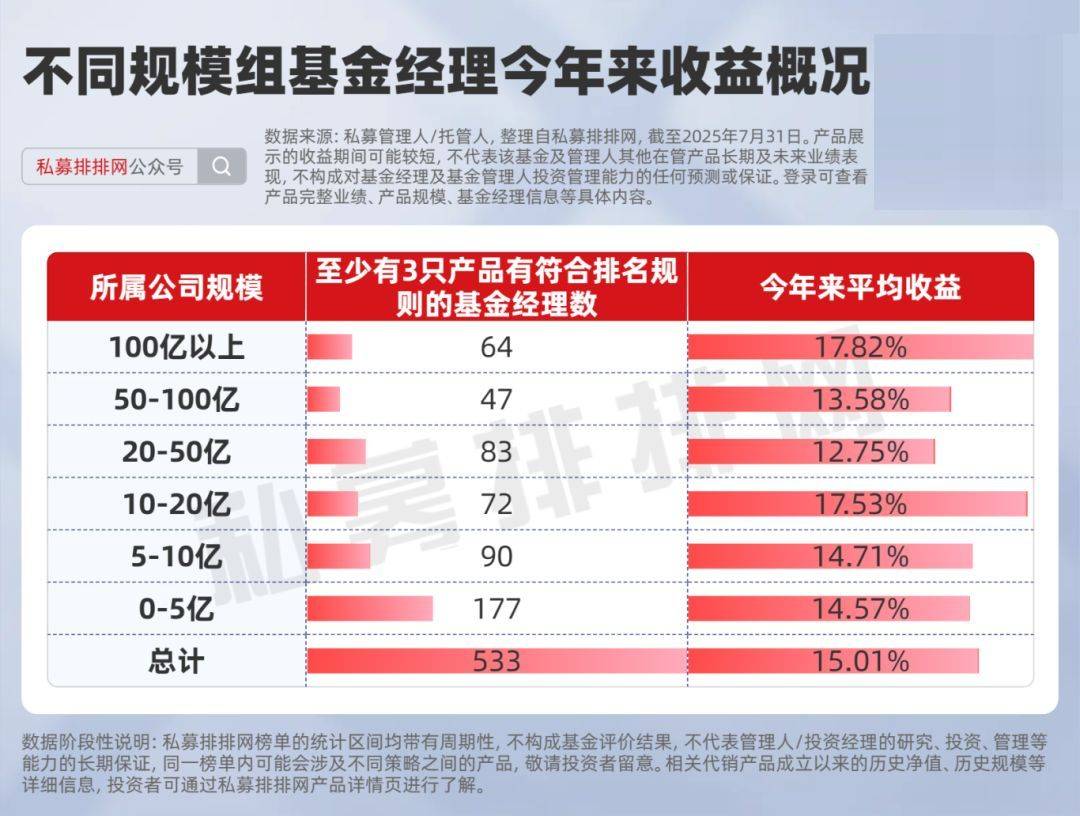
Core Viewpoint - In July, the A-share market exhibited characteristics of "index breakthrough, hot rotation, and increased trading volume," with the Shanghai Composite Index surpassing 3500 points for the first time on July 9 and closing above 3600 points by the end of the month. Key sectors driving the market included AI computing power and the Yarlung Tsangpo River hydropower station [1]. Private Equity Performance - As of July 31, there were 533 fund managers with at least three products meeting ranking criteria, achieving an average return of 15.01% year-to-date. Fund managers from firms with over 100 billion yuan in assets had an average return of 17.82%, ranking first among six size categories [2]. Fund Manager Rankings by Size - **100 Billion and Above**: 64 fund managers, with top performers including Lu Hang from Fusheng Asset, who focuses on new consumption and technology [3][6]. - **50-100 Billion**: 47 fund managers, with Tong Xun from Tong Xun Investment leading the pack [7][10]. - **20-50 Billion**: 83 fund managers, with Li Jiajia from Haokun Shengfa Asset taking the top spot [11][12]. - **10-20 Billion**: 72 fund managers, with Zhai Jingyong from Rongshu Investment ranking third, focusing on semiconductor and top-tier manufacturing sectors [14][18]. - **5-10 Billion**: 90 fund managers, with Liu Xianglong from Fuyuan Capital achieving the highest returns [20]. - **0-5 Billion**: 177 fund managers, with Yao Yong from Qinxing Fund leading this category [21][23]. Market Insights - The private equity sector is experiencing a positive trend, with many fund managers achieving significant returns amid a favorable market environment. The focus on sectors such as AI and new consumption is expected to continue driving performance [1][6][18].
培育创新动能,山东产研院高校科技创新创业训练营圆满收官
Qi Lu Wan Bao· 2025-08-18 02:29
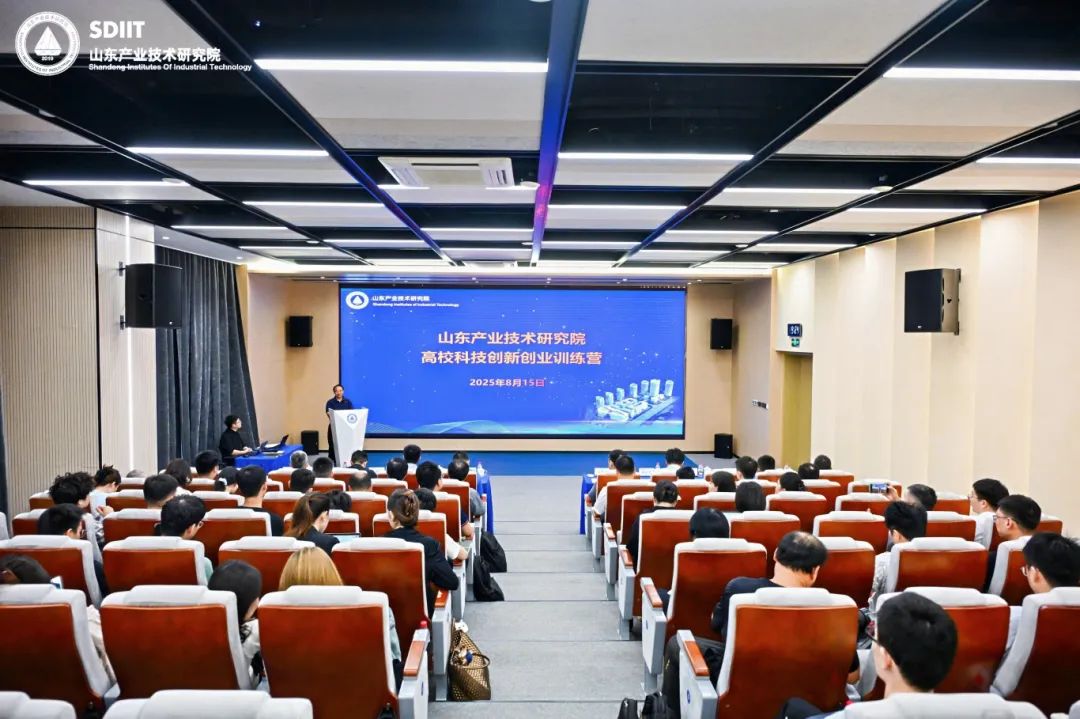
Group 1 - The core event was the closing ceremony and project roadshow of the Shandong Academy of Industrial Technology's innovation and entrepreneurship training camp, showcasing project outcomes and recognizing outstanding projects [1][3] - The roadshow featured teams presenting their projects focused on technological innovation, result transformation, and entrepreneurial planning, highlighting the cutting-edge perspectives and entrepreneurial vitality of young tech talents [3][5] - The first prize was awarded to the joint project of Shandong University’s Integrated Circuit Institute and Jinan Rongxin New Material Technology Co., Ltd. for their "High-Performance Flexible Transparent Nano-Silver Ring Electrode," recognized for significant technological breakthroughs and industrialization potential [3][5] Group 2 - The training camp aimed to deepen the cultivation of innovative talents and link university research resources, attracting over 30 outstanding students and young researchers from both within and outside the province [5] - Experts from various institutions provided practical courses, including innovation workshops, case studies, and simulated roadshows, to enhance participants' capabilities in technology transformation and business planning [5] - The projects covered strategic emerging fields such as artificial intelligence, biomedicine, and new materials, injecting new momentum into the industrial upgrade of Shandong [5][7] Group 3 - The Shandong Academy of Industrial Technology plans to continue leveraging its platform advantages to improve the technology innovation service system and promote the integrated development of education and technology talents [7] - The goal is to accelerate the transformation of technological achievements into real productive forces, providing solid support for high-quality development in the province [7]

A股慢牛行情下!私募产品“超涨”榜揭晓!远信、久期、前海博普等夺冠!
私募排排网· 2025-08-17 03:03
Core Viewpoint - The article discusses the performance of private equity funds in the context of a bullish market trend in A-shares, emphasizing the importance of both offensive and defensive capabilities of these funds to capture investment opportunities and mitigate risks [1][3]. Offensive Capability (Upward Capture Rate) - Offensive capability measures how sensitive a fund is to market uptrends, with a higher value indicating stronger performance against the market. The upward capture rate is calculated as: (Cumulative return of the portfolio during the benchmark's up period + 1) / (Cumulative return of the benchmark during the up period + 1) - 1 [2]. Defensive Capability (Downward Capture Rate) - Defensive capability assesses how well a fund performs during market downturns, with a lower value being preferable. A negative value indicates that the fund can generate positive returns even in a declining market. The downward capture rate is calculated similarly to the upward capture rate but focuses on down periods [3]. Performance Summary of Private Equity Funds - For the year to date, the average return of 4,377 qualifying private equity products is 15.28%, with an average offensive capability of 1.356 and a defensive capability of 0.128. The top three funds in terms of offensive capability among large private equity firms (over 5 billion) are from Yuanxin Investment, Harmony Huiyi Asset, and Longqi Technology [5]. - The top fund, "Yuanxin China Active Growth C Class," managed by Wang Aoye, has achieved significant returns and is noted for its strong offensive capability [5][6]. - In the small private equity category (under 5 billion), the top three funds are from Nengjing Investment Holdings, Hunan Zijin Private Equity, and Jiuge Investment [8]. Recent Performance Trends - Over the past year, the average return of 4,165 qualifying products is 36.34%, with an overall offensive capability of 0.975 and a defensive capability of -0.130. The leading funds in this category are from Jiuqi Investment, Heiyi Asset, and Stable Investment [10]. - The top fund, "Jiuqi Value Selection No. 1," managed by Jiang Yunfei, has demonstrated strong performance metrics [12][13]. Three-Year Performance Overview - For the past three years, the average return of 2,638 qualifying products is 43.03%, with an average offensive capability of 0.881 and a defensive capability of 0.248. The top funds in this category are from Qianhai Bopu Asset, Kaishi Private Equity, and Hainan Xiwa [16]. - The leading fund, "Bopu Value Far-reaching No. 1 A Class," managed by Yuan Hao, has shown impressive performance [18][19].
因未按合同约定向投资者进行信息披露等问题 珠海海泽私募被监管出具警示函
Bei Jing Shang Bao· 2025-08-14 14:58
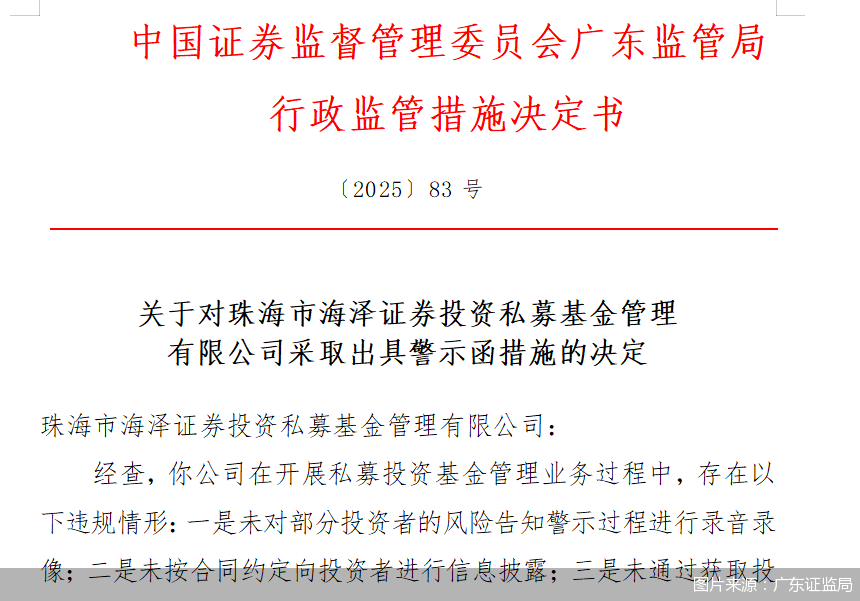
北京商报讯(记者郝彦)8月14日,广东证监局发布公告表示,珠海市海泽证券投资私募基金管理有限公司(以下简称"珠 海海泽私募")在开展私募投资基金管理业务过程中,存在以下违规情形:未对部分投资者的风险告知警示过程进行录音 录像;未按合同约定向投资者进行信息披露;未通过获取投资者资产证明等方式了解投资者财务状况。 上述行为违反规定,广东证监局决定对珠海海泽私募采取出具警示函的行政监管措施。 (文章来源:北京商报) ...
因未按合同约定向投资者进行信息披露等问题,珠海海泽私募被监管出具警示函
Bei Jing Shang Bao· 2025-08-14 13:48
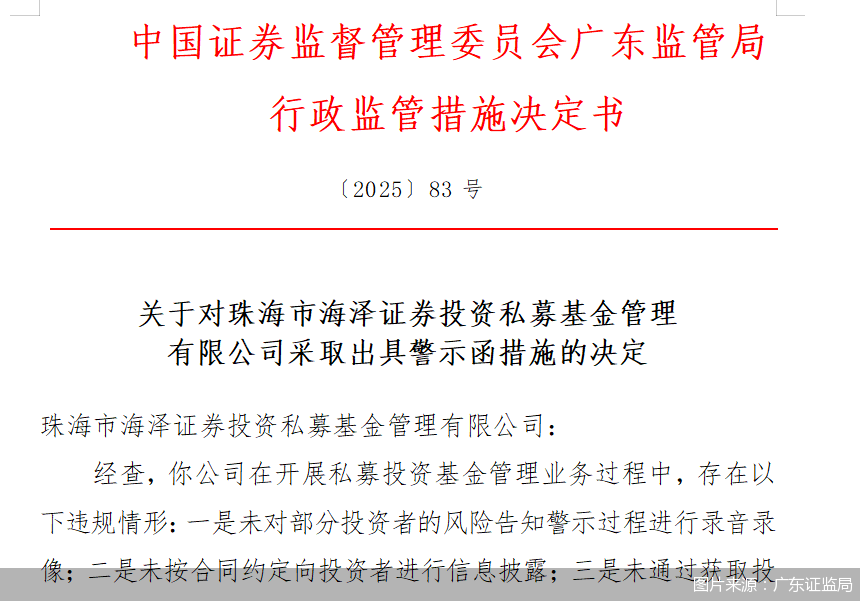
北京商报讯(记者 郝彦)8月14日,广东证监局发布公告表示,珠海市海泽证券投资私募基金管理有限公司(以下简称"珠 海海泽私募")在开展私募投资基金管理业务过程中,存在以下违规情形:未对部分投资者的风险告知警示过程进行录音 录像;未按合同约定向投资者进行信息披露;未通过获取投资者资产证明等方式了解投资者财务状况。 上述行为违反规定,广东证监局决定对珠海海泽私募采取出具警示函的行政监管措施。 ...
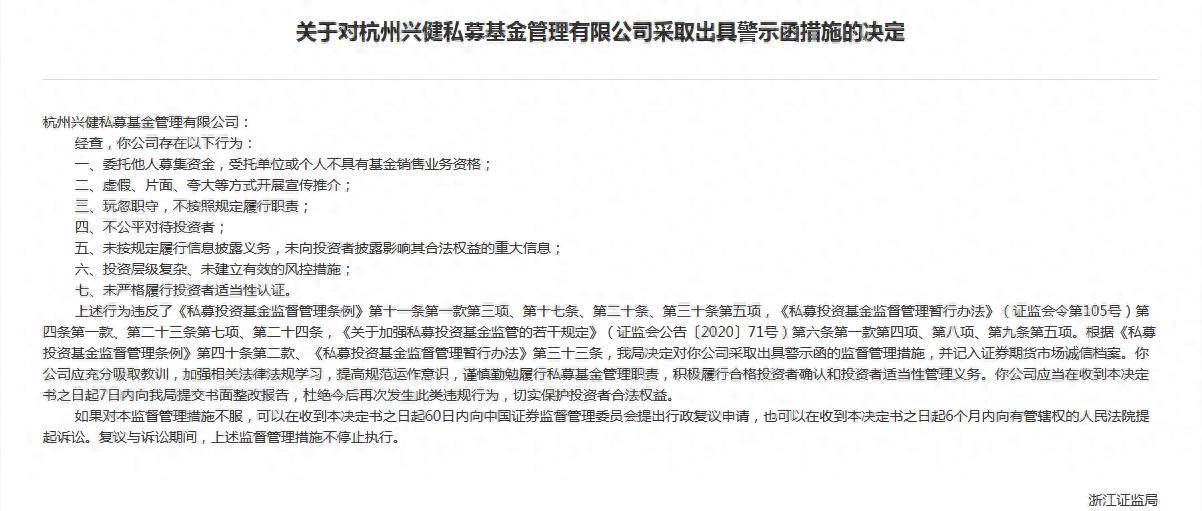
杭州兴健私募基金公司收警示函!涉玩忽职守,不按照规定履行职责等七项违规
Sou Hu Cai Jing· 2025-08-14 09:31
经查,该公司存在以下行为: 一、委托他人募集资金,受托单位或个人不具有基金销售业务资格;二、虚假、片面、夸大等方式开展宣传推介;三、玩忽 职守,不按照规定履行职责;四、不公平对待投资者;五、未按规定履行信息披露义务,未向投资者披露影响其合法权益的重大信息;六、投资层级复杂、 未建立有效的风控措施;七、未严格履行投资者适当性认证。 日前,浙江证监局发布关于对杭州兴健私募基金管理有限公司采取出具警示函措施的决定。 上述行为违反了《私募投资基金监督管理条例》第十一条第一款第三项、第十七条、第二十条、第三十条第五项,《私募投资基金监督管理暂行办法》(证 监会令第105号)第四条第一款、第二十三条第七项、第二十四条,《关于加强私募投资基金监管的若干规定》(证监会公告〔2020〕71号)第六条第一款 第四项、第八项、第九条第五项。根据《私募投资基金监督管理条例》第四十条第二款、《私募投资基金监督管理暂行办法》第三十三条,浙江证监局决定 对公司采取出具警示函的监督管理措施,并记入证券期货市场诚信档案。 浙江证监局同时对杭州兴健私募基金管理有限公司法定代表人、总经理、执行董事楼海淼采取出具警示函措施的决定。 来源:读创财经 ...