资本市场服务

Search documents
每经热评︱延长大股东协议转让锁定期 为培育耐心资本创造空间
Mei Ri Jing Ji Xin Wen· 2025-07-09 09:53
Group 1 - The recent trend in capital operations involves major shareholders extending the lock-up period for private equity fund acquisitions from the original 6 months to 12 or even 18 months [1][2] - In May, over 10 listed companies, including Weiling Co., Daile New Materials, and Luoxin Pharmaceutical, saw major shareholders terminate their agreement transfers, with the number of terminations in May nearly matching the total from the previous four months [1] - The new regulations stipulate that major shareholders must transfer at least 5% of the company's total shares to a single acquirer, and the acquirer cannot reduce their holdings within the first 6 months [1] Group 2 - The 6-month lock-up period coincides with the financial reporting cycle, allowing major shareholders to potentially exploit undisclosed performance data for profit [2] - The "major shareholder agreement transfer + private equity fund acquisition" model is not entirely negative, as it can prevent market disruptions from large sell-offs and introduce professional institutions to optimize the equity structure [2][3] - Extending the lock-up period helps balance the protection of minority investors with market liquidity, reducing short-term speculative arbitrage opportunities [2][3] Group 3 - Binding the lock-up period to the company's information disclosure cycle curbs short-term arbitrage and fosters the entry of patient capital into the market [3] - Private equity firms can act as strategic investors or patient industrial capital, promoting the integration of strategic investment and value discovery [3] - The commitment to lock-up periods exceeding 12 months by private equity firms encourages the cultivation of a long-term investment culture in the capital market [3]
济南市中政兴投资有限公司成立,注册资本5000万人民币
Sou Hu Cai Jing· 2025-07-09 03:14
企业名称济南市中政兴投资有限公司法定代表人于燕华注册资本5000万人民币国标行业金融业>资本市 场服务>其他资本市场服务地址山东省济南市市中区英雄山路129号祥泰广场10号楼2层206室企业类型 有限责任公司(非自然人投资或控股的法人独资)营业期限2025-7-8至无固定期限登记机关济南市市中 区市场监督管理局 来源:金融界 天眼查App显示,近日,济南市中政兴投资有限公司成立,法定代表人为于燕华,注册资本5000万人民 币,由济南市中财金投资集团有限公司全资持股。 序号股东名称持股比例1济南市中财金投资集团有限公司100% 经营范围含以自有资金从事投资活动;土地整治服务;市政设施管理;工程管理服务;非居住房地产租 赁;土地使用权租赁;会议及展览服务;城市绿化管理;文化场馆管理服务;供应链管理服务;煤炭及 制品销售;金属材料销售;普通货物仓储服务(不含危险化学品等需许可审批的项目);国内贸易代 理;国内货物运输代理;电子元器件与机电组件设备销售;化工产品销售(不含许可类化工产品);金 属矿石销售;塑料制品销售;机械设备销售;基础化学原料制造(不含危险化学品等许可类化学品的制 造);特种劳动防护用品销售;木材销 ...
多家企业取得隧道衬砌的渗漏水水样采集装置专利
Sou Hu Cai Jing· 2025-07-08 05:14
Group 1 - The State Intellectual Property Office has granted a patent for a "water sample collection device for tunnel lining leakage" to four companies, including Guangzhou Institute of Building Science, Zhuhai Dahengqin Co., Ltd., China Railway 16th Bureau Group Co., Ltd., and Guangzhou Construction Engineering Quality Safety Testing Center Co., Ltd. The patent was applied for on May 2020 and has the authorization announcement number CN111855286B [1][2] - Guangzhou Institute of Building Science, established in 2008, has a registered capital of 60 million RMB and has participated in 456 bidding projects, holding 566 patents and 17 trademarks [1] - Zhuhai Dahengqin Co., Ltd., founded in 2013, has a registered capital of 460 million RMB and has participated in 1,421 bidding projects, holding 42 patents [1] - China Railway 16th Bureau Group Co., Ltd., established in 1995, has a registered capital of 443 million RMB and has participated in 5,000 bidding projects, holding 1,907 patents and 5 trademarks [2] - Guangzhou Construction Engineering Quality Safety Testing Center Co., Ltd., founded in 2000, has a registered capital of 12.6 million RMB and has participated in 5,000 bidding projects, holding 264 patents [2]
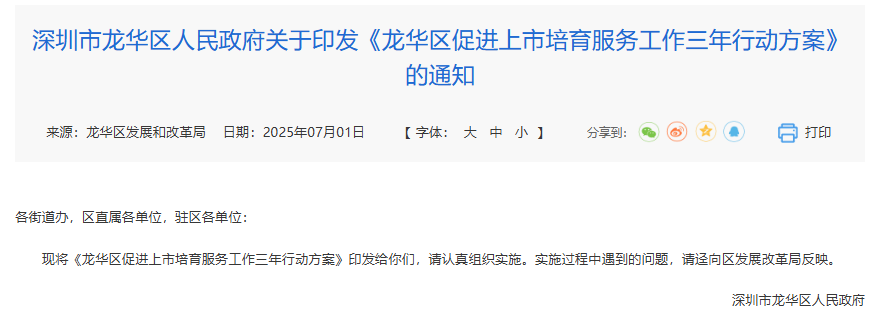
深圳《龙华区促进上市培育服务工作三年行动方案》发布
Huan Qiu Wang· 2025-07-03 02:04
Core Viewpoint - The recent policy issued by the Central Committee and the State Council allows enterprises from the Guangdong-Hong Kong-Macao Greater Bay Area that are listed on the Hong Kong Stock Exchange to also list on the Shenzhen Stock Exchange, aiming to invigorate the capital market [1][3]. Group 1: Policy and Implementation - The Longhua District has launched a three-year action plan to promote the listing of companies already listed on the Hong Kong Stock Exchange to also list on the Shenzhen Stock Exchange, aligning with the new policy [1][4]. - The action plan includes enhancing the listing cultivation service system, broadening financing channels for enterprises, and increasing support for mergers and acquisitions [3]. Group 2: Economic Impact - The plan aims to make listed and prospective listed companies a backbone for high-quality economic and social development, focusing on a modern industrial system layout [3]. - Analysts believe that the return of quality technology companies from Hong Kong to A-shares will boost investor confidence in China's capital market and technology assets, contributing to high-quality market development [3]. Group 3: Specific Measures - The action plan proposes a tiered cultivation system for listed companies, creating a rich reserve cultivation library categorized into "startup, growth, and mature" stages [3]. - It emphasizes supporting enterprises in conducting upstream and downstream mergers and acquisitions, encouraging leading companies to strengthen and supplement their supply chains [3].

★持续守住稳的底线 激发资本市场更大活力
Shang Hai Zheng Quan Bao· 2025-07-03 01:56
Core Viewpoint - The central government emphasizes the importance of a stable and active capital market for the economic vitality and the well-being of millions of families, directing efforts towards maintaining market stability and encouraging long-term investments [1][2]. Group 1: Market Stability - The stability of the capital market is deemed essential for healthy development, promoting social expectations, and enhancing the effectiveness of monetary and fiscal policies [1][2]. - A series of policy measures have been implemented to counteract market volatility, including strong signals from multiple government departments and active participation from state-owned enterprises and financial institutions [2][3]. - The People's Bank of China will support the Central Huijin Investment Ltd. in increasing its holdings in stock market index funds when necessary, ensuring the smooth operation of the capital market [2][3]. Group 2: Market Vitality - A vibrant capital market is crucial for resource allocation, guiding funds towards high-quality listed companies and supporting the real economy [3][4]. - Recent reforms aim to stimulate investment and financing, focusing on nurturing new productive forces and encouraging long-term capital inflow, particularly from public funds [3][4]. - The revised management measures for major asset restructuring of listed companies aim to enhance market activity and facilitate resource integration and transformation [4]. Group 3: Regulatory Efficiency - Continuous improvement in regulatory efficiency is necessary to achieve both stability and vitality in the capital market, with a focus on investor protection throughout the regulatory process [5][6]. - The introduction of a judicial guideline aims to strengthen the protection of investor rights and enhance collaboration between judicial and administrative bodies [5][6]. - Regulatory authorities are intensifying efforts to combat securities and futures violations, with a significant increase in the number of cases handled and penalties imposed [6].
机构指2025年香港IPO集资额有望重夺全球首位
Zhong Guo Xin Wen Wang· 2025-07-02 12:11
Group 1 - The core viewpoint is that Hong Kong's IPO market is expected to experience its most active fundraising wave in nearly four years, with projections of 90 to 100 companies going public in 2025, raising over 200 billion HKD [1][2] - In the first half of 2025, Hong Kong saw 44 new listings, raising 1,071 billion HKD, a sevenfold increase compared to the same period last year, making it the highest in nearly a decade and surpassing the total raised in 2024 [1] - The number of companies that have submitted applications to list in Hong Kong exceeds 200, indicating a diverse range of industries participating in the IPO market [1] Group 2 - Regulatory bodies have made multiple revisions to listing regulations, enhancing the approval process and increasing transparency and efficiency, which attracts more companies to list in Hong Kong [2] - Recent strong performance of new stocks has boosted investor confidence, alongside improved liquidity and rising valuation levels, contributing to the long-term stable development of Hong Kong's capital market [2] - The forecast for IPO fundraising in 2025 is between 200 billion HKD and 220 billion HKD, with expectations for continued activity in the IPO market driven by several large new listings [2]
普华永道:2025年香港新股市场将迎来近四年来最活跃的募资潮
Zheng Quan Ri Bao Wang· 2025-07-02 11:09
Core Insights - The Hong Kong IPO market raised HKD 107.1 billion in the first half of 2025, a sevenfold increase compared to the same period last year, making it the highest globally and the second highest in nearly a decade [1] - A total of 44 new stocks were listed in Hong Kong during the first half of 2025, marking a 47% increase from the first half of 2024, with the main board dominated by retail, consumer goods, and services [1] - The outlook for the second half of 2025 remains positive, with over 200 companies having submitted applications to list in Hong Kong, spanning various industries including traditional sectors and new economy sectors [1][2] Market Trends - The Hong Kong IPO market is experiencing a significant growth trend, supported by high liquidity in the banking system, which provides favorable conditions for companies to list and raise funds [2] - The market is becoming an important platform for Chinese companies to expand their business and raise capital, with many large enterprises listed on A-shares planning to split their Chinese operations to list in Hong Kong [2] - The anticipated influx of policy support and ample liquidity is expected to lead to the most active fundraising wave in nearly four years for the Hong Kong new stock market [2]
港股回深A!深圳再发声
证券时报· 2025-07-02 10:46
Core Viewpoint - The article discusses the "Three-Year Action Plan for Promoting Listing Cultivation Services in Longhua District," which aims to enhance the listing cultivation service system, broaden financing channels for enterprises, and support mergers and acquisitions to drive high-quality economic development in the region [1][2]. Group 1: Overall Requirements - The plan emphasizes the need to align with Longhua District's "1+2+3" modern industrial system layout, improve the listing cultivation service system, and promote the transition of small enterprises to standardized and refined operations, ultimately fostering listed and prospective listed companies as key forces in economic development [2][3]. Group 2: Key Measures - The plan outlines several key measures, including improving listing cultivation service levels, establishing a high-quality listing reserve cultivation database, implementing policies to promote enterprise listings, strengthening resource guarantees, optimizing the listing cultivation service ecosystem, and enhancing risk response mechanisms [2][3]. Group 3: Collaboration and Support - The plan proposes deepening collaboration with professional financial research institutions, facilitating domestic and international listing policy consultations for enterprises, and coordinating cross-border financial institutions to provide financial syndication services for companies going abroad [3]. - It also encourages the establishment of representative offices for overseas exchanges in Longhua and supports the creation of bilingual service teams to enhance cross-border service capabilities [3]. Group 4: Mergers and Acquisitions - The plan focuses on improving the quality of industrial and supply chains, supporting enterprises in conducting upstream and downstream mergers and acquisitions, and establishing a special fund for mergers and acquisitions to attract contributions from leading brokerage firms and large listed companies in the district [3]. Group 5: Context of Broader Policies - The article references a recent policy from the Central Committee of the Communist Party of China and the State Council aimed at deepening reforms and expanding openness in Shenzhen, which allows companies listed on the Hong Kong Stock Exchange to also list on the Shenzhen Stock Exchange under certain conditions [5][6][7]. - This policy is seen as a crucial step for financial collaboration in the Guangdong-Hong Kong-Macao Greater Bay Area and is expected to enhance investor confidence in China's capital markets [7].
南京空地数智产业投资基金成立,首期出资额高达9亿元
Sou Hu Cai Jing· 2025-07-01 22:01
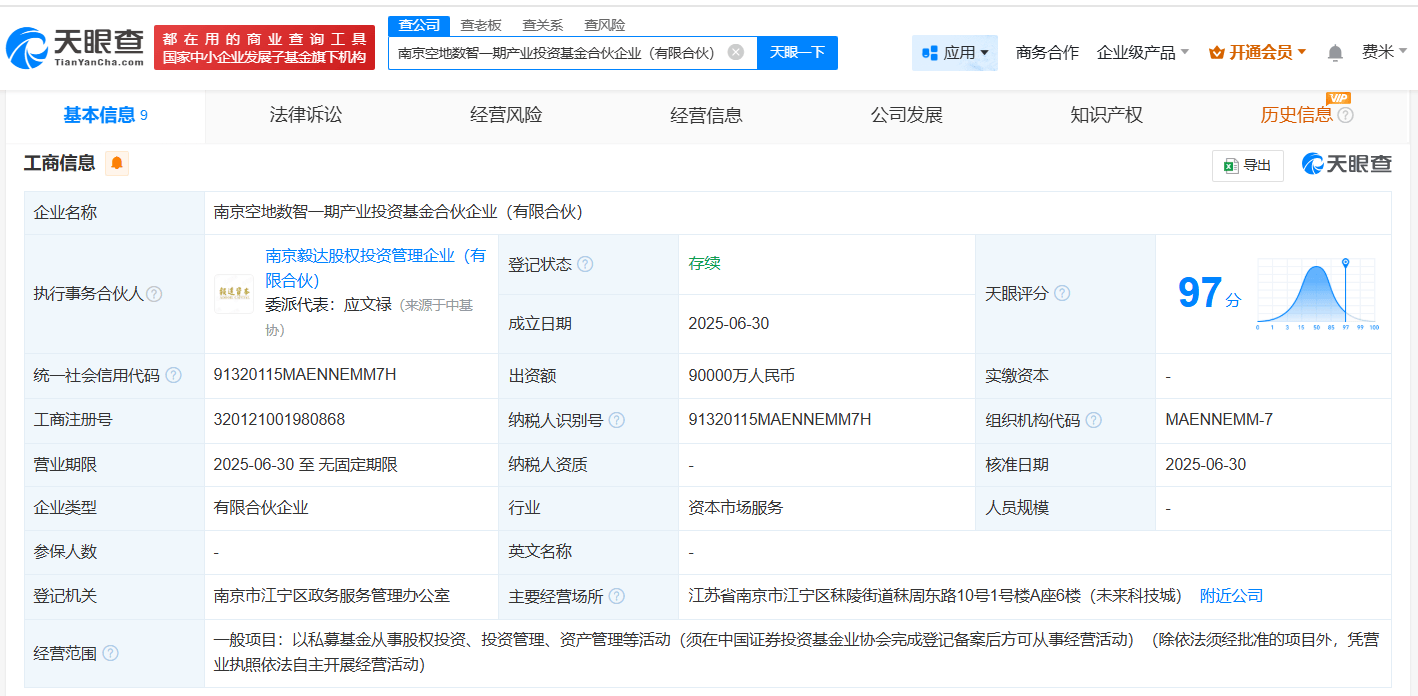
Core Viewpoint - The establishment of Nanjing Kongdi Shuzhi Phase I Industrial Investment Fund Partnership (Limited Partnership) marks a significant move in the private equity investment sector, with a registered capital of 900 million RMB, focusing on various emerging industries [1][2]. Group 1: Fund Overview - The fund is executed by Nanjing Yida Equity Investment Management Partnership (Limited Partnership) and has a strong backing from notable contributors such as Nanjing Zijin Industrial Investment Co., Ltd., Sujiao Science and Technology, and Nanjing Kongdi Shuzhi Industrial Development Co., Ltd. [1][2] - Sujiao Science and Technology has committed 135 million RMB of its own funds to the establishment of the fund, indicating a deep strategic engagement in the industrial investment sector [1][2]. Group 2: Investment Focus - The fund's investment strategy is broad yet targeted, concentrating on sectors such as low-altitude economy, intelligent connected vehicles, new energy, new infrastructure, smart logistics, aerospace, semiconductors, and new materials [1][2]. - These sectors are seen as representing future industrial development trends, offering substantial market potential and growth opportunities [1][2]. Group 3: Market Implications - The establishment of the fund is expected to provide robust capital support to enterprises within the relevant industrial chains, facilitating technological innovation and industrial upgrades [2][3]. - The collaboration among the fund's contributors is viewed as a strategic alignment to explore new development opportunities and accelerate the growth of related industrial chains [3].
IPO排队企业止跌回升,北交所成最大“蓄水池”
梧桐树下V· 2025-07-01 10:39
Core Viewpoint - The number of IPOs under review in A-shares has rebounded, reaching 321 companies as of June 30, 2025, indicating a recovery in corporate listing confidence and a steady enhancement of the capital market's financing function [1][3]. Group 1: IPO Data Overview - As of June 30, 2025, the breakdown of the 321 companies under review includes 34 for the ChiNext, 37 for the Sci-Tech Innovation Board, 59 for the Shenzhen Main Board, and 191 for the Beijing Stock Exchange [1][2]. - The Beijing Stock Exchange leads with 191 companies under review, accounting for 59.5% of the total, with 96 companies already accepted, highlighting its growing attractiveness for IPO candidates [2][3]. Group 2: Market Trends and Shifts - Some companies initially planning to list on the ChiNext have shifted their strategies to pursue listings on the Beijing Stock Exchange, reflecting a trend where companies that failed to secure IPOs on other boards are also turning to the Beijing Stock Exchange [3]. - The Beijing Stock Exchange's focus on serving "specialized, refined, distinctive, and innovative" enterprises and its more accommodating listing standards for light asset and high R&D investment SMEs have made it a preferred platform for capital seeking [3]. Group 3: Future Outlook - The rebound in IPO queue data, particularly the strong performance of the Beijing Stock Exchange, indicates that the capital market is effectively supporting the real economy and technological innovation [3]. - With the orderly progress of the review process, the A-share IPO market is expected to remain active in the second half of the year, injecting more capital into the real economy [3].