仓储

Search documents
7月中国仓储指数50.1%
Shen Zhen Shang Bao· 2025-08-07 16:59
Core Viewpoint - The article discusses the recent financial performance and strategic developments of a specific company, highlighting its growth trajectory and market positioning [2] Financial Performance - The company reported a revenue increase of 15% year-over-year, reaching a total of 1.5 billion in the last quarter [2] - Net profit rose by 10%, amounting to 300 million, indicating improved operational efficiency [2] Strategic Developments - The company has announced plans to expand its market presence in Asia, targeting a 20% increase in market share over the next two years [2] - A new product line is set to launch in Q3, expected to contribute an additional 200 million in revenue [2] Market Positioning - The company currently holds a 25% market share in its primary sector, positioning it as a leader among competitors [2] - Recent partnerships with key industry players are anticipated to enhance distribution channels and customer reach [2]

7月中国仓储行业整体保持良好运行态势
Zhong Guo Xin Wen Wang· 2025-08-07 16:42
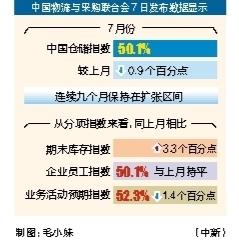
Core Viewpoint - The China Logistics and Purchasing Federation reported that the warehouse index for July is at 50.1%, a decrease of 0.9 percentage points from the previous month, but still above 50%, indicating continued expansion in the warehouse industry for nine consecutive months [1][2] Group 1: Warehouse Index Performance - The warehouse index for July is 50.1%, down 0.9 percentage points from June [1] - The index remains above 50%, indicating a sustained expansion in the warehouse sector [1] - The end-of-period inventory index increased by 3.3 percentage points compared to the previous month [1] Group 2: Sub-index Analysis - New orders index, average inventory turnover index, and business activity expectation index all decreased, with declines ranging from 1.4 to 7.2 percentage points [1] - The employee index remained stable at 50.5%, indicating a steady workforce in the sector [2] - Business activity expectation index is at 52.3%, down 1.4 percentage points from the previous month, but still in the expansion zone [2] Group 3: Future Outlook - Short-term fluctuations are expected due to weather factors, but long-term prospects remain positive [2] - The end of the rainy season and supportive macro policies are anticipated to enhance the vitality of the warehouse industry [2] - Companies maintain a relatively optimistic outlook for future business recovery [2]
7月份中国仓储指数为50.1% 连续9个月保持在扩张区间
Zheng Quan Ri Bao· 2025-08-07 16:27
Core Viewpoint - The China Logistics and Purchasing Federation and China Storage Development Co., Ltd. reported a decline in the warehousing index for July 2025, indicating a slowdown in growth while remaining above the expansion threshold for nine consecutive months [1] Group 1: Warehousing Index and New Orders - The warehousing index for July is 50.1%, down 0.9 percentage points from June [1] - The new orders index is at 50%, a decrease of 1.6 percentage points from June, with certain categories like non-ferrous metals and chemical products showing indices above 50, while others like mining products and home appliances are below 50 [1] Group 2: Inventory and Turnover - The ending inventory index is at 51%, an increase of 3.3 percentage points from June, with various categories such as steel and chemical products above 50, while non-ferrous metals and agricultural products are below 50 [1] - The average inventory turnover index is at 48.5%, down 7.2 percentage points from June, with non-ferrous metals and chemical products above 50, while steel and home appliances are below 50 [2] Group 3: Market Conditions and Future Outlook - Analysts attribute the slowdown in new orders to adverse weather conditions affecting consumer demand and outdoor construction [1] - The business activity expectation index is at 52.3%, down 1.4 percentage points from June, indicating stable confidence among enterprises [2] - The industry outlook remains optimistic in the long term, with expectations of improved activity post-rainy season supported by macroeconomic policies aimed at boosting consumption and optimizing the business environment [2]

可考虑将以旧换新品类从耐用消费品扩大到必需品|宏观晚6点
Sou Hu Cai Jing· 2025-08-07 10:14
Macro News - In July, China's export value increased by 7.2% year-on-year, with a growth rate rebounding by 1.4 percentage points compared to June [1] - Imports rose by 4.1% year-on-year, with an increase of 3.0 percentage points from the previous month [1] - The trade surplus for the month reached $98.24 billion [1] Education Funding - The Ministry of Finance has arranged for the annual childcare education subsidy funds, which will be distributed soon [2] - Local governments are being guided to develop detailed measures and standards for the subsidy based on local conditions [2] - Some regions that previously implemented preschool education funding are advised to ensure policy continuity [2] Warehousing Industry - The China Warehousing Index has maintained expansion for nine consecutive months [3] - In July, the index stood at 50.1%, a decrease of 0.9 percentage points from the previous month, indicating continued expansion but at a slower pace [5] - The warehousing sector is experiencing a generally good operational state despite weak demand due to extreme weather conditions [5]

中物联:7月中国仓储指数为50.1% 较上月回落0.9个百分点
智通财经网· 2025-08-07 02:26
Core Viewpoint - The China Warehousing Index for July 2025 is at 50.1%, a decrease of 0.9 percentage points from the previous month, indicating a slowdown in growth but still remaining in the expansion zone for nine consecutive months, reflecting a generally stable operation in the warehousing industry [1] Group 1: Index Characteristics - The new orders index for July is at 50%, down 1.6 percentage points from the previous month, indicating weakened demand due to high temperatures and rainy weather affecting end-consumer demand and outdoor construction [3] - The average inventory turnover index is at 48.5%, a decrease of 7.2 percentage points, entering the contraction zone, while the ending inventory index is at 51%, an increase of 3.3 percentage points, indicating a rise in inventory levels due to slowed turnover speed [3] Group 2: Future Outlook - Short-term fluctuations are expected, but the long-term outlook remains positive, with the business activity expectation index at 52.3%, down 1.4 percentage points, still indicating optimism for future operations [4] - The employee index is at 50.5%, unchanged from the previous month, suggesting stable growth in workforce numbers, which may support future business recovery [4]
7月份中国仓储指数为50.1% 连续九个月保持扩张
Yang Shi Xin Wen· 2025-08-07 01:12
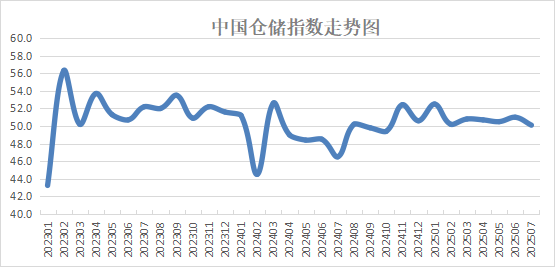
Core Insights - The China Logistics and Purchasing Federation released the July warehouse index, indicating a weak demand for warehousing services due to high temperatures and heavy rainfall, yet the index remains in the expansion zone for nine consecutive months [1] - The July warehouse index stands at 50.1%, a decrease of 0.9 percentage points from the previous month, suggesting continued expansion in the warehousing sector but at a slower pace [1] - The new orders index is at 50%, down 1.6 percentage points from last month, reflecting a slowdown in new order growth influenced by weather conditions, although demand for bulk commodity warehousing, particularly in non-ferrous metals and chemical products, has seen a notable increase [1] Demand and Inventory - Weather conditions have hindered the efficiency of inbound and outbound operations, coupled with weak terminal demand, leading to a significant slowdown in goods turnover speed [1] - As a result, inventory levels have generally increased across the sector [1] Employment and Future Outlook - The employee index for July is at 50.5%, unchanged from the previous month, indicating sustained expansion in employment within the sector [1] - The business activity expectation index also remains in the expansion zone, reflecting a positive outlook among enterprises regarding future market developments [1] - Experts suggest that with the end of the rainy season and supportive macro policies aimed at boosting consumption and optimizing the business environment, the warehousing industry is expected to enhance its vitality and maintain a stable and positive operational trend [1]
专家- 仓储板块基本面走到哪了?
2025-08-05 03:20
Summary of Conference Call Records Industry Overview - The logistics real estate market in China is experiencing a significant transformation, with a national high-standard warehouse vacancy rate nearing 18%, showing a downward trend. The average effective rent has slightly decreased to 21.6 yuan per square meter [1][2][3]. Key Points Market Dynamics - The total stock of high-standard warehouses reached 172 million square meters in Q2 2023, marking a nearly 2% quarter-over-quarter increase. Since December 2019, the stock has increased by nearly 100 million square meters [2]. - Major provinces for high-standard warehouse stock are Jiangsu, Guangdong, and Zhejiang, with Suzhou leading at 14 million square meters [1][2]. - New supply in Q2 2023 was concentrated in cities like Foshan, Guangzhou, Wuxi, Beijing, and Suqian, leading to a temporary imbalance in supply and demand, causing rents to decline in some areas [4]. Rental Trends - In cities with high occupancy rates, rents have bottomed out and are showing slight recovery. Cities like Shanghai, Dongguan, Guangzhou, and Beijing maintain rents above 30 yuan per square meter [4]. - The average rent in the logistics real estate market is experiencing a downward trend, despite improvements in occupancy rates over the past three quarters [31]. Demand Drivers - The primary demand for logistics real estate comes from e-commerce, third-party logistics, and express delivery sectors. During the 618 shopping festival, there was a notable increase in demand for temporary and external warehouses from platform companies [5][8]. - The home appliance industry and large supply chain companies are expanding warehouse space due to national subsidy policies, which continue to drive demand [5][7]. Future Supply Outlook - An estimated 10 million square meters of new supply is expected in the second half of 2025, with 13 million square meters in 2026, primarily in Guangdong, Beijing, and Shanghai [3][11]. - The overall supply is expected to decrease as the focus shifts towards stock integration and transactions, following a slowdown in project development over the past two years [11][30]. Regional Insights - The South China region is seeing significant integration in cross-border e-commerce warehouse layouts, with e-commerce platform leasing area share increasing from 7.6% in Q2 2024 to 30.9% in Q2 2025 [6][7]. - The Yangtze River Delta region has the largest stock of high-standard warehouses at approximately 60 million square meters, with a control rate of about 25% and average rent around 25 yuan per square meter [14][19]. Impact of External Factors - Changes in U.S. policies have led to increased direct mail costs, affecting user activity for companies like Shein and Temu, with declines of 25% and 50% respectively [3][9]. - Meituan's business adjustments have led to some warehouse de-leasing, but the overall impact on the market is limited due to continued demand from other segments [10]. Market Health Indicators - The health of the market cannot be judged by a fixed vacancy rate due to significant differences in stock bases across cities. For instance, a 10% vacancy rate in Beijing equates to 300,000 square meters, while the same rate in Tianjin represents 1 million square meters [34]. Conclusion - The logistics real estate market is adapting to changing demands and external pressures, with a focus on e-commerce and supply chain dynamics. Future supply will be closely monitored as the market continues to evolve, particularly in key regions like South China and the Yangtze River Delta.
仓储板块基本面走到哪了?
2025-08-05 03:19
Summary of Conference Call Notes Industry Overview - The conference call primarily discusses the logistics real estate market in China, focusing on high-standard warehouses and their performance metrics across various regions [2][3][4]. Key Points and Arguments 1. **Market Size and Growth**: The national high-standard warehouse market has reached a stock of 1.72 billion square meters, showing a slight increase of nearly 2% quarter-on-quarter [2]. 2. **Rental Trends**: Average rental prices have seen a decline, with a quarter-on-quarter decrease of 8% and a year-on-year decrease of 11% [1]. The effective rental rate is approximately 21.6 [3]. 3. **Occupancy Rates**: Despite the decline in rental prices, occupancy rates have shown signs of recovery, with most projects experiencing an increase in occupancy rates compared to previous quarters [1][5]. 4. **Regional Performance**: - **Top Regions**: Jiangsu, Guangdong, and Zhejiang are the top three provinces in terms of warehouse stock [3]. - **City Rankings**: Suzhou leads in stock with 14 million square meters, followed by Shanghai and Tianjin, each nearing 10 million square meters [4]. - **Emerging Cities**: New supply is concentrated in cities like Foshan, Guangzhou, and Wuxi, indicating a shift in market dynamics [5]. 5. **Demand Drivers**: The primary demand for warehouse space comes from e-commerce, third-party logistics, and express delivery sectors, with notable activity during promotional events like 618 [8][41]. 6. **Future Supply Outlook**: The anticipated supply for 2025 is projected to be around 1.3 billion square meters, indicating a slowdown compared to previous years [16][39]. 7. **Market Adjustments**: The market is experiencing adjustments due to increased supply and changing demand dynamics, leading to a potential decline in rental prices and occupancy rates in the short term [47]. Important but Overlooked Content 1. **Impact of E-commerce Promotions**: The 618 shopping festival has significantly influenced warehouse demand, with many e-commerce platforms increasing their rental space during this period [9][10]. 2. **Cross-Border E-commerce Trends**: The logistics market is also adapting to the needs of cross-border e-commerce, particularly in the southern regions, which are seeing increased warehouse integration and layout adjustments [9][11]. 3. **Market Resilience**: Despite the challenges, the logistics real estate market in regions like Guangdong remains robust, with a healthy occupancy rate of around 6% [46]. 4. **Long-term Adjustments**: The market is expected to stabilize as supply and demand reach a more balanced state, with some regions potentially seeing a rebound in rental prices as occupancy improves [40][41]. This summary encapsulates the key insights from the conference call, highlighting the current state and future outlook of the logistics real estate market in China.
保税科技: 张家港保税科技(集团)股份有限公司关于对控股子公司减资暨关联交易的公告
Zheng Quan Zhi Xing· 2025-08-04 16:12
Core Viewpoint - The company announced a reduction in capital for its subsidiary, Zhangjiagang Free Trade Zone Foreign Investment Service Co., Ltd. (referred to as "Foreign Service Company"), which will eliminate the current and potential competition with its controlling shareholder, JG Free Trade Zone Jinguang Asset Management Group Co., Ltd. [1][2] Summary by Sections 1. Overview of Related Transactions - The Foreign Service Company has a registered capital of RMB 467.33 million, with the company holding 54.004% and Jinguang Asset holding 45.996% [1][2] - The company plans to unilaterally reduce its capital in the Foreign Service Company by RMB 37.42 million, resulting in a new registered capital of RMB 429.91 million, with both the company and Jinguang Asset holding 50% equity each [1][2] 2. Related Party Introduction - Jinguang Asset is the controlling shareholder of the company, and the transaction constitutes a related party transaction but does not qualify as a major asset restructuring [2][3] - The company has had one related transaction with Jinguang Asset in the past 12 months, amounting to RMB 65.66 million [2][9] 3. Financial Overview of the Foreign Service Company - As of March 31, 2025, the Foreign Service Company reported total assets of RMB 631.98 million and net assets of RMB 598.58 million [4] - For the first quarter of 2025, the company generated revenue of RMB 16.89 million and a net profit of RMB 4.24 million [4] 4. Valuation and Pricing of the Transaction - The transaction price of RMB 65.66 million was determined based on an asset appraisal report, with the net asset value of the Foreign Service Company assessed at RMB 59.43 million [5][7] - The valuation methods included the asset-based approach and the income approach, with the asset-based approach being selected due to its reliability in reflecting the company's market value [5][7] 5. Agreement and Execution of the Capital Reduction - The capital reduction will be executed through legal procedures, with the company paying the reduction price in cash [6][8] - The company will modify its articles of association and update the shareholder register following the completion of the capital reduction [8] 6. Impact of the Transaction on the Company - The capital reduction will resolve the competition issue between the company and Jinguang Asset, and the long-term equity investment in the Foreign Service Company will shift from the cost method to the equity method [9] - It is expected that the company's net profit attributable to shareholders will increase by approximately RMB 65 million in 2025 due to this transaction [9]

2025年[最新]上海仓储实战案例分享:5家企业教你成功运营秘籍
Sou Hu Cai Jing· 2025-07-08 16:06
Core Insights - The article emphasizes the significant advancements in Shanghai's warehousing industry by 2025, focusing on digitalization, intelligence, and sustainability as key trends [2][8]. Group 1: Intelligent Warehousing - Duolong Logistics serves as a benchmark for intelligent warehousing, achieving a comprehensive upgrade in operations through the introduction of smart warehousing management systems [2]. - The company implemented automation and intelligent systems, such as Automated Guided Vehicles (AGVs) and smart shelves, which reduced manual intervention and error rates while enhancing picking and outbound efficiency [2][3]. - Data-driven decision-making allows Duolong Logistics to accurately forecast inventory needs, optimize layout, and minimize stockpiling and stockout risks [2][3]. Group 2: Supply Chain Optimization - Another Shanghai warehousing company improved inventory turnover rates significantly by optimizing supply chain management through deep collaboration with upstream and downstream partners [3]. - The company utilized historical sales data and market trends for precise demand forecasting, preventing over-purchasing [3]. - Establishing regional warehousing nodes shortened delivery distances, thereby enhancing customer satisfaction [3]. Group 3: Integrated Warehousing and Distribution - A company focusing on integrated warehousing and distribution achieved comprehensive logistics efficiency by consolidating storage and delivery resources [5]. - The optimization of warehousing layout and delivery routes led to reduced logistics costs and time losses [5]. - Providing customized warehousing and delivery solutions based on customer needs increased customer loyalty [5]. Group 4: Green Warehousing - A Shanghai warehousing company incorporated green logistics principles into operations, significantly reducing carbon emissions through the use of eco-friendly materials and optimized energy usage [6]. - The installation of solar panels and energy-saving devices in warehouses contributed to lower energy consumption [6]. - The promotion of recyclable and reusable packaging materials helped minimize resource waste [6]. Group 5: Digital Transformation - A warehousing company achieved transparency and efficiency in management through comprehensive digital transformation, utilizing blockchain technology and IoT devices [7]. - The application of blockchain technology ensured the immutability and transparent sharing of warehousing data, enhancing customer trust [7]. - Real-time monitoring of storage environments and equipment status via IoT devices reduced equipment failures and warehousing losses [7]. Conclusion and Implications - The practical cases from Shanghai's warehousing industry in 2025 highlight that intelligence, sustainability, and digitalization are the three major trends shaping the future of warehousing [8][9]. - Companies aiming for success in warehousing operations should focus on the integration of technological innovation, data-driven strategies, and green principles [9].