
仓储服务

Search documents
2025-2026年物流业全景纵览:在变局中淬炼韧性,在重构中定位新价值
Xin Lang Cai Jing· 2026-02-26 10:22
Core Insights - The Chinese logistics industry is experiencing resilience and differentiation amid global economic adjustments and domestic industrial transformations, with a focus on value creation driven by technological empowerment and policy guidance by 2026 [1][35]. Market Overview - In 2025, the total social logistics volume in China exceeded 360 trillion yuan, growing by 5.8%, while express delivery volume reached 1.82 billion pieces, maintaining a global leadership position for over a decade [2][35]. - The logistics industry is transitioning from scale expansion to value creation, with significant changes in operational capabilities across various segments [2][35]. Market Size and Growth - The logistics industry maintained steady growth in 2025, with the total logistics cost as a percentage of GDP decreasing to 14.1%, down 0.3 percentage points from 2024, indicating improved operational efficiency [36]. - The express delivery market showed a year-on-year growth of 11.2%, but the growth rate significantly slowed compared to over 20% in 2023, reflecting a shift from "traffic thinking" to "value thinking" [36][38]. Digital Transformation - 2025 marked a pivotal year for logistics digitalization, with technologies like IoT, big data, and AI becoming standard for small and medium enterprises [39]. - The number of automated storage systems (AS/RS) exceeded 9,000, growing by 18% from 2024, and the penetration rate of micro-automation solutions reached 43% in small e-commerce warehouses [39]. Intelligent Equipment - The intelligent logistics equipment market reached a tipping point for scale replication, with significant cost reductions driving further adoption [41]. - The deployment of L4 autonomous delivery vehicles in urban areas achieved daily delivery volumes of 80-120 orders, reducing operational costs to 60% of manual delivery [41]. Cost and Efficiency - The logistics industry faced pressures from rising oil, labor, and capital costs, while freight rates, warehouse rents, and equipment utilization remained under pressure, prompting innovation in operational models [44]. - Shared warehousing models emerged as effective responses to rising warehouse rents, improving overall space efficiency by 40%-60% [44]. Policy Environment - The regulatory landscape for the logistics industry in 2025 featured a balance of support and regulation, with stricter safety standards and increased focus on green logistics [12][26]. - The introduction of the "National Logistics Hub 2.0" plan emphasized the need for logistics hubs to attract supply chain headquarters and build unified information platforms [12]. Future Outlook - By 2026, the logistics industry is expected to shift from a focus on growth speed to value creation, with an anticipated growth rate of 5.2%-5.5% for total social logistics volume, while logistics value-added growth may reach 6.5% [19]. - The industry will increasingly adopt the concept of "Logistics as a Service (LaaS)," providing data-driven supply chain optimization solutions [19].

1月份中国仓储指数为51.9% 仓储行业保持良好运行态势
Zheng Quan Ri Bao· 2026-02-06 16:28
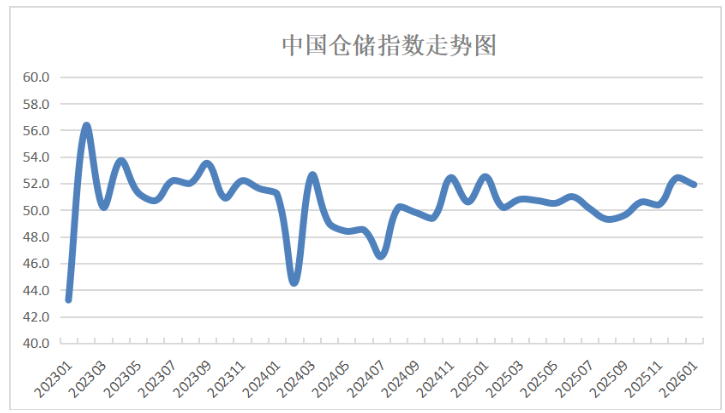
Core Viewpoint - In January 2026, China's warehousing index decreased to 51.9%, down 0.5 percentage points from December 2025, indicating a slight decline but still within the expansion range, reflecting a generally good operational status in the warehousing industry [1] Group 1: Warehousing Index and Business Volume - The business volume index stood at 52.2%, a decrease of 1.4 percentage points from the previous month, with steel, non-ferrous metals, food, and pharmaceuticals showing indices above 50%, while chemicals, coal, and daily necessities were below 50% [1] - The facility utilization index increased to 54.3%, up 0.3 percentage points from the previous month, indicating improved utilization of warehousing facilities [1] - The ending inventory index rose to 53.3%, an increase of 1.4 percentage points from the previous month, suggesting a rise in inventory levels [1] Group 2: Business Activity Expectations - The average inventory turnover index decreased to 51.9%, down 1.5 percentage points from the previous month, indicating a slight slowdown in turnover [1] - The business activity expectation index fell to 49.6%, a decline of 3.1 percentage points from the previous month, reflecting anticipated short-term fluctuations in demand as the holiday approaches [1] - Despite the expected short-term volatility, the overall demand foundation for the industry remains strong, with expectations for stabilization and improvement post-holiday [2]

中物联:中国仓储业务量继续增长 商品周转保持活跃
智通财经网· 2026-02-06 06:18
Core Viewpoint - The China Warehousing Index for January 2026 stands at 51.9%, a decrease of 0.5 percentage points from the previous month, yet remains in the expansion zone, indicating a generally positive operational trend in the warehousing industry [1]. Group 1: Business Volume and Facility Utilization - The business volume index is at 52.2%, down 1.4 percentage points from last month, but still indicates growth, reflecting a continued recovery in warehousing operations [2]. - The facility utilization index has increased to 54.3%, up 0.3 percentage points from the previous month, marking a 14-month high [2]. - Despite entering a traditional off-season for bulk commodities, pre-holiday inventory replenishment has led to a rebound in warehousing demand, particularly for steel, non-ferrous metals, and building materials [2]. Group 2: Inventory and Turnover Efficiency - The average inventory turnover index is at 51.9%, down 1.5 percentage points from last month, but still indicates efficient turnover of goods [2]. - The end-of-period inventory index has risen to 53.3%, up 1.4 percentage points from the previous month, showing a continuous upward trend for three consecutive months [2]. - These index changes suggest smooth and efficient circulation in the supply chain, with increased inventory replenishment by enterprises, laying a solid foundation for resuming production activities post-holiday [2]. Group 3: Business Activity Expectations - The business activity expectations index is at 49.6%, down 3.1 percentage points from last month, reflecting a notable decline due to seasonal factors [3]. - As the holiday approaches, demand for warehousing services is expected to weaken, leading to potential short-term fluctuations in the index [3]. - However, the overall demand foundation for the industry remains strong, and it is anticipated that the index will stabilize and improve after seasonal factors dissipate [3].
国际集运的核心服务是什么?主要包括哪些内容?
Sou Hu Cai Jing· 2026-01-26 07:14
Core Insights - International shipping services are essential for meeting the growing consumer demand for cross-border shopping, providing efficient logistics solutions such as international express delivery, warehousing, packaging, and customs clearance [2][4][14] - The collaboration with reputable courier companies enhances delivery efficiency and consumer trust, significantly improving the overall shopping experience for both individual packages and e-commerce goods [2][5][14] Group 1: Impact on Consumer Experience - International shipping enhances user experience by allowing consumers to purchase products globally without being limited to local merchants [5][12] - The logistics process is simplified, improving package handling and delivery efficiency [5][7] - Shipping costs are reduced through consolidated transportation of multiple packages, making shopping more attractive [5][12] Group 2: Key Elements of Efficient International Shipping - Trustworthy courier companies are fundamental for ensuring fast and safe delivery of packages, supported by experienced teams and robust transportation networks [7][10] - Effective warehousing management optimizes space utilization and accelerates package processing [7][9] - Proper packaging is crucial for protecting items during transit, while streamlined customs processes enhance overall efficiency [7][10][12] Group 3: Role of Warehousing and Packaging - Warehousing services provide a secure environment for storing packages, often located near logistics centers for quick processing and dispatch [9][12] - Modern warehousing facilities utilize advanced management systems for real-time inventory tracking, ensuring proper management of goods [9][12] - Professional packaging services select appropriate materials to prevent damage during transport, improving shipping efficiency and reducing costs [9][12] Group 4: Benefits for Cross-Border E-commerce - International shipping services lower logistics costs, giving merchants a competitive pricing advantage [9][12] - Reliable and fast transportation enhances customer satisfaction and encourages repeat purchases [9][12] - E-commerce businesses can flexibly manage inventory through shipping and packaging services, responding to varying market demands [9][12]

跨境电商广佛仓储大变阵
Hua Er Jie Jian Wen· 2026-01-20 15:23
Core Insights - The report indicates that the Guangzhou and Foshan warehousing logistics market experienced a significant rebound in demand and a decline in rental prices in 2025, driven by policy incentives, adjustments in e-commerce structures, and deepening regional divisions [1][2]. Supply and Demand - In 2025, Guangzhou's warehousing market reached a supply peak with 12 quality projects delivered, totaling approximately 930,000 square meters [1]. - The net absorption in Guangzhou was 757,000 square meters, a significant rebound from negative absorption in 2024, despite an increase in vacancy rates to 8.9% by year-end [1][3]. - Foshan's warehousing market saw a record net absorption of 1.68 million square meters, a year-on-year increase of 137%, with a decrease in vacancy rates to 6.6% [3]. Rental Trends - Guangzhou's rental prices fell by 7.6% year-on-year to 35.5 yuan per square meter per month by the end of 2025 [1]. - Foshan's rental prices also decreased by 7.0% year-on-year to 34.4 yuan per square meter per month [3]. - The decline in rental prices in both cities is attributed to increased supply and stronger bargaining power of tenants, particularly in the context of cross-border e-commerce [3]. Sector Performance - Third-party logistics accounted for the highest transaction share in Guangzhou at 65%, with significant contributions from a major e-commerce platform [2]. - Pure e-commerce transactions made up 27% of the total, with cross-border e-commerce representing 17% of all transactions [2]. - In Foshan, cross-border e-commerce transactions dominated, accounting for 81% of total transactions, indicating a shift in market dynamics [2]. Future Outlook - Both Guangzhou and Foshan are expected to continue experiencing supply peaks in 2026, with projected new warehousing facilities of 2.64 million and 1.33 million square meters, respectively [3]. - The expansion of the new airport in Foshan is anticipated to positively impact the local warehousing market [3].
惠农“税费通”|支持乡村振兴系列税费优惠政策(46)物流企业大宗商品仓储设施用地减半征收城镇土地使用税
蓝色柳林财税室· 2026-01-18 13:24
Core Viewpoint - The article discusses the tax reduction policy for logistics companies regarding urban land use tax for large commodity storage facilities, effective from January 1, 2023, to December 31, 2027, allowing a 50% reduction in tax assessment [3][9]. Group 1: Definition and Scope - Logistics companies are defined as those engaged in at least one type of warehousing or transportation business, providing third-party logistics services for agricultural and industrial production, circulation, import and export, and residential life [4]. - Large commodity storage facilities are defined as storage facilities with an area of 6,000 square meters or more, primarily storing various agricultural products, industrial raw materials, and mineral products [5]. - The land for storage facilities includes various types of warehouses, oil tanks, loading and unloading areas, and other logistics operation support facilities [6]. Group 2: Tax Policy Details - The tax reduction policy does not apply to office and living areas of logistics companies or any land not directly used for large commodity storage, which will be taxed according to regulations [7]. - To benefit from the tax reduction policy, taxpayers must submit a tax exemption application and retain property ownership proof, land use proof, and lease agreements for record-keeping [8].

三羊马(001317.SZ):拟变更部分募投项目用途
Ge Long Hui A P P· 2026-01-16 12:03
Core Viewpoint - The company, Sanyangma (001317.SZ), has announced the completion of its fundraising project "Sanyangma Multimodal Transport (Chongqing) Intelligent Application Base (Phase I)" which focuses on automotive display sales, warehousing services, and related logistics services [1] Group 1: Project Overview - The project includes the construction of facilities for automotive display, storage, and office centers, serving as a temporary storage warehouse for vehicles, a transit distribution center for used cars, and a vehicle display and trading center [1] - As of March 2025, the project buildings have been completed and passed joint acceptance, with fire safety registration compliant, allowing the company to transfer the buildings from construction in progress to fixed assets according to accounting standards [1] Group 2: Asset Utilization and Future Plans - Currently, part of the buildings is being utilized for automotive storage, display, and office purposes based on the company's operational needs [1] - Due to changes in market conditions and the company's development plans, some areas of the project will remain idle after meeting internal needs [1] - To enhance asset utilization efficiency and maximize shareholder value, the company has decided to change the use of certain project areas to include third-party collaborations for external services, financial management services, education and training services, information services, and platform services [1]
国际集运是什么?它为全球跨境物流提供了哪些全方位服务?
Sou Hu Cai Jing· 2026-01-11 05:08
Core Insights - International consolidation is a logistics solution designed for individuals and e-commerce businesses, emphasizing efficient handling of cross-border goods transportation [2][15] - The service includes various transport methods such as air, sea, and land, along with additional services like pickup, warehousing, and customs clearance to streamline the logistics process [2][17] - The growing demand for e-commerce is driving the evolution of international consolidation, aiming to provide a smoother shipping experience for global customers [2][20] Group 1: Service Features - International consolidation offers flexible shipping options, including air and sea transport, catering to diverse customer needs [11][20] - The service ensures efficient inventory management and reduced package dwell time through effective warehousing practices [7][8] - Simplified customs processes are crucial for minimizing shipping times and enhancing overall efficiency [7][19] Group 2: Transport Method Comparison - Air transport is faster and suitable for urgent shipments, particularly for small and high-value items, while sea transport is more cost-effective for bulk and non-urgent goods [5][18] - Companies can choose between air and sea transport based on urgency, cost, and the nature of the goods being shipped [5][9] Group 3: Importance of Collaboration - Effective collaboration with logistics partners is essential for maintaining information sharing and communication during the shipping process [7][19] - Real-time tracking systems enhance transparency and customer trust by allowing clients to monitor their package status [7][14] Group 4: Market Impact - As global markets expand, brands increasingly rely on international consolidation services to enhance competitiveness and ensure timely product delivery [9][20] - The integration of consolidation channels allows brands to achieve more competitive shipping rates and services, improving marketing effectiveness and brand image [9][20]
秒懂!一图轻松读懂生活服务与现代服务
蓝色柳林财税室· 2026-01-11 01:37
Core Viewpoint - The article discusses the tax rates applicable to various service sectors, including modern services and living services, highlighting the differences in VAT rates and exemptions for specific services [3][10]. Tax Rates for Living Services - The basic VAT rate for living services is 6% [3]. - Specific service categories and their VAT rates include: - Catering and accommodation: 6% [3] - Education and medical services: exempt from VAT [3] - Cultural and sports services: 6% [3] - Tourism services: 6%, with an option for differential taxation [3] - Entertainment services: 6% [3] - Daily resident services: 6%, with exemptions for marriage introduction and funeral services [3]. Tax Rates for Modern Services - The basic VAT rate for modern services is also 6% [3]. - The article provides a detailed breakdown of various service categories under modern services, although specific categories are not listed in the provided text [3]. Tax Policies for Affordable Housing - The article outlines tax policies related to the planning and construction of affordable housing, aimed at improving housing supply and addressing urban housing issues [10]. - Tax exemptions include: - Exemption from urban land use tax and stamp duty for affordable housing projects [11]. - Exemption from land value-added tax for certain transfers of old houses as affordable housing sources [11]. - Exemption from various administrative fees and government funds related to affordable housing projects [12]. Implementation Date - The tax policies regarding affordable housing will be effective from October 1, 2023 [13].

三羊马涨2.01%,成交额1.47亿元,主力资金净流入676.09万元
Xin Lang Cai Jing· 2026-01-09 02:58
Group 1 - The core viewpoint of the news is that the stock price of Sanyangma has shown a positive trend, with a 2.01% increase on January 9, reaching 55.70 CNY per share, and a total market capitalization of 4.766 billion CNY [1] - As of January 9, the stock has increased by 1.07% year-to-date, 34.48% over the past 20 days, and 12.03% over the past 60 days [2] - The company, Sanyangma (Chongqing) Logistics Co., Ltd., was established on September 6, 2005, and went public on November 30, 2021, focusing on comprehensive transportation services for vehicles and non-automotive goods, as well as warehousing services [2] Group 2 - The revenue composition of Sanyangma includes 60.54% from automotive logistics services, 36.66% from non-automotive logistics services, 1.60% from warehousing services, and 1.19% from other services [2] - As of November 28, the number of shareholders has increased to 19,400, with an average of 1,797 circulating shares per person, reflecting a 10.45% increase [2] - For the period from January to September 2025, Sanyangma reported a revenue of 1.172 billion CNY, representing a year-on-year growth of 44.60%, while the net profit attributable to the parent company was a loss of 11.794 million CNY, a decrease of 201.58% [2] Group 3 - Since its A-share listing, Sanyangma has distributed a total of 57.6294 million CNY in dividends, with 25.6134 million CNY distributed over the past three years [3]