
债券发行

Search documents
【立方债市通】一省级国企置换18亿非标融资/河南加速陆港资源整合/河南一便民服务中心ABS获受理
Sou Hu Cai Jing· 2025-11-24 12:54
Financing Developments - Yunnan Energy Investment Group's subsidiary, Weixin Energy, signed a non-standard financing replacement agreement worth 1.8 billion yuan, expected to save 50 million yuan in financial costs annually after replacing high-cost financing with an interest rate of less than 3% [1] - Henan Investment Group announced the transfer of 10.9 billion yuan in assets to Henan Zhongyu International Port Group as part of a strategy to optimize land port resources [3] - The issuance of an asset-backed security (ABS) project by Zhengxin Construction Investment Service Center has been accepted, with a proposed issuance amount of 1 billion yuan [5] Monetary Policy - The People's Bank of China conducted a 3,387 billion yuan reverse repurchase operation with a net injection of 557 billion yuan [6] - A 10,000 billion yuan Medium-term Lending Facility (MLF) operation is set to be conducted to maintain liquidity in the banking system [7] Corporate Changes - Huang Ming has been elected as the chairman of Xinyang Huaxin Investment Group, replacing Yang Fan [1] - Wang Qiang is no longer the chairman of Hefei High-tech Holding Group [16] Debt Market Activity - Xinxiang State-owned Capital Operation Group completed the issuance of 1 billion yuan in corporate bonds at an interest rate of 2.26% [9][10] - Shennong Industrial Co., Ltd. plans to issue up to 1 billion yuan in technology innovation bonds, with a coupon rate between 2.1% and 3.1% [11] - The second batch of technology innovation bonds supported by risk-sharing tools is set to be issued, totaling 930 million yuan [12] Risk Management - Inner Mongolia's 14th Five-Year Plan emphasizes the resolution of hidden debts and the dynamic clearance of high-risk financial institutions [8] - The announcement from Jingchu Cultural Industry Investment Group regarding its exit from the financing platform seeks creditor opinions on the matter [17] Market Sentiment - The Western Fixed Income team anticipates a more stable funding rate environment, with the bond market likely to remain volatile in the short term [20]


上交所:郎溪开创产业投资集团有限公司债券11月25日挂牌,代码280598
Sou Hu Cai Jing· 2025-11-24 02:12
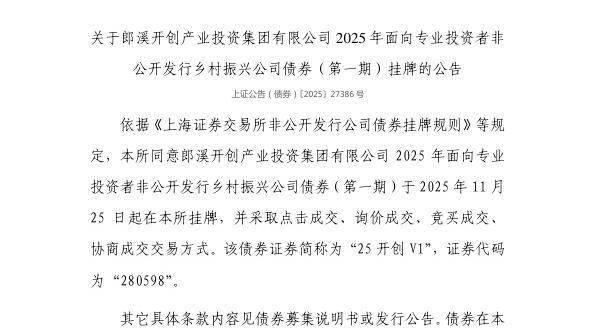
11月24日,上交所发布关于郎溪开创产业投资集团有限公司2025年面向专业投资者非公开发行乡村振兴 公司债券(第一期)挂牌的公告。 依据《上海证券交易所非公开发行公司债券挂牌规则》等规定,上交所同意郎溪开创产业投资集团有限 公司2025年面向专业投资者非公开发行乡村振兴公司债券(第一期)于2025年11月25日起在上交所挂 牌,并采取点击成交、询价成交、竞买成交、协商成交交易方式。该债券证券简称为"25开创V1",证 券代码为"280598"。 来源:市场资讯 ...
中国发行欧元主权债券,贝森特急了,警告中国不要动美国的奶酪
Sou Hu Cai Jing· 2025-11-23 07:53
消息很快传到大西洋彼岸。11 月 19 日,美国财长贝森特在一场公开讲话中罕见地提高分贝,点名对欧盟成员国发出警告,称"跨大西洋同盟应在这一刻体 现出来",并强调欧洲购买中国主权债券"不符合盟友精神"。言辞中不乏不满甚至焦躁。 这一天,美国的情绪,被许多外媒形容为"彻底破防"。 对中国而言,本次在卢森堡发行的欧元主权债券属于第二期,分为 4 年期与 7 年期,各 20 亿欧元。 财政部原本设定的目标十分务实:稳定发行、合理定价,吸引欧洲长期机构投资者。但事实证明,市场用行动给出了更热烈甚至近乎"抢货"的回应。 2025 年 11 月的欧洲,天气渐冷,但金融市场却被一股来自东方的热度点燃。 当地时间 11 月 18 日,中国财政部在卢森堡大公国完成了 40 亿欧元主权债券的发行。原本,财政部内部对发行规模和市场反应都有清醒估计:40 亿欧元, 只要顺利认购完成,就算达成既定目标。 然而市场随后爆发的热情,完全超出中国方面的预期。 短短几天时间,欧洲乃至全球主要资本机构纷纷下单,最终认购意向金额突破 1000 亿欧元——足足是发行量的 25 倍。这份如同"火山喷发"般的订单簿,让 国际市场一片哗然。 选择卢森堡, ...
招金矿业2025年面向专业投资者公开发行科技创新公司债券(第一期)票面利率为1.89%
Zhi Tong Cai Jing· 2025-11-21 08:41
Core Viewpoint - Zhaojin Mining (01818) has received approval from the China Securities Regulatory Commission to publicly issue corporate bonds totaling up to RMB 6 billion, with the first phase of issuance set at RMB 1 billion [1] Group 1: Bond Issuance Details - The company is authorized to issue bonds with a face value of up to RMB 60 billion, structured as a phased issuance [1] - The first phase of the bond issuance is capped at RMB 1 billion, with a maturity period of 5 years [1] - Investors have the option to sell back the bonds at the end of the third year, and the company has the right to adjust the coupon rate at that time [1] Group 2: Interest Rate and Issuance Schedule - The coupon rate for the bonds has been set at 1.89% following inquiries from professional institutional investors [1] - The bonds will be issued to professional institutional investors from November 21 to November 24, 2025 [1]
稳增长扩投资专项债 发行金额超千亿元
Jin Rong Shi Bao· 2025-11-21 00:28
Core Points - China Guoxin Holdings successfully issued 20.4 billion yuan special bonds for stable growth and investment expansion with a 10-year term and a coupon rate of 2.3% [1] - The cumulative issuance of special bonds for stable growth and investment expansion has exceeded 100 billion yuan, effectively supporting central enterprises in playing a backbone role in the national economy [1] - The issuance of the first batch of 50 billion yuan special bonds took place in November 2024, with a total of 5 issuances amounting to 109.9 billion yuan to date [1] Summary by Category - **Issuance Details** - The special bonds have been issued in five tranches, totaling 109.9 billion yuan, with China Guoxin issuing 73.4 billion yuan and China Chengtong issuing 36.5 billion yuan [1] - **Support and Collaboration** - The China Interbank Market Dealers Association is actively supporting the issuance of these special bonds in collaboration with the People's Bank of China and the State-owned Assets Supervision and Administration Commission [1] - **Future Plans** - The association plans to continue promoting the issuance of special bonds under the guidance of the People's Bank of China and the State-owned Assets Supervision and Administration Commission to enhance the effectiveness of the special bond policy [1]
时报观察丨主权债券屡受热捧 中国资产“圈粉”全球
Zheng Quan Shi Bao Wang· 2025-11-20 23:21
Group 1 - The Ministry of Finance successfully issued €4 billion in sovereign bonds in Luxembourg, attracting over 1,000 institutional investors with a subscription rate of 25 times, setting a record for China's euro-denominated sovereign bond issuance [1] - Two weeks prior, a $4 billion sovereign bond issuance also saw strong demand with a subscription rate of nearly 30 times, indicating unprecedented global investment demand for Chinese sovereign bonds [1] - The distribution of international investors shows a high proportion of long-term investors such as central banks, sovereign wealth funds, and banks, with over 60% of allocations going to regions outside Asia, reflecting confidence in the safety and sustainability of Chinese assets [1] Group 2 - In 2023, China has significantly increased its overseas sovereign bond issuance, surpassing the total amount issued in the previous year, supported by a favorable global financing environment due to central bank interest rate cuts [2] - The ongoing overseas bond issuance provides a pricing benchmark for Chinese enterprises seeking to finance abroad, helping to reduce their financing costs and uncertainties [1] - The recent data from the State Administration of Foreign Exchange indicates that in October, the scale of securities investment settlement reached a historical high of $31 billion, with a surplus of $5 billion, suggesting a continued inflow of foreign capital into Chinese assets [2]
俄罗斯发行350亿人民币主权债券!
Sou Hu Cai Jing· 2025-11-20 23:09
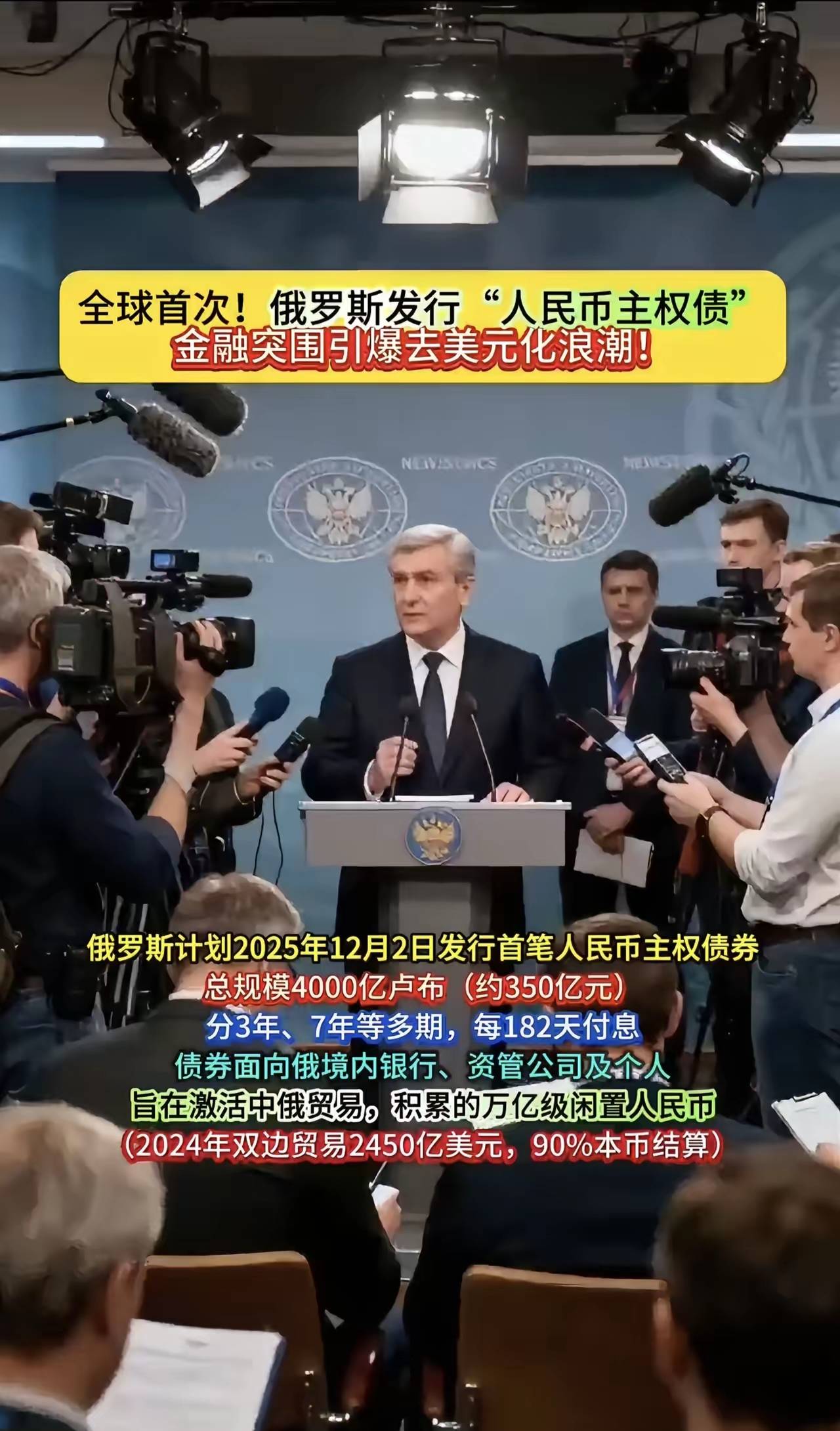
Core Insights - Russia is issuing RMB-denominated sovereign bonds to alleviate wartime fiscal pressure, utilizing the large amount of RMB accumulated from trade with China, where over 90% of transactions are settled in local currencies [1][4] - Brazil is also planning to issue similar bonds, aiming to stimulate its economy by leveraging its own RMB reserves, indicating a trend towards the internationalization of the RMB [1] Group 1 - The bond issuance by Russia amounts to 400 billion rubles, approximately 35 billion RMB, with maturities of three and seven years [4] - The bonds will be offered to domestic banks, asset management companies, and individuals, with interest payments made every 182 days [4] - The initiative aims to activate Sino-Russian trade, with projected bilateral trade reaching 245 billion USD in 2024, 90% of which will be settled in local currencies [4]
主权债券屡受热捧 中国资产“圈粉”全球
Zheng Quan Shi Bao· 2025-11-20 22:56
Group 1 - The Ministry of Finance successfully issued €4 billion in sovereign bonds in Luxembourg, attracting over 1,000 institutional investors with a subscription rate of 25 times, setting a historical record for China's euro-denominated sovereign bond issuance [1] - Two weeks prior, a $4 billion sovereign bond issuance also saw strong market demand with a subscription rate of nearly 30 times, indicating unprecedented global investment demand for Chinese sovereign bonds [1] - The distribution of international investors shows a high proportion of long-term investors such as central banks, sovereign wealth funds, and banks, with over 60% of allocations going to regions outside Asia, reflecting confidence in the safety and sustainability of Chinese assets [1] Group 2 - In 2023, China has significantly expanded its overseas sovereign bond issuance, surpassing the total amount issued in the previous year, supported by a favorable global financing environment due to central bank interest rate cuts [2] - The increasing overseas bond issuance is also driven by the rising financing needs of Chinese enterprises going global, providing a pricing benchmark for their offshore financing and helping to reduce costs and uncertainties [2] - The trend of foreign capital inflow into Chinese assets continues, with October seeing a record high of $31 billion in securities investment settlement, indicating a positive outlook for China's stock and foreign exchange markets [2]
银行间市场支持发行超千亿稳增长扩投资专项债
Xin Hua Cai Jing· 2025-11-20 12:15
Core Viewpoint - China Guoxin Holdings has issued 20.4 billion yuan in special bonds aimed at stabilizing growth and expanding investment, with a 10-year maturity and a coupon rate of 2.3% [1] Group 1: Special Bond Issuance - The cumulative issuance of special bonds has exceeded 100 billion yuan, effectively supporting central enterprises in playing a backbone role in the national economy [1] - The first batch of 50 billion yuan in special bonds was successfully issued in November 2024, with subsequent issuance work progressing steadily [1] - A total of 5 tranches have been issued so far, amounting to 109.9 billion yuan, with China Guoxin issuing 73.4 billion yuan and China Chengtong issuing 36.5 billion yuan [1] Group 2: Investment Focus - The special bonds are designed to support central enterprises in deepening investments in key areas such as major equipment upgrades, technological renovations, significant technological innovation projects, and strategic emerging industries [1] - The issuance of these bonds aims to achieve multiple objectives, including policy guidance, financial support, and enterprise development, thereby effectively promoting the implementation of national policies and serving the high-quality development of the real economy [1]
财政部:首次在卢森堡发行欧元主权债券
Sou Hu Cai Jing· 2025-11-19 10:02
Core Viewpoint - The Ministry of Finance of the People's Republic of China successfully issued €4 billion in sovereign bonds in Luxembourg, marking the first issuance of euro-denominated sovereign bonds in this market, which received strong demand from international investors [1] Group 1: Issuance Details - The issuance included €2 billion in 4-year bonds with an interest rate of 2.401% and €2 billion in 7-year bonds with an interest rate of 2.702% [1] - The total subscription amount reached €100.1 billion, which is 25 times the issuance amount, with the 7-year bonds having a subscription multiple of 26.5 times [1] Group 2: Investor Profile - The investor base was diverse, with geographical distribution as follows: 51% from Europe, 35% from Asia, 8% from the Middle East, and 6% from offshore investors in the United States [1] - The types of investors included sovereign entities (26%), fund management (39%), banks and insurance companies (32%), and dealers (3%) [1] Group 3: Settlement and Listing - All issued bonds will be custodied in the Central Moneymarkets Unit (CMU) of the Hong Kong Monetary Authority and will subsequently be listed on the Hong Kong Stock Exchange and the Luxembourg Stock Exchange [1]