
电动汽车充电

Search documents
ChargePoint(CHPT) - 2026 Q3 - Earnings Call Transcript
2025-12-04 22:32
Financial Data and Key Metrics Changes - Revenue for the third quarter reached $106 million, exceeding the high end of guidance by $6 million, marking a 7% sequential increase and a 6% year-on-year increase [5][14] - Non-GAAP gross margin remained at a record high of 33%, flat sequentially and up 7 percentage points year-on-year [14][15] - Non-GAAP adjusted EBITDA loss was $19 million, an improvement from a loss of $22 million in the prior quarter and a loss of $29 million in the same quarter last year [16] - Cash balance at the end of the quarter was $181 million, down from $195 million in the prior quarter, reflecting cash usage of $14 million [16][17] Business Line Data and Key Metrics Changes - Network charging systems revenue was $56 million, accounting for 53% of total revenue, up 12% sequentially and 7% year-on-year [14][15] - Subscription revenue reached $42 million, representing 40% of total revenue, up 5% sequentially and 15% year-on-year [15] - Other revenue was $7 million, making up 7% of total revenue [15] Market Data and Key Metrics Changes - North America accounted for 85% of total revenue, while Europe contributed 15%, consistent with previous quarters [15] - Demand in Europe is accelerating, with significant opportunities emerging across key markets, driven by favorable regulatory support and rapid EV adoption [7][8] Company Strategy and Development Direction - The company is focused on a three-year strategic plan built on four pillars: efficient hardware innovation, software innovation, world-class driver experiences, and operational excellence [9][10] - The partnership with Eaton is expected to enhance innovation and product offerings, particularly in the V2G and V2H segments [11][45] - The company aims to leverage new product launches to drive market share gains and margin improvements [10][12] Management's Comments on Operating Environment and Future Outlook - Management expressed confidence in continued revenue growth, particularly in the second half of calendar 2026, supported by new product launches and partnerships [5][19] - The competitive landscape is consolidating, creating opportunities for the company to expand its market presence [8] - Management remains cautious about the broader macroeconomic environment but is optimistic about growth prospects [19] Other Important Information - The company completed a debt exchange transaction that reduced total debt by $172 million and extended maturity to 2030, which is seen as a transformative step for financial stability [18][19] - The company manages approximately 375,000 ports globally, including over 39,000 DC fast chargers [9] Q&A Session Summary Question: Can you talk about product evolution and demand from virtual power plants? - Management highlighted the new Flex product line that is V2G and V2H-enabled, which is expected to roll out in 2026, and a new DC fast charging product that integrates directly with a DC grid [22][23] Question: What are the expectations for inventory reduction? - Management anticipates a small decline in inventory in Q4, with a more significant decrease expected throughout the next fiscal year as existing inventory is sold [25][26] Question: Will new products drive gross margins higher? - Improvements in hardware margin will depend on product mix, with expectations for margin improvement in the latter half of next year as new products are released [30][31] Question: Can you provide insights on projects in Europe? - Management expressed confidence in winning significant deals in Europe, driven by positive customer feedback on new products [35][36] Question: What drove the revenue beat this quarter? - The significant revenue beat was attributed to a boost in residential billing due to the expiration of federal EV credits, alongside strong performance in commercial sales [40][41] Question: How is the Eaton partnership progressing? - The partnership is exceeding expectations, with significant innovation and collaboration leading to differentiated products [44][45] Question: What is the status of NEVI funding? - Management noted that 40 states are active in NEVI and awarding contracts, with projects moving forward as expected [49][50]

武汉天源成立智充科技公司
Zheng Quan Shi Bao Wang· 2025-12-03 02:50
Core Viewpoint - Wuhan Tianyuan Smart Charging Technology Co., Ltd. has been established, focusing on digital technology services and electric vehicle charging infrastructure operations [1] Company Summary - The company is registered with a capital of 10 million yuan [1] - The legal representative of the company is Ni Wei [1] - Wuhan Tianyuan holds full indirect ownership of the new company [1] Industry Summary - The business scope includes centralized fast charging stations and electric vehicle charging infrastructure operations [1]
特锐德:收购控股子公司少数股东股权
Mei Ri Jing Ji Xin Wen· 2025-11-28 10:52
每经头条(nbdtoutiao)——已有75人遇难,1名死者为消防员,还有10名消防员受伤!记者现场直击香 港大埔火灾:燃烧的宏福苑,五级大火的五个谜团 (记者 曾健辉) 每经AI快讯,特锐德(SZ 300001,收盘价:26.63元)11月28日晚间发布公告称,基于对新能源汽车和 充电基础设施产业发展前景的认可以及对控股子公司特来电新能源股份有限公司未来发展的信心,青岛 特锐德电气股份有限公司拟以自有资金人民币5516.46万元收购上海久事产业投资基金合伙企业(有限 合伙)持有的特来电0.3677%的股权。 2025年1至6月份,特锐德的营业收入构成为:输配电行业占比70.57%,电动汽车充电占比29.43%。 截至发稿,特锐德市值为281亿元。 ...

哥伦比亚加速电动汽车充电基础设施建设
Shang Wu Bu Wang Zhan· 2025-11-27 16:20
Core Viewpoint - The Colombian Ministry of Mines and Energy has announced new policies aimed at accelerating the development of the national electric vehicle charging network, making Colombia an attractive destination for charging infrastructure investment [1] Group 1: Policy Changes - New regulations allow charging operators to enter the unregulated electricity market without power and monthly consumption limits [1] - Electricity used for electric vehicle charging will be exempt from a 20% contribution fee, reducing operational costs [1] Group 2: Technical Standards - All public charging stations for electric and plug-in hybrid vehicles must be equipped with at least one Type 2 interface and one CCS Combo 2 interface [1] - Existing public charging stations will have an 18-month transition period to complete upgrades [1] Group 3: Tax Incentives - Charging infrastructure projects can still benefit from tax incentives outlined in Laws 1715 and 2099, including exemptions from tariffs and VAT, accelerated depreciation, and income tax benefits [1] Group 4: Industry Impact - The Minister of Mines and Energy, Palma, stated that these incentive measures will help eliminate industry barriers and promote the development of clean transportation [1]
海螺水泥成立新公司 含电动汽车充电基础设施业务
Zheng Quan Shi Bao Wang· 2025-11-26 05:20
Core Insights - Shanghai Conch Jianye New Materials Co., Ltd. has been established with a registered capital of 30 million yuan [1] - The company's business scope includes domestic trade agency, loading and unloading, and electric vehicle charging infrastructure operation [1] - Conch Cement (600585) holds indirect full ownership of the new company [1]

财达证券每日市场观-20251120
Caida Securities· 2025-11-20 02:05
Market Performance - On November 19, the Shanghai Composite Index rose by 0.18% and the ChiNext Index increased by 0.25%[2] - On November 20, the trading volume decreased to 1.74 trillion yuan, down approximately 210 billion yuan from the previous trading day[1] Sector Trends - Over half of the sectors experienced declines, with notable gains in non-ferrous metals, oil, and military industries[1] - Real estate, media, building materials, and computer sectors saw the largest declines[1] Investment Strategy - The market is showing a conservative trend, suggesting a focus on low-position stocks in sectors like computing power, semiconductors, and new energy that have undergone phase adjustments[1] - Investors are advised to avoid short-term strong sectors and maintain a cautious position[1] Capital Flow - On November 19, net inflows into the Shanghai Stock Exchange were 11.193 billion yuan, while the Shenzhen Stock Exchange saw net inflows of 5.073 billion yuan[3] Industry Insights - The domestic market for trendy and collectible toys is projected to reach a retail total of 55.83 billion yuan in 2024, indicating a significant growth point for the toy industry[4] - As of October 2025, the total number of electric vehicle charging facilities in China reached 18.645 million, a year-on-year increase of 54%[9]

中国电动汽车充电基础设施总数达1864.5万个
Ren Min Ri Bao Hai Wai Ban· 2025-11-20 01:05
Core Insights - As of October 2025, China's electric vehicle charging infrastructure has reached a total of 18.645 million charging points, marking a year-on-year growth of 54.0% [1] Summary by Category Overall Infrastructure Growth - The total number of electric vehicle charging points in China is 18.645 million, which represents a significant increase of 54.0% compared to the previous year [1] Public Charging Facilities - Public charging facilities account for 4.533 million charging points, showing a year-on-year growth of 39.5% [1] - The total rated power of public charging stations has reached 203 million kilowatts, with an average power output of approximately 44.69 kilowatts [1] Private Charging Facilities - Private charging facilities comprise 14.112 million charging points, reflecting a year-on-year increase of 59.4% [1] - The installed electricity capacity for private charging facilities has reached 12.4 million kilovolt-amperes [1]
时报数说 我国电动汽车充电基础设施总数达1864.5万个
Zheng Quan Shi Bao· 2025-11-19 18:12
Core Viewpoint - The article discusses significant developments in the financial market, highlighting trends and potential investment opportunities in various sectors [2] Group 1: Financial Market Trends - The financial market is experiencing notable fluctuations, with specific sectors showing resilience amidst broader economic challenges [2] - Investment in technology and renewable energy sectors is gaining traction, driven by increasing demand and government support [2] Group 2: Company Performance - Several companies reported strong quarterly earnings, exceeding market expectations and indicating robust operational performance [2] - Mergers and acquisitions activity is on the rise, suggesting strategic consolidation within the industry to enhance competitive positioning [2]

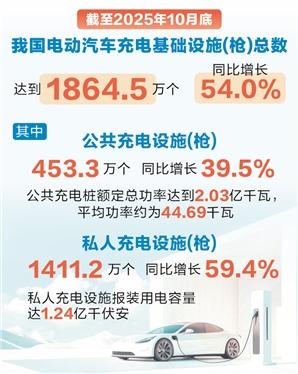
中国充电联盟:截至10月底我国电动汽车充电基础设施(枪)总数达1864.5万个 同比增长54%
Zhi Tong Cai Jing· 2025-11-19 12:56
Core Insights - The total number of electric vehicle charging infrastructure in China reached 18.645 million by the end of October 2025, representing a year-on-year growth of 54.0% [1][2] - Public charging facilities accounted for 4.533 million units, with a year-on-year increase of 39.5%, while private charging facilities reached 14.112 million units, growing by 59.4% [1][2] - The total charging power of public charging stations is approximately 203 million kilowatts, with an average power of about 44.69 kilowatts [1] Charging Infrastructure Overview - The top 10 regions for public charging infrastructure construction, including Guangdong, Zhejiang, and Jiangsu, account for 66.1% of the total [1] - The total charging electricity nationwide was approximately 9.11 billion kWh in October 2025, marking an increase of 1.44 billion kWh from the previous month and a year-on-year growth of 82.4% [1] - The charging electricity is primarily concentrated in provinces such as Guangdong, Jiangsu, and Hebei, with public transport and passenger vehicles being the main users [1] Operator Performance - As of October 2025, the top 15 charging operators managed a total of 1.1 million charging piles, accounting for 83.8% of the total [2] - The leading operators include Telecharge with 855,000 units and Star Charging with 718,000 units [2] - The overall increase in charging infrastructure from January to October 2025 was 5.827 million units, a year-on-year rise of 77.2% [2] Comparison with Electric Vehicle Sales - From January to October 2025, the increase in charging infrastructure was 5.827 million units, while domestic sales of new energy vehicles reached 10.929 million units [3] - The ratio of charging infrastructure to electric vehicles is approximately 1:1.9, indicating that the growth in charging facilities is keeping pace with the rapid development of new energy vehicles [3]
截至10月底我国电动汽车充电基础设施(枪)总数达到1864.5万个
Zhong Guo Xin Wen Wang· 2025-11-19 06:36
Core Insights - As of the end of October, China's electric vehicle charging infrastructure reached a total of 18.645 million units, marking a year-on-year growth of 54.0% [1] Summary by Category Overall Infrastructure - The total number of electric vehicle charging units in China reached 18.645 million, with a year-on-year increase of 54.0% [1] Public Charging Facilities - Public charging facilities accounted for 4.533 million units, showing a year-on-year growth of 39.5% [1] - The total rated power of public charging piles reached 203 million kilowatts, with an average power of approximately 44.69 kilowatts [1] Private Charging Facilities - Private charging facilities totaled 14.112 million units, reflecting a year-on-year increase of 59.4% [1] - The installed electricity capacity for private charging facilities reached 12.4 million kilovolt-amperes [1]