
支付

Search documents
综述丨警惕对美依赖 欧洲加快数字欧元布局
Xin Hua She· 2026-02-09 06:25
新华社贝尔格莱德2月9日电 综述|警惕对美依赖 欧洲加快数字欧元布局 新华社记者金丹依 欧洲中央银行近期呼吁欧盟加快推进数字欧元进程,并多次警告如果不尽快推进数字欧元相关立法和制 度安排,欧盟在数字支付和金融基础设施领域将进一步依赖非欧盟大型科技公司。 欧洲央行执行委员会成员皮耶罗·奇波洛内8日接受媒体采访时表示,目前欧元区近70%的银行卡交易依 赖非欧盟机构主导的支付平台。他指出,数字欧元是增强欧洲数字支付自主性的关键工具,同时能降低 企业支付成本。 目前,数字欧元相关法案已提交欧盟理事会和欧洲议会审议。根据官方最新设想,如果相关法律框架能 在2026年年底前通过,欧洲央行预计将于2027年启动试点项目,并力争在2029年正式发行数字欧元。 欧洲央行行长拉加德近日也呼吁欧盟领导人在推进数字欧元、深化单一市场等关键领域采取紧急集体行 动,以增强欧盟长期增长潜力和制度韧性。 责编:张荣耀、卢思宇 欧盟委员会负责经济事务的委员瓦尔季斯·东布罗夫斯基斯近日表示,欧盟需尽快建立数字欧元,以减 少对美国支付公司的依赖。他说,美国公司维萨和万事达卡目前处理欧盟约三分之二的信用卡交易,这 种高度集中使欧盟变得脆弱。他强调, ...
【环球财经】警惕对美依赖 欧洲加快数字欧元布局
Xin Hua She· 2026-02-09 05:36
法新社等媒体认为,近年来美欧关系波动加剧,使欧洲对在关键技术和支付领域依赖美国公司的担忧明 显上升,从而推动欧盟更积极地提升自身金融自主权。 新华财经贝尔格莱德2月9日电 欧洲中央银行近期呼吁欧盟加快推进数字欧元进程,并多次警告如果不 尽快推进数字欧元相关立法和制度安排,欧盟在数字支付和金融基础设施领域将进一步依赖非欧盟大型 科技公司。 欧洲央行执行委员会成员皮耶罗·奇波洛内8日接受媒体采访时表示,目前欧元区近70%的银行卡交易依 赖非欧盟机构主导的支付平台。他指出,数字欧元是增强欧洲数字支付自主性的关键工具,同时能降低 企业支付成本。 欧盟委员会负责经济事务的委员瓦尔季斯·东布罗夫斯基斯近日表示,欧盟需尽快建立数字欧元,以减 少对美国支付公司的依赖。他说,美国公司维萨和万事达卡目前处理欧盟约三分之二的信用卡交易,这 种高度集中使欧盟变得脆弱。他强调,支付系统是重要基础设施,过度依赖外部机构可能影响欧盟的经 济韧性和自主决策能力。 欧洲央行行长拉加德近日也呼吁欧盟领导人在推进数字欧元、深化单一市场等关键领域采取紧急集体行 动,以增强欧盟长期增长潜力和制度韧性。 (文章来源:新华社) 据悉,欧洲央行自2020年 ...
警惕对美依赖 欧洲加快数字欧元布局
Xin Hua Wang· 2026-02-09 03:58
欧洲中央银行近期呼吁欧盟加快推进数字欧元进程,并多次警告如果不尽快推进数字欧元相关立法和制 度安排,欧盟在数字支付和金融基础设施领域将进一步依赖非欧盟大型科技公司。 新华社贝尔格莱德2月9日电 综述|警惕对美依赖 欧洲加快数字欧元布局 新华社记者金丹依 据悉,欧洲央行自2020年启动数字欧元研究以来,一直强调该项目不会取代现金,而是作为公共支付选 项,与现有支付方式并行存在。欧洲央行同时指出,数字欧元的推出必须建立在完善的法律框架和隐私 保护机制之上。 目前,数字欧元相关法案已提交欧盟理事会和欧洲议会审议。根据官方最新设想,如果相关法律框架能 在2026年年底前通过,欧洲央行预计将于2027年启动试点项目,并力争在2029年正式发行数字欧元。 欧洲央行行长拉加德近日也呼吁欧盟领导人在推进数字欧元、深化单一市场等关键领域采取紧急集体行 动,以增强欧盟长期增长潜力和制度韧性。 欧洲央行执行委员会成员皮耶罗·奇波洛内8日接受媒体采访时表示,目前欧元区近70%的银行卡交易依 赖非欧盟机构主导的支付平台。他指出,数字欧元是增强欧洲数字支付自主性的关键工具,同时能降低 企业支付成本。 欧盟委员会负责经济事务的委员瓦尔季斯 ...
支无不言:VISA 在稳定币时代会如何应变?
Xin Lang Cai Jing· 2026-02-08 15:29
Core Insights - Visa has expanded its stablecoin settlement pilot to the U.S., allowing select U.S. issuing and acquiring banks to use USDC instead of fiat currency for transactions on VisaNet, aiming to enhance liquidity and efficiency in cross-border payments [9][10][12] - The annualized settlement volume for stablecoins reached $3.5 billion, indicating a growing integration of stablecoins into mainstream payment systems, although it remains a small fraction of the overall stablecoin market [14][15] - Visa's approach is chain-agnostic, focusing on the functionality of stablecoins rather than the underlying blockchain technology, which allows for flexibility in payment processing [22][23] Visa's Stablecoin Strategy - The pilot program does not alter Visa's four-party payment structure but introduces USDC as a settlement medium between issuing and acquiring banks [10][11] - Visa has been testing stablecoin transactions since 2020, with previous trials in Nigeria and partnerships with Crypto.com, indicating a long-term strategy rather than a sudden shift [12][13] - The integration of stablecoins is seen as a significant step towards mainstream acceptance, moving beyond mere concept validation to real operational use [13][14] Market Context - The stablecoin market is estimated to have a transaction volume in the trillion-dollar range, making Visa's $3.5 billion annualized figure relatively small [14][15] - Traditional banking systems require pre-funding for settlements, which stablecoins can reduce significantly due to their faster transaction speeds, enhancing capital efficiency [16][17] - Visa's use of stablecoins is expected to improve settlement speed and operational efficiency, allowing banks to lower their required working capital [16][17] Technological Considerations - Visa's choice of Solana for the pilot, rather than Ethereum, reflects its focus on high throughput and speed, continuing its previous collaborations with Solana [22][23] - The company aims to create a "network of networks," allowing payment credentials to flow across various blockchain networks, enhancing interoperability [30][31] Competitive Landscape - Visa's strategy contrasts with Mastercard's focus on building a multi-asset network, indicating different approaches to integrating stablecoins into their payment ecosystems [39][40] - The competitive dynamics in the payment space are evolving, with companies like Circle also developing their own payment networks, potentially challenging traditional card organizations [42][43]

市占率0.8%、高负债还有高分红,多牌照富友支付四闯港股IPO
Xin Lang Cai Jing· 2026-02-08 12:10
Core Viewpoint - Fuyou Payment has submitted its prospectus to the Hong Kong Stock Exchange for the fourth time, following three previous failed attempts. The company aims to leverage its strong licensing advantages in the competitive digital payment market in China [1][2][4]. Group 1: Company Background and Market Position - Fuyou Payment was established in 2011 and became a member of China UnionPay in 2013, positioning itself as an early licensed payment institution [4]. - As of October 31, 2025, Fuyou Payment has processed a total payment volume (TPV) of CNY 16.34 trillion, handling over 679 billion payment transactions and serving 6.2 million customers across various industries [7][24]. - The company ranks eighth among comprehensive digital payment service providers in China with a market share of 0.8% based on 2024 TPV, while it ranks fourth among independent providers with a market share of 4.5% [25]. Group 2: Financial Performance - Fuyou Payment's revenue for the years 2022, 2023, 2024, and the first ten months of 2025 were CNY 1.142 billion, CNY 1.506 billion, CNY 1.634 billion, and CNY 1.307 billion respectively, with net profits of CNY 71.17 million, CNY 92.98 million, CNY 84.33 million, and CNY 109 million [9][27]. - The majority of revenue comes from comprehensive digital payment services, accounting for 94.7%, 93.9%, 92.5%, and 91.6% of total revenue over the same periods [10][27]. - The gross profit margin has declined from 28.4% in 2022 to 25.2% in 2023, attributed to increased commission rates for channel partners and competitive pressures in the market [12][29]. Group 3: Dividend Policy and Financial Health - Fuyou Payment has consistently issued significant dividends, totaling CNY 225 million from 2022 to 2025, which represents 63% of total profits during this period [14][31]. - The company has a total debt of CNY 4.64 billion and total assets of CNY 5.34 billion as of the first ten months of 2025 [13][30]. - Concerns have been raised regarding the sustainability of high dividend payouts in light of a debt ratio nearing 90%, especially under current regulatory scrutiny emphasizing capital adequacy and risk management [32]. Group 4: Regulatory and Compliance Issues - Fuyou Payment has faced four administrative penalties totaling CNY 6.9 million for non-compliance with relevant laws and regulations since 2021, all fines have been paid [19][36]. - The company has been involved in 47 lawsuits related to P2P platform transactions, with 43 cases resolved favorably for the company [18][35]. - User complaints primarily focus on unauthorized charges and issues related to partnerships with heavily regulated installment services [36].

多尔西旗下布洛克公司为提升效率计划裁员至多10%
Xin Lang Cai Jing· 2026-02-07 22:21
Core Viewpoint - Block Inc., led by Jack Dorsey, is notifying hundreds of employees about potential layoffs as part of a broader business restructuring during its annual performance review period [1] Group 1: Employee Layoffs - Up to 10% of Block Inc.'s employees are at risk of being laid off [1] - As of late November, the total number of employees at Block Inc. was reported to be less than 11,000 [1] Group 2: Financial Performance - Block Inc. is scheduled to release its financial results after the market closes on February 26 [1] - Analysts expect the adjusted profit for the fourth quarter to be $403 million, with earnings per share of $0.68 and revenue reaching $6.25 billion [1]
支付行业洗牌持续深化
Zheng Quan Ri Bao· 2026-02-06 23:02
Core Viewpoint - The recent change in the major shareholder of China Mobile Payment Co., Ltd. (China Mobile Payment) reflects a strategic restructuring rather than a true ownership change, as the ultimate controller remains unchanged [1][2]. Group 1: Company Changes - The People's Bank of China approved the change of major shareholder of China Mobile Payment from China Mobile Communications Co., Ltd. to China Mobile Financial Technology Co., Ltd., with the latter still being owned by China Mobile Communications [1]. - This adjustment is seen as a strategic elevation and governance restructuring in response to regulatory guidance for the payment industry [1]. Group 2: Industry Trends - The change in shareholders is indicative of a broader structural reshuffle within the payment industry, driven by stricter regulations and the need for transformation [2]. - The implementation of the "Non-bank Payment Institutions Supervision and Management Regulations" on May 1, 2024, is expected to lead to significant adjustments in the payment sector, with many institutions updating their licenses and operational structures [2]. - Predictions for 2026 indicate that the payment industry will enter a "deep water zone," characterized by intensified competition, regulatory improvements, and a shift towards digital services beyond mere payment processing [3]. - Key trends expected in the payment industry include the exit of non-compliant institutions, a focus on "payment+" digital services, and the integration of AI technology as a core competitive advantage [3].
中移支付主要股东变更支付行业洗牌持续深化
Zheng Quan Ri Bao· 2026-02-06 16:50
Core Viewpoint - The change in the major shareholder of China Mobile Payment Co., Ltd. (China Mobile Payment) reflects a strategic restructuring rather than a true ownership change, aimed at enhancing governance and responding to regulatory guidance in the payment industry [1][2]. Group 1: Company Changes - The major shareholder of China Mobile Payment will change from China Mobile Communications Co., Ltd. to China Mobile Financial Technology Co., Ltd., although the ultimate actual controller remains unchanged [1]. - This adjustment is seen as a strategic elevation and governance restructuring by a large group to foster the development of its payment business [1]. Group 2: Industry Trends - The change in shareholders is indicative of a broader structural reshuffle in the payment industry, driven by stricter regulations and the need for transformation [2]. - The implementation of the "Non-bank Payment Institution Supervision and Management Regulations" on May 1, 2024, is expected to lead to significant adjustments in the payment sector, with many institutions updating their licenses and governance structures [2]. - The payment industry is predicted to enter a "deep water zone" of consolidation by 2026, characterized by intensified competition, enhanced regulatory frameworks, and a shift towards technology-driven services [3]. Group 3: Future Predictions - By 2026, the non-bank payment industry is expected to exhibit five key characteristics: improved regulatory systems, intensified competition, increased investment in technology and customer experience by leading firms, market share acquisition by new payment platforms from internet companies, and differentiated development paths by mid-tier payment institutions [3]. - The industry is anticipated to shift focus from pure payment services to "payment+" digital services, with a consensus on exploring overseas markets for growth [3].
CEO换人、利润不及预期,支付巨头PayPal遭重创!前总裁12年后首次发声:公司已错失先机
Sou Hu Cai Jing· 2026-02-06 11:50
Core Viewpoint - PayPal's recent financial report disappointed the market, leading to a swift leadership change as CEO Alex Chriss was replaced by Enrique Lores, signaling the board's loss of patience with the company's performance [1] Group 1: Financial Performance - PayPal's latest earnings report showed profits and revenues below expectations, prompting a decline in stock price [1] - The brand payment business experienced only 1% growth in the last quarter, indicating significant challenges in maintaining momentum [9] Group 2: Leadership Changes - Alex Chriss, who was brought in to restore product focus, was dismissed after failing to deliver results, highlighting the board's urgency for change [9] - Enrique Lores, the new CEO, has a background in hardware rather than payments, raising questions about his fit for leading a payment-focused company [9] Group 3: Historical Context and Strategic Shifts - David Marcus, a former president of PayPal, expressed that the company shifted from a product-centric approach to a finance-driven one, leading to strategic misalignments [2][3] - The company previously experienced a resurgence under Marcus's leadership, focusing on product development and acquisitions, but this momentum has since waned [3][5] Group 4: Competitive Landscape - PayPal has struggled to maintain its competitive edge against rivals like Apple Pay and others, losing market share in key areas such as branded payment processing [6] - The company's focus on transaction volume over profitability has led to critical missteps, particularly in its credit and buy-now-pay-later (BNPL) offerings [7][8] Group 5: Strategic Missteps - PayPal's failure to build a robust, scalable payment network post-split has left it reliant on third-party channels, undermining its market position [8] - The introduction of PYUSD, a stablecoin, lacked a compelling strategic rationale, failing to integrate deeply into core processes [8] Group 6: Organizational Challenges - The board's decision to remove experienced payment executives under Chriss's leadership has been criticized as detrimental to the company's strategic direction [9] - The emphasis on short-term financial predictability has overshadowed long-term vision and innovation, leading to a decline in the company's competitive capabilities [10]

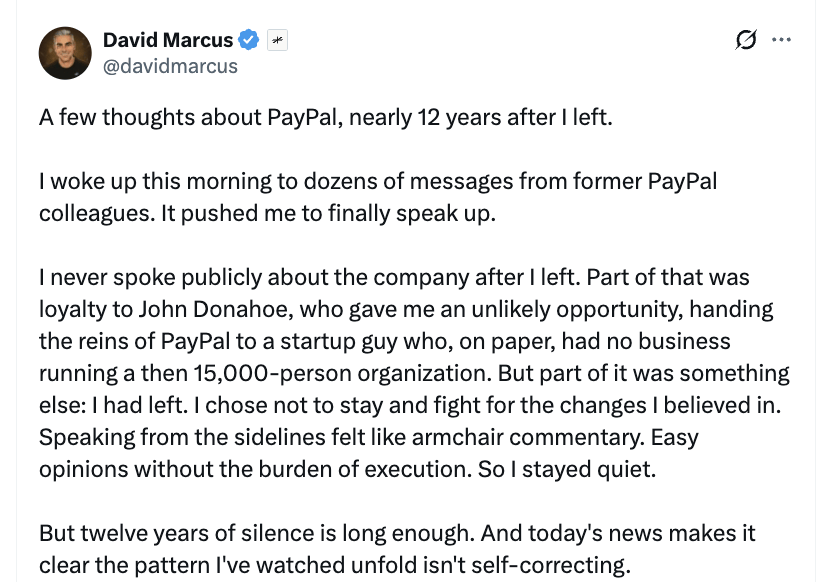
Ex-PayPal President David Marcus Says 'Defensive' BNPL Strategy Handed PYPL's Market Share To Rivals, Leading To Stagnant Growth
Yahoo Finance· 2026-02-06 10:46
Core Insights - PayPal Holdings Inc. has experienced a 20% decline in stock price and the removal of CEO Alex Chriss, prompting former president David Marcus to critique the company's shift towards a culture of "financial optimization" [1][2]. Company Culture and Leadership - David Marcus attributes PayPal's struggles to a transition from product-led innovation to a financially-driven leadership style, which he believes has diminished the company's competitive edge [2]. - Marcus expressed that the leadership's focus on predictability over innovation has led to a loss of the company's original "mojo" [3]. Product Strategy and Market Position - Marcus criticized PayPal's approach to the Buy Now, Pay Later (BNPL) service, stating that while competitors like Klarna and Affirm built strong consumer brands, PayPal treated BNPL merely as a feature rather than a core offering [4]. - This lack of strategic aggression in the BNPL space contributed to a slowdown in PayPal's core branded checkout growth, which fell to just 1%, described by management as a significant "execution shortfall" [4].