
IT

Search documents
中经资料:巴基斯坦证券市场一周回顾(2025.10.13 - 2025.10.17)
Zhong Guo Jing Ji Wang· 2025-10-20 07:03
Group 1: Economic Outlook - The International Monetary Fund (IMF) forecasts Pakistan's economic growth rate at 3.6% for the fiscal year 2025-2026, with the impact of summer floods in 2025 not yet reflected in this prediction [7] - The Pakistani government has revised its GDP growth target down from 4.2% to 3.5%, while the World Bank has projected a growth rate of 2.6% considering factors like flooding [7] Group 2: Agricultural Financing - The State Bank of Pakistan launched an unsecured digital agricultural financing program aimed at small and marginalized farmers, with 75% of the funds provided in kind for quality agricultural inputs and 25% in cash for other expenses [9] - Farmers will also receive agricultural consulting services to enhance crop yields and adopt sustainable farming practices [9] Group 3: Digital Account Inflows - As of September 2025, inflows through the Roshan Digital Account (RDA) reached $196 million, a 20% increase from the previous month [9] - Cumulative inflows to the RDA totaled $11.11 billion, with the number of accounts rising to 862,400, an increase of 10,600 from August [9] Group 4: Technology and Investment - Over 100 technology companies and more than 1,000 representatives from Pakistan attended the GITEX Global technology trade exhibition in Dubai, showcasing a range of IT and fintech firms [10] - The Pakistani Minister of Information and Communication emphasized the strategic partnership with Huawei in advancing digital transformation [10] Group 5: Infrastructure and Disaster Impact - Recent floods have caused extensive damage to housing, infrastructure, and public services in Pakistan, resulting in over 1,000 deaths and economic losses estimated at approximately 822 billion PKR (around $2.9 billion) [11] - A detailed Post-Disaster Needs Assessment (PDNA) is underway to determine the comprehensive economic impact of the floods [11] Group 6: Satellite Launch - Pakistan successfully launched its first hyperspectral satellite HS-1, equipped with advanced imaging technology to monitor land use, vegetation health, and water resources [11] - The satellite will enhance capabilities in precision agriculture, environmental monitoring, urban planning, and disaster management, contributing to development initiatives including the China-Pakistan Economic Corridor [11]

X @Bloomberg
Bloomberg· 2025-10-16 03:30
Sentiment remains cautious as investors digest Axis Bank’s earnings and await results from the remaining two of India’s Big Four IT firms — Wipro and Infosys. Read for free with your email on what could move markets today https://t.co/t8UCquJ41v ...
Hewlett Packard Enterprise (NYSE:HPE) Update / Briefing Transcript
2025-10-15 20:02
Summary of Hewlett Packard Enterprise (HPE) 2025 Security Analyst Meeting Company Overview - **Company**: Hewlett Packard Enterprise (NYSE: HPE) - **Event**: 2025 Security Analyst Meeting - **Date**: October 15, 2025 - **Key Speakers**: Antonio Neri (President and CEO), Rami Rahim (EVP and General Manager of Networking), Marie Myers (CFO) Core Industry Insights - **Industry Context**: The IT industry is undergoing significant transformation driven by digitalization, cloud growth, and AI advancements [10][11][12] - **Market Position**: HPE has evolved into a leaner, more innovative company with a differentiated portfolio, ready to capitalize on emerging opportunities in networking, cloud, and AI [11][12][15] Strategic Priorities - **Networking Leadership**: HPE aims to build a new networking industry leader, focusing on high-margin software and services growth through HPE GreenLake cloud [14][15] - **Financial Goals**: HPE targets annual run-rate synergies of at least $600 million from the Juniper integration and $350 million from Catalyst initiatives by 2028 [14][15] - **Free Cash Flow**: Expected to exceed $3.5 billion by fiscal year 2028, with plans for increased dividends and share buybacks [15] Market Opportunities - **Total Addressable Market (TAM)**: Anticipated to grow to over $1.1 trillion by fiscal year 2028, with significant growth in networking, cloud, and AI sectors [15][16] - **Networking Market**: Expected to reach $169 billion by 2028, driven by AI adoption and increased data center interconnectivity [38][46] - **AI Infrastructure**: HPE is positioned to capture growth in AI infrastructure, particularly in sovereign and enterprise markets, with a focus on high-performance computing [69][71] Product Innovations - **HPE GreenLake**: A unified platform that simplifies IT management and reduces costs, with 44,000 customers and over $2 billion in annual recurring revenue (ARR) [79] - **Alletra MP Storage**: A cloud-native platform for structured and unstructured data, gaining market share in the rapidly expanding AI market [84] - **HPE ProLiant Gen 12 Servers**: Delivering significant power savings and improved performance, with a focus on sustainability and profitability [88] Competitive Advantages - **Integration of Juniper Networks**: The acquisition enhances HPE's networking capabilities, creating a comprehensive portfolio that includes secure, AI-native networking solutions [19][20][21] - **AIOps Solutions**: HPE's advanced AIOps platforms are designed to improve network performance and reduce operational costs, positioning the company as a leader in AI-driven networking [39][40] - **Security Strategy**: HPE is focusing on integrated security solutions that align with the growing trend of Universal Zero Trust Network Access (UZTNA) [50][51] Customer Engagement and Success Stories - **Diverse Customer Base**: HPE serves a wide range of industries, including notable clients like Carnival Cruise Line and the University of Notre Dame [53] - **Ryder Cup Deployment**: HPE showcased its capabilities by powering a large-scale smart city for the Ryder Cup, demonstrating the effectiveness of its integrated solutions [54][55] Conclusion - **Future Outlook**: HPE is committed to leveraging its strengths in networking, cloud, and AI to drive growth and deliver value to shareholders, with a clear strategy and robust product offerings [67][68]

A股天价离婚案!近34亿元股份待分割,牵动老牌IT巨头控制权
Sou Hu Cai Jing· 2025-10-12 16:20
Core Viewpoint - A high-profile divorce case involving a market value of nearly 3.4 billion yuan is poised to impact the future control dynamics of Digital China Holdings Limited (神州数码) [1][3] Group 1: Divorce Case Details - The divorce case between the controlling shareholder Guo Wei and Guo Zhengli was ruled by the Beijing Haidian District People's Court, allowing the divorce but leaving property division unresolved [3][5] - Guo Wei's shares in Digital China, totaling 77.39 million shares, are frozen, representing 50% of his holdings and 11.56% of the company's total shares, with a market value of approximately 3.394 billion yuan based on the October 10 closing price of 43.86 yuan per share [3][6] - This divorce case is noted as the highest-value divorce case in the A-share market for 2025 [3] Group 2: Control and Ownership Implications - As of June 30, 2025, Guo Wei holds 21.49% of Digital China, making him the largest shareholder, while the second-largest shareholder, China New Era Limited, holds only 4.65% [5][6] - If the frozen shares are divided, Guo Zhengli could become the second-largest shareholder, significantly increasing her stake, while Guo Wei's ownership would drop to 10.74% [6][7] - Digital China acknowledged the uncertainty regarding potential changes in actual control due to the ongoing litigation [7] Group 3: Company Performance and Strategic Direction - In the first half of 2025, Digital China reported revenue of 71.59 billion yuan, a year-on-year increase of 14.4%, but net profit fell by 16.3% to 426 million yuan, indicating a trend of revenue growth without profit increase [8][11] - The company's IT distribution and value-added services have a gross margin below 3%, while the growth rate of its cloud services and software business has slowed from 62.7% to 14.1% [8][11] - Digital China is investing heavily in its "AI-driven cloud integration" strategy, which has led to increased R&D expenditures, impacting short-term profitability [8][10] - AI-related business revenue reached 13.332 billion yuan in the first half of 2025, reflecting a 56% year-on-year growth, although the management noted that AI commercialization is still in the trial phase, leading to inevitable short-term profit pressure [10][11]


A股又见天价离婚,分手费或近34亿
Ge Long Hui· 2025-10-11 13:47
Core Viewpoint - The recent divorce case involving Guo Wei, the controlling shareholder of Digital China, has attracted market attention, with implications for the company's control and financial situation as the court has ruled for the divorce but will continue to deliberate on asset division [1][6][7]. Group 1: Background Information - Guo Wei, born in 1963, is a prominent figure in China's IT industry, having co-founded Digital China after leaving Lenovo in 2000. He currently serves as the chairman and CEO of Digital China [4]. - Guo Zhengli, Guo Wei's ex-wife, has a strong professional background, including roles at Intel and Microsoft, and was previously the COO of Digital China [4][5]. Group 2: Legal Proceedings - The Beijing Haidian District People's Court has issued a first-instance ruling for the divorce, with further hearings scheduled for asset division [1][7]. - The upcoming negotiations regarding asset division are expected to be complex due to both parties' significant business acumen and legal resources [8]. Group 3: Financial Implications - As of October 10, Guo Wei holds approximately 155 million shares of Digital China, representing a 21.49% stake, valued at around 6.789 billion yuan based on the closing price of 43.86 yuan per share [9]. - A portion of Guo Wei's shares, totaling 77.39 million shares (50% of his holdings), has been judicially frozen, valued at approximately 3.394 billion yuan [9]. - The potential division of assets could lead to Guo Wei transferring half of his shares to his ex-wife, which may impact the control of Digital China [9]. Group 4: Company Performance - Digital China reported a revenue of 128.166 billion yuan for 2024, a year-on-year increase of 7%, but the net profit attributable to shareholders decreased by 36% to 753 million yuan [11]. - In the first half of 2025, the company achieved a revenue of 71.586 billion yuan, up 14.42% year-on-year, while the net profit fell by 16.29% to 426 million yuan [12].
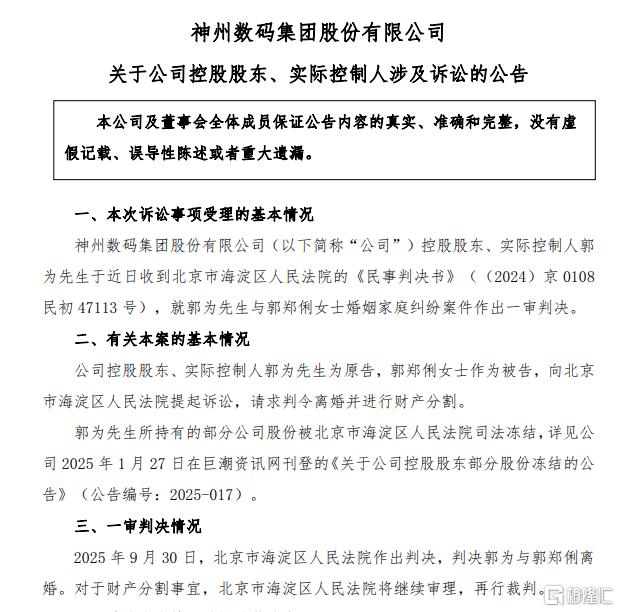
近34亿!A股再现“天价离婚案”,老牌IT巨头控制权或生变
2 1 Shi Ji Jing Ji Bao Dao· 2025-10-11 09:59
Core Viewpoint - The divorce case of the actual controller of Digital China, Guo Wei, may lead to a change in the company's control due to the ongoing property division dispute [1][4][5]. Company Summary - Digital China announced that Guo Wei holds 21.49% of the company's shares, making him the largest shareholder and actual controller [4]. - As of January 27, 2023, 7,738,890 shares (50% of his holdings, 11.56% of total shares) were judicially frozen due to the divorce dispute, with a market value of approximately 3.394 billion yuan based on the closing price of 43.86 yuan per share on October 10, 2023 [4]. - If the shares are awarded to Guo Zhengli during the property division, Guo Wei's shareholding could drop to 10.74%, while Guo Zhengli could become the second-largest shareholder with over 10% [4][5]. - The company is currently undergoing a critical transformation towards "AI-driven cloud integration," with a revenue of 71.59 billion yuan in the first half of 2025, a year-on-year increase of 14.4%, but a net profit of only 426 million yuan, down 16.3% year-on-year [5]. Industry Context - The trend of high-value divorce cases among A-share listed companies has been noted, with six companies experiencing similar situations since 2025, involving equity divisions worth over 3 billion yuan [5][6]. - Other companies, such as Yiyuan Communication and Zongheng Co., have also seen significant share divisions due to divorce, indicating a broader trend in the industry [6].
IT富豪一审被判离婚,巨额财产待分割!000034,最新公告
证券时报· 2025-10-11 09:16
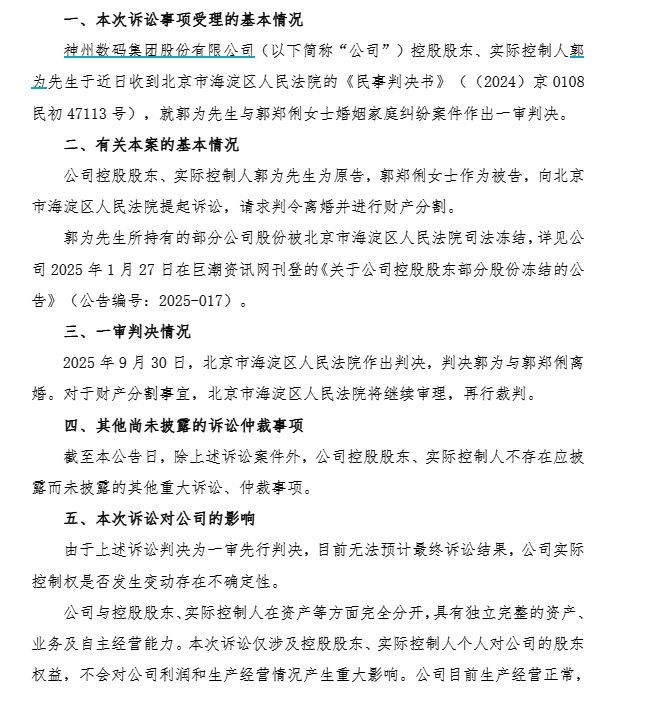
Core Viewpoint - The article discusses the recent divorce ruling of Guo Wei, the actual controller of Digital China (神州数码), and its potential implications for the company and its stock ownership [4][9]. Group 1: Divorce Ruling - Guo Wei has been ruled to divorce Guo Zhengli by the Haidian District Court in Beijing, with further proceedings on property division pending [4][5]. - Guo Wei's shares in Digital China, amounting to 77.39 million shares, have been frozen by the court, representing 50% of his total holdings, with a current market value of approximately 3.394 billion yuan [5]. Group 2: Guo Wei's Background - Guo Wei, born in 1963, has a master's degree in engineering from the University of Science and Technology of China and has a long history in the tech industry, including significant roles at Lenovo and Digital China [6]. - He has served as the chairman and CEO of Digital China and has been a prominent figure in the business community, appearing on wealth rankings multiple times [6][9]. Group 3: Financial Implications - As of now, Guo Wei directly holds 155 million shares of Digital China, valued at approximately 6.789 billion yuan [8]. - His salary from Digital China and another company, Digital Information, for the 2024 fiscal year is reported to be 6.3478 million yuan and 5.9329 million yuan, respectively [9]. Group 4: Company Independence - Digital China asserts that it operates independently from its controlling shareholder, with no significant impact expected on its profits or operations due to the ongoing legal proceedings [9].

Goldman Sachs sees AI and budget pressures persisting for North American IT firms in Q3
Proactiveinvestors NA· 2025-10-09 19:46
Core Insights - Proactive provides fast, accessible, and informative business and finance news content to a global investment audience [2] - The company focuses on medium and small-cap markets while also covering blue-chip companies and broader investment stories [3] - Proactive's news team delivers insights across various sectors including biotech, mining, oil and gas, and emerging technologies [3] Technology Adoption - Proactive is committed to adopting technology to enhance workflows and content production [4] - The company utilizes automation and software tools, including generative AI, while ensuring all content is edited and authored by humans [5]

知名天使投资人,车祸去世
中国基金报· 2025-10-08 07:39
Core Points - Renowned angel investor Xiao Qingping tragically passed away in a car accident in Tibet on October 6, 2023 [1][4] - Xiao was a prominent figure in the IT industry and served as the chairman of Beijing Zhangshangtong Network Technology Co., Ltd [4][6] - He was known for his contributions to the angel investment community and had invested in over 40 projects totaling nearly 100 million yuan [6] Group 1: Personal Background - Xiao Qingping was born in October 1964 and graduated from Hunan University in 1983, later obtaining a master's degree from the University of International Business and Economics in 1991 [4] - He pursued a doctoral degree at Renmin University of China starting in 1999 [4] Group 2: Career Highlights - Xiao held various significant positions, including general manager of Hainan Jindao Wenlan Company and vice president of Hainan International Investment Cooperation Company [6] - He became interested in the IT industry after investing over 800,000 yuan in Weilong Computer in 1995, marking the beginning of his investment career [6] - In 2000, he invested in China Holiday, the leading domestic travel website, and took over Zhangshangtong in 2001, leading to its listing on the New Third Board in 2011 [6] Group 3: Investment Philosophy - Xiao described himself as a "first-generation internet person" and an "old angel investor," emphasizing his commitment to investing in young entrepreneurs to help them succeed [6] - His investment portfolio included notable companies such as Lianbang Software, 8848, and Tianmai Juyuan [6]

BlackRock Eyes $38 Billion Acquisition of Power Utility Major
Yahoo Finance· 2025-10-02 07:30
Core Insights - BlackRock's Global Infrastructure Partners is negotiating to acquire AES, a power utility, in a deal potentially valued at $38 billion, marking it as one of the largest public power utility acquisitions in U.S. history [1] - AES has a substantial debt load of $29 billion, while its market capitalization has increased from $9.4 billion to $10.94 billion, suggesting the total deal value could exceed $40 billion [2] - The acquisition interest is driven by the rising electricity demand from the IT sector, particularly due to artificial intelligence developments and the need for data centers [3] Company Overview - AES has been exploring a sale after receiving takeover interest from large investment firms, with an enterprise value previously estimated at around $40 billion [4] - The company has contracts with major tech firms like Google, Microsoft, and Amazon, but its stock has seen a decline of 38% earlier this year and approximately 23% over the past 12 months, although it rebounded following news of the acquisition talks [4] - BlackRock acquired Global Infrastructure Partners for $12.5 billion last year, and the firm currently manages around $200 billion in assets globally [5]

