
神州问学

Search documents
神州数码:神州问学并不局限于办公场景
Zheng Quan Ri Bao Zhi Sheng· 2026-01-15 08:39
Group 1 - The core viewpoint of the article is that Digital China is expanding the application of its product, Shen Zhou Wen Xue, beyond office scenarios to various production and business contexts, including research and development, quality inspection, and compliance review [1] - Currently, the primary focus of Shen Zhou Wen Xue is on industry clients, although a version aimed at individual users has also been launched [1]

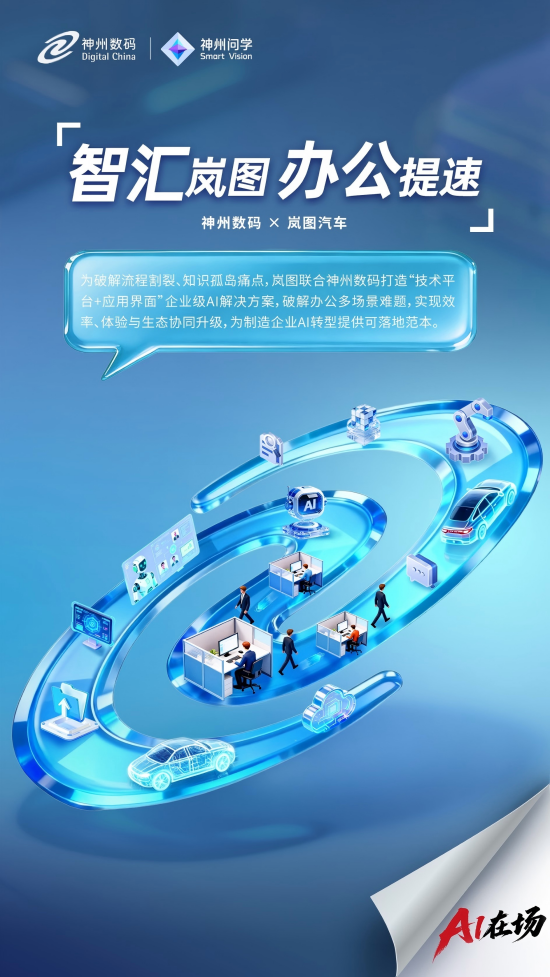
神州数码携手岚图 开启全流程智能协同办公新模式
Huan Qiu Wang· 2026-01-08 08:59
Core Insights - As artificial intelligence transitions from a technological hotspot to deeper industrial applications, companies are reassessing how to effectively implement AI to transform organizational operations [2] Group 1: Company Overview - Lantu Automotive, a high-end smart electric vehicle brand developed by Dongfeng Motor Group, is experiencing rapid growth while facing common management and collaboration challenges typical of large manufacturing enterprises [3] - The key issue for Lantu Automotive in its digital transformation process is how to introduce sustainable intelligent capabilities without overhauling the existing IT system [3] Group 2: Collaboration and Technology Implementation - Lantu Automotive has engaged in deep collaboration with Digital China to advance enterprise-level AI, focusing on building systematic intelligent capabilities from real business scenarios [3][4] - Digital China is constructing a model application development platform for Lantu Automotive, leveraging its self-developed middle platform, "Shenzhou Wenxue," aimed at making AI practical and emphasizing usability, compatibility, and scalability [3][4] Group 3: AI Product Development - The collaboration has led to the creation of the "Lantu One-Stop Intelligent Office Assistant," designed as a unified AI entry point for employees, addressing real and frequent office and business scenarios [4] - In addition to general office applications, a series of vertical business intelligent agents have been developed to ensure AI's involvement in discovering, analyzing, and optimizing business issues [4] Group 4: AI Implementation Pathway - The partnership between Digital China and Lantu Automotive validates a suitable AI implementation pathway for manufacturing enterprises: lowering the AI usage threshold through platform capabilities, designing applications driven by real business scenarios, and replacing one-time delivery with continuous co-creation [4] - This approach integrates AI into the operational fabric of the organization, continuously releasing efficiency and value rather than treating it as a detached "intelligent concept" [4]

神州数码IT分销业务增收不增利 高毛利业务营收占比仅为7% 转型关键期或存债务隐忧
Xin Lang Cai Jing· 2025-12-25 09:28
Core Viewpoint - The company is facing significant challenges due to its reliance on a low-margin, high-turnover business model, particularly in its IT distribution and real estate sectors, which has led to a decline in profitability despite revenue growth [2][5][7]. Group 1: Financial Assistance and Debt - The company announced a shareholder loan of up to 150 million yuan at an interest rate of 4.52% to its subsidiary, which has historically received annual loans since its establishment in 2016 [1]. - The total amount of external guarantees provided by the company and its subsidiaries has reached 65.245 billion yuan, with 60.5 billion yuan guaranteed for subsidiaries with over 70% debt-to-asset ratios [1]. Group 2: Business Model and Profitability - The company's traditional IT distribution business has a net profit margin consistently below 1%, indicating a clear trend of revenue growth without corresponding profit increases [3][5]. - Despite a significant increase in revenue from 40.531 billion yuan in 2016 to 128.166 billion yuan in 2024, the net profit has remained below 1 billion yuan for most years, with only slight increases in 2022 and 2023 [4][5]. Group 3: Inventory and Financing - The company's inventory has increased from 4.6 billion yuan to 17.3 billion yuan since its listing, leading to a significant rise in short-term liabilities, which have nearly tripled [5]. - The cash on hand is only 6.574 billion yuan, creating a substantial gap between cash and short-term debt [5]. Group 4: Real Estate Investment Impact - The company's investment in the Shenzhen Bay headquarters project, totaling over 7 billion yuan, has negatively impacted its financial statements, particularly with a fair value change of -386 million yuan in 2024 [6]. Group 5: Transition to New Business Models - The company is attempting to shift its business model by increasing R&D investments, which have grown at over 20% annually since 2019, and expanding its workforce in this area [8][9]. - The revenue contribution from self-branded and cloud services remains low, at around 7%, despite these segments showing high growth potential [9][10]. Group 6: Strategic Outlook - The management has identified key areas for growth, including the domestic PC market and AI applications, indicating a strategic pivot towards higher-margin business opportunities [10][11].
神州数码(000034):全栈AI生态能力,稳步推进大厂合作
NORTHEAST SECURITIES· 2025-12-24 05:24
Investment Rating - The report initiates coverage with a "Buy" rating for the company [3][6]. Core Insights - The company's microelectronics business, primarily focused on the distribution of general-purpose and AI-specific chips, is experiencing rapid growth, with IT distribution and value-added services accounting for 95.54% of revenue in the first half of 2025 [1]. - The company is advancing its "Digital Cloud Integration" strategy, with its AI-driven digital cloud services and software business achieving revenue of 1.64 billion yuan, a year-on-year increase of 14.1% [2]. - The company has established a robust ecosystem with over 1,500 partners through its "Thousand Sails Program," enhancing its channel network and industry coverage [1]. - The proprietary brand business is stable, with the company developing AI computing servers suitable for various applications, and has completed product mutual certification with nearly 300 ISV partners [3]. Financial Summary - Revenue projections for 2025-2027 are 144.87 billion yuan, 156.93 billion yuan, and 168.46 billion yuan, respectively, with corresponding net profits of 1.10 billion yuan, 1.55 billion yuan, and 1.76 billion yuan [3][4]. - The company’s PE ratios are projected to be 24.82, 17.60, and 15.47 for 2025, 2026, and 2027, respectively [3][4]. - The net profit margin is expected to improve, with net profit growth rates of 45.83% in 2025 and 41.05% in 2026 [4][17].
神州数码跌4.35%,成交额6.70亿元,近3日主力净流入-1.60亿
Xin Lang Cai Jing· 2025-10-17 07:09
Core Viewpoint - The company, Digital China, experienced a decline in stock price and trading volume, indicating potential investor concerns amidst its recent business developments and market performance [1][4]. Company Developments - Digital China launched the "Lingmi" brand AI PC in collaboration with JD.com, set to be available for sale soon [2]. - The company was recognized in IDC's "2024 Q2 Generative AI Ecosystem Map" and received multiple awards for its AI platform innovations [2]. - Digital China is a distribution partner for major tech companies like Intel and NVIDIA, enhancing its market position [2][3]. - The company holds the highest partnership levels with AWS, Azure, and Alibaba Cloud, and has a diverse cloud resource pool with over 120 SaaS applications [3]. Financial Performance - As of September 30, Digital China reported a revenue of 71.586 billion yuan for the first half of 2025, a year-on-year increase of 14.42%, while net profit decreased by 16.29% to 426 million yuan [8]. - The company has distributed a total of 1.388 billion yuan in dividends since its A-share listing, with 771 million yuan in the last three years [9]. Shareholder Information - As of September 30, the number of shareholders decreased by 2.37% to 164,700, while the average circulating shares per person increased by 2.43% to 3,652 shares [8]. - Notable changes in institutional holdings include an increase in shares held by the Southern CSI 500 ETF and a decrease by Hong Kong Central Clearing Limited [9].
神州数码净利降16%研发费率不足0.3% 62岁实控人郭为离婚“分手费”或达34亿
Chang Jiang Shang Bao· 2025-10-12 23:33
Core Viewpoint - The ongoing divorce case of Guo Wei, the controlling shareholder of Digital China, poses a risk of potential changes in the company's actual control, with significant financial implications due to the freezing of his shares valued at approximately 3.4 billion yuan [4][8][9]. Financial Performance - In the first half of 2025, Digital China reported a revenue of 71.586 billion yuan, marking a year-on-year increase of 14.42%, while net profit decreased by 16.29% to 426 million yuan [4][14]. - The company has been experiencing a trend of "increasing revenue without increasing profit," with net profit fluctuations observed in recent years [14][15]. - R&D expenses for the first half of 2025 were 189 million yuan, accounting for less than 0.3% of revenue, indicating a lower growth rate compared to revenue growth [5][15]. Shareholder and Control Issues - Guo Wei's 50% stake in Digital China, amounting to 77.3889 million shares, has been frozen due to the divorce proceedings, representing 11.56% of the company's total share capital [6][8]. - The court's decision on the division of assets is still pending, which adds uncertainty regarding the potential change in the company's actual control [7][9]. Company Background - Digital China was established after the split from Lenovo Group in 2000, with Guo Wei serving as the chairman and CEO [10][11]. - The company has evolved into a leading IT distribution and value-added services provider in China, focusing on AI solutions and digital transformation services [13].
A股天价离婚案!近34亿元股份待分割,牵动老牌IT巨头控制权
Sou Hu Cai Jing· 2025-10-12 16:20
Core Viewpoint - A high-profile divorce case involving a market value of nearly 3.4 billion yuan is poised to impact the future control dynamics of Digital China Holdings Limited (神州数码) [1][3] Group 1: Divorce Case Details - The divorce case between the controlling shareholder Guo Wei and Guo Zhengli was ruled by the Beijing Haidian District People's Court, allowing the divorce but leaving property division unresolved [3][5] - Guo Wei's shares in Digital China, totaling 77.39 million shares, are frozen, representing 50% of his holdings and 11.56% of the company's total shares, with a market value of approximately 3.394 billion yuan based on the October 10 closing price of 43.86 yuan per share [3][6] - This divorce case is noted as the highest-value divorce case in the A-share market for 2025 [3] Group 2: Control and Ownership Implications - As of June 30, 2025, Guo Wei holds 21.49% of Digital China, making him the largest shareholder, while the second-largest shareholder, China New Era Limited, holds only 4.65% [5][6] - If the frozen shares are divided, Guo Zhengli could become the second-largest shareholder, significantly increasing her stake, while Guo Wei's ownership would drop to 10.74% [6][7] - Digital China acknowledged the uncertainty regarding potential changes in actual control due to the ongoing litigation [7] Group 3: Company Performance and Strategic Direction - In the first half of 2025, Digital China reported revenue of 71.59 billion yuan, a year-on-year increase of 14.4%, but net profit fell by 16.3% to 426 million yuan, indicating a trend of revenue growth without profit increase [8][11] - The company's IT distribution and value-added services have a gross margin below 3%, while the growth rate of its cloud services and software business has slowed from 62.7% to 14.1% [8][11] - Digital China is investing heavily in its "AI-driven cloud integration" strategy, which has led to increased R&D expenditures, impacting short-term profitability [8][10] - AI-related business revenue reached 13.332 billion yuan in the first half of 2025, reflecting a 56% year-on-year growth, although the management noted that AI commercialization is still in the trial phase, leading to inevitable short-term profit pressure [10][11]

深夜公告实控人郭为离婚,神州数码迎来“关键时刻”
经济观察报· 2025-10-11 07:53
Core Viewpoint - The article discusses the significant issue of the actual control of Digital China (神州数码) amidst its ongoing transformation, which requires continuous investment and has already pressured profits due to a recent divorce case involving its controlling shareholder, Guo Wei [1][2][3]. Company Control and Shareholder Dynamics - On October 10, 2025, Digital China announced the first-instance judgment of Guo Wei's divorce, which did not clarify the property division but indicated that part of his shares had been judicially frozen [2][3]. - The frozen shares amount to 77,388,902, representing approximately 10.75% of Digital China's total share capital and half of Guo Wei's personal holdings [3][6]. - If these shares are divided, Guo Wei's ex-wife could become the second-largest shareholder, significantly impacting the company's decision-making structure [7][8]. Financial Performance and Strategic Investments - For the first half of 2025, Digital China reported revenues of 71.59 billion yuan, a year-on-year increase of 14.4%, but the net profit attributable to shareholders fell by 16.3% to 426 million yuan [5][10]. - The decline in profit is attributed to increased investments in research and development to seize opportunities in artificial intelligence (AI), with R&D spending rising by 10.6% to 210 million yuan [11][12]. - The company faces challenges with cash flow, having 5.346 billion yuan in cash against short-term borrowings of 10.219 billion yuan, indicating financial strain [12]. Business Model and Market Position - Digital China's primary revenue comes from IT distribution and value-added services, which contributed 95.5% of total revenue, but this segment has low profit margins, with a gross margin of only 2.7% [8][9]. - The company is transitioning towards AI-driven services, with AI-related business revenue reaching 13.332 billion yuan, a 56% increase year-on-year [20]. Strategic Direction and Leadership Changes - The management team, led by Wang Bingfeng, is focusing on the "AI-driven digital cloud integration" strategy, which aims to leverage AI technology for business transformation [19][20]. - Recent leadership changes, including the appointment of Wang Bingfeng as the legal representative, signal a shift in control and strategy execution during a critical transformation phase for the company [17][18]. - The company is exploring various avenues for growth, including self-owned AI servers and applications in finance and healthcare, while also considering overseas acquisitions [24].

深夜公告实控人郭为离婚,神舟数码迎来“关键时刻”
Jing Ji Guan Cha Wang· 2025-10-11 02:08
Core Viewpoint - The divorce case of the controlling shareholder and actual controller of Digital China, Guo Wei, has resulted in a court ruling that may impact the company's control structure and financial stability, as significant shares are frozen pending further legal proceedings [2][3][5]. Financial Performance - Digital China reported a revenue of 71.59 billion yuan for the first half of 2025, marking a year-on-year increase of 14.4%, but the net profit attributable to shareholders was only 426 million yuan, a decline of 16.3% [4][9]. - The company's revenue growth was primarily driven by its traditional IT distribution and value-added services, which contributed 68.39 billion yuan, accounting for 95.5% of total revenue [9]. - The gross profit margin for the IT distribution business was only 2.7%, reflecting a decrease compared to the previous year [9]. Strategic Focus - Digital China is increasing its investment in research and development to capitalize on opportunities in artificial intelligence (AI), with R&D spending rising by 10.6% to 210 million yuan in the first half of 2025 [10][11]. - The company is pursuing an "AI-driven cloud integration" strategy, which includes developing products like "Shenzhou Wenxue" and "Shenzhou Kuntai" to enhance AI capabilities for enterprises [21][23]. Shareholder Dynamics - Guo Wei's frozen shares amount to approximately 77.39 million shares, valued at around 3.4 billion yuan, representing about 10.75% of Digital China's total share capital [6][7]. - If these shares are divided in the divorce settlement, Guo Wei's ex-wife could become the second-largest shareholder, significantly altering the company's decision-making landscape [8]. Management Changes - Following the divorce ruling, Digital China has seen changes in its management structure, with Wang Bingfeng taking over as the legal representative, indicating a shift in leadership during a critical transformation phase for the company [18][19]. - The management team is focused on leveraging AI technology to drive future growth, despite the current challenges in profitability [20][26].

AI终端应用集中亮相 云栖大会描绘产业新蓝图
Zheng Quan Ri Bao Zhi Sheng· 2025-09-27 04:11
Core Insights - The 2025 Yunqi Conference showcased advancements in AI technology, including infrastructure, large models, and embodied intelligence applications in various industries [1] - The conference featured over 200 companies presenting the latest AI terminals and Agent applications, highlighting AI's penetration into manufacturing, logistics, commerce, and design [1] Group 1: Robotics in Industrial Applications - The embodied intelligent robot "Jarvis 2.0" from Junpu Intelligent is designed for flexible environmental perception and real-time response in industrial settings [1] - Junpu Intelligent's product matrix is based on a "perception-decision-execution" closed-loop integration, focusing on enhancing industrial manufacturing in sectors like automotive and healthcare [2] - The four-legged robot "Jueying X30" is capable of operating in extreme conditions, suitable for applications such as power station inspections and emergency rescues [2] Group 2: Automation in Manufacturing - Human-like robots in a simulated automotive assembly line demonstrated collaborative tasks, enhancing production efficiency and quality control [3] - The role of robots in factories has evolved from mere mechanical replacement to enhancing production efficiency, quality management, and safety through perception and collaboration [3] Group 3: AI in Business Model Innovation - Alibaba's CEO emphasized the future prevalence of robots and Agents in homes and businesses, indicating a shift towards AI-driven operational models [4] - The "Shenzhou Wenxue" enterprise-level Agent platform by Shenzhou Digital enables rapid construction of AI applications across various business scenarios [4] - The "X-FUN Intelligent Packaging Design Platform" allows users to design packaging through AI assistance, showcasing AI's role in creative industries [4] Group 4: Impact of AI on Business - AI is transitioning from exploration to large-scale commercial implementation, driving cost control, efficiency improvements, and reshaping business models [5] - The deployment of AI terminals enables businesses to innovate more rapidly and flexibly, significantly impacting industry ecosystem upgrades [5]
