
Artificial Intelligence

Search documents
印度人工智能峰会本周举行 消息称印度将宣传其发展较廉价AI工具以解决本土问题的做...
Xin Lang Cai Jing· 2026-02-17 00:22
据报道,在本周于新德里举行的全球科技巨头领袖和国家元首峰会上,印度将宣传其发展较廉价AI工 具以解决本土问题的做法,并将此作为其他中等收入国家的一条发展路径。印度电子部高级官员S.克里 希南(S. Krishnan) 1月份表示:"我们作为一个国家正在尝试做的……是实现技术的大众化。"他还 说:"(这次峰会)在全球南方举办,这个事实本身就很重要。"包括OpenAI首席执行官山姆.阿尔特曼 和Anthropic的达里奥.阿莫迪(Dario Amodei)在内的一些AI顶尖人物,预计将在印度总理莫迪周四为峰会 揭幕时出席。 ...
4 Signals from the Munich Security Conference Showing Geospatial Intelligence Is the Next Frontier at the Top Table
Prnewswire· 2026-02-17 00:07
Core Insights - Geospatial intelligence is emerging as a critical capability for addressing global security challenges, particularly in the context of Europe's strategic autonomy and resource geopolitics [1][2] Group 1: Strategic Autonomy and Geospatial Intelligence - The concept of "strategic autonomy" was a central theme at the Munich Security Conference, emphasizing Europe's need for independent security capabilities, which fundamentally rely on geospatial intelligence to understand threats and vulnerabilities [1] - The European Space Agency's new initiatives highlight the importance of independent Earth observation and satellite intelligence for achieving strategic autonomy, indicating that without these capabilities, autonomy remains merely a concept [1] Group 2: Investment in Space and Security - Germany has committed €35 billion from 2026 to 2030 for space security, marking a significant shift in investment priorities, with Berlin now contributing 23% of the European Space Agency's total budget [1] - Poland's tenfold increase in ESA contributions over three years further illustrates the growing recognition of space as integral to European defense and security [1] Group 3: Geopolitics of Resources - The discussions on resource geopolitics at the conference underscored the need for geospatial intelligence to map critical minerals and energy corridors, highlighting the importance of understanding physical supply chains [2] - The availability of satellite data and the ability to analyze it in real-time are crucial for addressing the geopolitical challenges related to resource management [2] Group 4: AI and Geospatial Intelligence - The AI discussions at the conference largely overlooked the spatial dimension, despite the urgent need for geospatial AI to address security challenges related to energy infrastructure and supply chains [2] - The BCG Defense Innovation Report identified a gap between defense innovation priorities and the ability to deliver capabilities, with geospatial AI being a mature technology ready to meet urgent demands [2]


Google (GOOGL) Cloud Revenue Just Surged 48% And May Have Delivered Knockout Blow To OpenAI
247Wallst· 2026-02-16 20:22
Core Insights - The competitive landscape between OpenAI and Alphabet is shifting, with Alphabet gaining an edge in several areas despite OpenAI's early lead in artificial intelligence [1][4] - There is a significant performance divergence between companies associated with OpenAI and those linked to Alphabet, with Oracle down 50.3% while Alphabet-associated stocks like Celestica, Lumentum, and Broadcom have performed well [2][7] - Media coverage of OpenAI has been excessively negative, particularly regarding its plans to raise substantial capital, which may not reflect the actual financial situation [2][9] Group 1: Competitive Dynamics - OpenAI was initially the leader in AI but is now facing strong competition from Alphabet, which has made a notable resurgence [1][4] - Companies linked to OpenAI, such as Oracle, have seen significant declines, while those associated with Alphabet have experienced positive momentum [2][7] - The media narrative surrounding OpenAI is largely negative, which contrasts with the underlying financial expectations that Wall Street has already factored in [2][9] Group 2: Investment Opportunities - The current negative sentiment towards OpenAI-related stocks may present investment opportunities, as the market may not accurately reflect the financial realities [12][17] - Alphabet's strong performance and positive narratives, including its stakes in companies like SpaceX and Waymo, contribute to its favorable market position [15][16] - The potential for OpenAI to raise $100 billion and pursue an IPO could provide it with the necessary capital to remain competitive in the AI sector [11][17]


Beyond NVIDIA: 4 AI & Quantum Plays Aiming Big Platform Upside in 2026
ZACKS· 2026-02-16 20:00
Core Insights - Investors in 2026 are focused on established AI leaders like NVIDIA for capital allocation, benefiting from AI infrastructure spending, with projected fiscal 2026 revenue near $213 billion driven by GPU platforms and software ecosystems [1] - The discussion centers on whether to invest in emerging AI companies with rapid monetization or speculative quantum computing firms with potential high returns [2] AI Companies - SoundHound AI reported a 68% year-over-year revenue increase in Q3 2025, with guidance suggesting nearly 98% annual growth, despite ongoing net losses as it invests in product scaling [5] - Marvell's revenue for Q2 fiscal 2026 reached $2.006 billion, a 58% increase year-over-year, with its data center segment contributing approximately 74% of total revenue, showcasing strong demand for AI infrastructure [6][7] - SoundHound AI is expected to achieve earnings growth of 56.9% on revenue growth of 38.3% in 2026, while Marvell anticipates earnings growth of 23.3% on revenue growth of 22.8% in fiscal 2027 [5][6] Quantum Computing Companies - IonQ reported a 222% revenue growth in Q3 2025, reaching $39.9 million, and holds $3.5 billion in cash after a $2 billion equity raise, indicating strong financial positioning for R&D [7][8] - D-Wave's Q3 2025 revenue doubled to $3.7 million, with a cash balance of $836 million, reflecting strong liquidity despite ongoing net losses [9] - IonQ is projected to achieve earnings growth of 65.8% on revenue growth of 38.3% in 2026, while D-Wave expects earnings growth of 8.7% on revenue growth of 67.8% [8][9] Comparative Analysis - SoundHound AI and Marvell are generating significant revenue tied to enterprise deployments, while IonQ and D-Wave are still in early revenue stages and heavily focused on R&D [13] - Valuation frameworks differ, with AI infrastructure companies evaluated on revenue durability and margin trajectory, while quantum firms are assessed based on technical milestones and commercialization potential [14]


Analysts Set $348 Target for Google After February Dip
247Wallst· 2026-02-16 19:00
Core Insights - Analysts have set a price target of $348 for Google, indicating a potential upside of over 13% despite a recent dip in share price [1] - Google Cloud revenue increased by 48% to $17.7 billion in Q4 2025, showcasing strong growth in the cloud segment [1] - The company has significantly reduced Gemini serving costs by 78% in 2025, enhancing profitability in AI services [1] Financial Performance - Google's total revenue reached $402.8 billion with an operating margin of 32%, demonstrating robust financial health [1] - Analysts maintain a consensus rating of "Strong Buy" from 44 analysts, reflecting confidence in Google's long-term growth prospects [1] Market Position - Gemini holds a 21% share of the enterprise LLM market, indicating a strong competitive position against rivals like ChatGPT [1] - The company is leveraging its TPU chips to compete effectively in both hardware and software aspects of AI development, positioning itself against NVIDIA [1] Investor Sentiment - Despite a 5.3% drop in shares over the past week, retail investor sentiment remains predominantly bullish, with 86% of discussions on platforms like Reddit leaning positive [1] - The community engagement around Google's AI potential is high, with notable posts receiving significant upvotes, reflecting investor confidence [1]


Hedge Fund and Insider Trading News: George Soros, Bill Ackman, Warren Buffett, Steve Cohen, Elliott Management, L1 Capital, Citadel Investment Group, Mattel Inc (MAT), and More
Insider Monkey· 2026-02-16 18:42
Core Insights - Generative AI is viewed as a transformative technology by Amazon's CEO Andy Jassy, indicating its potential to significantly enhance customer experiences across the company [1] - Elon Musk predicts that by 2040, humanoid robots could create a market worth $250 trillion, representing a major shift in the global economy driven by AI innovation [2][3] - Major firms like PwC and McKinsey acknowledge the potential of AI to unlock multi-trillion-dollar opportunities, reinforcing the optimistic outlook on AI's economic impact [3] Company and Industry Analysis - A breakthrough in AI technology is believed to be redefining work, learning, and creativity, leading to increased interest from hedge funds and top investors [4] - There is speculation about an under-owned company that may play a crucial role in the AI revolution, suggesting that it could be a significant investment opportunity [4][6] - Prominent figures in technology and finance, including Bill Gates and Warren Buffett, recognize AI as a major technological advancement with the potential for substantial social benefits [8]


这个春节后,中国AI进入千问豆包“双王时代”
Ge Long Hui· 2026-02-16 16:47
Core Insights - The 2026 Spring Festival marks a pivotal moment for China's AI industry, transitioning from technical experimentation to widespread public adoption [1][5] - Major tech companies like Alibaba and ByteDance have emerged as leaders in this competitive landscape, showcasing differentiated strategies and impressive operational metrics [1][5] Industry Overview - The Spring Festival AI competition has shifted from merely attracting users to cultivating habits and implementing practical applications, with Alibaba and ByteDance leading the way [5][6] - The competition has resulted in a dual development path for China's AI industry: Alibaba focuses on consumer-oriented applications, while ByteDance emphasizes content creation and innovation [6][18] Alibaba's Performance - Alibaba's Qwen 3.5-Plus model was released on New Year's Eve, achieving the status of the world's strongest open-source model, comparable to Gemini 3 Pro [1][8] - During the Spring Festival, over 1.3 billion AI-assisted transactions were completed, with users making 50 billion requests to the Qwen app, demonstrating its widespread adoption [1][5][12] Technological Breakthroughs - The Qwen 3.5-Plus model features a total of 397 billion parameters, with a significant performance improvement over previous models, achieving a 19-fold increase in inference throughput [10][11] - The model's API pricing is significantly lower than competitors, at 0.8 yuan per million tokens, making it more accessible for developers [10][11] Ecosystem Integration - Alibaba's extensive ecosystem, including platforms like Taobao and Alipay, enables seamless integration of AI into everyday tasks, enhancing user experience and driving rapid habit formation [11][15] - The Spring Festival saw a 372-fold increase in AI-assisted movie ticket purchases, highlighting the model's effectiveness in real-world applications [11][12] Competitive Landscape - The emergence of Alibaba and ByteDance as "dual kings" in the AI sector signifies a shift in China's AI industry towards original exploration, moving away from merely following Silicon Valley [18][19] - The competition between these two companies fosters a healthy industry environment, encouraging innovation and diverse development paths [18][19]

这个春节后,中国AI进入千问豆包“双王时代”
格隆汇APP· 2026-02-16 16:43
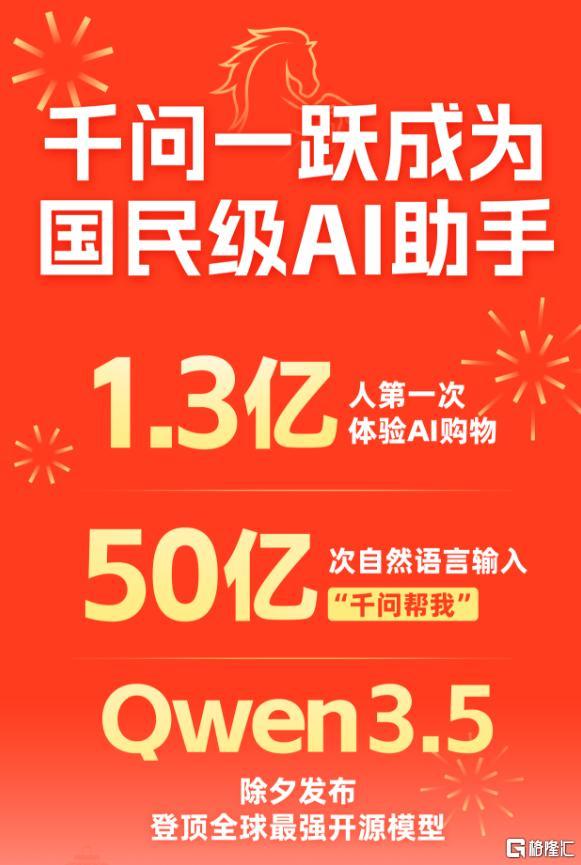
作者 | 贝隆行业研究 数据支持 | 勾股 大数 据(www.gogudata.com) 2026 年春节,成为中国 AI 产业从技术实验室走向全民生活的关键分水岭。 阿里、 腾讯、 字节跳动 等科技大厂纷纷祭出红包补贴、 应用推出、 功能上新等招式,在 AI 赛 道展开百花齐放的春节争夺战。而阿里与字节跳动凭借差异化的战略布局、现象级的应用表现和亮 眼的运营数据,在这场竞争中突围而出,站上中国科技春晚的塔尖 。 除夕 当天 下午 , 阿里巴巴开源全新一代大模型千问 Qwen3.5-Plus ,性能媲美 Gemini 3 Pro ,登顶全球最强开源模型。 初一 凌晨 , 千问 APP 发布的数据显示,春节活动期间,全国超过 1.3 亿人第一次体验 AI 购 物,说了 50 亿次 " 千问帮我 " ,千问一跃成为国民级 AI 助手。 图片 来源 : 公开 资料 阿里 AI 由此在这个春节完成双线爆发:模型全球开源最强, APP 在应用战场狂飙前进。 春节 AI 大战百舸争流 01 当 AI 技术从实验室走向大众生活, 2026 年春节成为各大科技企业争夺用户心智的主战场。 腾讯元宝推出 10 亿元现金红包活动, ...

AI chatbot firms face stricter regulation in online safety laws protecting children in the UK
CNBC· 2026-02-16 16:20
Core Viewpoint - The UK government is implementing new measures to regulate AI chatbots and social media platforms, particularly in response to concerns over the spread of sexually explicit content and the protection of children's wellbeing [2][3][4]. Group 1: Regulatory Measures - The UK government is closing a "loophole" in the Online Safety Act, making AI chatbots like OpenAI's ChatGPT and Google's Gemini subject to regulations against illegal content [2][3]. - New measures will require social media companies to retain data after a child's death unless the online activity is clearly unrelated to the death [4]. - The government is setting minimum age limits for social media platforms and restricting harmful features such as infinite scrolling [3][4]. Group 2: Industry Impact - The announcement reflects a shift in the UK government's approach to regulating technology, focusing on the design and behavior of technologies rather than just user-generated content [5][6]. - There is increased scrutiny on children's access to social media, with other countries like Australia and Spain implementing similar age restrictions [6][7]. - The House of Lords has voted to amend the Children's Wellbeing and Schools Bill to include a social media ban for under-16s, which will be reviewed by the House of Commons [8][9].




从“技术追随”到“生态引领” 北京AI崛起背后的制度密码
Xin Jing Bao· 2026-02-16 16:13
Core Viewpoint - In 2026, Beijing is emerging as a global hub for AI innovation, driven by a combination of policies, talent, capital, and technology, aiming to transform AI from a niche tool into a widespread production resource across various industries [1][9]. Group 1: Technological Advancements - Beijing is transitioning from "technology following" to "ecosystem leading," focusing on building a self-controlled and open collaborative AI industry ecosystem [3]. - Domestic model companies in Beijing are collaborating with local chip manufacturers to create a robust technological foundation, with models like GLM-5 achieving deep compatibility with various domestic computing platforms [3][4]. - GLM-5 has demonstrated high throughput and low latency on domestic chip clusters, providing a solid technical base for the large-scale deployment of domestic AI models [4]. Group 2: Efficiency and Innovation - Beijing AI companies are achieving remarkable efficiency, exemplified by Kimi, which developed a leading open-source model using only 1% of the resources typically required by top international labs [4]. - Kimi's innovations, such as the Muon optimizer and Kimi Linear attention mechanism, have significantly improved processing speeds, showcasing a path of "extreme efficiency" through foundational research [4]. Group 3: Capital Ecosystem - Beijing has established a supportive capital market environment, including a government investment fund with a total scale of 100 billion yuan, aimed at fostering long-term investment in AI and robotics [5]. - The city has seen a surge in AI companies going public, with 38% of China's top 50 AI firms based in Beijing, highlighting its dominance in the sector [5]. Group 4: Global Recognition and Impact - Chinese AI models are gaining international attention, with foreign media acknowledging the impressive capabilities of products like Seedance 2.0 and GLM-5, indicating China's rapid advancement in AI technology [6][7]. - The progress in AI technology in China is not only enhancing the domestic economy but also contributing to global innovation, as companies like Zhiyuan embrace open-source approaches [7]. Group 5: Future Goals - Beijing aims to achieve a core AI industry scale exceeding 1 trillion yuan within two years, with plans to establish a 100,000-card domestic intelligent computing cluster and implement over 100 benchmark AI applications [10]. - The city is on a clear path to becoming the "global AI capital," with a target of adding over 10 new listed companies and 20 unicorns in the AI sector [10].