免税业务

Search documents
绿地集团:推动2026年在海南增量业务规模超过100亿元
Zhong Zheng Wang· 2026-01-20 12:17
Group 1 - Greenland Group has signed strategic cooperation agreements with Hainan Agricultural Reclamation Group, Hainan Tourism Investment Group, and the People's Government of Dongfang City [1] - The agreements aim to introduce various business sectors including commerce, finance, health and wellness tourism, urban renewal, and infrastructure into Hainan, targeting to exceed a business scale of 10 billion yuan by 2026 [1] - The cooperation with Hainan Agricultural Reclamation Group focuses on urban renewal, asset optimization, agricultural product trade, and import-export trade, including revitalizing existing land resources and enhancing hotel and tourism assets [1][1] Group 2 - Collaboration with Hainan Tourism Investment Group will promote the export of new energy vehicles and focus on land revitalization, high-quality hotel tourism operations, and duty-free business layout [1] - The partnership with Dongfang City will concentrate on urban infrastructure construction, urban renewal, and the integration of cultural tourism development in areas like Jinyue Bay, Lanbo Bay, and Beili Old Street [1]

上市公司并购重组持续火热
Jin Rong Shi Bao· 2025-11-20 01:28
Core Insights - The A-share market is experiencing a surge in mergers and acquisitions (M&A), with 257 significant restructuring events disclosed as of November 18, including 223 major asset restructurings [1] - The "M&A Six Guidelines" issued by the China Securities Regulatory Commission (CSRC) on September 24, 2024, has significantly boosted the activity in the M&A market, particularly in strategic emerging industries like semiconductors and biomedicine [1][4] Group 1: M&A Activity - In November, M&A activities among listed companies have been flourishing, serving as an accelerator for transformation and high-quality development [2] - Fudan Microelectronics Group announced a share transfer to Guosheng Investment, which will make Guosheng the largest shareholder without affecting the company's management [2] - Xiamen Jiarong Technology is planning to acquire control of Hangzhou Lanran, indicating a significant asset restructuring [3] - Zhu Mian Group plans to transfer 100% equity of Gree Real Estate for 5.518 billion yuan, marking a strategic shift towards a focus on the duty-free business [3] Group 2: Policy Support - The "M&A Six Guidelines" have led to over 1,000 disclosed M&A transactions in the Shanghai market, with a 138% year-on-year increase in major asset restructurings [4] - Local governments, including Beijing and Shenzhen, have introduced supportive policies to encourage M&A activities, focusing on strategic emerging industries and enhancing market efficiency [6][7] - The policies aim to optimize resource allocation and promote industrial upgrades, indicating a strong governmental push towards a more active M&A market [7]
中国的新兴前沿-入境旅游增长:谁将受益?
2025-10-21 01:52
Summary of Inbound Tourism Growth in China Industry Overview - The report focuses on the inbound tourism industry in China, highlighting its potential growth as a significant profit engine within the next three years, driven primarily by online travel agencies (OTAs) and airlines [1][2][10]. Key Insights 1. **Inbound Tourism Growth**: - Inbound tourism is expected to become a major profit driver for China's tourism industry, which is currently dominated by domestic and outbound travel [1][10]. - The share of inbound tourism in China's tourism revenue is currently 11%, projected to increase to 18% within five years [2]. 2. **Macroeconomic Indicators**: - China's service exports grew by 14% year-on-year in the first eight months of 2025, significantly outpacing the overall export growth of 6% [2]. - Tourism service exports surged by 56%, reaching 150% of pre-pandemic levels [2]. 3. **Regional Growth**: - Non-first-tier cities are becoming increasingly attractive for inbound tourists, with Hangzhou seeing a 23% year-on-year increase in inbound visitors in the first eight months of 2025 [2]. 4. **Policy Impact**: - The introduction of the K1 visa on October 1, 2025, is expected to attract more young talent to China, further boosting the tourism sector [1]. 5. **Profitability Outlook**: - The hotel sector is anticipated to have the highest revenue exposure to inbound tourism, averaging over 20% by 2030 [2]. - OTAs, airlines, and duty-free businesses are expected to see revenue exposure of 5-10% over the next five years [2]. Investment Opportunities 1. **Selected Beneficiary Stocks**: - A list of ten stocks identified as potential beneficiaries of inbound tourism growth includes: - Trip.com (TCOM.O) - Air China (0753.HK) - Shanghai Airport (600009.SS) - China Tourism Group Duty-Free (1880.HK) - H World Group (HTHT.O) - Marriott (MAR.O) - IHG (IHG.L) - Hygeia Healthcare (6078.HK) - CR Mixc (1209.HK) - Hang Lung Properties (0101.HK) [3][11][14]. 2. **Sector Analysis**: - OTAs rank highest in potential profitability due to favorable market conditions and significant synergies with existing operations [10][12]. - Airlines are also positioned well, with new international routes expected to enhance profit margins [12]. 3. **Market Dynamics**: - The report emphasizes the importance of pricing power in inbound tourism, particularly for OTAs and airlines, which may achieve higher pricing due to increased demand [2][10]. Additional Considerations - The report notes the potential for upward pressure on profit margins from inbound tourism, driven by higher pricing and synergies with existing domestic and outbound operations [2][12]. - The impact of infrastructure upgrades and clean energy investments on air quality is expected to enhance the attractiveness of China as a leisure travel destination [1][10]. This comprehensive analysis provides insights into the evolving landscape of China's inbound tourism sector, highlighting key growth drivers, investment opportunities, and potential risks associated with this emerging market.
专家解读:海南封关落地进展和新看点
2025-07-28 01:42
Summary of Hainan Free Trade Port Conference Records Industry Overview - The conference discusses the Hainan Free Trade Port (FTP) and its upcoming operational closure scheduled for December 18, 2025, with significant policy changes and infrastructure developments aimed at enhancing trade and investment opportunities in the region [1][4][35]. Key Points and Arguments Hainan Free Trade Port Policies - Hainan FTP will implement a "zero tariff" policy, increasing the proportion of zero-tariff items from 21% to 74%, covering 6,600 tax items including automobiles, cosmetics, and electronics [1][4]. - The tax incentives will extend to all enterprises and non-profit organizations on the island, with a dual 15% income tax policy for both corporate and personal income [1][4]. - The customs declaration process has been simplified, reducing the number of declaration items from 105 to 42, enhancing the efficiency of goods clearance [2][4]. Infrastructure and Logistics - As of July 2025, significant progress has been made in logistics and hardware infrastructure, with eight open ports established, including Haikou Meilan Airport and Sanya Phoenix Airport [2][3]. - The establishment of 64 comprehensive law enforcement points across the island facilitates related declarations and enhances regulatory capabilities [2][3]. Strategic Design and Development Focus - The top-level strategic design includes "one book, three basics, four beams, and eight pillars," aiming for trade and investment liberalization by 2025 and establishing a high-level international free trade port by 2035 [1][11]. - Key development areas include processing manufacturing, trade, offshore finance, and consumption, with policies to support industry upgrades and simplify cross-border capital flow [1][14][17]. Pressure Testing and Market Confidence - Multiple rounds of pressure testing have been conducted to assess system stability and policy feasibility, leading to the optimization of regulatory details and enhancing market confidence [1][9][10]. - The pressure tests focus on policy execution, regulatory alignment, platform stability, and management capabilities [6][7][9]. Challenges and Future Outlook - Future challenges include increased risk management pressures, the need for innovative policy implementation, and heightened international competition [10][21]. - Hainan FTP aims to attract global resources and become a testing ground for domestic and international dual circulation [5][30]. Additional Important Insights - Hainan's unique consumption market is bolstered by its ecological tourism appeal and government initiatives to stimulate consumption, including an increase in duty-free shopping limits [19][20]. - The financial sector in Hainan is expected to benefit from tax incentives and the establishment of a digital RMB pilot area, enhancing cross-border capital flow and financial innovation [27][31]. - The strategic positioning of Hainan as a regional hub for trade with ASEAN and South Asia differentiates it from other free trade ports like Hong Kong, which serves as a global trade benchmark [21][24]. This summary encapsulates the critical developments and strategic initiatives surrounding the Hainan Free Trade Port, highlighting its potential as a significant player in global trade and investment.
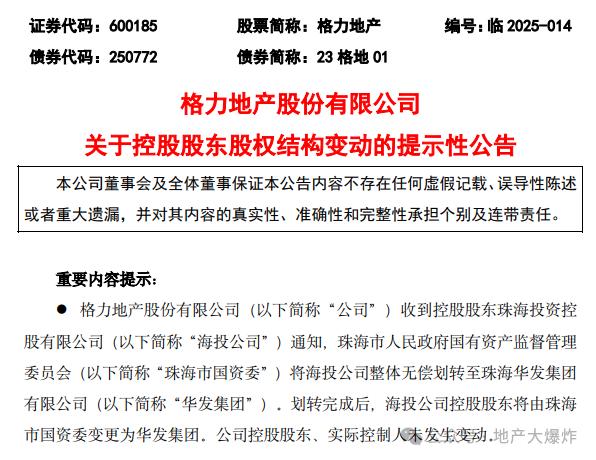
格力地产无偿划转至华发集团?故事还没完
3 6 Ke· 2025-04-14 03:53
Core Viewpoint - Gree Real Estate is undergoing significant restructuring as its controlling shareholder, Zhuhai Investment Holdings, is being transferred to Zhuhai Huafa Group, indicating a major internal adjustment within Zhuhai's state-owned enterprises [1][20]. Group 1: Company Restructuring - Gree Real Estate's parent company, Zhuhai Investment Holdings, will become a secondary company under Huafa Group, making Gree Real Estate a tertiary company under the same group [1]. - The restructuring is expected to involve the division of various business segments, such as real estate and duty-free operations, into different subsidiaries of Huafa Group [1][21]. - Gree Real Estate has already begun to transition away from real estate development, focusing instead on the duty-free business, with plans to change its name to "Zhuhai Duty-Free Group" [10][12]. Group 2: Financial Performance Comparison - In 2023, Huafa Group reported revenues of 721.45 billion yuan, while Gree Real Estate's revenue was only 47.32 billion yuan, less than one-tenth of Huafa's [7][6]. - Gree Real Estate has faced multiple issues, including allegations of insider trading and financial fraud, which have damaged its reputation in the market [9][8]. Group 3: Market Expectations - The market has shown optimism regarding Huafa Group's acquisition of Zhuhai Investment Holdings, as evidenced by a recent surge in Gree Real Estate's stock price [24]. - There are predictions that Huafa Group may inject its stake in Zhuhai Duty-Free Group into Gree Real Estate, further solidifying its position in the duty-free market [26]. - The restructuring efforts by Zhuhai's state-owned assets supervision are aimed at creating a stronger enterprise that could potentially enter the Fortune Global 500 list [27].