
文化创意等

Search documents
永争第一!中国最强省,出手了
Xin Lang Cai Jing· 2026-02-24 04:55
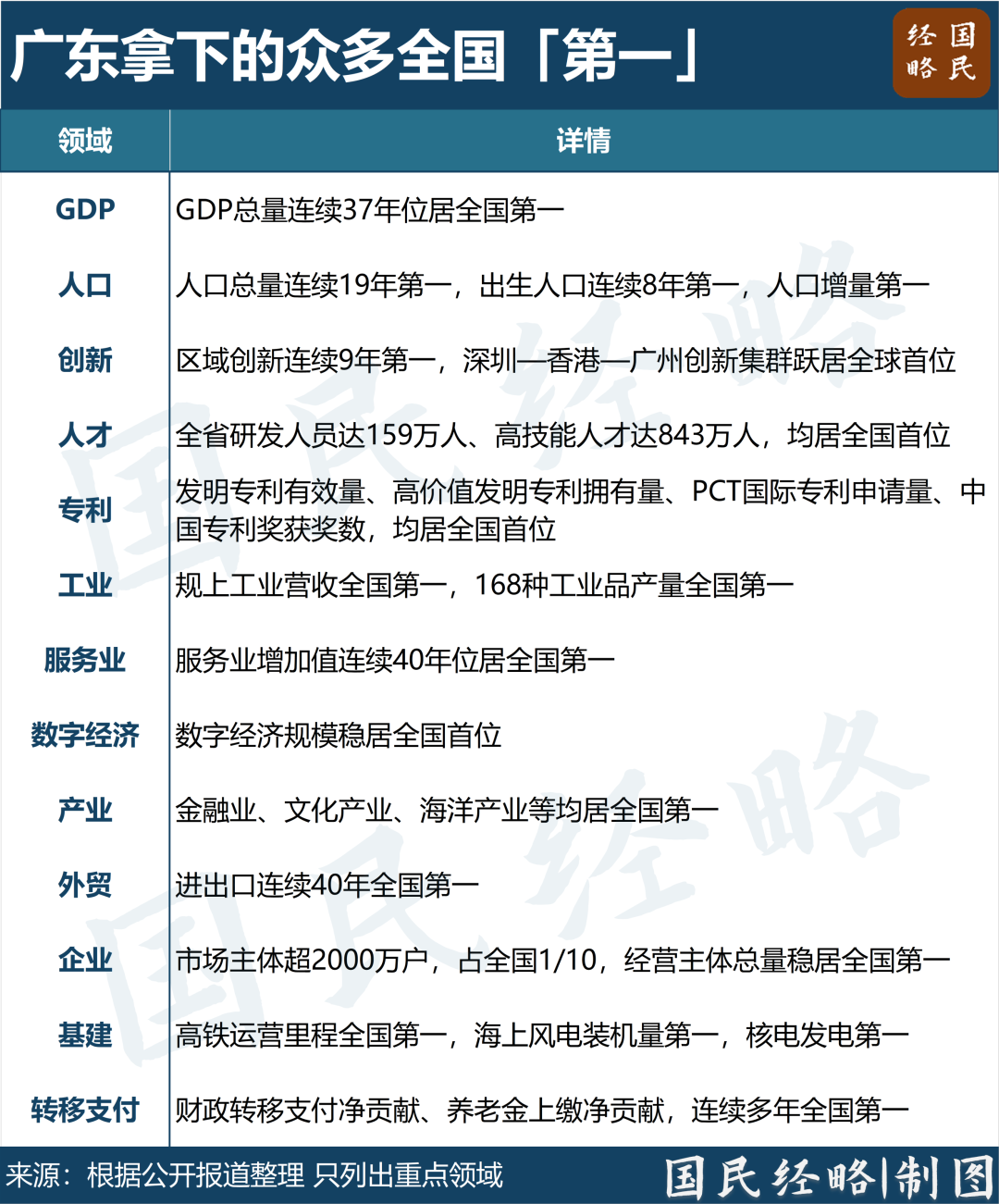
Core Viewpoint - Guangdong aims to double its economic output by 2035, reaching approximately 25.8 trillion yuan, showcasing its ambition to maintain its status as China's leading province in various sectors [1][11]. Economic Performance - Guangdong has maintained the highest GDP in China for 37 consecutive years, with a projected GDP of 14.58 trillion yuan by 2025, ranking 11th globally, surpassing countries like Australia and South Korea [3][11]. - The province's population reached 129 million in the previous year, with a net increase of 790,000 and a birth rate of 1.003 million, all ranking first in the nation [3][11]. Innovation and Competitiveness - Guangdong leads in regional innovation for nine consecutive years, with significant achievements in patent applications and awards, indicating a strong capacity for industrial technology integration [2][7]. - The "Shenzhen-Hong Kong-Guangzhou" innovation cluster is set to rank first globally by 2025, surpassing established tech hubs like Tokyo and San Francisco [8][7]. Industrial and Service Sector Leadership - The province's industrial revenue and service sector value added are both ranked first nationally, with Guangdong accounting for one-eighth of China's industrial scale [4][11]. - Guangdong has established ten trillion-yuan industrial clusters across various sectors, including electronics, information services, and new energy [4][11]. Fiscal Contributions - As the top fiscal contributor, Guangdong generates over 2 trillion yuan in domestic tax revenue annually, with a net contribution of approximately 800 billion to 1 trillion yuan after transfers [6]. - The province has contributed over 500 billion yuan in pension funds since 2018, exceeding the total contributions of all other provinces combined [6]. Future Growth Strategy - To achieve its 2035 GDP target, Guangdong needs to maintain an annual nominal growth rate exceeding 5%, which poses challenges given the current economic transition [11][13]. - The focus on the synergy between manufacturing and service industries is crucial for sustaining economic growth and enhancing competitiveness in a rapidly changing global landscape [9][11].

贵阳市获批国家“三新”消费试点城市 聚焦三大方向积极促进消费
Shang Wu Bu Wang Zhan· 2026-01-23 11:50
Group 1 - Guiyang has been approved as a pilot city for new consumption formats and models in 2025, focusing on innovative and diverse consumption scenarios, establishing a first-release economic service system, and promoting cross-industry collaborations [1] - The city aims to cultivate nine types of diverse consumption scenarios, including street, food, nightlife, performance, events, mountain, water, rural, and digital experiences, leveraging its cultural and regional advantages [1] - Guiyang will develop new consumer brands that reflect local cultural characteristics, such as "Qian Goods" and "Gui Products," and will host various first-release events to establish a regional manufacturing and first-release service system [1] Group 2 - The city will promote high-quality consumption resources by integrating local advantages and city IPs, such as "Cool Guiyang" and "Summer Performance City," to create a brand matrix and service system for "Guiyang Good Products" [2] - Efforts will be made to establish a center for cross-industry brand incubation, innovation, manufacturing, and promotion, focusing on immersive experiences and product innovation [2]
何建华专栏:工业化与城市化“双轮驱动”的国家奇迹
Xin Lang Cai Jing· 2025-12-27 12:30
Core Viewpoint - The rapid industrialization and urbanization in China since the establishment of the People's Republic and the reform and opening-up policy have created remarkable economic growth and social stability, positioning China as a modern nation with a successful transition from an agrarian society to an industrialized and urbanized one [1][2][15]. Group 1: Industrialization and Urbanization - China's industrialization and urbanization have progressed simultaneously, achieving a scale and speed unprecedented in human history, with urbanization rates increasing significantly from 1949 to 2024 [2][3]. - The urban population in China grew from approximately 5.765 million in 1949 to 943.5 million by the end of 2024, marking an increase of over 88 million people, which is nearly double the total population of the EU [3]. - The urbanization rate increased by 56 percentage points from 1949 to 2024, and by 49.08 percentage points from 1978 to 2024, significantly faster than many developed countries [3]. Group 2: Stages of Urbanization - The urbanization process in China has undergone three stages: individual city development, metropolitan area collaboration, and high-quality integrated development facilitated by high-speed rail and the internet [4]. - The current urbanization phase is characterized by rapid expansion of mega-cities, leading to challenges such as "big city diseases" [4]. Group 3: Global Context and Sustainable Development - The United Nations' 2030 Agenda for Sustainable Development emphasizes inclusive, safe, resilient, and sustainable cities, with cities contributing over 80% of global GDP [5]. - As a rapidly industrializing and urbanizing nation, China's advancements in urban development can serve as a model for global civilization progress [5][15]. Group 4: Cultural Dynamics in Urban Development - Urban culture is shaped by the interaction between individuals and the physical structure of cities, influencing how people experience and contribute to urban life [6]. - The cultural dynamics of cities involve consumption patterns, creative classes, and urban scenes that drive innovation and transformation [10]. Group 5: Future Directions and Challenges - The transition towards a knowledge-based society necessitates a shift in urban development strategies, focusing on creative industries rather than traditional manufacturing [9]. - The integration of urban and rural areas is essential for sustainable development, with a focus on enhancing the quality of life and ecological balance [13][14].