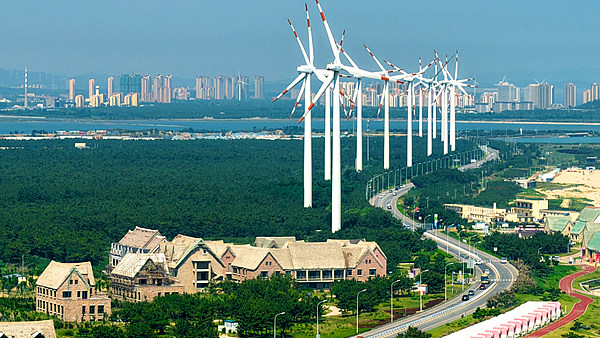
新能源(风电

Search documents
顶层设计标明能源行业奋进方向
中国能源报· 2025-12-21 23:33
Core Viewpoint - The article emphasizes the robust development of China's energy industry as it transitions into the "15th Five-Year Plan," highlighting the commitment to energy security, green transformation, and technological self-reliance [2][5]. Group 1: Energy Security and Supply - In 2025, China's energy sector achieved significant milestones in energy security, marking the best year since the "14th Five-Year Plan," with stable coal production and effective responses to peak electricity demands [3]. - Oil and gas production reached historical highs, with crude oil output at approximately 215 million tons and natural gas production exceeding 260 billion cubic meters, marking a continuous increase for nine years [3]. - Coal production surpassed 4.8 billion tons, with imports around 470 million tons, maintaining a reasonable supply margin and enhancing supply elasticity [3]. Group 2: Mechanism Innovation and Quality Development - The establishment of a cross-departmental collaboration system for energy monitoring and emergency response has transformed the management of energy resources, moving away from isolated operations [4]. - The renewable energy sector saw significant advancements, with major projects in wind and solar energy, including the completion of the first batch of wind and solar bases and the acceleration of hydropower and nuclear projects [4]. - The increase in non-fossil energy consumption and improvements in energy self-sufficiency and system regulation capabilities were highlighted as significant breakthroughs [4]. Group 3: Green Transformation and Technological Integration - The energy sector's development direction for the "15th Five-Year Plan" focuses on enhancing energy security while promoting a green and low-carbon transition [5]. - Innovative projects, such as a large-scale photovoltaic project in Shanxi and a solar thermal project in Gansu, exemplify the integration of renewable energy sources with storage systems and intelligent management platforms [5][6]. - The establishment of a virtual power plant platform in the Guangdong-Hong Kong-Macao Greater Bay Area aggregates over 5,000 adjustable load resources, enhancing grid flexibility and efficiency [6]. Group 4: Market Reform and Unified Energy Market - The energy industry is actively transforming reform momentum into high-quality development, with a focus on building a unified national market and enhancing resource allocation efficiency [8]. - The introduction of a unified electricity market framework aims to eliminate regional barriers and facilitate fair trading of electricity across the country [8][9]. - The need for a flexible adjustment mechanism in the electricity system is emphasized, particularly in response to the increasing share of variable renewable energy sources [9][10].

“我们早知道中国正大规模推进风电和太阳能,但还是被震撼到了”
Guan Cha Zhe Wang· 2025-06-27 01:33
Core Insights - China's rapid growth in renewable energy capacity reflects its commitment to climate change and green development, with over 1000 GW of solar capacity, accounting for half of the global total [1][3][4] - In the first five months of this year, China added 198 GW of solar and 46 GW of wind capacity, enough to meet the electricity needs of countries like Indonesia or Turkey [1][3] - The installation rate is astonishing, with 93 GW of solar capacity added in May alone, equivalent to nearly 100 solar panels installed every second [1][3] Renewable Energy Capacity - As of May 2023, China's total installed power generation capacity reached 3.61 billion kW, a year-on-year increase of 18.8% [3] - The solar photovoltaic capacity has surpassed 1 billion kW, reaching 1.08 billion kW, which is equivalent to the total capacity of approximately 48 Three Gorges Dams [4][5] - The annual output from over 1 billion kW of solar capacity can generate 1.2 trillion kWh of clean energy, replacing 152 million tons of standard coal [5] Wind Energy Growth - Wind power generation accounted for over 12% of China's total electricity generation, with cumulative installed wind capacity reaching 15.5% of the total [7] - In the first four months of this year, wind power generation reached 381.43 billion kWh, representing 12.78% of the total power generation [7] - The rapid growth in wind power capacity is expected to lead to decreasing costs for wind energy [7] Global Context and Comparisons - The data highlights China's significant advancements in renewable energy compared to the U.S., especially in light of past political tensions regarding climate agreements [7][8] - China's investment in clean energy is projected to surpass that of the U.S., EU, and UK combined by 2024, indicating a strong competitive edge in the global clean energy market [8]