能源强国

Search documents
内蒙古能源局党组书记、局长曹思阳: 结合开展光伏治沙工程 谋划实施一批区内自用新能源项目
Zhong Guo Dian Li Bao· 2026-03-31 03:12
Core Viewpoint - The 20th Central Committee's Fourth Plenary Session emphasizes the construction of a new energy system and the development of an energy powerhouse, with specific targets set for 2030 and 2035, guiding the energy sector's development for the "14th Five-Year Plan" and beyond [1] Group 1: Energy Security and Development - Inner Mongolia has made significant progress in high-quality energy development since the "14th Five-Year Plan," focusing on traditional energy transformation and green energy development, ensuring energy supply tasks are met with over 12 billion tons of coal production [2] - The region's electricity generation capacity has doubled, with power delivery increasing by 72% compared to the end of the "13th Five-Year Plan," maintaining a leading position in national energy security [2] Group 2: New Energy Development - New energy capacity has reached 170 million kilowatts, achieving a 2.4 times increase in installed capacity and a 2.1 times increase in power generation compared to the end of the "13th Five-Year Plan," with over 70% of new electricity consumption coming from new energy sources [3] - The region has established 230 intelligent coal mines, accounting for 80% of coal mines in operation, with a production capacity of 1.14 billion tons, leading the nation [3] Group 3: Energy Reform and Cooperation - The approval process for new energy and grid projects has been streamlined, reducing processing time from six months to approximately three months, facilitating market entry for new energy [4] - Cooperation with central enterprises has expanded, with agreements totaling over 1.1 trillion yuan, and energy collaboration with Mongolia has strengthened, including the establishment of nine power transmission channels [4] Group 4: Future Energy Strategy - The "15th Five-Year Plan" aims to enhance traditional energy supply capabilities and promote the development of modern energy economies, transitioning Inner Mongolia from an energy region to an energy powerhouse [5][6] - The focus will be on improving the efficiency of new energy development, expanding renewable energy applications, and enhancing the construction of a new power system [6][7] - The region plans to develop green hydrogen and establish a comprehensive hydrogen transport network, positioning itself as a leader in the green hydrogen industry [7]
媒体报道︱新型能源体系建设提速
国家能源局· 2026-03-30 08:31
Core Viewpoint - The article emphasizes the importance of energy security and the transition to a new energy system in China, driven by recent geopolitical tensions and domestic policy initiatives aimed at achieving carbon neutrality and sustainable energy development [2][4]. Group 1: Energy Security and Transition - The Chinese government has outlined plans to strengthen energy security and transition towards renewable energy sources, as highlighted in the recent government work report [2]. - The "14th Five-Year Plan" explicitly includes the goal of building an energy powerhouse, which will guide energy development over the next five years [4]. - The construction of a new energy system is deemed essential, with significant achievements in renewable energy over the past decade, including a shift where non-fossil energy consumption has surpassed that of oil [4][6]. Group 2: Renewable Energy Development - By 2025, the power generation structure is expected to see a significant increase in renewable energy sources, with wind and solar power installations projected to rise dramatically by 2060 [6]. - Wind power capacity is expected to grow from 520 million kilowatts in 2024 to between 3.22 billion and 3.34 billion kilowatts by 2060, while solar power capacity is projected to increase from 890 million kilowatts to between 5.5 billion and 6.5 billion kilowatts [6]. - By 2060, renewable energy is anticipated to account for over 90% of total power generation, with wind and solar contributing approximately 77% of the total generation [6]. Group 3: Electrification and Energy Efficiency - The electrification rate in China is projected to reach around 35% by 2030, significantly above the OECD average, with electricity expected to account for over 50% of terminal energy consumption by 2050 [8]. - The government aims to ensure that new electricity demand is primarily met by renewable energy sources by the end of the "14th Five-Year Plan" [8]. - The article highlights the need for technological innovation and improved systems to enhance the proportion of renewable energy in total electricity consumption [9]. Group 4: Hydrogen Energy Potential - Hydrogen energy is identified as a crucial component for achieving carbon neutrality, with policies shifting towards a more integrated approach involving industry funds and green finance [11]. - The development of green ammonia and green methanol is projected to significantly reduce reliance on oil and natural gas imports, with green ammonia potentially decreasing oil import dependence by 1.77% and natural gas by 62.67% [12]. - The article suggests that hydrogen and hydrogen-based fuels can play a vital role in decarbonizing various sectors, including industry and transportation, thereby contributing to a cleaner energy landscape [13].


哈尔滨电气:收入利润订单多维全面改善-20260327
HTSC· 2026-03-27 10:45
Investment Rating - The investment rating for Harbin Electric is maintained as "Buy" with a target price of HKD 29.15 [6][9]. Core Views - Harbin Electric reported a comprehensive improvement in revenue, profit, and orders for 2025, achieving a revenue of RMB 46.1 billion, a year-on-year increase of 19%, and a net profit attributable to the parent company of RMB 2.67 billion, up 58% year-on-year [7][9]. - The company is expected to benefit from the growth in domestic electricity demand and the increasing importance of traditional power supply, including coal, gas, water, and nuclear energy [7][9]. - The global shortage of electricity is creating opportunities for the company's gas turbine exports, with a significant increase in global gas turbine orders projected for 2025 [8][9]. Financial Performance - Revenue projections for the upcoming years are as follows: RMB 52.3 billion in 2026, RMB 57.3 billion in 2027, and RMB 59.8 billion in 2028, reflecting growth rates of 13.54%, 9.57%, and 4.39% respectively [5][9]. - The net profit attributable to the parent company is forecasted to reach RMB 3.54 billion in 2026, RMB 4.15 billion in 2027, and RMB 4.36 billion in 2028, with year-on-year growth rates of 32.72%, 17.21%, and 5.08% respectively [5][9]. - The earnings per share (EPS) are projected to be RMB 1.58 in 2026, RMB 1.85 in 2027, and RMB 1.95 in 2028 [5][9]. Order Growth and Market Opportunities - The company secured new orders worth RMB 64.6 billion in 2025, a year-on-year increase of 14%, with significant contributions from coal, hydro, and nuclear power sectors [7][9]. - The company is positioned to capitalize on the increasing electrification rates in regions like North America and the Middle East, which may lead to substantial export opportunities for its small gas turbines [8][9]. - The ongoing investment in energy infrastructure, with an expected increase of 40% in fixed asset investments during the 14th Five-Year Plan, supports the demand for traditional power supply equipment [7][9].
消费占比25%、单位GDP二氧化碳排放下降17%、能源综合生产能力
Orient Securities· 2026-03-27 09:45
Group 1: Energy Security - By 2030, China's energy comprehensive production capacity is targeted to reach 5.8 billion tons of standard coal, a 13% increase from 5.13 billion tons in 2025[6] - The energy consumption total is expected to reach 7 billion tons of standard coal by 2030, with a production coverage ratio of approximately 82.9% during the 14th Five-Year Plan period[6] - The oil production is aimed to stabilize at around 200 million tons annually, with natural gas production steadily increasing[6] Group 2: Energy System Construction - The goal is to increase the share of non-fossil energy in total energy consumption to 25% by 2030, up from 16% in 2020 and 21.7% in 2025[13] - The plan includes the construction of major clean energy bases, with a cumulative installed capacity of offshore wind power expected to exceed 100 million kilowatts and nuclear power capacity reaching approximately 110 million kilowatts[15][17] - The new energy system will focus on multi-energy complementarity and innovation mechanisms, with a target of adding over 30 million kilowatts of new energy base capacity during the 15th Five-Year Plan[15] Group 3: Green Low-Carbon Transition - A 17% reduction in carbon emissions per unit of GDP is necessary to achieve the carbon peak by 2030, with projections indicating a decrease to approximately 0.78 tons per 10,000 yuan by that year[18][19] - The plan emphasizes dual control of carbon emissions, focusing on total emissions and intensity, with specific measures for high-energy-consuming industries[24] - Key actions include enhancing energy efficiency in major sectors, promoting circular economy initiatives, and implementing non-CO2 greenhouse gas management[25][27] Group 4: Future Energy Industry Development - The plan aims to foster technological breakthroughs in future energy industries, focusing on smart driving, new solar cells, and energy storage technologies[28] - Hydrogen energy and nuclear fusion are highlighted as key areas for future development, with a focus on creating a comprehensive hydrogen energy ecosystem[29] - The investment in nuclear fusion technology is expected to yield results during the 15th and 16th Five-Year Plans, positioning China at the forefront of future energy technology[29]
哈尔滨电气(01133):收入利润订单多维全面改善
HTSC· 2026-03-27 06:22
Investment Rating - The investment rating for Harbin Electric is maintained as "Buy" with a target price of HKD 29.15 [6][7]. Core Insights - Harbin Electric reported a comprehensive improvement in revenue, profit, and orders for 2025, achieving a revenue of RMB 46.1 billion, a year-on-year increase of 19%, and a net profit attributable to the parent company of RMB 2.67 billion, up 58% year-on-year [7][9]. - The company is positioned to benefit from the growth in domestic electricity demand and the increasing importance of traditional power supply, including coal, gas, and nuclear energy [7][9]. - The global shortage of electricity is expected to create export opportunities for the company's small gas turbines, with a significant increase in overseas orders anticipated [8][9]. Financial Performance - Revenue projections for the upcoming years are as follows: RMB 52.3 billion in 2026, RMB 57.3 billion in 2027, and RMB 59.8 billion in 2028, reflecting growth rates of 13.54%, 9.57%, and 4.39% respectively [5][9]. - The net profit attributable to the parent company is forecasted to reach RMB 3.54 billion in 2026, RMB 4.15 billion in 2027, and RMB 4.36 billion in 2028, with year-on-year growth rates of 32.72%, 17.21%, and 5.08% respectively [5][9]. - The company’s earnings per share (EPS) are projected to be RMB 1.58 in 2026, RMB 1.85 in 2027, and RMB 1.95 in 2028 [5][9]. Order Growth and Market Position - In 2025, Harbin Electric secured new orders totaling RMB 64.6 billion, a 14% increase year-on-year, with significant contributions from coal, hydro, and nuclear power sectors [7][9]. - The company has optimized its contract signing strategy since 2022, leading to the gradual digestion of low-margin orders and an increase in high-margin orders [11][9]. - The fourth-generation nuclear power layout is expected to open new growth opportunities, with the company actively developing advanced nuclear technologies [11][9].
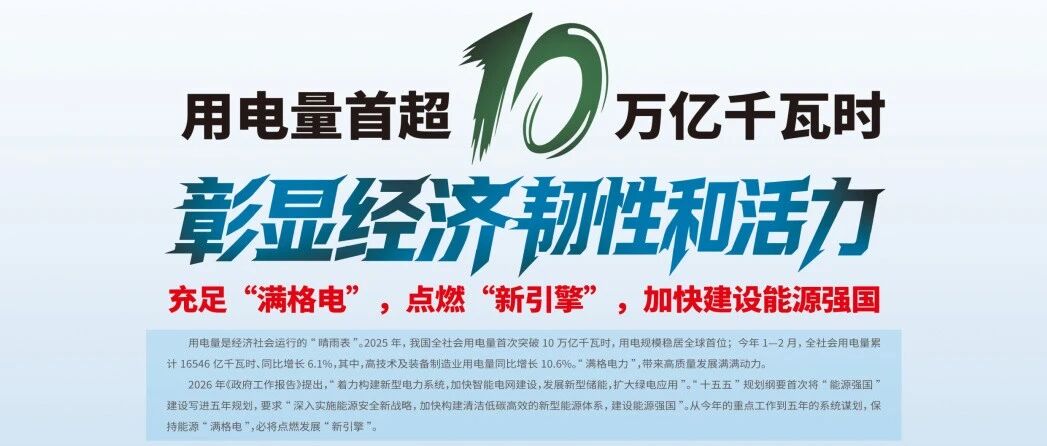
人民日报丨数说高质量发展:充足“满格电”,点燃“新引擎” ,加快建设能源强国
国家能源局· 2026-03-25 10:14
Group 1 - The National Energy Administration serves as an important platform for news dissemination, information transparency, and public service in the energy sector [3] - The agency focuses on publishing industry dynamics and providing public services related to energy [3] - The official WeChat account of the National Energy Administration is a key resource for staying updated on energy developments [3]
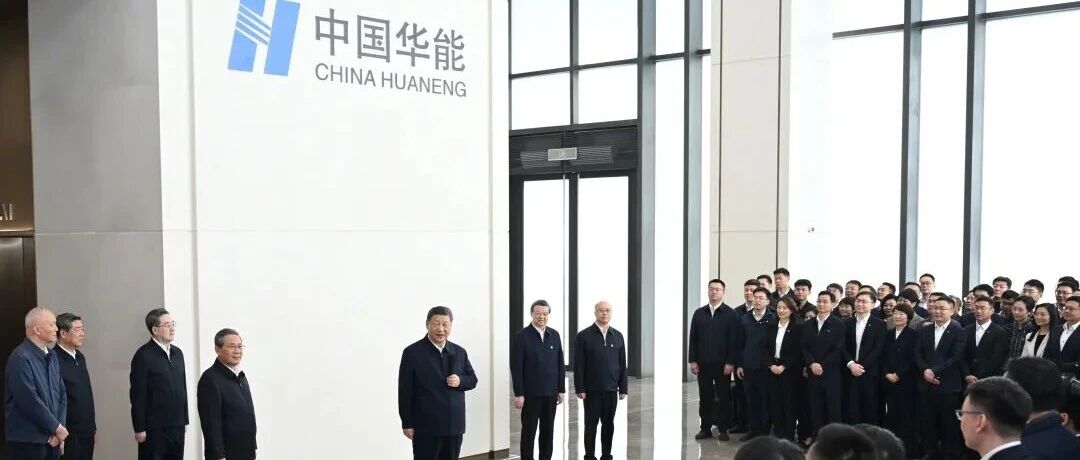
习近平总书记考察华能集团
中关村储能产业技术联盟· 2026-03-24 02:09
Group 1 - The core viewpoint emphasizes the importance of the Xiong'an New Area as a key area for the relocation of non-capital functions from Beijing, aiming to build a high-quality development model and an innovation hub for the new era [6][10] - Xi Jinping highlighted the need for strategic patience and innovative thinking to enhance the internal development momentum of the Xiong'an New Area, focusing on resource allocation and coordination [6][9] - The construction progress of the Xiong'an New Area has been acknowledged as orderly and vibrant, indicating significant achievements in its development [6][8] Group 2 - China Huaneng Group will relocate over 1,000 employees to the Xiong'an New Area by October 2025, which is seen as an opportunity to stimulate innovation and entrepreneurship among its staff [7][8] - The Beijing Fourth Middle School in Xiong'an is set to open in August 2023, currently serving over 380 students, with an emphasis on ensuring the well-being and comprehensive development of children [7][8] - Xi Jinping's visit included discussions on enhancing the comprehensive carrying capacity of the Xiong'an New Area, focusing on high-quality construction and efficient governance [9][10] Group 3 - The meeting emphasized the need for a systematic approach to improve the quality of life and public services in the Xiong'an New Area, aiming for a beautiful environment with blue skies, green land, and clear water [9][10] - There is a strong focus on integrating technological and industrial innovation to develop a modern industrial system suitable for the Xiong'an New Area [9][10] - The leadership underlined the importance of a clean political environment and the need for all parties to actively support the high-quality construction and development of the Xiong'an New Area [9][10]

中国矿业大学(北京)校长刘波:太空资源赋予能源更多可能
中国能源报· 2026-03-23 04:18
Core Viewpoint - The "14th Five-Year Plan" marks a critical period for China's space resource development, focusing on breakthroughs in extraterrestrial resource exploration, intelligent autonomous mining, in-situ utilization, and smart construction [1][11]. Group 1: Space Resource Potential - Various resources exist in space, particularly on celestial bodies like the Moon, which has abundant Helium-3, a clean nuclear fusion material rare on Earth. Near-Earth asteroids and Mars also contain rich reserves of precious metals and water ice [5]. - The ability to mine these resources in space could provide essential materials for technologies such as water electrolysis for hydrogen and oxygen production, significantly reducing material costs in related industries [6]. Group 2: Technological Advancements - Space resource development is expected to drive advancements in energy technology and equipment. The transition of technologies like autonomous navigation and intelligent decision-making from space to terrestrial mining can facilitate the automation and green development of mining operations [8]. - The high costs of transporting materials from Earth to extraterrestrial bodies necessitate the local extraction, transformation, storage, and utilization of resources, which will push the development of new mining technologies and high-end equipment [9]. Group 3: Systematic Layout and Strategic Development - China has established a systematic layout for space resource development, integrating national strategy with collaborative efforts from academia and industry. This comprehensive approach is crucial for advancing space resource technology [10]. - The "14th Five-Year Plan" outlines the implementation of various space exploration projects, including planetary exploration and the construction of an international lunar research station, aiming to transition from research to practical application in deep space resource utilization [11].
电力行业周报:政府工作报告:算电协同首次写入新基建,双碳目标夯实绿电价值
GOLDEN SUN SECURITIES· 2026-03-08 12:24
Investment Rating - The report maintains a "Buy" rating for the industry, emphasizing the potential of "算电协同" (computing and electricity collaboration) as a new infrastructure category [9][10]. Core Insights - The concept of "算电协同" has been officially included in the government work report, marking it as a significant direction for new infrastructure development. This indicates a shift from local trials to a national strategic deployment [2][14]. - The report highlights the rapid growth of intelligent computing power in China, projected to reach 725.3 EFLOPS by 2024, a 74.1% increase year-on-year, significantly outpacing general computing power growth [2][14]. - The dual carbon goals are reinforcing the value of green electricity, with a focus on constructing a new power system and promoting the application of renewable energy [5][17]. Summary by Sections Government Work Report - "算电协同" is recognized as a key component of new infrastructure, aimed at building a smart economy and enhancing integrated computing power monitoring and scheduling [2][14]. - The report emphasizes the construction of zero-carbon parks and factories, the development of a new power system, and the acceleration of smart grid construction [2][14]. Policy Developments - Continuous policy support for "算电协同" has been noted, with plans for a comprehensive computing infrastructure system by the end of 2025 [3][15]. - The government has initiated pilot projects in key regions to explore technology innovations related to green electricity supply and multi-source complementarity [3][15]. Power Generation and Grid Upgrades - The report indicates a structural increase in electricity demand from data centers, which is driving the need for upgrades in power generation and grid infrastructure [4][16]. - The emphasis on low electricity prices and high green energy ratios makes certain parks more attractive for data center electricity needs [4][16]. Investment Recommendations - The report suggests focusing on companies involved in "算电协同," recommending specific firms such as 涪陵电力 (Fuling Power) and 金开新能 (Jin Kai New Energy) [9][10]. - It also highlights the potential for growth in green electricity companies and suggests monitoring traditional power companies that are adapting to flexible operations [9][10].
今年加快智能电网建设
第一财经· 2026-03-05 08:57
Core Viewpoint - The article emphasizes the importance of establishing a strong energy nation, focusing on energy security and supply capabilities to meet the demands of economic development and social stability [3]. Group 1: Energy Security and Development - The core essence of building an energy strong nation is energy security, which requires robust supply capabilities to effectively meet the energy needs of national economic development and social stability [3]. - The construction of a new energy system will be significantly influenced by smart grids, which will enhance the safety, efficiency, cleanliness, and reliability of the energy system, thereby better ensuring national energy security and supporting a comprehensive green transformation of economic and social development [3][4]. Group 2: Smart Grid Development - Smart grids are a crucial component of the new energy system, designed to adapt to the rapid development of high-proportion renewable energy, consisting of main grids, distribution networks, and microgrids with distributed energy sources and storage devices [4]. - The construction of smart grids and microgrids will facilitate multi-level collaborative development, improving the grid's ability to accept, allocate, and regulate clean energy, thus ensuring safe, reliable, and economically efficient grid operations [4]. - Major investment plans have been announced by State Grid and Southern Power Grid, with State Grid's fixed asset investment expected to reach 4 trillion yuan during the 14th Five-Year Plan period (2026-2030), a 40% increase compared to the previous period, averaging 800 billion yuan annually [4]. - Southern Power Grid's investment for 2026 is projected at 180 billion yuan, with total investments during the 14th Five-Year Plan expected to reach around 1 trillion yuan, leading to a combined total investment of nearly 5 trillion yuan from both companies [4]. - The construction and operation of smart grids encompass a complete chain from high-end equipment manufacturing to data analysis and operation services, driving the development of related industries such as information technology, high-end equipment manufacturing, new materials, and renewable energy, thus creating new economic growth points [4].