
有色业

Search documents
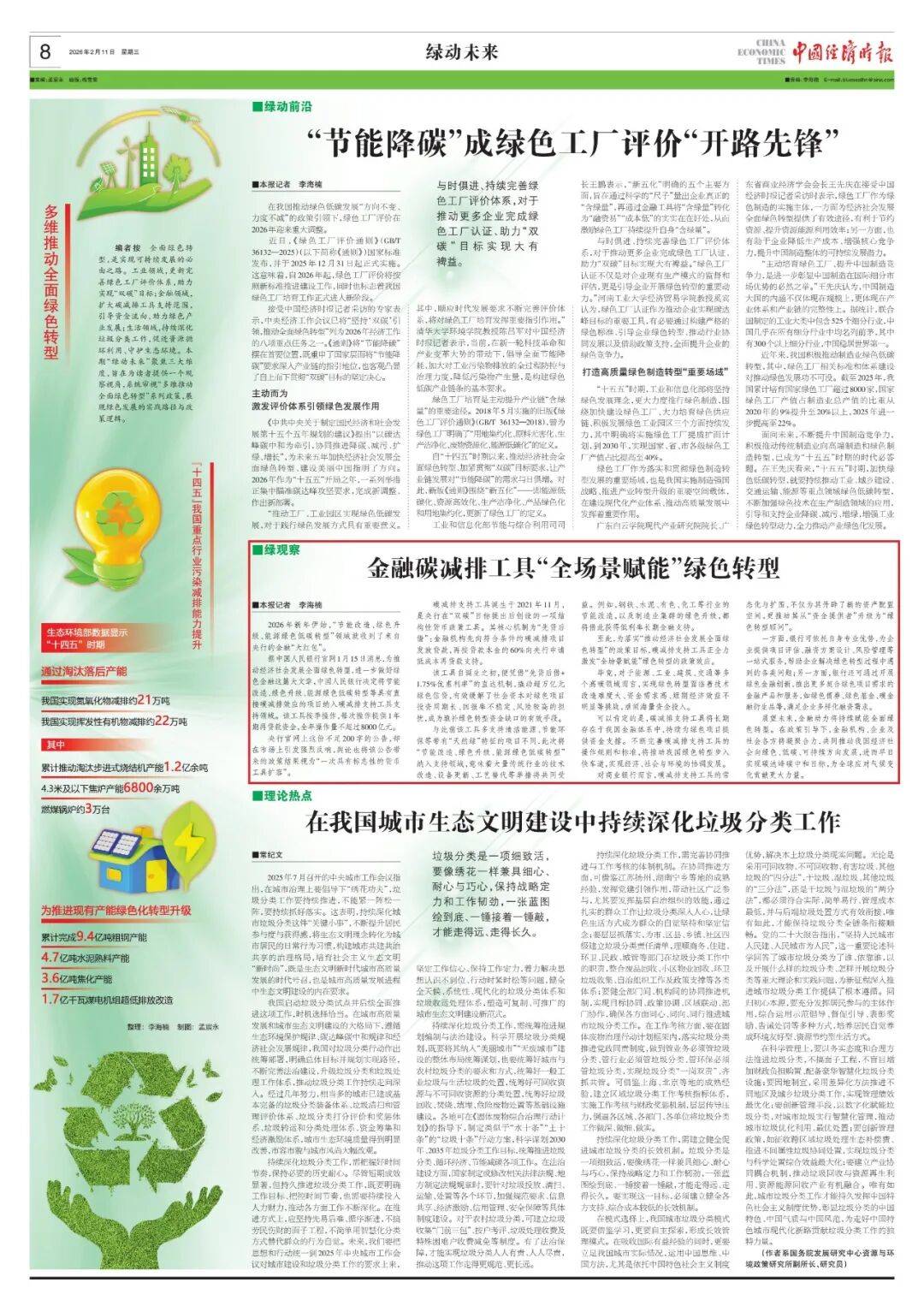
绿动未来丨金融碳减排工具“全场景赋能”绿色转型
Sou Hu Cai Jing· 2026-02-11 03:26
Core Viewpoint - The People's Bank of China (PBOC) has expanded its carbon reduction support tool to include projects related to energy efficiency upgrades and low-carbon transitions, aiming to facilitate a comprehensive green transformation in the economy [1][2][3]. Financial Sector - The PBOC's announcement has been perceived as a significant expansion of a structural monetary policy tool created in November 2021, which operates on a "lend first, borrow later" mechanism, allowing financial institutions to issue loans for eligible carbon reduction projects and then seek low-cost refinancing from the central bank [2][3]. - The carbon reduction support tool has mobilized over 1 trillion yuan in green credit since its inception, effectively addressing concerns about the long investment cycles and uncertain returns associated with green projects [2][3][4]. Industrial Sector - The inclusion of energy efficiency upgrades and low-carbon transitions in the support tool signifies that traditional industries such as steel, cement, and chemicals will benefit from long-term, low-interest financial support for technological upgrades and process improvements [2][3][4]. - The tool aims to address the high capital demands and technical challenges faced by high-carbon sectors, ensuring a steady flow of funds to facilitate their green transformation [3][4]. Policy Implications - The ongoing refinement of the carbon reduction support tool's operational rules and standards is expected to accelerate China's green transition, promoting coordinated economic, social, and environmental development [3][4]. - The central government's commitment to green transformation is underscored by its inclusion in the key economic tasks for 2026, emphasizing energy efficiency and carbon reduction as primary objectives [9][10]. Green Manufacturing - The new national standard for green factory evaluation, effective from December 31, 2025, aims to enhance the green manufacturing landscape, aligning with the broader goals of carbon neutrality and sustainable development [9][10][11]. - The green factory certification process is seen as a crucial driver for enterprises to adopt greener practices, thereby improving resource efficiency and reducing production costs [11][12][13]. Future Outlook - The financial sector is expected to evolve from merely providing funds to becoming a "green transformation consultant," offering comprehensive services to businesses undergoing green transitions [4][16]. - The collaborative efforts among financial institutions, enterprises, and society are anticipated to propel the economy towards a sustainable, low-carbon future, contributing to global climate change mitigation efforts [4][16].

宏观策略周报:美国持续释放关税缓和信号,全球风险偏好大幅升温-20250428
Dong Hai Qi Huo· 2025-04-28 08:01
1. Report Industry Investment Rating - Short - term maintain A - share four major stock index futures (IH/IF/IC/IM) as short - term cautious long; commodities as cautious wait - and - see; treasury bonds as cautious wait - and - see; ranking: stock index > treasury bonds > commodities [2] - Commodity strategy ranking: precious metals > non - ferrous metals > energy > black metals [2] 2. Core Viewpoints - Domestically, in Q1 2025, the economy grew strongly and exceeded market expectations. The US's signal of trade relaxation and the Politburo meeting's indication of new incremental policies supported the domestic market sentiment. Internationally, the US economy slowed due to the decline in service - sector prosperity, but the US released positive signals on tariffs, which affected the dollar and global risk appetite. Overall, the domestic market rebounded in the short term, with the stock index maintained for cautious long, the bond market in high - level short - term oscillation, and the commodity market showing different trends [2] 3. Summary by Directory 3.1 Last Week's Important News and Events - The IMF significantly lowered the global economic growth forecast in its April report, with the US economic growth forecast cut by 0.9 percentage points in 2025 [3] - The US President called for the Fed to cut interest rates, mentioned cryptocurrency regulation, and said the US - China trade tension would ease and might "significantly reduce" tariffs on China [3][4] - The Fed's Beige Book showed that international trade policy uncertainty led to a slowdown in the US economic outlook [4] - US economic data such as PMI, initial jobless claims, durable goods orders, consumer confidence index, and inflation expectations were released, showing a mixed economic situation [4][5] - The European Central Bank's president mentioned the negative impact of tariffs on economic growth, and the ECB's survey adjusted the euro - zone economic growth and inflation forecasts [5][9] - China's 4 - month LPR remained unchanged, and the central bank increased liquidity support through MLF operations. The Politburo meeting proposed a series of economic stimulus policies [7][8][9] 3.2 This Week's Important Events and Economic Data Reminders - From April 28 to May 2, various industrial data, economic sentiment indices, consumer confidence indices, and housing price indices in different regions will be released [10] 3.3 Global Asset Price Movements - Stock markets: Different stock indices showed different daily, weekly, monthly, and year - to - date changes, with some rising and some falling [11] - Bond markets: Yields of 10 - year bonds in different countries changed, with some rising and some falling [11] - Commodity markets: Prices of various commodities such as steel, iron ore, copper, aluminum, oil, and precious metals had different price changes [11] - Exchange rates: The dollar index, exchange rates between major currencies also had corresponding fluctuations [11] 3.4 Domestic High - Frequency Macroeconomic Data - Upstream: Data on commodity price indices, energy prices, coal consumption and inventory, and iron ore prices and inventory were presented through various charts [13][16][23] - Midstream: Information on steel prices, production, and inventory, non - ferrous metal prices and inventory, building material prices and capacity utilization, and chemical product prices and inventory were shown [41][51][57] - Downstream: Data on real estate transaction area, automobile sales and tire production, and agricultural product prices were provided [70][72][79] 3.5 Domestic and Foreign Liquidity - Global liquidity: The US Treasury yield curve and its weekly changes were presented [81] - Domestic liquidity: Central bank's open - market operations, reverse - repurchase maturities, and domestic interest rates such as inter - bank lending rates and bond yields were shown [83][90][94] 3.6 Global Financial Calendar - From April 27 to May 2, important economic indicators such as industrial enterprise profits, economic sentiment indices, consumer confidence indices, housing price indices, GDP, inflation rates, employment data, and central bank policy announcements in different countries and regions will be released [102]