核聚变发电

Search documents
Thea能源公司公布“赫利俄斯”核聚变电厂设计方案,灵感源自像素技术
Xin Lang Cai Jing· 2025-12-15 13:05
Core Insights - Nuclear fusion power has the potential to reshape a multi-trillion-dollar energy market, but startups must first prove the feasibility and cost-effectiveness of their designs [1][7] - Thea Energy's reactor design, inspired by pixel technology, allows for power generation without the need for high precision in installation, which may provide a competitive edge [1][7] Group 1: Thea Energy's Reactor Design - Thea Energy is developing a unique stellarator device that uses a combination of large and small magnets to guide plasma fuel into specific shapes [2][9] - The design allows for rapid iteration and optimization of magnet designs, with over 60 adjustments made in the past two years [3][9] - The reactor, named "Helios," is expected to produce 1.1 billion watts of thermal energy, converting to 390 million watts of electrical energy, with a capacity factor of 88% [5][11] Group 2: Technical Innovations and Testing - The reactor's design incorporates a software control system that compensates for manufacturing or installation errors, tested successfully under extreme fault scenarios [4][10] - Thea Energy plans to build an initial fusion device named "Eros" to validate the scientific principles behind the design, with a site announcement expected in 2026 and construction aimed for around 2030 [5][11] - The company is exploring the application of artificial intelligence in its control systems, enhancing the potential for automated error correction [3][9] Group 3: Market Position and Strategy - Thea Energy's strategy involves building the power plant first and then optimizing it through software, which could significantly reduce fusion power generation costs [1][7] - The company aims to establish collaborations and engage end-users to initiate the construction of its first device, marking a critical moment for the industry [6][12]
A股异动丨可控核聚变概念股普跌,哈焊华通跌超8%
Ge Long Hui A P P· 2025-12-15 07:48
Core Insights - The A-share market for controllable nuclear fusion concept stocks experienced a significant decline, with major stocks like Ha Welding Huatong and Yongding Co. dropping over 8% [1] - Elon Musk publicly criticized nuclear fusion power on social media, stating that building small nuclear fusion reactors on Earth is economically foolish, as the Sun itself is a massive, free nuclear fusion reactor [1] Stock Performance Summary - Ha Welding Huatong: Decreased by 8.72%, market cap at 89.62 billion [2] - Yongding Co.: Decreased by 8.04%, market cap at 29.4 billion [2] - Ice Wheel Environment: Decreased by 6.98%, market cap at 16.8 billion [2] - Changfu Co.: Decreased by 6.46%, market cap at 2.512 billion [2] - Juguang Technology: Decreased by 5.45%, market cap at 14 billion [2] - Aike Saibo: Decreased by 4.62%, market cap at 6.081 billion [2] - Hezhuan Intelligent: Decreased by 4.35%, market cap at 11.7 billion [2] - Hailu Heavy Industry: Decreased by 3.76%, market cap at 10.6 billion [2] - Western Superconducting: Decreased by 3.73%, market cap at 47.2 billion [2] - Rongfa Nuclear Power: Decreased by 3.59%, market cap at 15.6 billion [2] - Changguang Huaxin: Decreased by 3.20%, market cap at 25.5 billion [2]


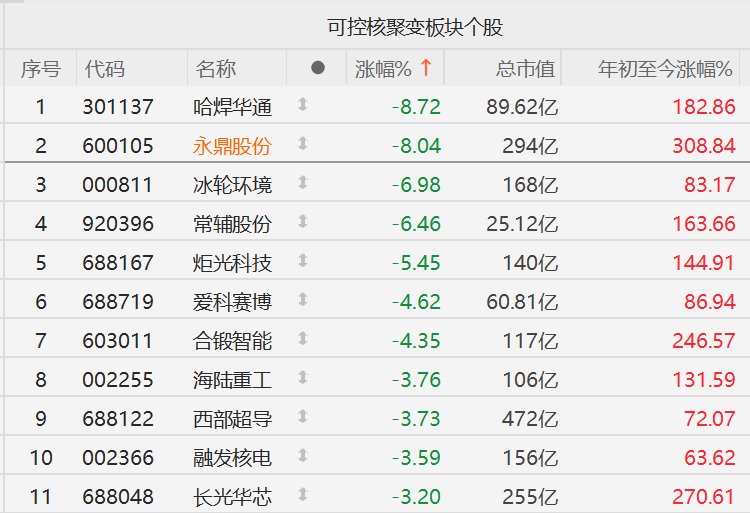
可控核聚变概念股普跌,哈焊华通跌超8%
Ge Long Hui· 2025-12-15 07:44
Group 1 - The core viewpoint of the news is that the controlled nuclear fusion concept stocks in the A-share market experienced a significant decline, influenced by Elon Musk's negative comments on nuclear fusion power generation [1] - Specific stocks that fell include: - Ha Huan Huatong down 8.72% with a market cap of 8.962 billion - Yongding Co. down 8.04% with a market cap of 29.4 billion - Ice Wheel Environment down 6.98% with a market cap of 16.8 billion - Changfu Co. down 6.46% with a market cap of 2.512 billion - Juguang Technology down 5.45% with a market cap of 14 billion [2] Group 2 - Elon Musk publicly criticized the idea of building small nuclear fusion reactors on Earth, calling it economically wasteful and stating that the Sun itself is a massive, free nuclear fusion reactor [1] - Musk emphasized that the energy produced by the Sun could meet all energy demands in the solar system, further questioning the feasibility of small-scale nuclear fusion projects [1]
“人造太阳”核聚变的发电,有望两年后“点燃” 中国核聚变发电将给世界带来廉价新能源!
Sou Hu Cai Jing· 2025-11-24 09:25
Core Insights - The global energy market is facing a dual crisis with increased volatility in fossil fuel prices and the intermittent nature of renewable energy sources, highlighting the significance of China's "artificial sun" nuclear fusion project, which is expected to achieve a critical "ignition" in two years and be completed by the end of 2027, paving the way for commercial power generation [1][12] Group 1: Nuclear Fusion Technology - The core advantage of nuclear fusion lies in its fuel efficiency and the abundance of its primary fuels, deuterium and tritium, with deuterium being virtually limitless in seawater, where extracting energy equivalent to 1 ton of gasoline can be achieved from just 30 liters of seawater [3][4] - Tritium can be produced through lithium, which is abundant in regions like Qinghai and Sichuan in China, allowing for a self-sustaining fuel supply chain, making nuclear fusion fuel acquisition costs significantly lower compared to fossil fuels and other renewable sources [3][4] Group 2: Cost and Efficiency - The "ignition" goal of the BEST device is a critical technological milestone that will break down cost barriers, enabling the plasma to reach a state where it can sustain itself through its own fusion energy, thus achieving net energy output without continuous external energy input [4][6] - Once operational, nuclear fusion is expected to have minimal fuel consumption costs, with the primary expenses being related to device maintenance and energy conversion, contrasting sharply with traditional fossil fuel and renewable energy costs [4][6] Group 3: Global Impact and Cooperation - China's advancements in nuclear fusion technology are set to provide affordable clean energy globally through a dual approach of "technology export and cost demonstration," with the BEST device's design aimed at commercial viability and long-duration energy output [6][9] - The successful validation of the BEST device could allow China to assist developing countries in bypassing fossil fuel dependency, while also pressuring developed nations to accelerate their energy transitions due to the cost advantages of Chinese nuclear fusion technology [6][9] Group 4: Future Prospects - The commercialization of nuclear fusion could revolutionize energy usage, particularly in high-energy-consuming industries, potentially reducing electricity costs to one-fifth of current coal-fired power prices, thus facilitating a green transition and lowering production costs [7][10] - The rapid progress of the BEST device, including the successful domestic production of key components, suggests that the world's first nuclear fusion power plant could be operational in China by around 2040, with electricity prices potentially dropping below 0.1 yuan per kilowatt-hour [10][12]
和讯投顾吴青宇:情绪有所好转,有色维持上涨核心逻辑不变
Sou Hu Cai Jing· 2025-10-20 02:33
Group 1 - Major companies are increasing investments in nuclear fusion power, which will impact the nuclear fusion, shoreline energy storage, and photovoltaic or green energy sectors [1] - The A50 index rose nearly 1% on Friday, indicating improved market sentiment, with expectations of a likely high opening on Monday [1] - The third-quarter report of the technology company Hanwang shows revenue of 1.727 billion, a year-on-year increase of 1332.52%, and a net profit of 567 million, a year-on-year increase of 391.47% [1] Group 2 - The recent drop in spot gold and silver prices has led to bearish sentiment, but this is viewed as an opportunity rather than a risk [2] - The core logic behind the recent cycle of price increases is driven by inflation and potential interest rate cuts by the Federal Reserve [2] - The demand for copper, aluminum, and silver is expected to rise due to advancements in AI technology [2]
日本把2030年代验证核聚变发电写入国家战略
日经中文网· 2025-05-20 07:19
Core Viewpoint - Japan is positioning nuclear fusion power as a key component of its energy strategy, aiming for verification in the 2030s to enhance industrial competitiveness and economic security [1][4][5]. Group 1: Government Strategy - The Japanese government plans to revise the "Fusion Energy Innovation Strategy" to explicitly state its goal of leading global verification efforts in nuclear fusion by the 2030s [3]. - A special task force will be established within the Cabinet Office to address legal, budgetary, and talent development issues related to nuclear fusion technology [4]. - The government aims to promote international standardization in collaboration with private enterprises, which could facilitate market expansion for Japanese companies [4][5]. Group 2: Technological Development - Nuclear fusion is considered a safer alternative to current nuclear power, with lower radioactive waste and no greenhouse gas emissions, making it an "ideal energy" source [1][4]. - Japan plans to allocate 10 billion yen in the 2024 budget to enhance experimental facilities across three institutions, including the National Institute for Fusion Science and the Quantum Science and Technology Research and Development Agency [4]. - The establishment of the "J-Fusion" consortium in 2024, involving over 80 companies, aims to accelerate the development of nuclear fusion technology [6]. Group 3: Global Context and Competition - Japan's focus on nuclear fusion aligns with similar goals from the US and China, both targeting verification in the 2030s, while the UK aims for verification by 2040 [5]. - The ITER project, a collaborative international nuclear fusion experiment, has faced delays, pushing its operational target to 2034, prompting Japan to expedite its own fusion power initiatives [6].