海水制氢

Search documents
向新而行︱向海图强 1500米深海建成40层楼高、超5万吨的海上巨构 蕴藏中国的能源底气!
国家能源局· 2026-03-06 08:47
Core Viewpoint - The article emphasizes the importance of energy transformation as a strategic precursor to productivity advancement, highlighting the need to cultivate energy technologies and related industries as new growth points for industrial upgrading in China [2]. Group 1: Deepwater Oil and Gas Exploration - In the past decade, nearly 60% of the 100 largest newly discovered oil and gas fields globally are deepwater fields [4]. - "Deep Sea One" is China's first complete large-scale deepwater project, with a total weight exceeding 50,000 tons and a height equivalent to a 40-story building [8]. - The "Deep Sea One" gas field has proven natural gas reserves exceeding 150 billion cubic meters, with the first phase of development targeting 103.1 billion cubic meters at an average water depth of 1,500 meters [7][12]. Group 2: Technological Innovations - The "Deep Sea One" energy station is the world's first 100,000-ton ultra-deepwater semi-submersible production and storage platform, utilizing three world-first technologies and 13 domestic-first technologies [10]. - All equipment for "Deep Sea One" is custom-designed for the extreme conditions of deepwater environments, ensuring decades of maintenance-free operation and a fatigue life of over 150 years [10]. Group 3: Energy Transition and Hydrogen Production - Hydrogen energy is recognized as the "ultimate energy of the 21st century," playing a crucial role in the global energy structure transformation [14]. - The first factory-scale seawater direct hydrogen production research project in China began trial operations in Qingdao, Shandong, in December 2024, marking a significant step in developing marine energy productivity [14].


只有想不到,没有做不到!山东有哪些经略深蓝的“金点子”?
Ren Min Wang· 2025-12-20 05:47
Group 1 - The core viewpoint emphasizes the vibrant development of Shandong's marine economy, highlighting innovation as a key driver for high-quality growth in the sector [1] - The marine production value of Shandong is projected to reach 1,801.18 billion yuan in 2024, accounting for 17.1% of the national marine economy total, positioning it as a "blue engine" for high-quality development [1] - The transition from "scale growth" to "quality improvement" in the marine economy is identified as a crucial factor for regional economic development [1] Group 2 - Shandong's approach to marine development balances protection and exploitation, achieving a 93.6% rate of good water quality in coastal waters by 2024, which supports the ecological foundation for high-quality marine economic growth [2] - Innovative projects such as the first factory-based seawater hydrogen production project in China and the successful cultivation of "space reed" in coastal saline-alkali land demonstrate the synergy between ecological protection and economic development [2] - The narrative of modern marine development in China is characterized by innovation and responsibility, aiming to transform the blue ocean into a golden treasure trove [2]
2025年中国海水制氢行业产业链、发展现状、海上制氢重点项目及发展趋势研判:技术突破赋能,海水制氢开启场景拓展与集群发展新篇章[图]
Chan Ye Xin Xi Wang· 2025-05-02 23:11
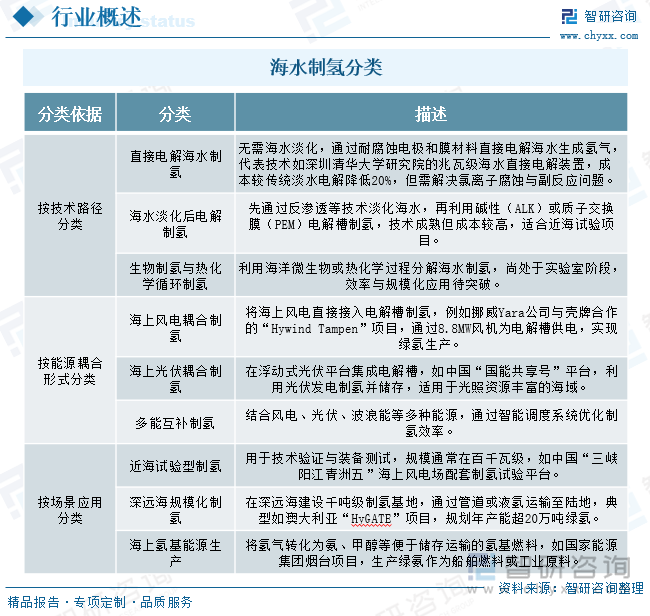
Core Insights - The Chinese offshore hydrogen production industry is making significant breakthroughs, transitioning from demonstration to large-scale commercial applications, showcasing a multi-dimensional development trend [1] - Key projects include the Zhoushan Hydrogen Island, which has achieved stable operation with an annual production of 5,000 tons of hydrogen, and the "Hai Hydrogen 1" platform, which is set to begin trial operations [15][1] - The industry aims to establish a global leading hydrogen-based energy network through technological iteration, scenario expansion, and ecosystem construction [23] Industry Overview - Offshore hydrogen production utilizes marine resources to generate green hydrogen through seawater electrolysis or renewable energy sources like offshore wind and solar power [2] - The technology addresses freshwater resource scarcity and the instability of green electricity, providing new pathways for comprehensive marine energy utilization [2] Technological Pathways - Offshore hydrogen production can be categorized into three main types: direct seawater electrolysis, seawater desalination followed by electrolysis, and biological/thermochemical hydrogen production [3] - Direct seawater electrolysis is cost-effective but faces corrosion challenges, while desalination methods are mature but more expensive [5][3] Industry Chain Development - The Chinese offshore hydrogen industry chain is forming a complete system, transitioning from demonstration to commercialization, with a focus on renewable energy development, seawater desalination, and key material production [7] - The midstream focuses on technological integration, with established pathways for direct electrolysis, desalination, and floating platforms [7] Market Dynamics - China's offshore wind power capacity has rapidly developed, with new installations reaching 40.27 million kilowatts, marking a 9.47% year-on-year increase [8] - The global hydrogen market is expected to see a significant increase in renewable energy's share, with hydrogen's contribution projected to rise from less than 1% to 14% by 2050 [11] Competitive Landscape - The industry features a three-tier competitive structure comprising state-owned enterprises, local energy groups, and specialized technology firms, with state-owned enterprises dominating large-scale projects [19] - Key players include China National Offshore Oil Corporation, China Petroleum & Chemical Corporation, and various local energy companies [2][19] Future Trends - The industry is expected to see technological upgrades and large-scale applications, with a focus on high-power, intelligent, and low-cost solutions [23] - Spatial development will progress from nearshore to deep-sea projects, maximizing the utilization of China's vast marine resources [24] - A complete value network encompassing technology, industry, and ecology is anticipated, contributing to significant carbon emission reductions by 2030 [25]