海水制氢

Search documents
资本重仓海水制氢与氢能无人机,氢能细分赛道风口已至?
势银能链· 2026-03-11 03:53
Core Viewpoint - The hydrogen energy industry is entering a phase of deep cultivation in segmented tracks, with technological breakthroughs and scene adaptation becoming the core logic for capital investment [7]. Group 1: Recent Financing Events - Shenzhen Hydrogen Energy Co., focused on seawater electrolysis hydrogen production equipment, completed Series A+ financing on March 9, with investment from Shenzhen Energy Investment, which will further promote its R&D and industrialization in renewable energy and hydrogen equipment [2]. - Qinghang Times (Shenzhen) Technology Co., a hydrogen drone company established only two months ago, also completed seed round financing of several million yuan, indicating strong capital interest in the hydrogen drone sector [2]. Group 2: Seawater Hydrogen Production - Seawater hydrogen production addresses two major pain points of traditional green hydrogen development, aligning with national energy security and dual carbon goals, making it a key breakthrough for large-scale green hydrogen development [3]. - Traditional water electrolysis requires 9 kg of freshwater to produce 1 kg of hydrogen, while seawater hydrogen production utilizes abundant seawater, breaking the geographical limitations of hydrogen production resources [3]. - The integration of seawater hydrogen production with offshore wind and solar energy allows for local consumption of renewable energy, creating a closed-loop model of "green electricity to green hydrogen" [3][4]. - China's seawater hydrogen production technology has advanced from laboratory to pilot and demonstration applications, with significant breakthroughs achieved, enabling industrial promotion [4]. Group 3: Hydrogen Drone Development - Hydrogen drones represent a significant application of hydrogen energy in mobile transportation, overcoming performance limitations of traditional drones and marking an important shift from heavy applications to lighter scenarios [5]. - The low-altitude economy has become a national strategy, creating a market demand worth hundreds of billions, with hydrogen energy emerging as a preferred solution for clean and efficient power in this sector [5]. - Despite challenges such as lightweight hydrogen storage and airworthiness standards, the foundation for industrialization of hydrogen drones is in place, with over 90% localization of core components [6]. Group 4: Industry Trends and Future Outlook - The hydrogen energy industry is transitioning from "concept popularization" to "industrial landing," moving away from chaotic competition to focused development in segmented tracks [7]. - The competition in hydrogen production will focus on technological economic viability and scene adaptability, with green hydrogen becoming the core direction under dual carbon and energy security requirements [8]. - Capital is increasingly flowing into early-stage technology companies, particularly in seawater hydrogen production and hydrogen drones, indicating a shift in investment strategy [8]. - The development of segmented tracks requires overcoming industrialization bottlenecks, with policy support needed to enhance technology standards and promote demonstration projects [8]. Group 5: Conclusion - The rise of seawater hydrogen production and hydrogen drones reflects the potential and diversification of the hydrogen energy industry, with ongoing technological breakthroughs and policy improvements expected to create more development opportunities [9].


中国又一科技突破,海水制氢新技术,或引领能源革命
Sou Hu Cai Jing· 2026-02-10 09:14
Core Insights - A breakthrough by a research team from Shenzhen University has solved the "scaling" problem in seawater electrolysis for hydrogen production, achieving a cost of $0.698 per kilogram, which could revolutionize the global energy economy [2][15][19] Group 1: Technological Breakthrough - The Shenzhen University team shifted the focus from preventing scaling to making electrodes resistant to scaling, leading to a significant innovation in seawater electrolysis [4][11] - The new electrode design allows for over 5000 hours of stable operation under industrial conditions, addressing the critical issue of stability in hydrogen production [6][11] Group 2: Economic Implications - The production of high-purity magnesium hydroxide as a byproduct of hydrogen production can offset the costs of electricity and equipment, making hydrogen production economically viable [15][19] - The new cost structure allows green hydrogen to compete with fossil fuel-derived hydrogen, marking a significant shift in the economic landscape of the hydrogen industry [15][19] Group 3: Strategic and Geopolitical Impact - This technology could enhance China's energy security by utilizing its extensive coastline to produce clean hydrogen, reducing dependence on foreign fossil fuels [17][19] - The potential widespread adoption of this technology may disrupt the traditional energy power dynamics, challenging Western dominance in high-end energy technologies and prompting a new global technological competition [19][21] Group 4: Future Prospects - The industrialization of this technology is accelerating, with plans for large-scale demonstration projects by 2027, particularly in offshore wind power areas [21][23] - A new trillion-dollar ecosystem around green hydrogen production, storage, transportation, and application is anticipated to emerge, positioning China as a key player in the global market [23]

从赔本到狂赚!中国海水制氢玩出新花样,产氢顺带造工业香饽饽
Sou Hu Cai Jing· 2026-01-09 18:36
Core Viewpoint - The breakthrough in seawater hydrogen production by a Chinese research team led by Academician Xie Heping marks a significant advancement in the energy sector, potentially ending the reliance on costly desalination methods previously favored in the West [1][21]. Group 1: Technical Challenges and Solutions - Seawater contains 92 dissolved chemical elements, making it a challenging medium for electrolysis due to the corrosive nature of chlorine and magnesium ions [3][5]. - Traditional electrolysis equipment has a very short lifespan when directly exposed to seawater, often failing within hours due to corrosion and fouling [3][5]. - The Western approach to seawater hydrogen production has focused on desalination, which is expensive and inefficient, leading to higher costs compared to hydrogen production from coal or oil [5][7]. Group 2: Innovative Technology - The new technology developed by the Chinese team involves a special gel membrane that allows water vapor to pass while blocking harmful ions, effectively purifying seawater in situ [9][11]. - This gel membrane technology significantly reduces energy consumption to 4.5 kWh/Nm³, aligning the cost of seawater hydrogen production with that of pure water hydrogen production [11][21]. - The system features a self-regulating mechanism that adjusts water intake based on consumption, simplifying the design and reducing failure rates compared to traditional systems [13][15]. Group 3: Market Implications and Strategic Importance - The procurement of a 100 Nm³/h alkaline electrolysis unit by Shenzhen University signifies the transition from experimental technology to industrial application, indicating readiness for large-scale deployment [15][17]. - The ability to convert excess wind energy into hydrogen directly from seawater addresses the issue of energy wastage in coastal regions, providing a more efficient solution than traditional grid connections [17][19]. - The modular nature of the new technology allows for deployment in remote areas, potentially transforming isolated islands into self-sufficient energy and water stations, enhancing China's strategic capabilities in maritime regions [19][21].
汽车早餐 | 首个全车规级无人物流车将于明年初上市;我国首次发布工业数据资源基础库;海水直接电解制氢实现新突破
Zhong Guo Qi Che Bao Wang· 2025-12-29 03:07
Domestic News - Chongqing has added 160 million yuan in automobile replacement and scrapping subsidies to boost car consumption, bringing the total subsidy amount to 185 million yuan [2] - The Industrial Internet Research Institute of China has launched the first industrial data resource database, which consolidates key data for industrial AI model training [3] - The first highway expansion project in China, converting a 6-lane highway to 12 lanes, has been completed, enhancing the capacity of the Beijing-Taipei Expressway in Shandong [4] International News - Russia has extended its temporary export ban on automotive gasoline until February 28, 2026, affecting all exporters, including direct producers [5] - Chile has formed a new joint venture between its state-owned copper company and a lithium giant to enhance lithium exploration and production in the Atacama salt flat [6] - The UK has seen a significant slowdown in the construction of public charging stations, with only 13,500 new stations added by the end of November, marking the lowest growth rate since 2022 [7] Corporate News - XPeng Motors and Peking University have proposed a new visual token pruning framework for autonomous driving models, aiming for L4 capabilities [8] - The first fully compliant autonomous logistics vehicle is set to launch in early 2026, as announced at the 2025 China New Energy Unmanned Vehicle Ecological Conference [9] - A joint research team has achieved a breakthrough in direct seawater electrolysis for hydrogen production, marking a significant step towards industrialization [10] - GAC Group is collaborating with China Aerospace to develop a prototype for a manned lunar rover [11] - Mercedes-Benz (Shanghai) Digital Technology Co., Ltd. has increased its registered capital from 1 million to 50 million yuan, reflecting a 4900% increase [12]

深圳能源:公司500kW海水制氢装置在妈湾电厂已运行超过5000小时
Zheng Quan Ri Bao Wang· 2025-12-19 15:13
Core Viewpoint - Shenzhen Energy has successfully operated its 500kW seawater hydrogen production facility for over 5,000 hours and has passed the final acceptance for a major technology project [1] Group 1: Company Developments - The 500kW seawater hydrogen production unit is located at the Mawan Power Plant [1] - The project is part of the Shenzhen State-owned Assets Supervision and Administration Commission's 2024 top ten original technology projects [1] - The company plans to undertake larger-scale seawater hydrogen technology development projects to further expand industrial hydrogen production capacity [1] Group 2: Future Plans - Shenzhen Energy will strictly adhere to relevant regulations for information disclosure regarding any related investment plans [1]

世纪难题被破解!中国攻克海水制氢,外媒:石油要变“廉价货”?
Sou Hu Cai Jing· 2025-10-02 09:46
Core Insights - The global research community has been exploring seawater hydrogen production as a clean fuel alternative to fossil fuels, but challenges such as high costs and efficiency have hindered progress [2][5] Group 1: Technological Advancements - A team led by Academician Xie Heping in China has developed a method to directly electrolyze seawater without the traditional desalination step, utilizing phase transition technology [5][9] - The first offshore trial of this technology, named "Dongfu No. 1," demonstrated stable hydrogen output with a purity of 99.9% and a cost of 0.4 yuan per cubic meter, significantly cheaper than coal-based hydrogen [7][9] - In 2025, a 250 kW seawater hydrogen production system was tested, achieving a direct current consumption of 3.8 kWh per cubic meter of hydrogen with a purity of 99.999% [11] Group 2: Industry Impact - The hydrogen demand in China is projected to exceed 10 million tons by 2030, positioning the country as a major player in the hydrogen industry [11] - The successful integration of renewable energy sources, such as wind and solar, with seawater electrolysis addresses water scarcity issues and enhances the feasibility of hydrogen production in coastal areas [9][11] - International media has highlighted China's advancements in seawater hydrogen production, suggesting a potential shift in the global energy landscape, particularly concerning oil prices [13][15] Group 3: Market Dynamics - In 2023, global hydrogen production reached 97 million tons, with low emissions accounting for less than 1%, while China's electrolyzer manufacturing capacity doubled to 25 GW, representing 60% of the global market [15] - The technology's ability to utilize seawater directly could alleviate water shortages in arid regions, making it a viable solution for countries facing water scarcity [15] - The rapid development of hydrogen technology in China contrasts with Japan's earlier investments, which faced higher production costs, indicating a competitive edge for China in the hydrogen market [15]
ST热电分析师会议-20250827
Dong Jian Yan Bao· 2025-08-27 12:11
Group 1: Report Overview - The report is about the analyst meeting of ST Thermoelectric, a company in the power industry, with a research date of August 27, 2025 [1][2] Group 2: Research Basic Information - The research object is ST Thermoelectric, belonging to the power industry, and the reception time is August 27, 2025. The listed company's reception personnel include the general manager Zhang Yongjun, independent director Zhang Ting, board secretary Guo Jing, and financial director Sun Hongmei [17] Group 3: Detailed Research Institutions - The research institutions mainly involve investors and others [20] Group 4: Main Content Question 1: Progress of the "One - Enterprise, One - Policy" Reform of the Controlling Shareholder - The controlling shareholder, Dalian Clean Energy Group Co., Ltd., was adjusted to a secondary enterprise under the management of Dalian State - owned Assets Operation Company in late May this year, and the state - owned assets operation company will restructure it. Future plans will be implemented in accordance with laws and regulations and information will be disclosed in a timely manner [24] Question 2: Measures to Turn Losses into Profits - The company will implement management plans, seek new profit - growth points, optimize heat source and pipeline network operation, strengthen raw material procurement management, and explore market - based means to enhance profitability [24][25][26] Question 3: Progress of Relying on the State - owned Assets Platform to Integrate Resources - Future plans will be implemented in accordance with laws and regulations and information will be disclosed in a timely manner [26] Question 4: Possibility of Injecting High - quality Assets from the Controlling Shareholder - The Dalian Constant - current Energy Storage Power Station and seawater hydrogen production industrial integration demonstration projects are the strategic layout of the controlling shareholder in the new energy field. Whether they will be included in the listed company requires further research and there is no clear plan yet [26] Question 5: Measures to Reduce Asset - Liability Ratio - In 2025, the company's asset - liability ratio in the first half of the year was 85.43%. The company will optimize operation processes, reduce procurement costs, and financial expenses to improve production efficiency and profitability, thereby reducing the asset - liability ratio [27] Question 6: Progress of Exploring Market - based Means - The company is in the early stage of demonstrating market - based means, and there is no specific plan or substantial progress yet. Future plans will be disclosed in accordance with regulations [28] Question 7: Possibility of Business Cooperation or Asset Integration with Dalian Rongke Energy Storage - As of now, there is no business or capital cooperation between the company and Rongke Energy Storage [28]
世界领先!石油时代将被终结?中国黑科技让能源价格跌成白菜价!
Sou Hu Cai Jing· 2025-08-20 05:22
Core Viewpoint - Chinese scientists have developed a groundbreaking technology for hydrogen production directly from seawater, significantly reducing the cost to below 20 RMB per kilogram, which could disrupt the global energy market and challenge the dominance of oil [1][5][10]. Group 1: Technological Breakthrough - The Chinese team has achieved a global lead in "direct seawater electrolysis for hydrogen production," overcoming decades of challenges associated with impurities in seawater that previously hindered such efforts [3][5]. - The new technology utilizes corrosion-resistant electrode materials and novel catalysts, allowing for efficient hydrogen production with a low operational voltage of 1.59 volts and an energy consumption of only 3.8 kWh per cubic meter of hydrogen [5][7]. - This method bypasses the costly desalination step, enabling direct electrolysis from seawater, which enhances efficiency and equipment durability [7][8]. Group 2: Strategic Implications - With this technology, China can leverage its vast maritime resources, transforming seawater into hydrogen and reducing reliance on imported oil, thus enhancing energy security [10][23]. - The development of this hydrogen production method represents a significant shift from being an energy importer to becoming a technology exporter, potentially allowing China to set global standards and market rules in the hydrogen sector [18][21]. - The transition to hydrogen energy not only addresses environmental concerns with zero carbon emissions but also positions China as a leader in the clean energy race, contrasting with traditional fossil fuel reliance [12][21]. Group 3: Market and Economic Impact - The successful integration of hydrogen production into urban infrastructure signifies a move towards commercial viability, with plans for significant deployment of hydrogen vehicles by 2025 [16][18]. - China's dominance in hydrogen energy patents indicates a shift in market power, allowing the country to influence future developments and pricing in the global hydrogen market [18][19]. - The emergence of hydrogen as a viable alternative to oil could accelerate the decline of the oil market, as hydrogen becomes a key player in the energy transition [21][23].
2025年中国海水制氢行业产业链、发展现状、海上制氢重点项目及发展趋势研判:技术突破赋能,海水制氢开启场景拓展与集群发展新篇章[图]
Chan Ye Xin Xi Wang· 2025-05-02 23:11
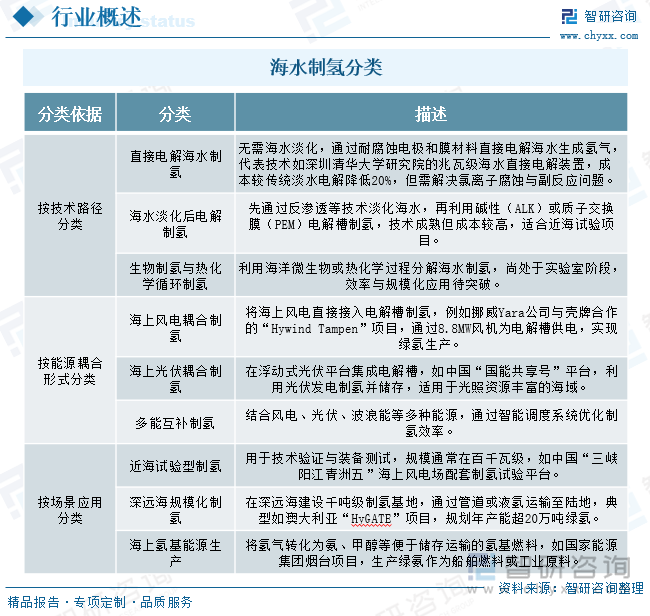
Core Insights - The Chinese offshore hydrogen production industry is making significant breakthroughs, transitioning from demonstration to large-scale commercial applications, showcasing a multi-dimensional development trend [1] - Key projects include the Zhoushan Hydrogen Island, which has achieved stable operation with an annual production of 5,000 tons of hydrogen, and the "Hai Hydrogen 1" platform, which is set to begin trial operations [15][1] - The industry aims to establish a global leading hydrogen-based energy network through technological iteration, scenario expansion, and ecosystem construction [23] Industry Overview - Offshore hydrogen production utilizes marine resources to generate green hydrogen through seawater electrolysis or renewable energy sources like offshore wind and solar power [2] - The technology addresses freshwater resource scarcity and the instability of green electricity, providing new pathways for comprehensive marine energy utilization [2] Technological Pathways - Offshore hydrogen production can be categorized into three main types: direct seawater electrolysis, seawater desalination followed by electrolysis, and biological/thermochemical hydrogen production [3] - Direct seawater electrolysis is cost-effective but faces corrosion challenges, while desalination methods are mature but more expensive [5][3] Industry Chain Development - The Chinese offshore hydrogen industry chain is forming a complete system, transitioning from demonstration to commercialization, with a focus on renewable energy development, seawater desalination, and key material production [7] - The midstream focuses on technological integration, with established pathways for direct electrolysis, desalination, and floating platforms [7] Market Dynamics - China's offshore wind power capacity has rapidly developed, with new installations reaching 40.27 million kilowatts, marking a 9.47% year-on-year increase [8] - The global hydrogen market is expected to see a significant increase in renewable energy's share, with hydrogen's contribution projected to rise from less than 1% to 14% by 2050 [11] Competitive Landscape - The industry features a three-tier competitive structure comprising state-owned enterprises, local energy groups, and specialized technology firms, with state-owned enterprises dominating large-scale projects [19] - Key players include China National Offshore Oil Corporation, China Petroleum & Chemical Corporation, and various local energy companies [2][19] Future Trends - The industry is expected to see technological upgrades and large-scale applications, with a focus on high-power, intelligent, and low-cost solutions [23] - Spatial development will progress from nearshore to deep-sea projects, maximizing the utilization of China's vast marine resources [24] - A complete value network encompassing technology, industry, and ecology is anticipated, contributing to significant carbon emission reductions by 2030 [25]