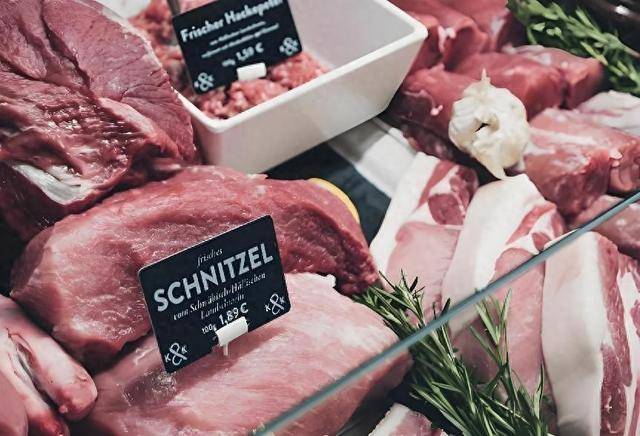
猪肉养殖与加工

Search documents
看2026|琪金集团林其鑫:以高质量发展满足市场消费升级需求
Bei Ke Cai Jing· 2025-12-31 04:01
Group 1 - The central economic work meeting emphasizes the need to continuously expand domestic demand and optimize supply, which will guide the strategic initiatives of companies like Qijin Group [4][2] - Qijin Group aims to enhance its operations by focusing on "new quality productivity" and implementing strategies to improve both incremental and stock optimization [4][2] Group 2 - Qijin Group's initiatives include strengthening the supply chain by improving breed protection and standardizing breeding practices, as well as promoting smart farming technologies to enhance production efficiency and product quality [5] - The company plans to complete the cold chain logistics and brand marketing systems to ensure product freshness and improve market recognition by integrating the "Rongchang Pig" regional brand with its corporate brand [6] - Qijin Group will focus on deep processing of pork products and market expansion, developing high-value-added products such as leisure foods and functional meat products, while diversifying sales channels [7] Group 3 - For 2026, Qijin Group sets ambitious growth targets, aiming for a compound annual growth rate of 10%-15% in revenue through enhanced operational efficiency and market share growth in core regions [8] - The company plans to launch 3-5 competitive deep-processed pork products within the next two years, targeting health foods and convenient dining to meet evolving consumer demands [9] - Qijin Group intends to build a comprehensive operational capability across the entire industry chain, from breed protection to smart farming, deep processing, cold chain distribution, and brand marketing, to enhance overall value and resilience [10] Group 4 - By 2026, Qijin Group aims to lead the Rongchang pig industry towards green, intelligent, and branded development through technological empowerment and management innovation, contributing to modern agricultural development in China [11]

中国征税欧盟,西班牙乐呵应下,中国目标实现,西班牙也能有钱赚
Sou Hu Cai Jing· 2025-12-18 03:11
Group 1 - China will impose anti-dumping duties ranging from 4.9% to 19.8% on pork products originating from the EU starting December 17, aimed at protecting its domestic pork industry from low-priced imports [1][3] - The tax rates vary significantly among EU countries, with France facing a 9.8% rate, while the Netherlands and Denmark face much higher rates of 19.8% and 18.6% respectively [3] - Spain has the lowest tax rate among EU countries, with an average of 9.8%, and in some cases, as low as 4.9%, allowing Spanish companies to remain profitable despite the duties [3][5] Group 2 - Spain's proactive approach, including high-level government visits to China, has resulted in favorable treatment regarding the anti-dumping duties, showcasing a strong willingness to resolve trade issues [3][5] - Spanish pork exporters provided detailed data to Chinese authorities, contrasting with Dutch and Danish companies that withheld information, which may have influenced the lower tax rate for Spain [5] - The recent African swine fever outbreak in Spain has heightened the importance of maintaining access to the Chinese market, making the lower tax rate critical for Spanish pork producers [5] Group 3 - The anti-dumping duties serve to protect China's domestic pork industry while allowing Spain to maintain its market share and avoid severe economic repercussions [5] - The situation illustrates a strategic trade negotiation where both China and Spain benefit, with China securing its domestic supply and Spain enhancing its position in EU-China trade relations [5]

最新政策!中国对欧盟猪肉实施62.4%重税,国内猪价或迎大变革?
Sou Hu Cai Jing· 2025-09-10 09:37
Core Viewpoint - The Chinese government's announcement of imposing temporary anti-dumping duties on EU pork products, ranging from 15.6% to 62.4%, is expected to significantly impact global pork prices and reshape the domestic pork market in China [3][6][23]. Group 1: Market Impact - The announcement led to a sharp decline in stock prices of European pork companies, indicating immediate market reactions [3][6]. - The new tariffs are projected to raise the import costs of EU pork, with the highest rate of 62.4% potentially increasing the cost of imported pork to nearly 49,000 yuan per ton, surpassing the current domestic wholesale price of approximately 38,000 yuan per ton [25][27]. - The influx of EU pork products has historically accounted for over 54% of China's total pork imports from 2020 to 2023, highlighting a significant trade imbalance [10][18]. Group 2: Domestic Market Dynamics - The domestic pork prices have been declining, nearing the breakeven point of 14 yuan per kilogram, with many farmers in major pork-producing provinces facing continuous losses [16][20]. - The introduction of tariffs is expected to shift procurement focus back to domestic pork, potentially increasing domestic demand and stabilizing prices [27][39]. - Analysts predict that by mid-2026, domestic pork prices could exceed 16 yuan per kilogram, indicating a return to a more profitable range for local producers [39]. Group 3: Industry Transformation - The anti-dumping measures are anticipated to drive a significant transformation within the Chinese pork industry, pushing it towards a more self-sufficient and competitive model [37][44]. - The focus will shift from large-scale production to more refined, efficient practices across the supply chain, including breeding, farming, and processing [39][41][42]. - The overall goal is to establish a sustainable market order that prioritizes domestic production while allowing for necessary imports [45].