香氛香薰

Search documents
一场疗愈上万元!妇女节新消费图鉴:不买包的年轻人,开始“买情绪”了?
新浪财经· 2026-03-08 10:09
Core Insights - The article highlights the rise of emotional consumption among women, particularly during the "3.8 Women's Day Promotion," where brands are capitalizing on the emotional economy and self-care trends [3][4][21]. Group 1: Emotional Consumption Trends - The "3.8 Women's Day Promotion" has seen a surge in emotional consumption, with products like Disney plush toys selling out rapidly during live streams, indicating a strong demand for emotional value products [6][8]. - The popularity of emotional value products has expanded beyond single brand hits to a variety of categories, including collaborations and multi-functional items that resonate with consumers [8][21]. Group 2: Crystal and Aromatherapy Market Growth - The crystal market, particularly in Jiangsu's Donghai County, reported a trading volume of 39 billion yuan from January to August 2025, reflecting a 27.8% year-on-year growth, with expectations to exceed 60 billion yuan for the year [12]. - The aromatherapy market in China is experiencing explosive growth, with a projected market size of 27.85 billion yuan in 2024, driven by a compound annual growth rate of 18.9% over the past five years, significantly outpacing the global average [13]. Group 3: Healing Spaces and Services - The healing economy in China has surpassed 10 trillion yuan, with 840 million users, predominantly young women aged 25-49, indicating a strong market for wellness and emotional support services [15][21]. - Healing salons are becoming increasingly popular, with prices for sessions often ranging from hundreds to thousands of yuan, reflecting a willingness among consumers to invest in emotional well-being [16][19]. Group 4: Market Dynamics and Consumer Behavior - The rise of emotional value products is attributed to a shift in consumer demand from material satisfaction to prioritizing emotional fulfillment, particularly among younger demographics facing anxiety [21][24]. - Despite the growth, the industry faces challenges such as consumer complaints regarding product authenticity and quality, highlighting the need for better regulation and industry standards [24].


“嗅觉经济”崛起:中国香氛产业迎百亿增长机遇 线下门店解决新锐品牌三大痛点
Zheng Quan Shi Bao Wang· 2025-08-24 10:16
Core Insights - The trend of consumers paying for "emotional value" is driving the growth of the fragrance market, with scent becoming a new medium for self-consumption and cultural consumption [1] - The opening of the first Tmall fragrance space in Hangzhou marks a significant development for the fragrance industry, providing a physical space for over 40 domestic and international brands to showcase their products [1][3] - The Chinese fragrance market is experiencing explosive growth, with a projected market size of 27.85 billion yuan in 2024 and a compound annual growth rate of 18.9% over the past five years, significantly outpacing the global average of 7% [1][2] Market Potential - The current penetration rate of the fragrance market in China is only 5%, indicating substantial growth potential compared to mature overseas markets [2] - International brands are developing exclusive fragrances for Chinese consumers, while domestic beauty brands are increasingly entering the fragrance sector [2] Industry Trends - The fragrance market is witnessing three notable trends: the optimization of consumer demographics with a rise in young and male consumers, the strong emergence of domestic brands, and significant product innovation across various categories [4] - The rise of domestic brands is supported by cultural confidence and the ability to leverage unique design elements, with some categories experiencing growth rates as high as 100% [4][5] Supply Chain Advantages - The flexibility of the Chinese supply chain is facilitating the growth of new domestic brands, allowing for rapid adjustments to meet consumer preferences [5][6] - The overall improvement in the fragrance supply chain has led to better product quality and faster response times, enhancing the competitiveness of new brands [6] Competitive Landscape - New brands are focusing on innovation, supply chain efficiency, cultural relevance, and market positioning to differentiate themselves from international competitors [6][7] - The increasing importance of emotional value and personalized experiences is driving the demand for diverse fragrance products, with brands encouraged to innovate continuously [7][8] Market Growth - The number of fragrance-related companies in China has seen significant growth, with registrations increasing by 60.2% in 2022 and 53.5% in 2023, indicating a vibrant and expanding market [8] - Projections suggest that by 2025, the fragrance industry in China will reach a production volume of approximately 70.94 million pieces and a market size of 30.03 billion yuan [8]
2025年中国香氛香薰行业产业链、相关政策、发展规模、市场结构、竞争格局及行业发展趋势研判:应用场景增多,需求日益多元化,市场规模将达300.34亿元[图]
Chan Ye Xin Xi Wang· 2025-07-28 01:09
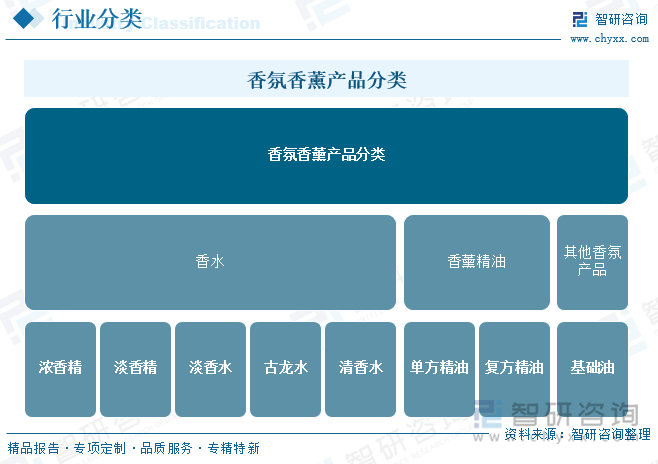
Core Viewpoint - The aromatherapy market is experiencing significant growth, transitioning from luxury items to essential daily products, driven by increasing disposable income and consumer demand for wellness solutions, especially in the post-pandemic era [1][7][28]. Industry Definition and Classification - Aromatherapy products include essential oils, candles, diffusers, stones, and tablets, aimed at improving air quality and enhancing mood [2][3]. - The market is categorized into various segments, including perfumes, essential oils, and other fragrance products, with specific classifications based on concentration levels [3]. Current Development Status Global Market - The global aromatherapy market is projected to reach USD 79.003 billion in 2024, with the perfume segment accounting for USD 65.543 billion and essential oils for USD 8.743 billion [5]. - The market is expected to grow to USD 82.374 billion by 2025, indicating a robust demand for natural therapies over synthetic alternatives [5]. Chinese Market - In China, the aromatherapy industry is expected to produce 656.907 million units and reach a market size of CNY 27.852 billion in 2024, with projections of 709.388 million units and CNY 30.034 billion by 2025 [7][10]. Industry Chain - The upstream of the aromatherapy industry includes flower cultivation, fragrance materials, and packaging, which are crucial for product quality and market competitiveness [12][14]. - The distribution channels are diversifying, with both online and offline sales channels playing significant roles in market growth [12]. Competitive Landscape - The global market features intense competition with established brands like Chanel and Dior dominating the high-end segment, while emerging brands focus on natural and organic products [23][25]. - In China, domestic brands are gaining traction, appealing to younger consumers with unique cultural narratives and product offerings [23][27]. Development Trends Product Diversification and Personalization - The industry is moving towards offering a wider range of products, including smart diffusers and personalized fragrance options to cater to diverse consumer preferences [28][29]. Environmental and Health Focus - There is a growing emphasis on eco-friendly and health-conscious products, with a shift towards natural and organic ingredients [30]. Technological Innovation - The integration of smart technology in aromatherapy products is becoming a key trend, enhancing user experience and convenience [31].