AI算力基础设施

Search documents
比亚迪电子(00285):2025年业绩点评报告:25年净利润同比下降,关注AI液冷、电源量产交付进展
EBSCN· 2026-03-30 14:39
Investment Rating - The report maintains a "Buy" rating for BYD Electronics, indicating a positive outlook for the company's future performance [3]. Core Insights - In 2025, BYD Electronics achieved revenue of 179.48 billion RMB, a slight increase of 1.22% year-on-year. However, gross profit decreased by 12.56% to 10.76 billion RMB, resulting in a gross margin of 6.0%, down 0.9 percentage points due to reduced capacity utilization from changes in product structure and shipment volume for North American clients [1]. - Net profit for 2025 was 3.52 billion RMB, reflecting a year-on-year decline of 17.61% [1]. - The smart terminal component business saw a revenue decline to 29.33 billion RMB, influenced by changes in product structure and demand from North American clients, while assembly business revenue increased slightly to 122.18 billion RMB [2]. - The new energy vehicle (NEV) business experienced significant growth, with revenue reaching 27.03 billion RMB, a year-on-year increase of 27.69%, driven by rising shipments of smart driving systems and other products [2]. - The AI computing infrastructure business reported a robust growth of 31.7%, with revenue of 943 million RMB, as the company focuses on liquid cooling and power supply products [3]. Financial Forecasts and Valuation - The report projects a net profit of 3.84 billion RMB for 2026, down 27% from previous estimates, and 4.66 billion RMB for 2027, down 25% [3]. - The estimated net profit for 2028 is projected at 5.76 billion RMB [3]. - The company's market capitalization corresponds to a price-to-earnings (P/E) ratio of 15x for 2026, 12x for 2027, and 10x for 2028 [3]. - Revenue forecasts for the upcoming years are as follows: 2026E at 185.57 billion RMB, 2027E at 197.54 billion RMB, and 2028E at 206.63 billion RMB, with growth rates of 3.4%, 6.5%, and 4.6% respectively [4].
比亚迪电子2025年收入达1794.77亿元,新能源汽车业务保持高速增长
Ju Chao Zi Xun· 2026-03-29 03:43
Group 1: Financial Performance - The company reported a revenue of 179.477 billion RMB for the year ending December 31, 2025, representing a year-on-year increase of 1.22% [3] - Gross profit was 10.756 billion RMB, a decrease of 12.56% compared to the previous year [3] - Net profit attributable to the parent company was 3.515 billion RMB, down 17.61% year-on-year, with earnings per share at 1.56 RMB [3] Group 2: Business Segments - The new energy vehicle segment generated approximately 27.027 billion RMB in revenue, a year-on-year growth of 27.69%, accounting for 15.06% of the total revenue [1] - The AI computing infrastructure segment achieved revenue of about 943 million RMB, reflecting a year-on-year increase of 31.7% [2] - The smart terminal business saw overall revenue of 151.507 billion RMB, with component revenue at approximately 29.331 billion RMB and assembly revenue at about 122.176 billion RMB [4] Group 3: Research and Development - The company invested approximately 4.465 billion RMB in research and development, representing 2.49% of total revenue for the year [4] - The total number of patents applied for reached 12,010, with 8,279 patents granted, indicating a significant increase in patents related to AI computing infrastructure [4] Group 4: Cash Flow and Financial Health - The net cash inflow from operating activities was approximately 1.877 billion RMB, a significant improvement from 671 million RMB in the previous year [4] - Interest-bearing bank and other borrowings were about 7.184 billion RMB, a decrease of 33.5% compared to the previous year [4] - The debt ratio improved from 18.01% to -13.53%, indicating a strong net cash position for the company [4] Group 5: Future Outlook - The company plans to continue focusing on core technology research and development, enhancing high-end manufacturing innovation capabilities [5] - The new energy vehicle business is expected to maintain rapid growth, while emerging sectors like AI computing infrastructure and AI robotics are anticipated to accelerate [5] - The company aims to capitalize on the strategic opportunities presented by the acceleration of smart technology in the automotive industry [5]


“失速”与“领跑”:“达链”公司的股价“见顶”了吗?
经济观察报· 2025-11-04 08:38
Core Viewpoint - The performance of "Dachain" companies shows a mixed picture, with some experiencing significant year-on-year profit growth while facing sequential declines, raising questions about whether this is a temporary adjustment or a sign of peak industry conditions driven by AI demand [2][3][4]. Group 1: Financial Performance - In Q3, several "Dachain" companies reported impressive year-on-year profit growth: Shenghong Technology (300476.SZ) up 260.52%, Xinyi Technology (300502.SZ) up 205.38%, Zhongji Xuchuang (300308.SZ) up 124.98%, and Industrial Fulian (601138.SH) up 62.04% [3]. - Despite strong year-on-year growth, the market reacted negatively, with significant stock price declines for many companies, including a combined market value loss of over 140 billion yuan for leading firms in the optical module segment [3][4]. - Sequentially, Shenghong Technology's net profit fell by 9.88%, Xinyi's revenue decreased by 4.97%, and Tianfu Communication's revenue dropped by 3.18% [4][6]. Group 2: Industry Dynamics - The PCB segment, crucial for AI servers, is showing signs of pressure, with Shenghong Technology citing product upgrades and increased labor costs as reasons for its sequential decline [6][7]. - New Yisheng experienced its first sequential revenue drop after nine consecutive quarters of growth, attributed to changes in product shipment schedules [7]. - The liquid cooling segment, led by Yingweike, also faced sequential declines, with revenue down 11.44% in Q3 [8]. Group 3: Market Trends and Future Outlook - Zhongji Xuchuang and Industrial Fulian emerged as leaders, with Zhongji's net profit up 124.98% and Industrial Fulian's net profit surpassing 10 billion yuan for the first time [8][9]. - The demand for 800G optical modules is expected to continue growing, with significant orders anticipated for next-generation 1.6T products [9][10]. - The industry is witnessing a shift towards "Scale-up" scenarios, where high bandwidth connections between GPUs are becoming critical for AI model training [10]. Group 4: Inventory and Financial Pressure - Companies are facing financial pressure due to increased inventory levels, with Industrial Fulian's inventory rising to 164.66 billion yuan, leading to higher short-term borrowings [12][13]. - New Yisheng reported a significant increase in asset impairment losses due to rising inventory write-downs, indicating potential financial risks [13]. Group 5: Shareholder Behavior - There has been a notable increase in shareholding among retail investors, while major shareholders and executives have begun to reduce their stakes, indicating a potential shift in market sentiment [14]. - The number of shareholders for New Yisheng surged by 58.46% to 155,300, reflecting growing retail interest in the sector [14]. Group 6: Market Projections - TrendForce analysts predict a 20% increase in global AI server shipments in 2026, with a significant rise in the value of AI servers driven by higher-priced integrated solutions [15]. - The growth rate of ASIC chip shipments is expected to surpass that of GPUs, potentially impacting Nvidia's market share [15].






数字经济板块上半年表现亮眼,数字经济ETF(560800)本月以来新增规模同类居首!
Xin Lang Cai Jing· 2025-07-31 06:41
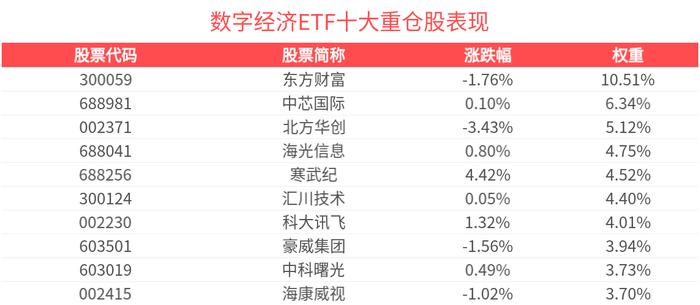
Group 1 - The core viewpoint of the articles highlights the performance and trends of the digital economy sector, particularly focusing on the 中证数字经济主题指数 and its related ETF [1][2] - The 中证数字经济主题指数 has shown a decline of 0.19% as of July 31, 2025, with mixed performance among its constituent stocks [1] - The digital economy ETF has experienced a significant increase in scale, growing by 21.46 million yuan this month, ranking first among comparable funds [1][2] Group 2 - The digital economy sector is identified as a key variable for high-quality economic development, with various segments such as AI computing infrastructure and smart manufacturing showing growth rates exceeding 15% in the first half of the year [1] - Predictions indicate that national operators' investment in computing power is expected to grow by over 20% by 2025, with leading internet companies projected to invest over 500 billion yuan in AI over the next three years [1] - The top ten weighted stocks in the 中证数字经济主题指数 account for 51.3% of the index, with notable companies including 东方财富 and 中芯国际 [2][3]