
AI软件和服务

Search documents
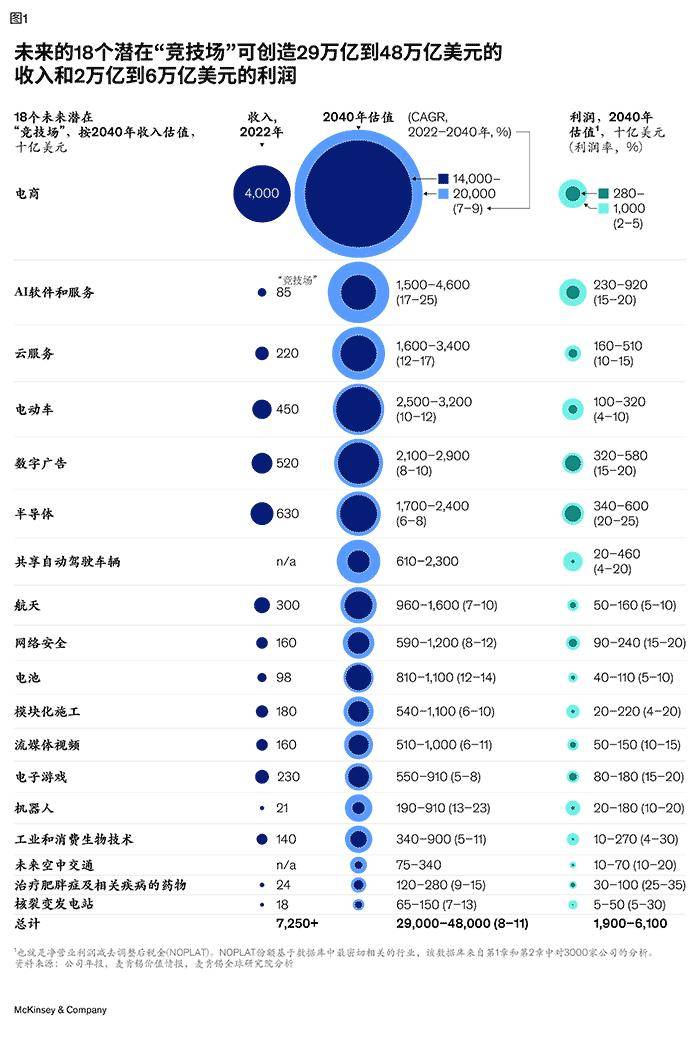
麦肯锡报告:未来的18个风口行业
Sou Hu Cai Jing· 2025-12-09 00:43
Core Insights - The article discusses the potential future opportunities in various industries, highlighting 18 sectors that could reshape the global economy by 2040, generating revenues between $29 trillion and $48 trillion, and contributing 18-34% to global GDP growth [5][8]. Industry Opportunities - The 18 identified sectors include e-commerce, electric vehicles, cloud services, digital advertising, semiconductors, AI software and services, shared autonomous vehicles, aerospace, cybersecurity, batteries, modular construction, streaming video, video games, robotics, industrial and consumer biotechnology, future air mobility, obesity treatment drugs, and nuclear fission power plants [7][8]. - E-commerce is projected to account for 27%-38% of global retail revenue by 2040, driven by market expansion in developing countries and new product categories in developed markets [36]. - Electric vehicles are expected to exceed 50% of global passenger car sales by 2040, influenced by advancements in battery technology and smart algorithms [38]. - Cloud services are anticipated to grow at a compound annual growth rate (CAGR) of approximately 17%, driven by increasing connectivity and the demand for computational power [40]. - The semiconductor industry is projected to maintain a CAGR of 6%-8%, fueled by demand across various sectors including computing, automotive, and industrial electronics [42]. - AI software and services are rapidly evolving, with increasing adoption of AI assistants and a competitive race among companies to develop advanced models and applications [43]. - Digital advertising is expanding as more middle-class individuals gain internet access, with platforms needing to invest heavily to attract user attention [44]. - Streaming video platforms are expected to innovate and seek new revenue streams due to rising customer acquisition and content production costs [46]. - Shared autonomous vehicles could capture 25%-51% of shared mobility revenue by 2040, although widespread adoption may take time [48]. - The aerospace sector is transitioning towards a space economy, with advancements in reusable rocket technology [49]. - Cybersecurity investments are increasing as businesses recognize the financial impact of cybercrime, which caused direct losses of approximately $950 billion in 2020 [50]. - Battery technology is advancing significantly, with electric vehicles projected to account for over 80% of the battery market by 2040 [51]. - The video game industry is expected to see 40% of the global population as players by 2030, driven by new gaming models and increased spending on high-quality games [52]. - Robotics is gaining attention as AI and robotics converge, with expectations for widespread personal robot ownership in the future [55]. - Biotechnology is accelerating in applications such as agriculture and alternative proteins due to technological breakthroughs [57]. - Modular construction is improving efficiency in building processes, addressing global housing shortages [58]. - Nuclear fission power is being considered as a supplement to renewable energy, with commitments from multiple countries to increase nuclear output by 2050 [59]. - Future air mobility is being explored through electric vertical takeoff and landing vehicles, although regulatory progress is needed [60]. - The market for obesity treatment drugs is expected to grow significantly as obesity rates rise globally [61].

英伟达财报难消市场疑虑 AI赛道陷”泡沫论“ 与 ”早期论“激辩
Zhi Tong Cai Jing· 2025-11-24 00:13
Core Viewpoint - The explosive earnings report from Nvidia did not alleviate investor concerns about a potential AI stock bubble, leading to a divided market sentiment regarding the current state of AI trading [1][5]. Group 1: Market Sentiment - Skeptics worry that the market valuations of AI-related growth stocks have soared to dangerous levels, with concerns about the sustainability of the massive investments required to maintain competitive positions [1][3]. - Optimists view the recent pullback in AI stocks as a healthy adjustment before further gains, believing that major tech companies will continue to invest in AI development without signs of slowing down [1][2]. - Market volatility was highlighted after Nvidia's earnings report, with initial gains followed by a significant drop, reflecting uncertainty among investors regarding future profitability and energy demands [2][5]. Group 2: Financial Performance and Projections - Nvidia's strong earnings report was anticipated due to prior disclosures of spending plans from major clients like Microsoft, Amazon, Meta, and Alphabet, which collectively account for over 40% of Nvidia's sales [3]. - These major clients are expected to increase their capital expenditures by 34% over the next 12 months, reaching $440 billion [3]. - Despite Nvidia's solid performance, other semiconductor companies have faced challenges, with the semiconductor index down 11% in November, marking the worst monthly performance since 2022 [3][5]. Group 3: Investment Returns and Concerns - Investors are increasingly questioning the return on investment (ROI) for AI software and services, with the timing of when substantial investments will translate into growth and profitability being a critical issue [4][5]. - Concerns about the sustainability of large capital expenditures have led to significant stock price declines for companies like Meta and Microsoft, with declines of 21% and 13% respectively since their earnings reports [5]. - Companies with weaker balance sheets, such as CoreWeave and Oracle, have experienced even more severe stock price drops, indicating heightened scrutiny on their financial health [5]. Group 4: Broader Economic Context - The macroeconomic uncertainty and differing views on the stage of the AI revolution contribute to the observed market volatility, compounded by the collapse of cryptocurrency markets [6].




