AI软件和服务

Search documents
英伟达独强难支,AI股何去何从?
Jin Shi Shu Ju· 2025-11-24 03:26
Core Insights - The initial positive reaction to Nvidia's earnings report did not alleviate investor concerns about the AI stock bubble, leading to significant market volatility [1] - The market is currently divided into two camps: skeptics who warn of bubble risks and optimists who see potential for long-term growth [2] Group 1: Skeptics' Concerns - Skeptics are worried that the market valuations are reaching unreasonable levels as investors chase a few AI-related stocks [3] - There are concerns about the sustainability of the massive capital investments made by companies to remain competitive, especially as they begin to incur debt [3] - The cyclical nature of these financing arrangements could pose systemic risks, where the weakness of one company could drag down the entire AI-related sector [3] Group 2: Optimists' Perspective - Optimists view the recent pullback in AI stocks as a healthy correction, indicating that greater growth is on the horizon [4] - Major tech companies like Microsoft, Amazon, Meta Platforms, and Alphabet are expected to continue investing heavily in AI, with a projected 34% increase in capital expenditures to $440 billion over the next 12 months [4] - There is a belief that the AI investment cycle is just beginning, supported by strong industry demand and a favorable regulatory environment [4] Group 3: Nvidia's Role and Market Reactions - Nvidia's performance was anticipated due to prior disclosures from its major clients, which account for over 40% of its sales [5] - Despite Nvidia's strong earnings, other semiconductor stocks have faced significant declines, with the chip-related stock index dropping 11% in November, marking the worst monthly performance since 2022 [5] - Concerns about the sustainability of AI spending have led to sharp declines in stocks of companies like AMD and ARM, with losses exceeding 20% [5] Group 4: Investment Return Concerns - Investors are increasingly questioning the return on investment (ROI) for AI-related expenditures, which is critical for future growth and profitability [6] - The need for clarity on ROI is seen as essential for reviving interest in AI investments, with expectations that it may take one or two more quarters to see relevant evidence [6] - Nvidia's earnings report may have temporarily alleviated immediate concerns about AI investment sustainability, but doubts about large spending companies remain [6] Group 5: Market Volatility and Consensus - The divergence in investor perspectives contributes to ongoing volatility in the AI market, with macroeconomic uncertainties and differing views on the AI revolution's development stage [8] - The collapse of the cryptocurrency market is also seen as a factor contributing to the observed volatility [8]

英伟达财报难消市场疑虑 AI赛道陷”泡沫论“ 与 ”早期论“激辩
Zhi Tong Cai Jing· 2025-11-24 00:13
Core Viewpoint - The explosive earnings report from Nvidia did not alleviate investor concerns about a potential AI stock bubble, leading to a divided market sentiment regarding the current state of AI trading [1][5]. Group 1: Market Sentiment - Skeptics worry that the market valuations of AI-related growth stocks have soared to dangerous levels, with concerns about the sustainability of the massive investments required to maintain competitive positions [1][3]. - Optimists view the recent pullback in AI stocks as a healthy adjustment before further gains, believing that major tech companies will continue to invest in AI development without signs of slowing down [1][2]. - Market volatility was highlighted after Nvidia's earnings report, with initial gains followed by a significant drop, reflecting uncertainty among investors regarding future profitability and energy demands [2][5]. Group 2: Financial Performance and Projections - Nvidia's strong earnings report was anticipated due to prior disclosures of spending plans from major clients like Microsoft, Amazon, Meta, and Alphabet, which collectively account for over 40% of Nvidia's sales [3]. - These major clients are expected to increase their capital expenditures by 34% over the next 12 months, reaching $440 billion [3]. - Despite Nvidia's solid performance, other semiconductor companies have faced challenges, with the semiconductor index down 11% in November, marking the worst monthly performance since 2022 [3][5]. Group 3: Investment Returns and Concerns - Investors are increasingly questioning the return on investment (ROI) for AI software and services, with the timing of when substantial investments will translate into growth and profitability being a critical issue [4][5]. - Concerns about the sustainability of large capital expenditures have led to significant stock price declines for companies like Meta and Microsoft, with declines of 21% and 13% respectively since their earnings reports [5]. - Companies with weaker balance sheets, such as CoreWeave and Oracle, have experienced even more severe stock price drops, indicating heightened scrutiny on their financial health [5]. Group 4: Broader Economic Context - The macroeconomic uncertainty and differing views on the stage of the AI revolution contribute to the observed market volatility, compounded by the collapse of cryptocurrency markets [6].




英伟达救不了AI股,市场想看到什么?
Hua Er Jie Jian Wen· 2025-11-24 00:07
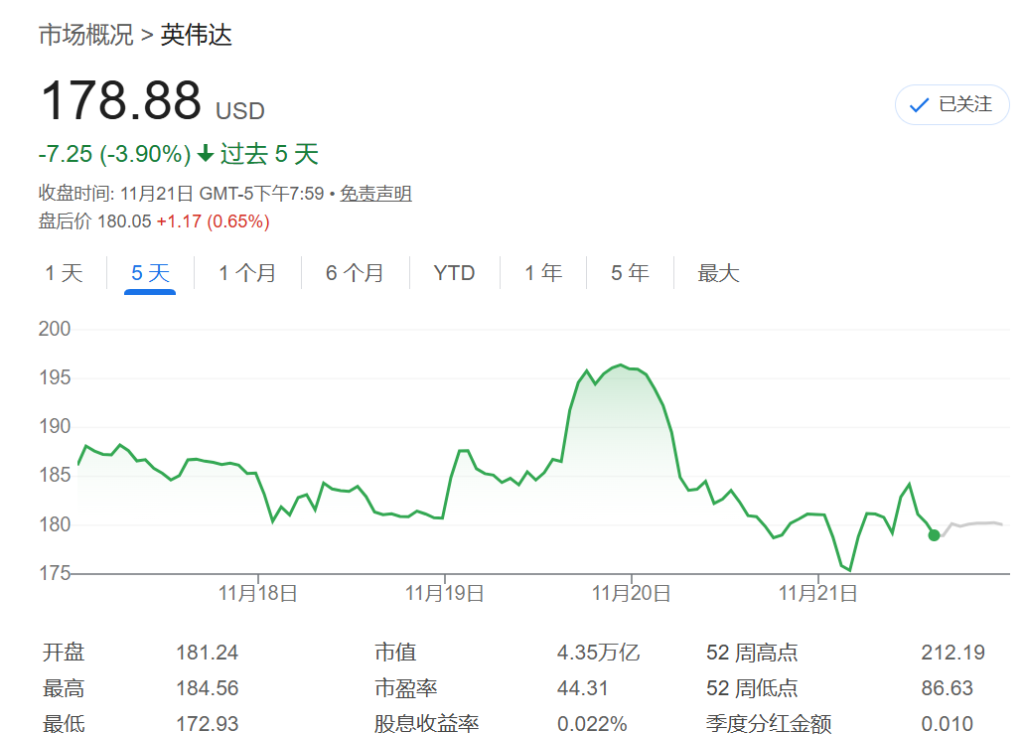
Core Insights - Despite Nvidia's strong earnings report, market anxiety persists, leading to a significant stock price reversal and a broader market decline [1] - The AI ecosystem is under pressure, with a notable drop in chip-related stocks and significant declines in companies heavily investing in AI, such as Meta and Microsoft [5][9] Market Reactions - Nvidia's stock initially rose over 5% following its earnings report but closed down 3.2%, reflecting a volatile market response [1] - A chip-related stock index fell by 11% in November, marking its worst month since 2022, with AMD and Arm experiencing declines over 20% [5] Investor Sentiment - Investors are increasingly questioning the sustainability of capital expenditures and the return on investment (ROI) from AI investments [2][10] - Concerns are growing that high valuations in the AI sector may not be justified, with fears of a potential bubble [9] Company Performance - Meta's stock has dropped 21% since its earnings report due to investor concerns over aggressive capital spending plans, while Microsoft's stock has fallen 13% for similar reasons [5] - Companies with weaker balance sheets, such as CoreWeave and Oracle, have faced even steeper declines, with CoreWeave's stock plummeting over 40% [5][8] Future Outlook - There is a divide in market sentiment regarding the future of AI investments, with some investors viewing recent corrections as healthy, while others fear unsustainable spending [9][11] - The focus is shifting from capital expenditures to the need for clear evidence of ROI, which is critical for restoring momentum in AI investments [10]