
Gas Turbine

Search documents
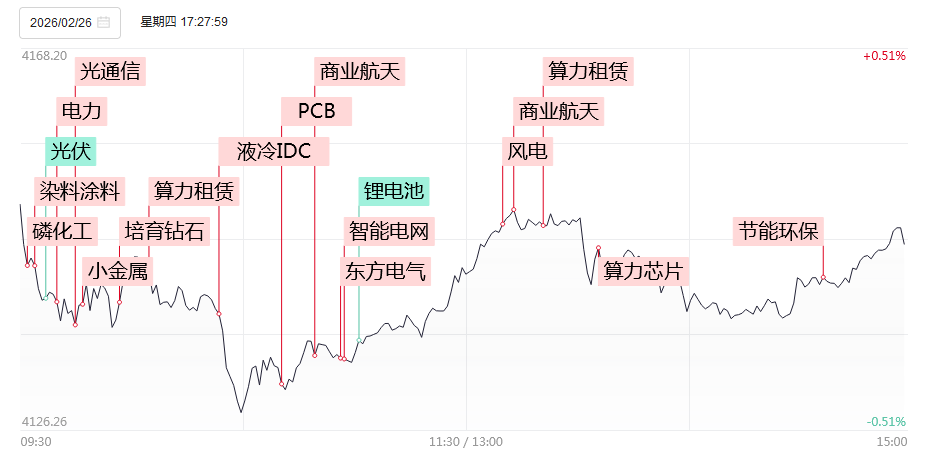
涨停复盘:今日全市场共80只股涨停,连板股总数9只,算力硬件板块爆发,大族激光、川润股份涨停!
Jin Rong Jie· 2026-02-26 10:46
Market Overview - On February 26, the market showed mixed performance with the three major indices fluctuating, where the ChiNext index briefly fell over 1% [1] - The total trading volume in the Shanghai and Shenzhen markets reached 2.54 trillion yuan, an increase of 759 billion yuan compared to the previous trading day [1] - Over 2800 stocks in the market experienced declines, indicating a rapid rotation of market hotspots [1] Sector Performance - The computing power hardware sector led the gains, with strong performances from PCB, CPO, liquid cooling servers, and computing power chip concepts [1] - Notable stocks included ShenNan Circuit, Dazhu Laser, Guanghe Technology, and Chuanrun Co., all hitting the daily limit [1] - The power sector also showed strength, with GanNeng Co. achieving two consecutive limit-ups and HuaYin Power hitting the daily limit [1] - The gas turbine concept saw collective gains, with YingLiu Co., WanZe Co., DongFang Electric, and ChangBao Co. all reaching the daily limit [1] - Small metal concepts were active, with YunNan Ge Co. and ZhangYuan Tungsten Co. both achieving two consecutive limit-ups [1] - Environmental stocks surged in the late trading session, with ZhongKe Environmental and Qidi Environment hitting the daily limit [1] Declining Sectors - The film and insurance sectors, along with real estate, experienced significant declines, with film and cinema stocks suffering continuous drops, including Bona Film Group hitting the limit down [1] Market Statistics - A total of 61 stocks hit the daily limit (excluding ST and delisted stocks), with 9 stocks achieving consecutive limit-ups and 23 stocks failing to hit the limit, resulting in a limit-up rate of 73% [1] Focus Stocks - Notable focus stocks included YuNeng Holdings in the computing power sector achieving six consecutive limit-ups, and FaErSheng in the optical fiber sector achieving four consecutive limit-ups [1] Related Hotspots 1) The computing power hardware sector is experiencing explosive demand due to AIDC, with supply imbalances in multiple sub-products like optical fibers and drill bits, leading to continuous price increases [11] 2) The generator sector is influenced by upcoming commitments from tech executives to cover the electricity costs of high-energy data centers, as announced by former President Trump [11] 3) The environmental sector is preparing for the upcoming National People's Congress in 2026, where multiple drafts of laws, including the ecological environment code, will be reviewed [11] 4) The new power system sector is seeing developments with the National Energy Administration announcing the first batch of pilot lists for enhancing new power system construction capabilities [12]


Gas Turbine Supply Chain Bottlenecks Could Reshape the Generation Mix in 2030 and Beyond
Yahoo Finance· 2026-01-15 13:06
Supply Chain Challenges - The gas turbine industry is experiencing significant supply chain challenges, with backlogs extending years into the future and utilities struggling to secure dispatchable capacity [1] - Rotor forgings and hot-section blades are identified as primary bottlenecks, constrained by limited suppliers and complex manufacturing processes [1] - Some large frame turbines have been shipped without rotors or blades, with installation occurring later to maintain construction schedules [1] Vendor Qualification Issues - Qualifying new vendors is a lengthy process, heavily dependent on the original equipment manufacturer (OEM), supplier, and specific component [2] - Large forgings present particular challenges due to a limited number of global suppliers, many of whom serve multiple OEMs [2] - The qualification process for advanced machines requiring single-crystal blades or exotic materials is even more complex [2] Demand Drivers - Current demand for gas turbines is driven by multiple factors, including near-term needs from data centers and limited dispatchable power options due to increasing non-dispatchable resources on the grid [3] - New coal generation is no longer a viable option for most utilities, while natural gas supplies are more abundant, providing stability for gas-fired generation investment [3] - Data centers are driving acute short-term demand for dispatchable power, competing directly with utilities for small- and mid-sized turbines in the 30 MW to 100 MW range [3]
应流股份-关键高端铸造供应商,有望受益于燃气轮机供应短缺;首次覆盖,评级:买入
2026-01-14 05:05
Summary of Yingliu (603308.SS) Conference Call Company Overview - **Company**: Yingliu, a leading domestic manufacturer of high-end precision cast components, primarily focused on gas turbine and aerospace components. The company has transitioned from traditional casting to high-end markets since 2015, with a current global market share below 1% [1][21][23]. Industry Context - **Industry**: Gas turbine supply chain, which is currently experiencing shortages, particularly in hot-section components like turbine blades. Major OEMs such as Siemens Energy, GE Vernova, and Mitsubishi Heavy Industries (MHI) report high capacity utilization and extended backlogs, indicating a supply-demand imbalance that is expected to last until at least 2028-2030 [2][28][39]. Key Insights and Projections - **Market Opportunity**: Yingliu is well-positioned to capitalize on the gas turbine supply shortages due to its available capacity, competitive average selling prices (ASPs), and ongoing R&D advancements. The company aims to increase its market share to approximately 4% with Siemens Energy and 8% with Baker Hughes by 2030 [3][58]. - **Revenue Growth**: Yingliu's revenue from gas turbine components is projected to grow from 29% of total revenue in 2025 to 48% in 2030, while aerospace components are expected to rise from 15% to 20% over the same period. Total revenue is forecasted to increase from Rmb2,943 million in 2025 to Rmb8,847 million by 2030, representing a CAGR of 25% [4][110]. - **Earnings Growth**: The company anticipates a 40% CAGR in earnings per share (EPS) from 2025 to 2030, driven by operating leverage and improved gross profit margins (GPM), which are expected to rise from 36% in 2025 to 43% in 2030 [4][110]. Customer Relationships and Contracts - **Key Customers**: Yingliu has secured long-term agreements with major clients including Siemens Energy, Baker Hughes, GE Aerospace, and Safran. The company expects significant revenue growth from these relationships, particularly with Siemens Energy, which is projected to become the largest customer by 2030, contributing around Rmb1 billion in revenue [61][98]. Competitive Positioning - **Price Advantage**: Yingliu's products may have a price advantage of approximately 20%-30% compared to global peers, which could enhance its competitiveness in securing contracts with overseas customers [10][83]. - **Employee Growth**: Yingliu's subsidiary, Yingliu Hangyuan, plans to increase its workforce by 40% from the end of 2024 to the end of 2025 to support anticipated order ramp-ups [16][78]. Financial Metrics - **Valuation**: The company is valued at a target price of Rmb52.7, implying an 18% upside from current levels. The valuation is based on a 30x P/E ratio for 2028E, discounted to 2026E using a 10% cost of equity [1][4]. - **R&D and Capex**: R&D expenses as a percentage of revenue are expected to decline from 9.2% in 2025 to 8.1% in 2030, reflecting increased production efficiency. Capex as a percentage of revenue is projected to decrease significantly as the company moves past its heavy investment phase [110][112]. Additional Considerations - **Nuclear and Aerospace Segments**: Yingliu is also expanding into nuclear applications and the commercial aerospace industry, with expected revenues from nuclear components reaching Rmb1 billion by 2030. The aerospace segment is anticipated to become a significant growth driver, contributing 20% of total revenue by 2030 [106][98]. - **Yield Rates**: Current yield rates for different blade types are 70-80% for equiaxed and directionally solidified crystals, but only 10-60% for single crystal blades, indicating room for improvement in production efficiency [85][90]. This comprehensive overview highlights Yingliu's strategic positioning within the gas turbine and aerospace markets, its growth potential, and the financial metrics that support its investment case.

A股指数集体高开:创业板指涨1.42%,算力硬件领涨
Feng Huang Wang Cai Jing· 2025-11-25 01:36
Market Overview - Major indices in China opened higher, with the Shanghai Composite Index up 0.36%, Shenzhen Component Index up 0.85%, and ChiNext Index up 1.42% [1] - Key sectors showing strong performance include precious metals, computing hardware, and storage chips [1] Index Performance - Shanghai Composite Index: 3850.57, up 0.36%, with 1669 gainers and 332 losers, total turnover of 6.918 billion [2] - Shenzhen Component Index: 12692.09, up 0.85%, with 2156 gainers and 435 losers, total turnover of 11.132 billion [2] - ChiNext Index: 2970.73, up 1.42%, with 1053 gainers and 223 losers, total turnover of 4.762 billion [2] External Market - US stock markets rebounded, with the Nasdaq Composite Index rising 2.69% to 22872.01, marking the largest single-day gain since May [3] - Notable gains in Chinese concept stocks, with the Nasdaq China Golden Dragon Index up 2.82% [3] Industry Insights - CITIC Construction Investment highlights positive changes in the humanoid robot sector, suggesting focus on quality segments and upcoming product launches [4] - China Galaxy Securities anticipates structural opportunities in the food and beverage industry, with traditional consumption showing signs of recovery [5] - Huatai Securities projects a significant increase in global gas turbine orders, driven by various factors including energy policy shifts and AI power demand [6] - CITIC Construction Investment maintains a positive outlook on energy storage demand, despite short-term market adjustments [7]


聚焦AI|中国AI数据中心的潜行加速
野村东方国际证券· 2025-04-03 08:37
- ■■- 核心摘要 2022年12月ChatGPT发布,引发全球市场对于AI发展的关注。伴随美国头部云厂商不断提升资本开 支,AI基建领域产生众多投资机会。涉及产品包括变压器、UPS(不间断电源)、服务器电源、液 冷;甚至由于AIDC(AI数据中心)建设的火爆,导致电网接入点稀缺,核电成为AIDC的优质电 源,包括核电公司以及可控核聚变公司均受到关注。 我们复盘ChatGPT发布后,海外AIDC基建类产业链股价走势,可以发现各区间段收益率靠前的细分 赛道,基本对应当时AI产业演进中的核心矛盾或进展。从规律来看,大致可以分为四个阶段:1) ChatGPT出现带来算力需求高增,期间服务器电源关注度攀升;2)算力高增推动芯片技术迭代,相 应导致功耗提升,服务器电源、液冷需求提升;3)AIDC进入实际建设阶段,AI基建(备用电源、 变压器需求增加);4)AIDC建设导致电网接入点难寻,燃气轮机、核电相应概念热度提升。 综合以上分析,对于中国AIDC各细分产业链,我们观点如下: 传统备用电源有望享受量价齐升红利。 海外头部企业整体指引2025年营业利润率有望提升。我们认 为主要原因有(1)需求量端,AI数据中心建设浪 ...