Medical AI

Search documents
募资8亿港元!医学影像AI企业成功IPO
思宇MedTech· 2026-03-31 10:38
Core Viewpoint - The article highlights the successful IPO of Hangzhou Deshi Biotechnology Co., Ltd., which is one of the few companies focused on medical imaging AI to enter the capital market, raising approximately 800 million HKD through the issuance of 7.9992 million H-shares at 99 HKD per share [2][14]. Group 1: Company Overview - Deshi Biotechnology has established itself as a key player in the medical imaging AI sector, focusing on a specific application rather than a general model, with its core technology being the iMedImage® medical imaging base model [3][4]. - The company has developed a comprehensive business structure that includes medical imaging software, medical devices, reagents, consumables, and technology licensing, with applications in over 400 medical institutions [4]. Group 2: Product and Technology - The company's flagship product, AI AutoVision® chromosome karyotype auxiliary diagnostic system, has achieved a karyotype analysis accuracy of 99.86% and reduced reporting time from approximately 30 days to 4-7 days, addressing long-standing clinical issues related to manual operations [8]. - The sensitivity and specificity for detecting abnormal numbers and structural abnormalities are reported at 100.00% and 94.05% respectively, showcasing the effectiveness of the technology [9]. Group 3: Market Position and Growth - The IPO reflects a growing market interest in the medical imaging AI sector, with Deshi's revenue showing significant growth, reaching approximately 112 million CNY in the first three quarters of 2025, a year-on-year increase of about 470%, and a gross margin of 75.9% [14][15]. - The company is transitioning from a single product provider to a foundational capability supplier, with an evolving business model that includes technology licensing and platform delivery, indicating a shift in revenue structure [17][19]. Group 4: Industry Implications - The article suggests that the listing of companies like Deshi provides a reference path for the medical AI industry, emphasizing the importance of moving from technical capabilities to product implementation and scaling commercial operations [20].


讯飞医疗科技:GBC synergy to drive long-term growth-20260330
Zhao Yin Guo Ji· 2026-03-30 02:24
Investment Rating - The report maintains a "BUY" rating for Xunfei Healthcare, indicating potential returns of over 15% over the next 12 months [12]. Core Insights - Xunfei Healthcare reported FY25 revenue of RMB 915 million, reflecting a year-on-year growth of 24.7%, which was approximately 4% below estimates due to slower G-end growth in the second half of the year [1]. - The G-end growth decelerated significantly from 87% YoY in 1H25 to 4% YoY in 2H25, primarily due to centralized provincial procurement affecting project pricing [1]. - The B-end business showed robust recovery in 2H25, achieving a full-year growth of 31.1% YoY after a weaker first half [1]. - The attributable net loss narrowed by 51.1% YoY to RMB 65 million, driven by improved operating leverage [1]. - The company is focusing on solidifying its G-end leadership, accelerating B-end hospital penetration, and leveraging GBC synergy to develop C-end patient services as a long-term growth engine [1]. Financial Performance - Revenue projections for FY26E, FY27E, and FY28E are RMB 1,119 million, RMB 1,347 million, and RMB 1,599 million respectively, with YoY growth rates of 22.3%, 20.4%, and 18.7% [2]. - The attributable net profit is expected to improve from a loss of RMB 65 million in FY25 to a loss of RMB 40 million in FY26E, narrowing further to RMB 21 million in FY27E, and turning positive with a profit of RMB 3 million in FY28E [2]. - The earnings per share (EPS) is projected to improve from a loss of RMB 0.54 in FY25 to a loss of RMB 0.33 in FY26E, and finally to a profit of RMB 0.03 in FY28E [2]. Market Position and Strategy - Xunfei Healthcare has expanded its client base significantly, serving over 77,000 primary healthcare institutions and 600+ graded hospitals by the end of 2025 [1]. - The company achieved full coverage of its General Practice CDSS across all 90 counties in Zhejiang and secured its first out-of-province imaging cloud platform project in Guangxi [1]. - C-end patient management services revenue increased by 29% YoY to RMB 273 million, accounting for approximately 30% of total revenue, indicating a strategic shift towards a more recurring patient-paid business model [1]. - The communication conversion rate for paying patients reached 50% in 2025, with the Net Promoter Score (NPS) improving from 35% to 50% [1]. Valuation and Target Price - The target price for Xunfei Healthcare has been revised to HK$ 92.55, down from a previous target price of HK$ 143.59, reflecting a 33% upside from the current price of HK$ 69.60 [3]. - The target price is based on a price-to-sales (P/S) ratio of 9x for the 2026 estimates [1].
行业聚焦:全球AI 皮肤科影像系统市场规模及主要企业排名情况
QYResearch· 2026-03-09 01:57
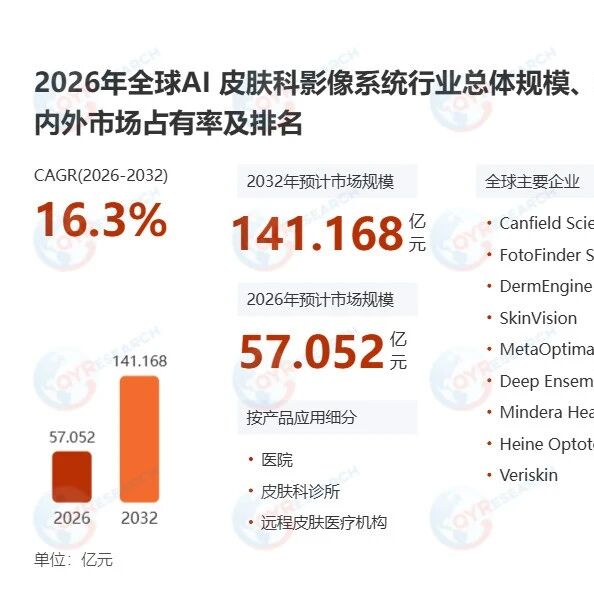
Core Viewpoint - The article discusses the development and market potential of AI dermatology imaging systems, highlighting their role in enhancing skin disease diagnosis and management through advanced imaging and AI algorithms [2][12]. Group 1: Industry Chain Analysis - The upstream of AI dermatology imaging systems includes high-resolution camera modules, dermatoscopes, light source systems, and data annotation resources, which are essential for image quality and algorithm accuracy [2][3]. - The midstream focuses on integrating imaging devices with AI algorithms to create clinically applicable systems, which require compliance with medical device regulations [4][5]. - The downstream applications encompass hospitals, primary healthcare institutions, health check centers, aesthetic medical institutions, and telemedicine platforms, addressing the need for early skin cancer screening and risk assessment [6][8][9]. Group 2: Global Market Size and Structure - According to QYResearch, the global market for AI dermatology imaging systems is projected to reach 4.873 billion yuan by 2025 and 14.12 billion yuan by 2032, with a compound annual growth rate (CAGR) of 16.3% from 2026 to 2032 [12][27]. Group 3: Development Trends, Opportunities, and Challenges - The technology is evolving towards higher precision and multi-modal integration, enhancing predictive accuracy through the combination of various data types [14][15]. - The increasing incidence of skin cancer and the demand for early screening present stable market opportunities, alongside the digitalization of primary healthcare and telemedicine support [16][17]. - The industry faces challenges such as stringent regulatory requirements, the need for extensive clinical validation, and the necessity for continuous data updates and model optimization [18][19][20]. Group 4: Downstream Analysis - In hospital systems, AI dermatology imaging systems serve as auxiliary diagnostic tools to improve screening efficiency, while primary healthcare institutions prioritize ease of use and affordability [21]. - Aesthetic medical institutions focus on image comparison and visual presentation to enhance client communication, and telemedicine platforms expand accessibility for initial skin screenings [22]. Group 5: Industry Entry Barriers - Entry barriers in the AI dermatology imaging system industry stem from the accumulation of data resources, algorithm capabilities, and compliance with medical regulations, with high costs associated with obtaining quality annotated data [23][24]. - Continuous optimization of algorithm performance and lengthy regulatory approval processes contribute to high entry costs, while brand trust and clinical reputation are critical for market expansion [25][26].
Clairity Appoints Founder Dr. Connie Lehman as Chief Executive Officer; Joe Kiani Named Chairman of the Board
Globenewswire· 2026-01-21 21:30
Core Insights - Clairity has appointed Connie Lehman, MD, PhD, as CEO and Joe Kiani as Chairman of the Board, marking a significant leadership transition as the company focuses on clinical adoption and growth [1][2]. Company Developments - The leadership changes come after Clairity received FDA De Novo authorization for its AI-based mammography risk prediction platform, which is gaining traction with health systems globally [2]. - The company aims to enhance health outcomes, promote early disease prevention, and reduce healthcare costs through the responsible use of medical AI [3]. Strategic Vision - Dr. Lehman will oversee the company's strategy and operations, focusing on integrating Clairity's technology across diverse clinical environments [4]. - Joe Kiani emphasized that Clairity is positioned to lead advancements in breast cancer screening and prevention, leveraging the growing demand for its risk prediction platform [5]. Innovation and Impact - Clairity's platform analyzes standard mammograms to estimate a woman's five-year risk of developing breast cancer, facilitating personalized and proactive screening approaches [7]. - Dr. Lehman highlighted the need to shift the focus from detection to early risk identification and prevention, aiming to improve the effectiveness of screening and prevent advanced disease [5][6]. Financial Backing - In 2025, Clairity secured $43 million in Series B financing to support the commercialization and clinical adoption of its technology [8].


「商汤医疗」再获数亿元战略融资,A轮投后估值超30亿元 | 36氪独家
3 6 Ke· 2025-11-17 01:32
Group 1 - SenseTime Medical has completed a strategic financing round of several hundred million yuan, with investors including Lenovo Ventures, Lianchuang Capital, and others, and is currently initiating Series A financing with a post-investment valuation exceeding 3 billion yuan [1] - The company is leveraging AI technology to promote the construction of "future smart hospitals," with core technology engines including the medical health large language model "Dai Yi" and a multi-modal medical image foundational model group [1] - The "Dai Yi" model, based on SenseTime's large language model with hundreds of billions of parameters, is capable of covering various medical scenarios such as intelligent self-diagnosis, medication consultation, and clinical decision support [1] Group 2 - CEO Zhang Shaoting emphasizes that while pure technology can provide a first-mover advantage in the competitive medical AI industry, a rich product matrix and capital-supported industrial ecosystem are harder to replicate [2] - Since 2018, the company has adopted a platform-based strategy to empower comprehensive hospital diagnosis and treatment, resulting in applications across clinical diagnosis, intelligent decision-making, patient services, and medical research [2] - To avoid price wars in standardized software, SenseTime Medical has established a dual middle platform system for intelligent agent development and model application production, creating a differentiated advantage [2] Group 3 - The company aims to continuously attract industry partners and financial investors with ecological synergy capabilities to accelerate the intelligent upgrade of the medical industry [3]
「商汤医疗」再获数亿元战略融资,A轮投后估值超30亿元|36氪独家
36氪· 2025-11-17 00:10
Core Viewpoint - SenseTime Medical has completed a strategic financing round of several hundred million yuan, indicating strong investor interest and confidence in the company's AI-driven healthcare solutions [1][4]. Financing and Valuation - The company has initiated its Series A financing, with a post-investment valuation exceeding 3 billion yuan and subscription amounts surpassing 500 million yuan [2][4]. - Previous investments in early 2023 included over 100 million yuan from major industry players [1]. Technology and Product Development - SenseTime Medical leverages AI technology to promote the construction of "future smart hospitals," utilizing a "fusion of general and specialized" technical approach [2]. - The core technology includes the "Da Yi" medical language model, which is trained on vast amounts of high-quality medical knowledge, enabling capabilities in self-diagnosis, medication consultation, structured imaging reports, and clinical decision support [2]. - The multi-modal medical image foundational model group addresses various data modalities, supporting efficient model training to overcome challenges in medical data scarcity and annotation difficulties [2]. Strategic Positioning - The CEO emphasizes that while pure technology can provide a competitive edge, a rich product matrix and a capital-supported industrial ecosystem are harder to replicate, which is crucial for long-term success [2]. - Since 2018, the company has adopted a platform-based approach to empower comprehensive hospital diagnosis and treatment, covering clinical diagnosis, intelligent decision-making, patient services, and medical research [2]. Market Demand and Competitive Strategy - The platform strategy aligns with hospitals' implicit needs for extensible products rather than multiple software solutions from various vendors [3]. - To avoid price wars in standardized software, SenseTime Medical has established a dual middle platform system for intelligent agent development and model application production, creating a differentiated advantage [3]. Commercialization and Future Plans - Following the "1+X" strategy, SenseTime Medical operates independently in the market, focusing on large-scale "full-hospital intelligence" projects while also expanding standardized software modules to grassroots hospitals [5]. - The company aims to attract resourceful shareholders to foster a collaborative ecosystem, emphasizing that financing is not solely for capital but also for partnership development [5].

哈佛学生靠医疗“ChatGPT”,成了亿万富翁
虎嗅APP· 2025-08-29 10:10
Core Viewpoint - The article discusses the rapid growth and innovative business model of OpenEvidence, a medical AI application that has gained significant traction among U.S. physicians, highlighting its unique approach to providing clinical decision support through AI-driven medical search capabilities [5][10][11]. Group 1: Company Overview - OpenEvidence has reached a valuation of $3.5 billion within three years of its inception, with its user base growing from a few thousand to over 430,000 registered physicians, covering more than 40% of practicing doctors in the U.S. [8][10][24]. - The platform processes approximately 850 million clinical consultations monthly, showcasing its high usage frequency among healthcare professionals [10][11]. Group 2: Problem Solving - OpenEvidence addresses the challenge of rapidly evolving medical knowledge, which doubles every 73 days, by providing a platform that allows doctors to quickly access the latest and most relevant medical evidence [5][7][11]. - The application enables physicians to ask clinical questions in everyday language and receive concise answers with authoritative citations within seconds, significantly reducing the time spent searching for information [13][14]. Group 3: Business Model - The company employs a "freemium + advertising" business model, offering its services for free to verified physicians while generating revenue through targeted advertising from pharmaceutical companies and medical device manufacturers [23][24][25]. - This approach allows OpenEvidence to bypass traditional B2B sales processes in the healthcare industry, facilitating rapid user acquisition and establishing a strong network effect among its users [24][25]. Group 4: Competitive Landscape - OpenEvidence operates in a competitive environment where other AI startups are emerging, such as DynaMed and Hippocratic AI, which also focus on providing accurate clinical decision support tools [32][33]. - The article contrasts OpenEvidence's success with the failure of IBM's Watson Health, emphasizing the importance of practical application and user trust in the medical AI sector [32]. Group 5: Founders and Team - OpenEvidence was co-founded by Daniel Nadler and Zachary Ziegler, both Harvard alumni, with Nadler previously selling his AI company Kensho for approximately $550 million [8][27][30]. - The team includes experts from top institutions, ensuring a strong foundation in both AI technology and medical knowledge [20][27].