Server ODM

Search documents
AI算力行情爆发:核心驱动因素与长期价值细分领域
Mei Ri Jing Ji Xin Wen· 2025-12-25 01:13
Core Insights - The core factor driving the AI computing power market this year is the acceleration of AI development globally, supported by previous technological accumulation and a recent alleviation of computing power shortages, particularly with the ramp-up of NVIDIA's Blackwell cards [1][2] - The performance of AI models is rapidly improving, with significant updates from major companies like Google and domestic internet firms, leading to a decrease in costs and an increase in performance [1] - A-share computing power chain companies have shown remarkable growth in performance, especially in Q2, with some core optical module and PCB companies experiencing year-on-year growth rates of over 30% to 100% [1][2] Industry Analysis - The rapid growth in performance is primarily due to the acceleration of underlying computing chip production, with NVIDIA's Blackwell chip overcoming previous production challenges and achieving significant deployment rates [2] - In May, NVIDIA's large-scale customers deployed over 1,000 devices weekly, each containing 72 cards, indicating a substantial demand for related components like optical modules and PCBs [2] - The price of these components has increased due to technological upgrades, with Blackwell requiring optical modules of at least 800G, compared to the previous generation's 400G [2] Long-term Value Segments - Within the computing power industry chain, segments with strong long-term value include optical modules, PCBs, and servers, particularly in the A-share overseas computing power industry [2][3] - The PCB sector is experiencing high demand due to ongoing technological iterations, with increased requirements for transmission as chip computing power grows [3] - The optical module market is currently in a strong growth phase, with clear upward trends in both volume and price [3] - The ODM server sector is also poised for growth as cabinet complexity increases, leading to higher technical requirements and potential profit margin improvements for server manufacturers [3]

科技:ASIC 受益标的;按 AI 芯片平台划分的营收敞口- Tech_ ASIC beneficiaries; revenues exposures by AI chips platform; Read across to Google's Gemini 3 announcement
2025-12-01 03:18
Summary of Key Points from the Conference Call Industry Overview - The report focuses on the ASIC (Application-Specific Integrated Circuit) market, particularly in relation to AI (Artificial Intelligence) chips and servers, highlighting the increasing demand and customization in this sector [1][11][22]. Core Insights and Arguments - **ASIC Market Growth**: ASIC chips are expected to play a significant role in AI server solutions, with projections indicating that ASICs will contribute 40% of total AI chips by 2026 and 45% by 2027 [11][22]. - **Demand Projections**: The demand for AI chips is forecasted to reach 10 million, 14 million, and 17 million units from 2025 to 2027, with ASIC shipments contributing 38%, 40%, and 45% respectively [1]. - **Revenue Growth**: The global server total addressable market (TAM) is expected to grow by 42%, 32%, and 19% year-over-year, reaching $359 billion, $474 billion, and $563 billion from 2025 to 2027 [13]. - **Customization Benefits**: ASIC solutions provide higher gross margins for suppliers due to their customization, which allows for better performance and energy efficiency compared to general-purpose GPUs [15][22]. Company-Specific Highlights - **Wiwynn**: Expected to have the largest ASIC exposure among ODMs by 2026, with significant partnerships with Amazon and Meta. The company has reported over 100% year-over-year growth in revenue for the first three quarters of 2025 [6][27]. - **Hon Hai**: Anticipated to expand its ASIC customer base significantly by 2026, benefiting from its role as a supplier for Google TPU servers [23]. - **Innolight**: Positioned as a key supplier of optical transceivers, with expected revenue growth of 104% year-over-year in 2026 from 800G optical modules [24][25]. - **LandMark**: Expected to see a revenue increase from 71% in 2025 to 85% in 2026 due to the demand for high-speed optical transceivers [26]. - **EMC**: Anticipated to maintain a strong market position with over 50% market share in the ASIC AI server supply chain, expecting solid revenue growth [28]. - **TSMC**: Expected to manufacture next-generation TPUs, with projections indicating that TPU revenue will account for less than 5% of TSMC's total revenue through 2026 [29]. Additional Important Insights - **Market Dynamics**: The shift towards ASICs is driven by major AI model suppliers developing in-house ASIC platforms to optimize performance and reduce costs [22]. - **Investment Trends**: Amazon plans to invest up to $50 billion in AI infrastructure, which will utilize in-house Trainium chips and Nvidia GPUs [24]. - **Emerging Partnerships**: OpenAI's collaboration with Broadcom to design in-house AI accelerators is expected to enhance the capabilities of AI systems by 2029 [24]. This summary encapsulates the key points from the conference call, providing insights into the ASIC market's growth, company-specific developments, and broader industry trends.


高盛:汇聚科技-高速线缆及服务器代工;中国云资本支出将推动未来增长
Goldman Sachs· 2025-07-09 02:40
Investment Rating - The report does not explicitly provide an investment rating for Time Interconnect (1729.HK) Core Insights - Time Interconnect is expected to experience revenue growth in 2025 driven by rising AI demand, production site diversification, and exposure to various end markets [1][8] - The company reported revenues of HK$7.4 billion in 2024, with a gross margin of 14.6% [3] - The revenue from server ODM business reached HK$3.2 billion in 2024, accounting for 43% of total revenue [7] Summary by Sections Industry Overview - Time Interconnect specializes in customized copper and optical fiber cables, as well as servers ODM, with production sites in mainland China, Japan, and Mexico [3] - Key applications include telecommunications, data centers, industrial equipment, medical equipment, and automotive wiring harnesses [3] Growth Drivers - AI demand is driving the adoption of high-speed cables, with a reported 208% year-over-year growth in high-speed cable revenues in 2024 [4] - 42% of cable assembly revenues were derived from data center clients in 2024, indicating strong demand from this sector [4] Business Outlook - Management is optimistic about revenue growth in 2025, supported by the expansion of the Mexican production site and increasing capex spending from Chinese CSP clients [8] - The planned acquisition of Leoni AG is expected to diversify the business into automotive cables and wiring harnesses [8]
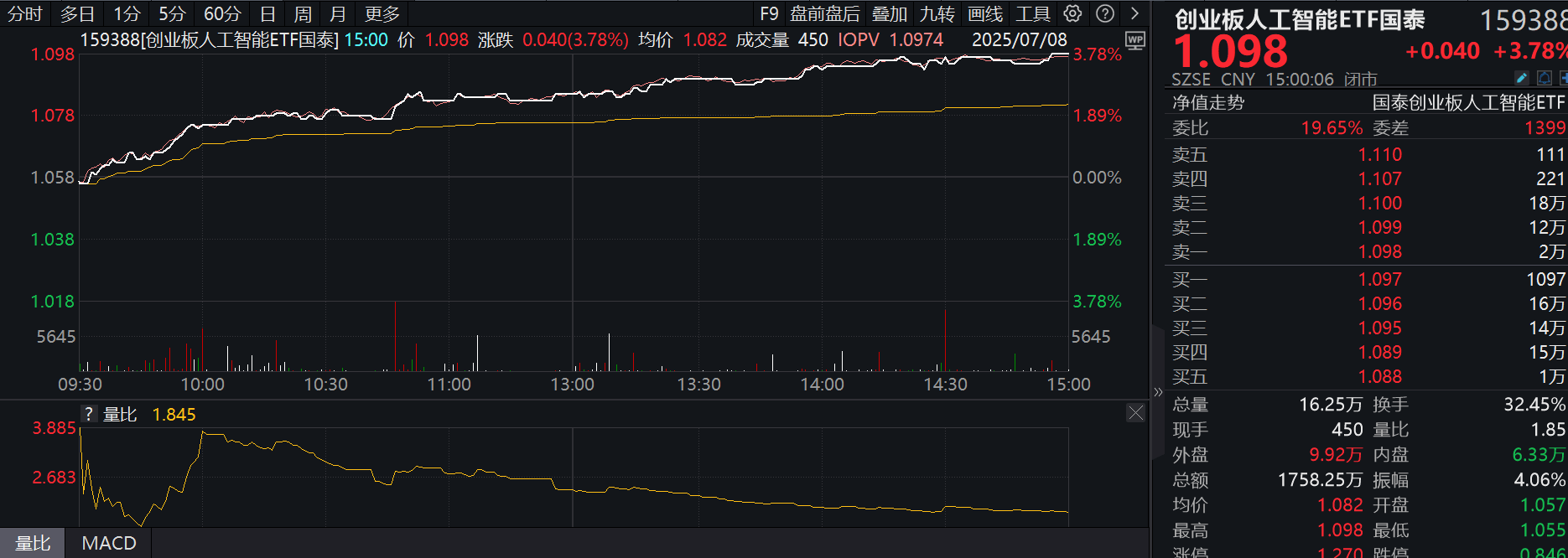
通信ETF及创业板人工智能ETF国泰大涨点评:盘一下最近发生了啥事?
Sou Hu Cai Jing· 2025-07-08 12:29
Group 1 - Industrial Fulian's preliminary forecast for Q2 2025 indicates a net profit of 6.727 billion to 6.927 billion yuan, representing a year-on-year increase of 47.72% to 52.11% [2] - The company reported that AI server revenue grew over 60% compared to the same period last year, highlighting its leading position in core product shares among major clients [2] - Despite the traditional off-season for consumer electronics in Q2, the strong growth in AI contributed to a significant overall profit increase [2] Group 2 - The AI industry chain, including sectors like server ODM, PCB, and IC manufacturing, is experiencing high growth rates, with some companies seeing accelerated performance in recent months [3] - Demand for ASICs is also rising, with Broadcom holding a 55% to 60% market share, and its financial reports indicate that ASIC business is a core growth driver [3] - Google has launched its seventh-generation TPU, which can achieve computing power 24 times that of the fastest supercomputer globally, indicating strong demand for AI accelerators [3] Group 3 - The A-share market is witnessing rapid growth in sectors like PCB and optical modules, alongside a new wave of investment expansion [5] - Companies like Huadian Co. are planning significant investments, such as 3.6 billion yuan for new projects, to enhance production capacity [5] - The AI wave is expected to continue driving growth in the industry chain, with recommendations for strategic investments in related sectors [5]