
通信ETF

Search documents
量化择时周报:耐心防御等缩量-20260322
ZHONGTAI SECURITIES· 2026-03-22 11:42
Core Insights - The report indicates that the market is currently in a consolidation phase, with a potential for further short-term adjustments as trading volume continues to decrease, but remains above critical thresholds [2][5][6] - The overall market (wind All A index) experienced a decline of 4.13% last week, with small-cap stocks (CSI 1000) dropping by 5.25% and mid-cap stocks (CSI 500) falling by 5.82% [6][7] - Key sectors showing resilience include telecommunications and banking, while materials such as non-ferrous metals and steel have underperformed significantly [6][7] Market Dynamics - The distance between the short-term (20-day) and long-term (120-day) moving averages has narrowed to 4.33%, indicating a bearish market sentiment with a negative profit effect of -4.35% [5][6][9] - The report highlights that the core variable to observe is the change in risk appetite, influenced by factors such as shifts in Federal Reserve interest rate expectations and ongoing geopolitical tensions in the Middle East [7][9] - A trading volume below 17 trillion is anticipated to signal a potential rebound in the market [5][7] Sector Allocation - The mid-term industry allocation model suggests focusing on sectors related to computing power, such as semiconductor equipment (ETF code 159516.SZ) and telecommunications (ETF code 515880.SH), as well as cyclical sectors like oil and gas (ETF code 159309.SZ) and energy chemicals (ETF code 159981.SH) [5][12] - In a defensive strategy, short-term attention should be given to banking ETFs and tourism ETFs [5][12] Valuation Metrics - The wind All A index's PE ratio is positioned around the 85th percentile, indicating a moderately high valuation level, while the PB ratio is at the 50th percentile, reflecting a medium valuation level [7][9] - Based on the current market conditions, a 50% allocation in absolute return products based on the wind All A index is recommended [5][7]
量化择时周报:缩量之前防御为主-20260315
ZHONGTAI SECURITIES· 2026-03-15 07:43
Quantitative Models and Construction Methods 1. Model Name: Timing System Model - **Model Construction Idea**: The model uses the distance between the short-term moving average (20-day) and the long-term moving average (120-day) of the Wind All A Index to identify market trends and timing signals[2][7][12] - **Model Construction Process**: 1. Calculate the 20-day moving average and 120-day moving average of the Wind All A Index 2. Compute the distance between the two moving averages: $ Distance = \frac{MA_{20} - MA_{120}}{MA_{120}} $ 3. Define thresholds: If the absolute value of the distance is greater than 3%, it indicates a significant trend signal[7][12] 4. Incorporate additional metrics such as market trend line (6796 points) and profitability effect (-0.02%) to refine the signal[7][12] - **Model Evaluation**: The model effectively captures market oscillations and provides actionable timing signals during periods of market uncertainty[7][12] 2. Model Name: Mid-term Industry Allocation Model - **Model Construction Idea**: This model identifies industries with strong performance potential based on earnings trends and macroeconomic factors[6][8][13] - **Model Construction Process**: 1. Analyze earnings trends across industries to identify sectors with upward momentum 2. Incorporate macroeconomic indicators and policy drivers to refine sector selection 3. Highlight key sectors such as computing power (e.g., semiconductor equipment, communication), cyclical industries (e.g., oil and gas, energy chemicals), and agriculture[6][8][13] - **Model Evaluation**: The model provides a robust framework for sector rotation and aligns with defensive strategies during market uncertainty[6][8][13] --- Model Backtesting Results 1. Timing System Model - Moving average distance: 5.28% (greater than the 3% threshold)[7][12] - Market trend line: 6796 points[7][12] - Profitability effect: -0.02% (not yet positive)[7][12] 2. Mid-term Industry Allocation Model - Key sectors identified: - Computing power: Semiconductor equipment ETF (159516.SZ), Communication ETF (515880.SH) - Cyclical industries: Oil and gas ETF (159309.SZ), Energy chemicals ETF (159981.SH) - Agriculture: Agriculture ETF (562900.SH)[6][8][13] --- Quantitative Factors and Construction Methods 1. Factor Name: Moving Average Distance - **Factor Construction Idea**: Measures the relative distance between short-term and long-term moving averages to capture market momentum[7][12] - **Factor Construction Process**: 1. Calculate the 20-day and 120-day moving averages of the Wind All A Index 2. Compute the relative distance using the formula: $ Distance = \frac{MA_{20} - MA_{120}}{MA_{120}} $ 3. Use a threshold of 3% to determine significant signals[7][12] - **Factor Evaluation**: The factor is effective in identifying market trends and oscillations, providing a clear signal for timing decisions[7][12] --- Factor Backtesting Results 1. Moving Average Distance Factor - Current value: 5.28% (above the 3% threshold)[7][12]
量化择时周报:两会来临,短期关注政策驱动
ZHONGTAI SECURITIES· 2026-03-01 13:25
Investment Rating - The industry investment rating is "Increase" with an expectation of a relative increase of over 10% compared to the benchmark index in the next 6 to 12 months [17]. Core Insights - The market is currently in an upward trend, with the core observation variable being the change in profit effect, which is at 1.91%, indicating a potential for continued market growth [5][8]. - The upcoming Two Sessions (Lianghui) period is expected to drive short-term policy focus, historically associated with stable market performance [5][8]. - The market has shown resilience despite geopolitical tensions in the Middle East, which may suppress risk appetite [5][8]. Summary by Sections Market Overview - The overall market (WIND All A Index) has shown an increase of 2.75% and reached a new high, with small-cap stocks (CSI 1000) rising by 4.34% and mid-cap stocks (CSI 500) by 4.32% [2][7]. - The steel sector has performed particularly well, with an increase of 11.8%, while the media sector has declined by 4.44% [2][7]. Timing System Analysis - The distance between the 20-day and 120-day moving averages is 6.28%, indicating a positive market trend, with the short-term average above the long-term average [2][5]. - The market trend line is positioned around 6812 points, suggesting a favorable environment for continued investment [5][8]. Sector Allocation - The industry trend configuration model suggests waiting for a reversal signal in the real estate chain (Construction Materials ETF code 159745.SZ) during the Two Sessions window, which may present short-term opportunities [6][15]. - The TWO BETA model continues to recommend the technology sector, particularly focusing on commercial aerospace (Satellite ETF code 563230.SH) for rebound opportunities [6][15]. - The performance trend model highlights the importance of focusing on the computing-related industry chain (Semiconductor Equipment ETF code 159516.SZ, Communication ETF code 515880.SH) as well as non-ferrous metals (Industrial Non-ferrous ETF code 560860.SH, Rare Earth ETF code 516150.SH) and chemicals (Chemical ETF code 159870.SZ) [6][15]. Valuation Metrics - The PE ratio of the WIND All A Index is near the 90th percentile, indicating a high valuation level, while the PB ratio is at the 50th percentile, suggesting a moderate valuation level [9][11]. - Based on the short-term trend assessment, an 80% allocation in absolute return products based on the WIND All A Index is recommended [9].
量化择时周报:两会来临,短期关注政策驱动-20260301
ZHONGTAI SECURITIES· 2026-03-01 12:42
Quantitative Models and Construction Methods 1. Model Name: Timing System Signal - **Model Construction Idea**: The model uses the distance between the short-term and long-term moving averages of the WIND All A Index to determine market trends and timing signals [2][7][13] - **Model Construction Process**: 1. Define the short-term moving average (20-day) and long-term moving average (120-day) of the WIND All A Index 2. Calculate the distance between the two moving averages: $ Distance = \frac{Short\text{-}term\ MA - Long\text{-}term\ MA}{Long\text{-}term\ MA} $ 3. If the absolute value of the distance is greater than 3%, it indicates a significant trend signal [2][7][13] - **Model Evaluation**: The model effectively identifies market trends and provides actionable timing signals [2][7][13] 2. Model Name: Industry Trend Allocation Model - **Model Construction Idea**: This model identifies industry allocation opportunities based on medium-term reversal expectations and performance trends [6][8][15] - **Model Construction Process**: 1. Monitor medium-term reversal signals for specific industries, such as the real estate chain 2. Use performance trend analysis to identify industries with strong growth potential, such as technology, semiconductors, and chemicals 3. Recommend ETF products corresponding to these industries for allocation [6][8][15] - **Model Evaluation**: The model provides clear industry allocation guidance and captures sectoral opportunities effectively [6][8][15] 3. Model Name: Position Management Model - **Model Construction Idea**: This model determines the recommended equity allocation ratio based on valuation levels and market trends [9] - **Model Construction Process**: 1. Assess the PE and PB valuation levels of the WIND All A Index 2. Combine valuation levels with short-term market trends to determine the recommended equity allocation ratio 3. For example, with the current PE at the 90th percentile and PB at the 50th percentile, the model suggests an 80% equity allocation [9] - **Model Evaluation**: The model provides a systematic approach to position management, balancing valuation and trend considerations [9] --- Model Backtesting Results 1. Timing System Signal - Moving average distance: 6.28% (absolute value > 3%) - Market trend line: 6812 points - Profitability effect: 1.91% (significantly > 0) [2][7][13] 2. Industry Trend Allocation Model - Recommended sectors: - Real estate chain (e.g., Building Materials ETF: 159745.SZ) - Technology (e.g., Satellite ETF: 563230.SH) - Semiconductors and communication (e.g., Semiconductor Equipment ETF: 159516.SZ, Communication ETF: 515880.SH) - Metals and chemicals (e.g., Industrial Metals ETF: 560860.SH, Rare Earth ETF: 516150.SH, Chemical ETF: 159870.SZ) [6][8][15] 3. Position Management Model - Recommended equity allocation: 80% [9] --- Quantitative Factors and Construction Methods 1. Factor Name: Profitability Effect - **Factor Construction Idea**: Measures the market's profitability to assess upward momentum [2][7][13] - **Factor Construction Process**: 1. Calculate the profitability effect as a percentage of profitable stocks in the market 2. A positive profitability effect indicates upward momentum [2][7][13] - **Factor Evaluation**: The factor effectively captures market sentiment and momentum [2][7][13] --- Factor Backtesting Results 1. Profitability Effect - Current value: 1.91% (significantly > 0) [2][7][13]
ETF午评 | AI应用回暖,创业板软件ETF华夏涨2.9%
Ge Long Hui· 2026-02-27 03:57
Market Overview - The three major A-share indices experienced a collective decline in the morning session, with the Shanghai Composite Index down by 0.17%, the Shenzhen Component Index down by 0.68%, and the ChiNext Index down by 1.46% [1] - The North China 50 Index fell by 0.74%, and the total trading volume in the Shanghai and Shenzhen markets reached 1.5966 trillion yuan, a decrease of 53.2 billion yuan compared to the previous day [1] - Over 2,300 stocks in the market saw an increase [1] Sector Performance - The sectors that performed well included small metals, computing power leasing, cloud computing, coal mining and processing, cross-border payments, steel, photovoltaic equipment, AI applications, and tourism and hotel industries [1] - Conversely, the sectors that faced declines included paper making, PCB, CPO, storage chips, batteries, photolithography machines, and PET copper foil [1] ETF Performance - In the ETF market, AI applications showed a rebound, with the ChiNext Software ETF from Huaxia rising by 2.9%, the Software ETF increasing by 2.33%, and the Online Consumption ETF from Southern rising by 1.84% [1] - The small metals sector also strengthened, with the Rare Earth ETF from Jiashi and the Rare Metals ETF rising by 2.57% and 2.52%, respectively [1] - The computing power leasing sector saw gains, with the Computer ETF from Southern and the Big Data ETF increasing by 2.5% and 2.4%, respectively [1] - Growth sectors faced declines, with the ChiNext Growth ETF and the Shenzhen Growth ETF from Dacheng falling by 3% and 2.79% [1] - The semiconductor equipment sector experienced a pullback, with various ETFs in this category declining between 2.20% and 2.77% [1]

热门产品,全线飘红
Sou Hu Cai Jing· 2026-02-26 16:25
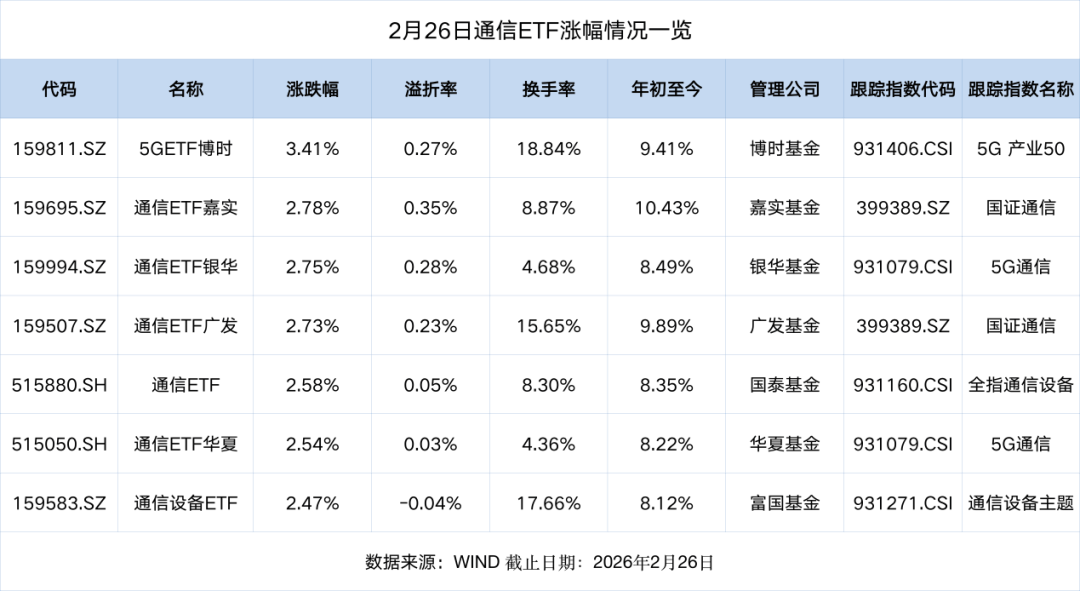
Core Viewpoint - The communication ETF sector has seen a collective increase of over 2%, driven by Nvidia's better-than-expected performance and domestic technological breakthroughs, highlighting the focus on AI computing power in the market [1]. Group 1: Market Performance - On February 26, A-shares showed mixed results, with the communication sector reaching new highs, particularly in optical communication stocks and CPO concepts [1][3]. - Seven communication ETFs experienced significant gains, becoming focal points in the market [3]. - The 5G ETF from Bosera led the gains with a daily increase of 3.41%, while other ETFs tracking various communication indices also saw notable rises [4][5]. Group 2: ETF Details - The 5G ETF from Bosera has a year-to-date increase of over 9%, with a trading volume turnover rate of 18.84% [4][5]. - Other notable ETFs include: - Jia Shi Communication ETF with a daily increase of 2.78% and a year-to-date increase of 10.43% [5]. - Yin Hua Communication ETF with a daily increase of 2.75% and a year-to-date increase of 8.49% [5]. - Guang Fa Communication ETF with a daily increase of 2.73% and a year-to-date increase of 9.89% [5]. - The overall market saw 563 ETFs rise, with the highest increase being 9.64% for the Korea Semiconductor ETF [6]. Group 3: Industry Insights - CITIC Securities reports that the demand for AI computing power is driving upgrades in the optical communication industry, with strong capital expenditure from overseas cloud vendors supporting robust demand for high-speed optical modules [5]. - Despite short-term supply gaps in high-speed optical chips, upstream manufacturers are actively expanding production, which may alleviate supply chain bottlenecks [6]. - The overall sentiment in the market is bullish, with significant capital inflows into stock ETFs [6].

ETF收评 | AI硬件股全线领涨,中韩半导体ETF逼近涨停
Ge Long Hui· 2026-02-26 07:37
Market Performance - The three major A-share indices showed mixed results, with the Shanghai Composite Index down 0.01%, the Shenzhen Component Index up 0.19%, and the ChiNext Index down 0.29% [1] - The total trading volume in the Shanghai, Shenzhen, and Beijing markets reached 25,566 billion yuan, an increase of 757 billion yuan compared to the previous day, with over 2,400 stocks rising [1] Sector Performance - Leading sectors included CPO, copper cable high-speed connections, optical fibers, PCBs, liquid-cooled servers, wind power equipment, aviation engines, cultivated diamonds, semiconductors, and sugar substitute concepts, which saw significant gains [1] - Underperforming sectors included film and television, insurance, real estate, short drama games, complete automobiles, precious metals, duty-free shops, liquor, and retail, which experienced notable declines [1] ETF Performance - AI hardware stocks led the gains, with the China-Korea Semiconductor ETF nearing a limit-up, while various communication ETFs saw increases of 3.41%, 2.78%, 2.58%, and 2.54% [1] - The electric grid sector also performed well, with the electric grid ETF and electric grid equipment ETF rising by 3.23% and 2.91%, respectively [1] - The medical sector faced declines, with the Hang Seng Medical ETF and other related ETFs dropping over 3%, while the real estate ETF fell by 3% [1]
英伟达Q4业绩超预期,通信ETF、通信设备ETF涨超2%
Ge Long Hui· 2026-02-26 06:10
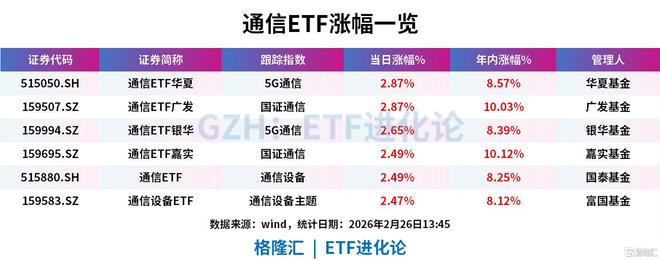
Core Viewpoint - The artificial intelligence computing power sector continues to show strong performance, with various communication ETFs experiencing significant gains, reflecting investor confidence in the industry [1]. Group 1: ETF Performance - Communication ETFs such as 华夏, 广发, 银华, and 嘉实 have all seen gains exceeding 2% on the day, with year-to-date increases ranging from 8.25% to 10.12% [3]. - Specifically, 华夏 Communication ETF, tracking the 5G communication index, rose by 2.87% and has a year-to-date increase of 8.57% [3]. - 广发 Communication ETF, which tracks the National Communication Index, also increased by 2.87% with a year-to-date rise of 10.03% [3]. Group 2: Key Holdings and Market Trends - The 华夏 Communication ETF focuses on electronic and communication hardware, holding stocks of leading companies such as 中际旭创, 新易盛, and 立讯精密 [5]. - The communication equipment ETF tracks the communication equipment theme index, with a high proportion of leading optical module and computing hardware companies [6]. - NVIDIA's recent Q4 earnings exceeded expectations, with a record revenue of $68.1 billion, marking a year-on-year increase of approximately 70%, which has positively influenced market sentiment [6]. Group 3: Industry Outlook - The demand for computing power resources is expected to expand, with the industry remaining in a high prosperity cycle, driven by developments in AI applications and data center construction [8]. - The collaboration between META and NVIDIA is anticipated to accelerate the adoption of CPO (Cloud Processing Optimization), further enhancing the growth of the optical communication sector [9]. - The competition in AI large models is shifting towards productivity and efficiency, with significant updates from major players like Google and Alibaba, indicating a clear competitive landscape [9].

国内外需求共振带动电网行业高景气发展,电网ETF、电网设备ETF广发、电网设备ETF涨超3%
Ge Long Hui A P P· 2026-02-26 05:19
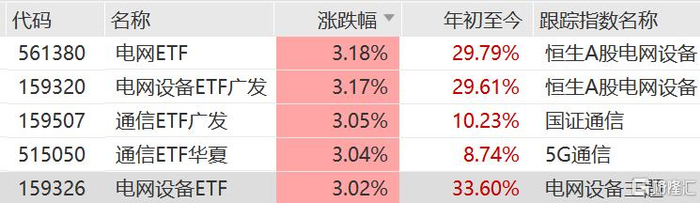
Core Viewpoint - The electric grid ETFs and related sectors are experiencing significant growth, with year-to-date increases of nearly 30% for both the electric grid ETF and the electric grid equipment ETF, driven by rising demand and investment in the electric power infrastructure [1][2]. Group 1: ETF Performance - The electric grid ETF has increased by 3.18% recently and has a year-to-date growth of 29.79%, tracking the Hang Seng A-share Electric Grid Equipment Index [2]. - The electric grid equipment ETF from GF Securities has risen by 3.17% and has a year-to-date increase of 29.61%, also tracking the same index [2]. - The electric grid equipment ETF focuses on the power equipment sector, covering areas such as transmission and transformation equipment, ultra-high voltage industries, and smart grid construction [2]. Group 2: Market Demand and Investment - Goldman Sachs has raised its forecast for global data center electricity demand growth from 175% to 220% by 2030, indicating a significant shift in investment towards the power supply chain due to AI developments [3]. - The U.S. government is convening major tech companies to discuss commitments regarding the electricity costs of high-energy data centers, highlighting the increasing need for reliable power sources [3]. - The State Grid Corporation of China has announced a fixed asset investment plan of 4 trillion yuan during the 14th Five-Year Plan, with expectations for high investment in ultra-high voltage and smart grid sectors [4]. Group 3: Industry Outlook - The electric grid industry is experiencing high demand due to both domestic and international factors, with expectations for investment to exceed market forecasts [4]. - The aging U.S. electric grid infrastructure, built primarily in the 1950s to 1970s, is entering a replacement cycle, creating a bottleneck for AI development [4]. - The surge in renewable energy installations in Europe is driving demand for electric grid support, alongside strong needs for upgrades and renovations in power equipment [4].
ETF午评 | 沪指微跌0.08%,电力板块领涨,电网ETF、电网设备ETF均涨3%
Xin Lang Cai Jing· 2026-02-26 04:14
Market Overview - The Shanghai Composite Index fell by 0.08% and the ChiNext Index decreased by 0.39% [1] - Sectors such as AI applications, lithium batteries, fintech, photovoltaic, gold, and innovative pharmaceuticals showed weakness, while real estate and insurance industries experienced significant declines [1] Sector Performance - The storage chip sector continued to rise, with the South Korea-China semiconductor ETF increasing by 4.82% [1] - The AI hardware sector strengthened, with the 5G ETF from Bosera rising by 3.28%, and the communication ETFs from Huaxia and others increasing by 2.79% and 2.49% respectively [1] - The electric grid sector performed well, with both the electric grid ETF and electric grid equipment ETF rising by 3% [1] - The machinery sector also saw gains, with the Jiashan technology machinery ETF and industrial mother machine ETF increasing by 2.94% and 2.48% respectively [1] Declining Sectors - Oil and gas stocks declined, with the S&P oil and gas ETF from Jiashan dropping by 2.8% [1] - The real estate sector faced a pullback, with the real estate ETF and the real estate ETF from Yinhua falling by 2.74% and 2.71% respectively [1] - Automotive stocks were also down, with the Hong Kong automotive ETF and the Hong Kong Stock Connect automotive ETF from Fuguo decreasing by 2.38% and 2.09% respectively [1]