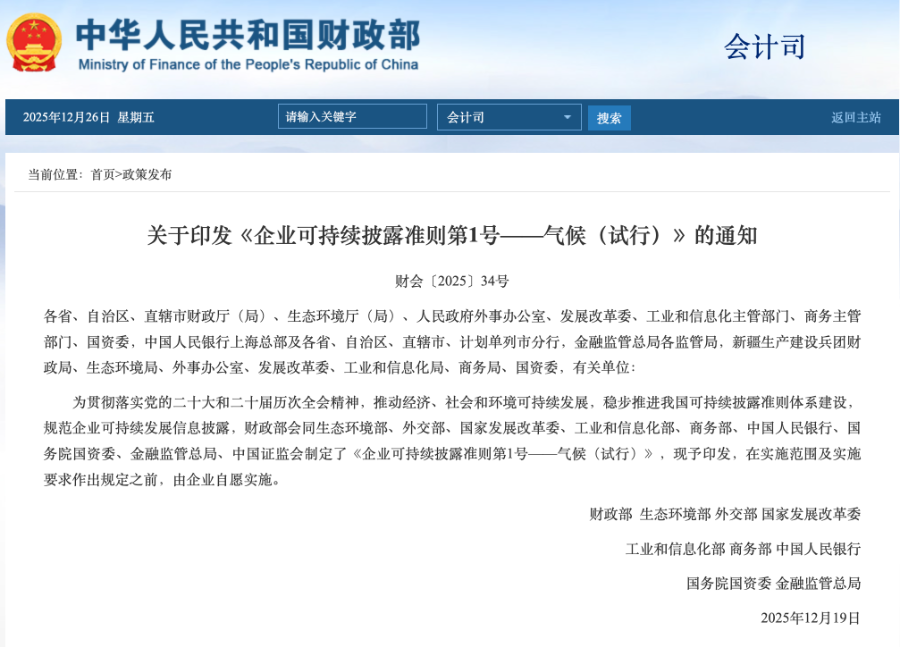
《企业可持续披露准则第1号——气候(试行)》

Search documents
企业气候信息披露迎统一规则
Xin Lang Cai Jing· 2026-01-04 22:08
Core Viewpoint - The Ministry of Finance, in collaboration with various governmental departments, has established the "Corporate Sustainable Disclosure Standard No. 1 - Climate (Trial)" to enhance climate-related information disclosure among enterprises, marking a significant step in China's sustainable disclosure framework [1][2]. Group 1: Overview of the Climate Standard - The Climate Standard is the first specific guideline under the unified sustainable disclosure framework, transitioning from a general framework to specific issues [1]. - It aims to create a transparent, comparable, and reliable climate information disclosure system, supporting green and low-carbon development [1][2]. Group 2: Structure of the Climate Standard - The Climate Standard consists of four main parts: Governance, Strategy, Risk and Opportunity Management, and Metrics and Targets [2]. - The Governance section outlines disclosure targets related to climate governance, including information on governance bodies and third-party verification [2]. - The Strategy section specifies disclosure requirements regarding climate-related risks and opportunities, their impact on corporate strategy, and financial implications [2]. - The Risk and Opportunity Management section details how companies should disclose their management processes for climate-related risks and opportunities [2]. Group 3: Implementation and Adaptation - The Climate Standard combines international practices with China's unique context, allowing companies to adapt disclosure methods based on their resources, thus reducing compliance costs for small and medium enterprises [3]. - It aims to address issues of "greenwashing" by providing standardized disclosure that directs capital towards low-carbon projects [3]. - The implementation will be gradual, starting with voluntary disclosures and expanding to mandatory requirements over time, focusing on different company sizes and types [3].
九部门联合发布气候披露准则 中国气候信息披露迎来“统一标尺”
Zhong Guo Jing Ying Bao· 2025-12-27 06:54
Core Viewpoint - The release of the "Corporate Sustainable Disclosure Standard No. 1 - Climate (Trial)" marks a new phase in standardized climate information disclosure for Chinese enterprises, providing essential institutional support for the country's "dual carbon" goals [1][2]. Group 1: Standardization and Implementation - The "Climate Standard" is the first specific standard under the unified sustainable disclosure framework, following the release of the "Basic Standard" in November 2024, highlighting its significance in transitioning national strategies to corporate practices [1]. - The standard aligns with international disclosure frameworks, maintaining four core pillars: governance, strategy, risk and opportunity management, and metrics and targets, enhancing the international comparability of Chinese enterprises' climate disclosures [2]. - Currently, the "Climate Standard" is positioned as a trial document with voluntary implementation, planning a gradual expansion from listed companies to non-listed companies and from qualitative to quantitative requirements [2]. Group 2: Impact on Corporate Practices - The "Climate Standard" requires companies to systematically incorporate climate change factors into strategic decision-making, risk management, and resource allocation, pushing enterprises to enhance collaboration across departments and improve value chain management [3]. - A simulation disclosure testing was conducted from July to September 2025, involving 40 companies to assess the scientific validity and operability of the "Climate Standard," aiming to refine and optimize the guidelines [3]. - The implementation of the "Climate Standard" is expected to provide operational guidance for corporate climate information management and contribute to the development of subsequent standards in environmental and social sectors, promoting China's role in global climate governance [3].
9部门发布ESG披露气候准则,从自愿向强制披露扩展
2 1 Shi Ji Jing Ji Bao Dao· 2025-12-26 13:25
Group 1 - The core viewpoint of the news is the introduction of the "Climate Guidelines," which marks a significant step towards a unified sustainable disclosure framework in China, aimed at enhancing corporate transparency regarding climate-related actions and risks [1][3][11] - The "Climate Guidelines" are positioned as a trial document, allowing voluntary implementation by companies, with plans for gradual expansion from listed to non-listed companies and from large to small enterprises [1][3][9] - The guidelines consist of four main parts: governance, strategy, risk and opportunity management, and metrics and targets, aligning with international standards such as IFRS and TCFD [5][6][7] Group 2 - The implementation of the "Climate Guidelines" is expected to reduce compliance and communication costs for companies, providing a transparent framework for disclosing climate actions and risks [8][9] - A+H share listed companies are identified as the core group affected by the guidelines, as they will no longer need to comply with two different sets of standards, thus lowering compliance pressure [9][10] - The guidelines will encourage companies to focus on climate issues, enhancing their governance mechanisms and risk management processes, which is seen as a breakthrough in corporate climate awareness [13]