《小武》

Search documents
过年返乡,一场大型的方言水平测试 | 编辑部聊天室
Xin Lang Cai Jing· 2026-02-22 03:30
Group 1 - The article discusses the impact of dialects on identity and social interactions, particularly during family gatherings and cultural exchanges [2][4][5] - It highlights the generational differences in language use, where younger individuals often feel pressure to adapt to standard Mandarin in urban settings while older generations may prefer their local dialects [2][6] - The article notes that dialects can carry social connotations, with some being perceived as fashionable while others are seen as less sophisticated, reflecting broader societal values [5][6][9] Group 2 - The discussion includes how dialects are represented in media and entertainment, with dialect films and regional music gaining popularity, showcasing local culture [14][24][25] - It emphasizes the role of social media in reshaping perceptions of dialects, allowing for a more diverse representation of regional identities [9][24] - The article also touches on the preservation of dialects in contemporary society, noting that while some dialects are thriving, others are at risk of fading due to urbanization and the dominance of standard Mandarin [31][32][34] Group 3 - The article explores the evolution of dialects in artistic expressions, such as films and music, where dialects are used to convey cultural narratives and local experiences [14][25][27] - It discusses the significance of dialects in expressing personal and communal identities, particularly in the context of regional pride and cultural heritage [27][29] - The article concludes with examples of how dialects have entered mainstream language, illustrating their adaptability and relevance in modern communication [34][36][37]

汾阳,不只是贾樟柯痛城
3 6 Ke· 2025-12-11 02:55
Core Insights - The film "Mountains May Depart" by Jia Zhangke is set to be re-released on December 12, 2025, marking a significant moment as it reflects on the passage of time and the changes in personal and collective memories [1][2][4] - The narrative emphasizes the emotional resonance of the film, highlighting themes of nostalgia, loss, and the desire to reconnect with the past [5][7] Summary by Sections Film and Emotional Resonance - The re-release of "Mountains May Depart" allows audiences to revisit their understanding of the film, deepening emotional connections to its themes of time and change [2][5] - The recurring motif of keys in the film symbolizes the longing for access to the past and the inevitability of change [4][7] Jia Zhangke's Cinematic Universe - Jia Zhangke's films, including "Mountains May Depart," serve as a lens through which viewers can explore the slow evolution of the city of Fen Yang, reflecting both personal and societal transformations [10][12] - The film's settings are rooted in real locations, enhancing the authenticity of the narrative and its connection to the audience's experiences [18][27] Fen Yang as a Cultural and Historical Context - Fen Yang is portrayed as a city with a rich history, where the past and present coexist, and its landmarks, such as the Wenfeng Tower, symbolize the continuity of cultural heritage [20][21][28] - The local architecture and historical sites contribute to the city's identity, making it a significant backdrop for Jia Zhangke's storytelling [32][39] Reflections on Time and Memory - The narrative reflects on the passage of time, emphasizing that while people may change, the essence of the landscape and memories remain [18][44] - The film and its re-release serve as a reminder of the transient nature of life and the enduring significance of personal and collective memories [27][44]
贾樟柯和朋友们的摄影展现身上海,用影像讲述中国的变化
Di Yi Cai Jing· 2025-05-12 03:18
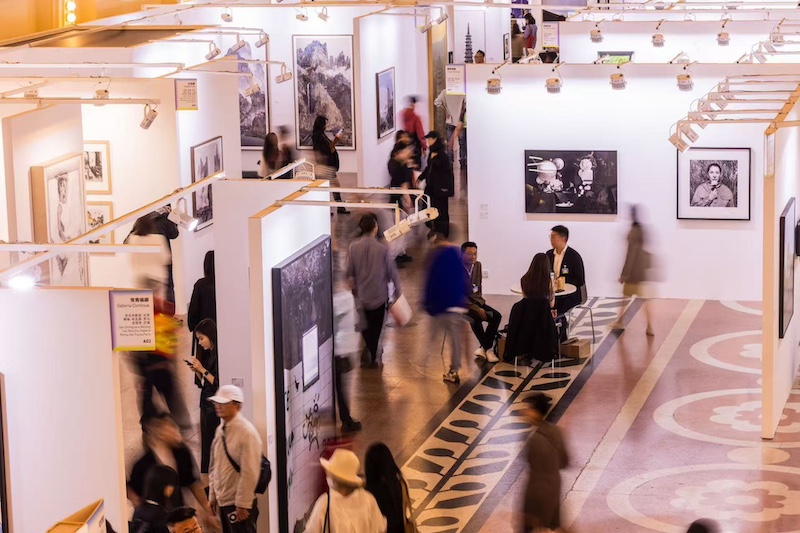
Core Perspective - The exhibition "Like Water and Light" features works by Jia Zhangke and three closely related artists, presenting a richer visual world that explores the relationship between film and photography, as well as the connections between filmmakers and photographers [1][3] Group 1: Exhibition Overview - The 10th Shanghai Image Art Fair, held from May 8 to 11, attracted over 10,000 visitors, showcasing thousands of works from over a hundred galleries and institutions from countries including France, Italy, the USA, and Japan [1] - The special exhibition "Like Water and Light" includes works from Jia Zhangke, Apichatpong Weerasethakul, Liu Zheng, and Yu Lik-wai, drawing significant attention from the audience [1][3] Group 2: Artistic Collaboration - The exhibition aims to rekindle the dialogue between different artistic mediums, as curators note that the communication between filmmakers, photographers, and contemporary artists has diminished over time [3] - The collaboration between Jia Zhangke and Yu Lik-wai began in the early 1990s, with Yu serving as the cinematographer for all of Jia's films, highlighting a long-standing partnership [5] - Liu Zheng and Jia Zhangke both address social realities through their respective mediums, with Liu's "The People" series capturing the diverse lives of various social classes [5] Group 3: Artistic Themes - The works of the featured artists often focus on marginalized groups and the struggles of ordinary individuals, reflecting a commitment to documenting the human experience [5][6] - Jia Zhangke's film and photography work emphasizes the lives of small characters amidst China's social changes, with his "Tattoo" series representing a form of self-expression for those who rarely have a voice [7] - Apichatpong's works blend documentary and fiction, using non-linear narratives to respond to social realities, while Liu Zheng's latest work "The Power of Silence" captures the intricate structures of machines, symbolizing the harshness of reality [9] Group 4: Artistic Philosophy - The curatorial perspective suggests that both film and photography are expressions of time, with static images providing a space for imagination and reflection on past events [9][11] - The artists' practices are rooted in genuine social experiences, contrasting with contemporary artists who may focus more on theoretical concepts rather than lived experiences [11] - The exhibition emphasizes the importance of individual life experiences in shaping unique artistic expressions, suggesting that art becomes richer when it reflects personal and societal narratives [11]