《速度与激情7》

Search documents
《阿凡达3》遇冷,好莱坞电影真的不用再看?
Feng Huang Wang· 2026-01-04 10:40
Core Viewpoint - Hollywood is increasingly focusing on mature IP development, leading to a more conservative approach and a decline in original script development, resulting in a loss of adventurous spirit and a perception of declining film quality [1][12]. Group 1: Box Office Performance - "Avatar 3" has underperformed at the box office, failing to replicate the success of its predecessors, with director James Cameron indicating that if global box office expectations are not met, plans for sequels may be halted [2]. - The domestic box office for Hollywood films has been declining, with only 15% market share in 2023, a record low in over a decade [4]. - The pandemic significantly impacted the film industry, with domestic box office revenue dropping from 641 billion yuan in 2019 to 203 billion yuan in 2020, followed by a slow recovery [4]. Group 2: Changing Audience Preferences - Audiences are no longer blindly trusting Hollywood's allure, as the era of being captivated solely by visual spectacles has passed [2][10]. - The rise of domestic films has provided audiences with more choices, leading to a shift in preferences towards films that resonate more closely with local realities and issues [8][9]. Group 3: Hollywood's Challenges - Hollywood films in China are predominantly based on established IPs, with a lack of original content leading to a perception of stagnation and formulaic storytelling [5][7]. - The quality of Hollywood films has been perceived as declining, with recent Marvel films receiving lower ratings compared to earlier releases [7]. Group 4: Cultural and Market Dynamics - The deterioration of US-China relations has influenced the reception of Hollywood films in China, with rising nationalism leading some audiences to reject American cultural products [10][11]. - The marketing strategies of Hollywood films have shifted, with less emphasis on engaging Chinese audiences directly, impacting their box office performance [11]. Group 5: Economic Implications - Despite the challenges, importing Hollywood films remains economically beneficial for both Hollywood and the domestic film industry, providing a diverse range of content and supporting cinema revenue [14][15]. - The introduction of foreign films is seen as a means of cultural exchange, with the potential for mutual benefits in the film industry [15].


好莱坞大片遇冷,国产片要好起来了吗?
虎嗅APP· 2025-10-30 14:20
Core Viewpoint - The article analyzes the evolution of the Chinese film market over the past decade, highlighting the significant changes in the number, box office performance, and audience reception of domestic and imported films, particularly in the context of policy shifts and market dynamics [4][30]. Group 1: Policy Environment - Since 2015, the number of imported films in the Chinese market surged, peaking at 136 films in 2019, accounting for over 20% of films released annually [6][9]. - The increase in imported films was facilitated by a series of policy relaxations, including agreements between China and the US, and later with the UK, promoting co-productions and diversifying sources of imported films [7][9]. - However, after 2019, the number of imported films sharply declined to 62 in 2020, with the proportion of imported films never exceeding 20% again, indicating a significant policy shift [10][12]. Group 2: Box Office Composition - From 2015 to 2024, the ratio of domestic to imported films in the top ten box office rankings shifted from 7:3 to a complete dominance of domestic films, particularly after 2020 [12][30]. - In 2015, imported films accounted for 34.8% of the top ten box office, but by 2020, all top ten films were domestic, with domestic films maintaining over 90% of box office share in subsequent years [15][30]. - The contribution of imported films to box office revenue has steadily decreased, with domestic films now leading both in quantity and revenue [18][30]. Group 3: Audience Reception - The competition between domestic and foreign films in terms of audience ratings has been intense, with domestic films experiencing fluctuations in high ratings over the years [22][30]. - High-rated domestic films peaked in 2022 with eight entries, but subsequently fell back to lower numbers, indicating a competitive landscape where both domestic and foreign films vie for audience approval [25][30]. - Despite the volatility, foreign films have consistently maintained higher average ratings, often exceeding 8 points, while domestic films have struggled to stay above this threshold until recent improvements [28][30]. Group 4: Future Outlook - The article suggests that the Chinese film market will continue to evolve under the dual influences of globalization and localization, with an emphasis on diversifying the types of films being imported and produced domestically [30].

又刷新!《哪吒2》总票房超115亿!
Xin Hua Wang· 2025-08-12 06:00
Group 1 - The total box office of "Ne Zha" has exceeded 11.5 billion yuan, including previews and advance sales [1] - "Inside Out 2" is set to be released in the US on June 14, 2024, with a projected box office of 12.319 billion yuan ($1.698 billion) [4] - "Jurassic World" has a total box office of 12.12 billion yuan ($1.671 billion) [6] Group 2 - "The Lion King" has a total box office of 12.051 billion yuan ($1.662 billion) [8] - "Ne Zha 2" is scheduled for release in mainland China on January 29, 2025, and has already included box office from Hong Kong, Macau, Taiwan, and overseas totaling $3.22 million [8] - "The Avengers" and "Furious 7" are also notable films in the box office rankings [10][11]

“关税大棒”下的好莱坞影业之殇
Guo Ji Jin Rong Bao· 2025-05-16 09:02
Core Viewpoint - The U.S. government's decision to impose a 100% tariff on foreign-produced films entering the U.S. signifies an extension of trade sanctions from goods to services, which will significantly impact Hollywood and its performance in the Chinese market [1][5]. Group 1: Impact on Hollywood - The U.S. tariffs and China's response to reduce the import of American films will create substantial challenges for Hollywood, pushing it into a more difficult situation [1]. - Hollywood's revenue from the Chinese market has seen a drastic decline, with box office earnings dropping from 216 billion RMB in 2017 to only 62.73 billion RMB in 2024, representing a decrease from 38.7% to 15.1% of global box office revenue [4][10]. - The number of Hollywood films generating over 1 billion RMB in China has decreased for two consecutive years, indicating a significant downturn in market performance [4]. Group 2: Market Dynamics - The Chinese film market has grown significantly, with over 80,000 screens and a total box office of 425.02 billion RMB in 2024, making it the second-largest globally [3]. - Hollywood films once accounted for half of their global box office revenue from China, but this share has diminished as the market dynamics shift [3][10]. - The competition from streaming platforms like Netflix and YouTube has further eroded traditional cinema attendance, with only 34% of U.S. adults preferring to watch films in theaters [10]. Group 3: Financial Implications - The average production cost of Hollywood films exceeds 200 million USD, and rising tariffs on imported materials will increase production costs and strain profitability [8][9]. - The overall U.S. film box office revenue is projected to decline from approximately 86 billion USD in 2023 to around 70 billion USD by 2025, reflecting a significant contraction in the industry [10]. - The U.S. service trade surplus, which includes film exports, may be adversely affected by the restrictions on Hollywood films in China, despite the relatively small direct contribution of film revenues to the overall service trade [12][14]. Group 4: Cultural and Strategic Considerations - Hollywood's cultural influence and the portrayal of American values through its films are at risk due to the increasing isolation from international markets [14]. - The U.S. government's tariffs may lead to retaliatory measures from other countries, further complicating Hollywood's ability to access key markets [13]. - The decline in Hollywood's global market share, which has fallen from over 60% a decade ago to 51% in 2023, underscores the industry's diminishing competitive edge [10].
好莱坞焦虑背后的美国服务贸易顺差收缩阵痛
Di Yi Cai Jing· 2025-05-11 12:33
Core Viewpoint - Hollywood is facing significant challenges due to declining international market share, increased competition, and the impact of tariffs, which collectively threaten its historical dominance and the broader U.S. service trade [1][4][14] Group 1: Hollywood's Historical Context and Achievements - Hollywood has evolved over a century, pioneering various film production and distribution methods, and has historically dominated global box office revenues [3][4] - In 2024, Hollywood films occupied 9 out of the top 10 global box office spots, with "Inside Out 2" leading at $1.757 billion [3] Group 2: Current Market Challenges - The global box office revenue for Hollywood films fell to $30.5 billion in the previous year, a 10% decrease, with international market share dropping from 82% to 77% [4] - The number of Hollywood films grossing over $200 million globally decreased from 31 to 23, indicating a contraction across all markets [4] - In North America, the number of Hollywood films earning over $100 million fell from 25 to 22, with a revenue drop of nearly $300 million [4] Group 3: Impact of Streaming Services - Streaming platforms like Netflix and YouTube are increasingly preferred by audiences, with only 34% of U.S. adults favoring cinema, while nearly 80% prefer streaming [5] - The average time spent by U.S. audiences on streaming platforms reached 3.13 trillion minutes weekly, indicating a shift in viewing habits [5] Group 4: Tariff Policies and International Relations - The U.S. tariff policies under the Trump administration have led to reduced imports of American films in China, a crucial market for Hollywood [7][9] - China has historically been a significant market for Hollywood, contributing to a peak revenue of $21.6 billion in 2017, but this has declined to approximately $6.273 billion in 2024 [9] Group 5: Financial Implications and Future Outlook - The average production cost for Hollywood films exceeds $200 million, and rising tariffs on imported materials are expected to increase production costs and reduce profitability [9][10] - The usage rate of Los Angeles studios dropped from over 90% to 63%, with filming days at a six-year low, indicating a contraction in production activity [10] - The U.S. service trade, heavily reliant on Hollywood films, is projected to face significant challenges due to declining revenues and potential retaliatory measures from other countries [13][14]
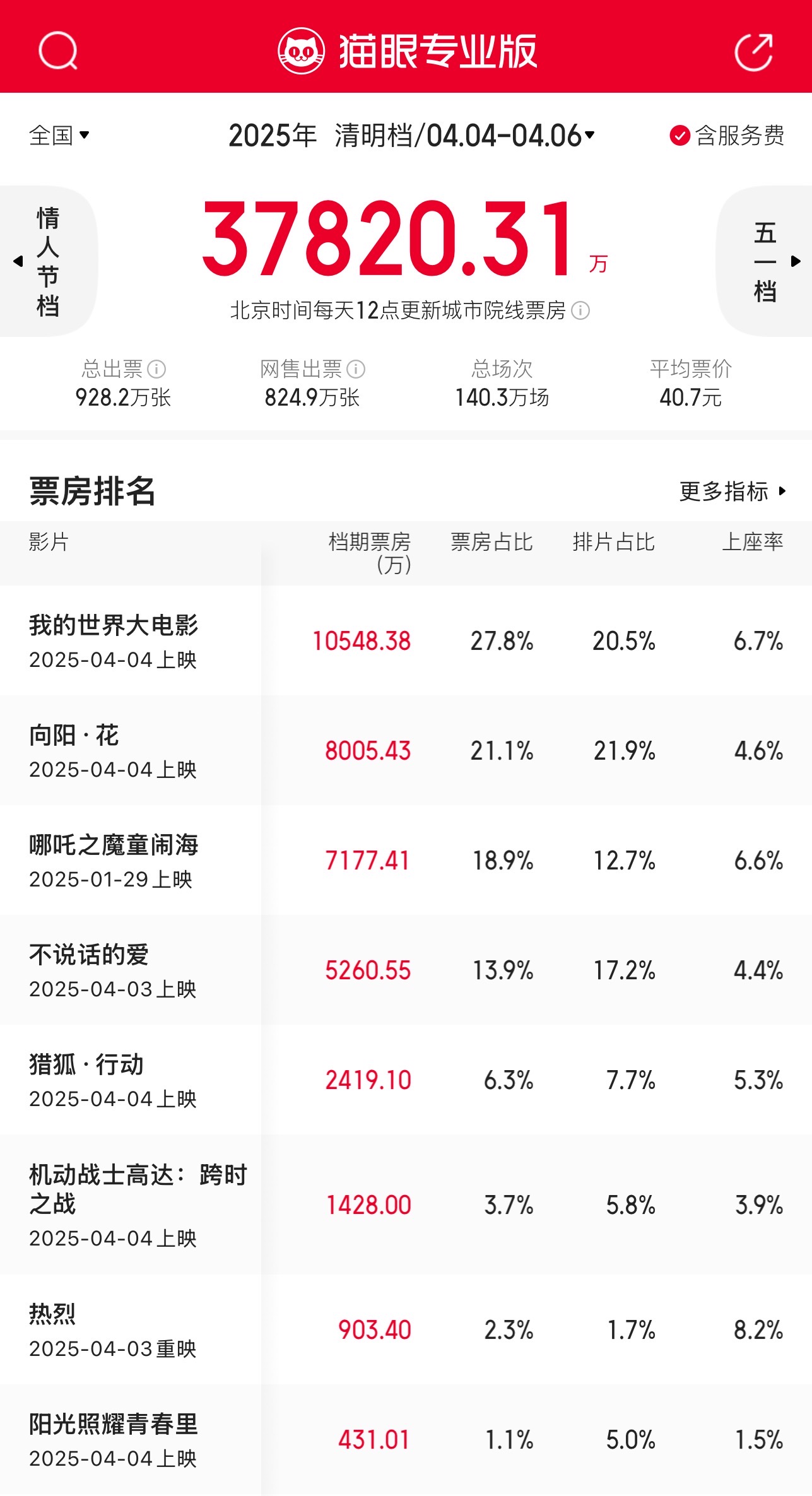
清明档3.78亿元收官,仅一部影片票房过亿
Guo Ji Jin Rong Bao· 2025-04-07 06:48
Core Insights - The 2025 Qingming Festival box office reached 378 million yuan, with over 9.28 million attendees and 1.395 million screenings, setting a record for the number of screenings during this period in Chinese film history [1][5] - Despite the release of over ten films across various genres, the lack of major blockbuster films led to a lower overall box office performance compared to previous years [1][5] - "My World Movie" emerged as the box office champion with 105 million yuan, being the only film to surpass the 100 million yuan mark during the Qingming period [1][2] Box Office Performance - Total box office for the Qingming period was 378.2 million yuan, a 55.1% decrease compared to the previous year [5] - The top films by box office performance included: - "My World Movie": 105.5 million yuan (27.8% of total box office) [2] - "Sunshine Flower": 80.1 million yuan (21.1% of total box office) [3] - "Nezha: The Devil's Child": 71.8 million yuan (18.9% of total box office) [4] - "The Silent Love": 52.6 million yuan (13.9% of total box office) [3] - "Operation Fox Hunt": 24.2 million yuan (6.3% of total box office) [4] Historical Context - The Qingming Festival box office has shown a trend of growth from 300 million yuan in 2014 to over 800 million yuan in 2021, but faced a decline in 2022 and 2023 [4][5] - The previous year's success was attributed to major imported films, which accounted for 80% of the box office during the Qingming period [4] Future Outlook - Upcoming films in April include "Forrest Gump" sequel, "The Spy Network," and "Wild Stories," which may help revitalize the box office following the Qingming period [5] - The market is expected to see increased demand as weather improves and diverse content becomes available [5]