
万智2.5企业多智能体

Search documents
「AI新世代」掘金智能招采蓝海,科大讯飞按下AI to B加速键
Hua Xia Shi Bao· 2026-01-15 13:12
Core Insights - The enterprise service market is undergoing a significant transformation driven by AI, with iFlytek launching the "Intelligent Procurement Platform" aimed at enhancing efficiency in the procurement process [2][4] - iFlytek's projects in the AI 2.0 era have led to a record-breaking revenue, with the company ranking first in the industry for project bids and amounts [2][7] Group 1: Intelligent Procurement Platform - The "Intelligent Procurement Platform" utilizes AI capabilities to streamline processes, reducing the average time for preparing bidding documents from 5-7 working days to 30 minutes, and achieving a 96% accuracy rate in bid-rigging detection [3] - The platform addresses challenges in procurement efficiency, compliance, and cost optimization, indicating a strong demand for digital transformation in this area [3][4] - iFlytek's shift from project-based delivery to a platform-based model allows businesses to assemble AI components with low-code or no-code solutions, enhancing customization and adaptability [3][5] Group 2: Market Position and Financial Performance - iFlytek's strong position in the market is highlighted by its substantial number of project bids, particularly in the financial sector, where it has secured contracts with major banks and financial institutions [7] - The company reported a revenue of 60.78 billion yuan for Q3 2025, a year-on-year increase of 10.02%, with a net profit of 1.72 billion yuan, reflecting a significant growth of 202.4% [7] - iFlytek's strategic focus on both B-end and C-end business development is crucial for balancing growth and profitability, with plans to enhance its platform and subscription models [8]


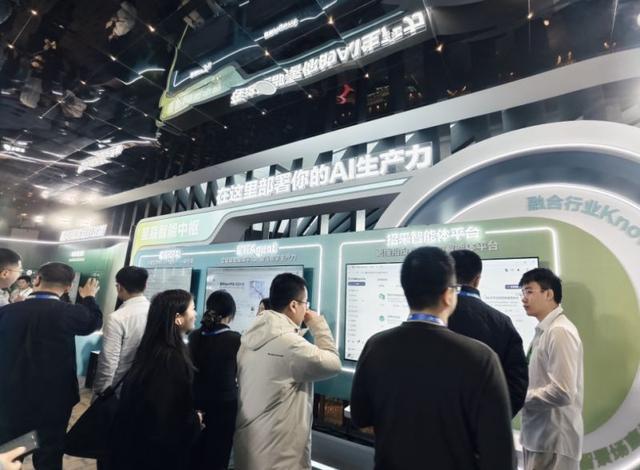
企业级智能体加速落地 2026将成“上岗元年”
Zhong Guo Jing Ying Bao· 2026-01-06 07:28
Core Insights - The article discusses the transformative impact of multi-agent AI technology on organizational structures, shifting from reliance on human talent to software capabilities [1][3] - It highlights the prediction that the enterprise application software market, valued at $650 billion, will be disrupted by AI agents, with a projected market size of over $27 billion for enterprise AI applications in China by 2028 [2][3] Group 1: Multi-Agent Technology Evolution - Multi-agent technology is evolving from single-point tools to intelligent management systems, fundamentally restructuring organizational forms and enhancing overall optimization [3][5] - The rise of multi-agent systems is breaking down traditional departmental barriers, enabling seamless cross-departmental collaboration without cumbersome processes [2][5] Group 2: Market Predictions and Trends - IDC forecasts that by 2031, the penetration rate of AI agents in customer service, sales, and marketing applications will approach 100% [2] - The article emphasizes that 2026 is expected to be the year when multi-agent systems will scale up significantly in enterprises [6] Group 3: Organizational Restructuring - The emergence of multi-agent systems is leading to the "atomization" and "automation" of traditional functions, transforming departments into fluid, task-oriented clusters of intelligent agents [5][6] - Companies are encouraged to adapt to multi-agent operations by creating specialized roles for managing these systems, which will require a deep understanding of their mechanisms [6] Group 4: Human-Centric Approach - The article stresses the importance of balancing efficiency with human rights, advocating for a shift where employees are seen as commanders and trainers of AI rather than replaceable costs [7] - Organizations must implement top-down changes to foster a culture that embraces AI, allowing human employees to transition from executors to decision-makers [7]
零一万物发布万智2.5企业级多智能体 2026年将成“多智能体上岗元年”
Zheng Quan Shi Bao Wang· 2026-01-05 14:19
Core Insights - The article discusses the launch of "Multi-Agent 2.5" by Zero One Everything, which aims to transform enterprise structures through AI-driven multi-agent systems [1][2]. Group 1: Multi-Agent System Development - Zero One Everything has shifted its strategic focus to the application of large models in enterprises, with the "Multi-Agent 2.5" platform designed to address dynamic and open challenges in enterprise scenarios [2]. - The platform utilizes a "code-first, model-driven" architecture to ensure stability and relevance to real production environments, allowing complex workflows previously requiring large teams to be managed by multi-agents [2][3]. - Demonstrations of "Market Department Replacement" and "HR Replacement" showcased how multi-agents can efficiently handle tasks that typically required teams of ten or more, indicating a significant shift in organizational structure and value chains [2][3]. Group 2: Future Predictions and Market Impact - Zero One Everything predicts that 2026 will mark the year of large-scale deployment for multi-agents in enterprises, shifting the competitive focus from hiring to managing AI agents [4]. - The role of "Agent Operators" is expected to emerge as a key position responsible for deploying, training, and optimizing these agents [4]. - The company emphasizes that decision-making will become the core competency for knowledge workers, with a focus on early adoption, advanced agent selection, and closed-loop data utilization as critical competitive factors for enterprises [4][5]. Group 3: Industry-Specific Insights - Different industries will experience varying paces of multi-agent implementation, with sectors like finance benefiting from established data infrastructures, while traditional industries will focus on efficiency improvements through AI [5]. - IDC reports indicate that the enterprise application software market, valued at $650 billion, is poised for disruption by AI agents, with a projected near 100% penetration in customer service, sales, and marketing applications by 2031 [6]. - Zero One Everything anticipates significant revenue growth in 2025 and plans to expand further in 2026, focusing on high-value projects in overseas markets and leveraging government partnerships for local industry transformation [6].
零一万物发布万智2.5企业级多智能体,开启2026“硅基团队”上岗元年
Cai Jing Wang· 2026-01-05 12:20
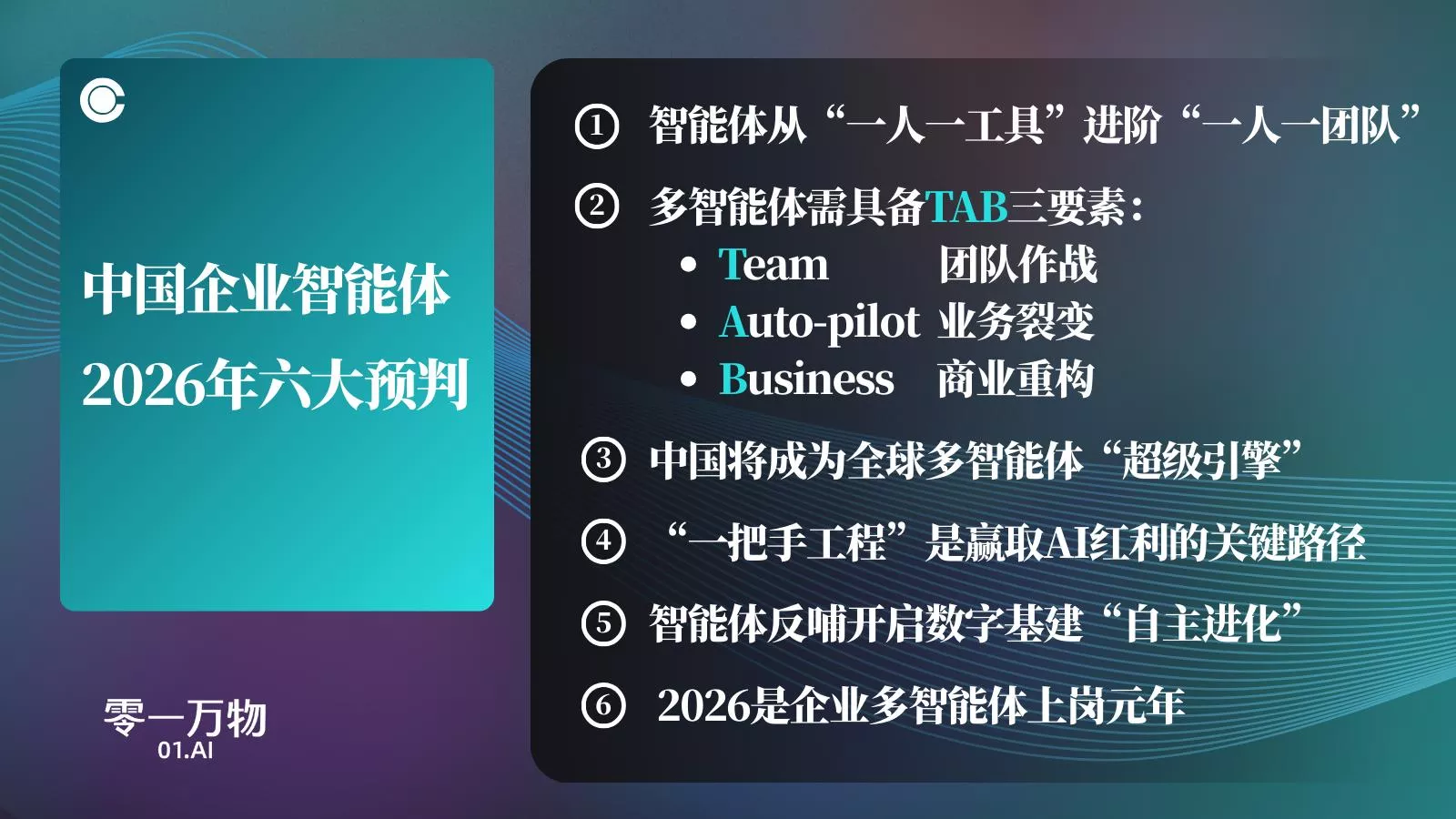
Core Insights - The article discusses the transformative impact of AI multi-agent systems on enterprise organization structures, highlighting a significant shift towards "organizational intelligence" [4][6][20] - It emphasizes the importance of strategic leadership in AI transformation, advocating for a top-down approach to integrate AI into business processes [3][14][31] Group 1: AI Multi-Agent Systems - The release of "Wanzhi 2.5" showcases advancements in enterprise multi-agent systems, enabling complex workflows that previously required large teams to be managed by a single agent [1][22] - IDC predicts that the enterprise application software market, valued at $650 billion, will be disrupted by AI agents, with a projected market size of over $27 billion for enterprise AI applications in China by 2028 [1][12] - Multi-agent systems allow for enhanced collaboration and efficiency, enabling a single employee to manage a virtual marketing department or HR processes, thus transforming traditional roles [2][8] Group 2: Six Predictions for 2026 - Prediction 1: Multi-agent systems will evolve from "one person, one tool" to "one person, one team," facilitating systemic intelligence across organizations [10][12] - Prediction 2: Multi-agent systems must incorporate the TAB elements—Team, Auto-pilot, and Business—to enhance operational efficiency and business restructuring [8][9] - Prediction 3: China is positioned to become a global leader in multi-agent deployment due to its comprehensive industrial chain and advanced open-source models [12][14] - Prediction 4: The "top-down engineering" approach is essential for realizing AI benefits, requiring leadership to drive systemic changes in organizational structure [14][15] - Prediction 5: Multi-agent systems will contribute to the autonomous evolution of digital infrastructure within enterprises, enhancing knowledge management and decision-making processes [17][18] - Prediction 6: The year 2026 is anticipated to mark the large-scale deployment of multi-agent systems in enterprises, shifting focus from hiring to managing AI agents [20][31] Group 3: Implementation Strategies - Companies are encouraged to adopt a three-step approach for multi-agent evolution: establishing a top-down strategy, utilizing Forward Deployed Engineers (FDE) to bridge organizational gaps, and fostering collaborative evolution through a mixed-model architecture [25][27][29] - The integration of multi-agent systems is seen as a pathway to transform business capabilities into digital assets, enabling rapid adaptation and scalability [8][10][22]
零一万物发布万智2.5企业级多智能体
Zheng Quan Ri Bao Wang· 2026-01-05 11:45
Core Insights - The article discusses the transformative impact of AI on organizational structures, particularly through the introduction of multi-agent systems in enterprises, as highlighted by Beijing Zero One Technology Co., Ltd. [1][2] Group 1: Industry Trends - The competition in large models is shifting towards application, leading to unprecedented changes in organizational forms [1] - China is expected to transition from being the "world's factory" to an "intelligent factory" due to its comprehensive manufacturing system and vast consumer market [1] - By 2026, the focus of enterprise competition will shift from hiring personnel to managing silicon-based teams, with multi-agent systems being deployed in complex business processes [1] Group 2: Market Potential - The enterprise application software market, valued at $650 billion, is predicted to be disrupted by AI agents, with a near 100% penetration rate in customer service, sales, and marketing applications by 2031 [2] - The market size for enterprise-level AI applications in China is conservatively estimated to reach $27 billion by 2028 [2] Group 3: Practical Applications - Zero One Technology demonstrated practical applications of multi-agent systems through "market department" and "HR department" scenarios, showcasing how complex workflows can be managed by AI agents [2][3] - In the "market department" scenario, a single prompt can activate a "Marketing Director Agent" that assembles a team of specialized agents, achieving better collaboration than human teams [3] - The "HR department" scenario illustrates the ability of multi-agent systems to handle unstructured demands, streamlining the recruitment process from job postings to interview assistance [3] Group 4: Strategic Vision - The CEO of Zero One Technology emphasizes that AI transformation should not be merely a procurement tool but a top-down strategic initiative that integrates deeply into business operations [4] - The goal is to turn AI into a core asset that continuously generates returns and drives business model innovation, positioning organizations to thrive in the era of "organizational intelligence" [4]