万智平台

Search documents
2026“企业 Agent 上岗元年”?零一万物六大判断定义企业多智能体,不再沿用大厂标准化产品模式”
AI前线· 2026-01-06 12:10
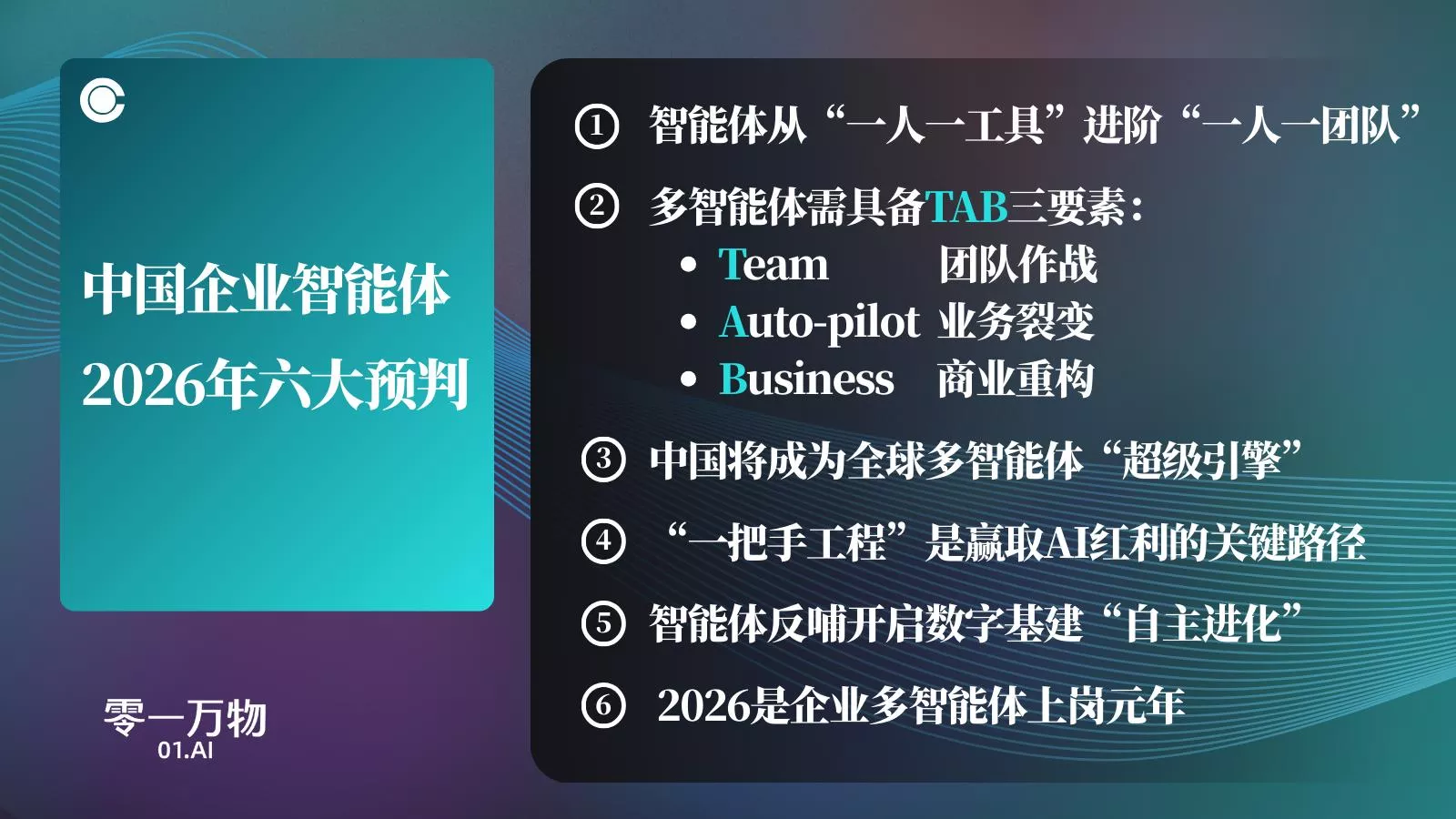
Core Insights - The article presents six key predictions regarding the evolution of enterprise intelligent agents by 2026, emphasizing the transition from single-point tools to comprehensive intelligent management systems [2][3][4]. Group 1: Evolution of Intelligent Agents - Prediction 1: Intelligent agents will evolve from "one person, one tool" to "one person, one team," enabling systemic intelligence across organizations and transforming top talent's capabilities into reusable business assets [5]. - Prediction 2: Multi-agent systems must possess three essential elements: AI Team (collaboration between humans and agents), allowing for flexible scaling of capabilities and reducing dependency on individual experts [6][7]. Group 2: China's Role and Strategic Implementation - Prediction 3: China is positioned to become a global leader in deploying multi-agent systems due to its complete industrial chain, leading open-source models, and vast market [8]. - Prediction 4: Successful AI transformation requires a "top-down" approach, where leadership drives systemic changes rather than isolated technical trials, emphasizing the need for leaders to understand AI's potential [9][10]. Group 3: Autonomous Evolution and Future Workforce - Prediction 5: Intelligent agents will contribute to the autonomous evolution of enterprise digital infrastructure, enhancing knowledge systems and decision-making processes [10]. - Prediction 6: By 2026, the focus of enterprise competition will shift from hiring to managing intelligent agents, with new roles such as "intelligent agent operators" emerging [11]. Group 4: Implementation Framework - The article outlines a three-step approach for enterprises to evolve their multi-agent systems: establishing a comprehensive strategy led by top management, utilizing Forward Deployed Engineers (FDE) to bridge organizational gaps, and fostering collaborative evolution through a mixed-model architecture [14][15][16]. Group 5: Technological Foundations and Future Directions - The foundation of enterprise multi-agent systems includes open-source models and industry-specific frameworks, aiming to create "super digital employees" that directly contribute to business objectives [17][18]. - The article concludes with a vision for the future of agents, highlighting the importance of safety, tool integration, task planning, and multi-model collaboration in enterprise environments [19][20].


零一万物发布万智2.5企业级多智能体,开启2026“硅基团队”上岗元年
Cai Jing Wang· 2026-01-05 12:20
Core Insights - The article discusses the transformative impact of AI multi-agent systems on enterprise organization structures, highlighting a significant shift towards "organizational intelligence" [4][6][20] - It emphasizes the importance of strategic leadership in AI transformation, advocating for a top-down approach to integrate AI into business processes [3][14][31] Group 1: AI Multi-Agent Systems - The release of "Wanzhi 2.5" showcases advancements in enterprise multi-agent systems, enabling complex workflows that previously required large teams to be managed by a single agent [1][22] - IDC predicts that the enterprise application software market, valued at $650 billion, will be disrupted by AI agents, with a projected market size of over $27 billion for enterprise AI applications in China by 2028 [1][12] - Multi-agent systems allow for enhanced collaboration and efficiency, enabling a single employee to manage a virtual marketing department or HR processes, thus transforming traditional roles [2][8] Group 2: Six Predictions for 2026 - Prediction 1: Multi-agent systems will evolve from "one person, one tool" to "one person, one team," facilitating systemic intelligence across organizations [10][12] - Prediction 2: Multi-agent systems must incorporate the TAB elements—Team, Auto-pilot, and Business—to enhance operational efficiency and business restructuring [8][9] - Prediction 3: China is positioned to become a global leader in multi-agent deployment due to its comprehensive industrial chain and advanced open-source models [12][14] - Prediction 4: The "top-down engineering" approach is essential for realizing AI benefits, requiring leadership to drive systemic changes in organizational structure [14][15] - Prediction 5: Multi-agent systems will contribute to the autonomous evolution of digital infrastructure within enterprises, enhancing knowledge management and decision-making processes [17][18] - Prediction 6: The year 2026 is anticipated to mark the large-scale deployment of multi-agent systems in enterprises, shifting focus from hiring to managing AI agents [20][31] Group 3: Implementation Strategies - Companies are encouraged to adopt a three-step approach for multi-agent evolution: establishing a top-down strategy, utilizing Forward Deployed Engineers (FDE) to bridge organizational gaps, and fostering collaborative evolution through a mixed-model architecture [25][27][29] - The integration of multi-agent systems is seen as a pathway to transform business capabilities into digital assets, enabling rapid adaptation and scalability [8][10][22]
AI六小虎人事动荡加剧,李开复公司迎百度系“救火队长”
凤凰网财经· 2025-10-28 14:08
Core Insights - The article discusses a significant leadership change at Zero One Everything, part of the "AI Six Tigers," with the appointment of Shen Pengfei as co-founder and the promotion of key members Zhao Binqiang and Ning Ning to vice president roles, aimed at enhancing commercialization efforts [1][3][4] - Zero One Everything, founded by Li Kaifu in 2023, focuses on large model technology development and enterprise-level AI solutions, emphasizing the need for CEO involvement in AI strategy to ensure value delivery [3][10] - The company has shifted its strategy from a consumer-focused approach to a business-oriented model, indicating a broader trend among AI companies facing commercialization challenges [10][11] Leadership Changes - Shen Pengfei, with over 26 years of experience in IT and internet sectors, has been appointed to oversee domestic ToB and ToG business expansion [1][3] - Zhao Binqiang will lead the core algorithm development for large models, bringing 17 years of experience in internet algorithms and AI [4] - Ning Ning will focus on international business and AI consulting, leveraging over 20 years of experience in AI and enterprise services [4] Industry Context - The leadership changes at Zero One Everything reflect a broader trend of instability within the "AI Six Tigers," with multiple companies experiencing executive turnover [5][9] - The article highlights the commercialization difficulties faced by AI companies in China, where project-based and privatized models hinder standardization and cost-effectiveness [10] - The shift in strategy from consumer to business solutions is not unique to Zero One Everything, as other companies in the sector are also exploring different paths for survival [10][11]

AI Agent“元年”:李开复的零一万物,是破局还是折戟?
Sou Hu Cai Jing· 2025-10-15 01:27
Core Insights - Zero One Technology, one of the "Six Little Dragons" in the domestic large model field, is embarking on a new journey by upgrading its service strategy for government and enterprise sectors, aiming to build a collaborative AI 2.0 ecosystem with partners and industry leaders [2] - The company has faced significant challenges, including high executive turnover, which has raised concerns about its strategic direction and ability to compete in the market [3][4] - The shift in focus from consumer-oriented AI applications to enterprise-level solutions is seen as a necessary survival strategy, although it presents its own set of challenges [4][10] Group 1: Strategic Developments - Zero One Technology announced a comprehensive upgrade of its service strategy at the "Yuanqi Shanghai" conference, leveraging the WanZhi 2.0 platform to create a collaborative ecosystem [2] - The company aims to become an ecosystem connector in the AI era, relying on industry clients for scenarios and data, while partners provide technical capabilities [2] - The strategic shift towards B-end solutions is a response to the competitive landscape and aims to deepen cooperation with leading clients in various sectors [4] Group 2: Executive Changes and Challenges - The company has experienced significant executive turnover, with seven executives, including key technical leaders, leaving the organization [3] - This turnover is attributed to the company's struggles in a competitive market and a strategic retreat to redefine its focus [3][4] - The loss of core technical talent poses risks to the company's research and development capabilities, necessitating a rapid rebuilding of a stable and efficient team [4] Group 3: Market Landscape and Competition - The AI Agent market is projected to grow significantly, with estimates of $5.1 billion in 2024 and $47.1 billion by 2030, indicating a lucrative opportunity for enterprise solutions [6] - However, the competitive landscape is intensifying, with major players like OpenAI, Google, and domestic giants such as Alibaba and Tencent aggressively pursuing the B-end market [7][8] - Zero One Technology's lack of an established ecosystem and scale presents a significant barrier to competing against these larger firms, which have substantial resources and market presence [7][8] Group 4: Future Prospects and Risks - The company is focusing on vertical industries and customized solutions to differentiate itself from larger competitors [8] - However, the path forward is fraught with challenges, including the need to prove long-term value to enterprise clients who may prefer established players [8][10] - The reliance on a few key clients for revenue poses a risk, as larger competitors may target these clients aggressively [10][11]

向大厂叫板?零一万物瞄准企业Agent私有化新战场
第一财经· 2025-09-26 13:28
Core Viewpoint - The article discusses the strategic focus of the company "Zero One Everything" on private deployment of AI agents for B-end clients, contrasting with the standardized solutions offered by larger tech firms [3][4]. Group 1: Market Positioning - Zero One Everything aims to provide customized and differentiated architecture solutions, targeting head enterprises in niche industries that require deep private deployment services [3]. - The company emphasizes that as data becomes a core asset for enterprises, private deployment is almost a necessity, as larger firms often generalize capabilities after acquiring enterprise data, which is undesirable for leading companies [3]. Group 2: Implementation Challenges - The article highlights that beyond engineering implementation, the architectural paradigm poses challenges for the deployment of agents in the B-end market [4]. - Traditional methods, such as using Directed Acyclic Graphs (DAG) for low-code workflows, are deemed insufficient for the dynamic intelligence demands of the large model era [4]. Group 3: Business Strategy - Zero One Everything's revenue for 2025 has already surpassed the total revenue of the previous year, indicating strong growth [4]. - The company prefers to collaborate with top-tier enterprises across various industries rather than expanding customer numbers indiscriminately, aiming to use lighthouse cases to attract more clients [4].
向大厂叫板?零一万物瞄准企业Agent私有化新战场
Di Yi Cai Jing· 2025-09-26 12:00
Core Insights - The article discusses the challenges of deploying Agents in the B-end market, emphasizing the need for private deployment solutions tailored to specific industries [1][2] - Zero One Everything, one of the "Six Little Dragons" in the large model sector, aims to capitalize on the private deployment benefits in the B-end market by offering customized and differentiated architectural paths [1] Group 1: Company Strategy - Zero One Everything's co-founder, Shen Pengfei, highlights that many leading enterprises in niche industries require deep private deployment services rather than standardized solutions offered by larger companies [1] - The company prefers to engage directly with core management, such as decision-makers, to implement technology solutions through a consulting approach [1] Group 2: Technological Approach - The company has shifted from a low-code workflow model, which relies on drag-and-drop configurations, to a code-first approach that emphasizes programming to drive the construction of intelligent agents [2] - This new architecture allows for more flexibility and better alignment with actual business scenarios, addressing the limitations of previous methods [2] Group 3: Financial Performance - Zero One Everything reported that its revenue for 2025 has already surpassed the total revenue for the previous year, indicating strong growth [2] - The company is focused on collaborating with top-tier enterprises across various industries rather than expanding its customer base indiscriminately [2]
李开复:智能体才是未来AI的核心形态
母基金研究中心· 2025-09-13 09:04
Core Viewpoint - The 2025 Sixth China Fund of Funds Summit highlighted the rapid advancements in AI, particularly the transition from traditional models to intelligent agents, which are expected to significantly enhance business efficiency and create new value in various industries [2][3][4]. Group 1: AI Development Trends - The development of large models has evolved from relying solely on data and computing power to incorporating "slow thinking" capabilities, allowing for deeper reasoning and self-training [3][4]. - The significance of Chinese models, such as Alibaba's Tongyi Qianwen and DeepSeek, lies in their open-source nature, which facilitates easier training and innovation compared to the closed-source models prevalent in the U.S. [3][4]. Group 2: Importance of Intelligent Agents - Intelligent agents are identified as the core future form of AI, possessing memory and execution capabilities that enable them to understand and fulfill business needs, thus acting as "super employees" [4][5]. - The advancement from workflow intelligent agents to reasoning intelligent agents allows for the autonomous breakdown and execution of complex tasks, potentially replacing human labor over hours to days [4][5]. Group 3: Challenges and Strategic Implementation - Traditional enterprises face challenges in deploying intelligent agents, often only replicating past AI capabilities without a clear future strategy [5]. - Successful deployment requires top-level management involvement to align with strategic goals, leading to business restructuring and value redefinition [5]. Group 4: Practical Applications and Value Creation - The company has implemented practical strategies by recruiting experienced consultants to help businesses develop transformation strategies and create quantifiable commercial value through intelligent agents [5]. - Applications in various sectors, such as energy, patent writing, game optimization, and supply chain management, have demonstrated both cost reduction and revenue enhancement [5].