
上汽大众途观L插混

Search documents
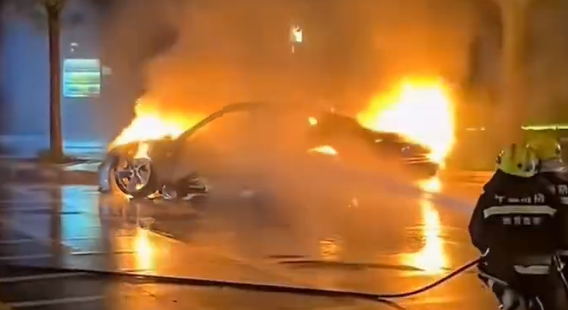
西安一保时捷行驶途中突然起火,车被烧成空架,“车辆未涉及碰撞”!专家:新能源车火灾发生概率与燃油车相差不大,但强度更高
Mei Ri Jing Ji Xin Wen· 2025-10-25 12:35
Core Viewpoint - A Porsche Taycan caught fire while driving in Xi'an, Shaanxi, with no casualties reported. The cause of the fire is under investigation, and this incident is part of a concerning trend of electric vehicle fires in recent days [1][3]. Group 1: Incident Details - A Porsche Taycan was completely engulfed in flames while in motion, leaving only the frame of the vehicle [1]. - This incident marks the third electric vehicle fire in two days, following similar incidents involving a Li Auto MEGA and a Volkswagen Touareg [3]. Group 2: Fire Risk Analysis - The probability of fire incidents in electric vehicles is comparable to that of traditional fuel vehicles, but the intensity of fires in electric vehicles is significantly higher [4]. - Data from the National Fire Rescue Administration indicates that the fire occurrence rate for electric vehicles is 0.288% compared to 0.2% for fuel vehicles [4]. - Over 50% of electric vehicle fires occur while the vehicle is charging or stationary, often due to battery thermal runaway [4][6]. Group 3: Safety Standards and Regulations - China has established some of the highest safety standards globally for electric vehicles, including a new mandatory standard for battery safety set to take effect in July 2026 [9]. - The revised battery safety standard emphasizes that batteries must not catch fire or explode during thermal runaway events, and includes new tests for battery protection against impacts [9][10]. - New regulations also require mechanical door handles on electric vehicles to ensure safety in emergencies, reflecting a proactive approach to managing risks associated with electric vehicle innovations [10].

爆燃事故接二连三,电车真不如油车安全?
第一财经· 2025-10-24 15:03
Core Viewpoint - The article discusses the increasing frequency of fire incidents involving electric vehicles (EVs), raising concerns about their safety compared to traditional fuel vehicles, particularly focusing on the role of lithium batteries in these incidents [3][5][6]. Group 1: Fire Incidents Overview - Recent incidents include a Li Auto MEGA, a SAIC Volkswagen Tiguan L, and a Xiaomi SU7 Ultra, all of which caught fire, with the first two resulting in total vehicle destruction but safe escape for occupants [3][4]. - The vehicles involved were equipped with ternary lithium batteries, which are noted for their higher energy density and associated risks [3][5]. Group 2: Fire Risk Comparison - Data from the National Fire Rescue Bureau indicates that the fire occurrence rate for EVs is 0.288 per 10,000 vehicles, while for fuel vehicles, it is 0.2 per 10,000, suggesting that the fire risk is comparable [6]. - However, the intensity of fires in EVs is reported to be significantly higher, with peak heat release rates reaching 11.6 MW and toxic gas emissions posing serious risks to occupants [7][10]. Group 3: Battery Safety and Technology - Ternary lithium batteries are more prone to thermal runaway compared to lithium iron phosphate batteries, with higher combustion temperatures exceeding 1100°C [11]. - The article highlights the need for improved battery safety measures, including better design of battery structures and real-time monitoring systems [11][12]. Group 4: Regulatory Developments - New national standards for electric vehicle battery safety are set to be implemented in July 2026, focusing on preventing fires and ensuring passenger safety during incidents [15][16]. - The standards include revised testing protocols for thermal diffusion and battery impact resistance, aiming to enhance overall vehicle safety [15][16].

爆燃事故接二连三,电车真不如油车安全?
Di Yi Cai Jing· 2025-10-24 14:33
Core Viewpoint - The frequent fire incidents involving electric vehicles (EVs) have raised public concerns about the safety of new energy vehicles, particularly those equipped with ternary lithium batteries, which are linked to several recent accidents [2][3][4]. Group 1: Incident Overview - On the night of the 23rd, a Li Auto MEGA caught fire after sparks ignited from the vehicle's underside, leading to a total loss of the vehicle but allowing passengers to escape safely [2]. - A SAIC Volkswagen Tiguan L hybrid spontaneously ignited on an overpass, causing significant traffic disruption, but the occupants managed to escape unharmed [2]. - A Xiaomi SU7 Ultra caught fire after a collision, resulting in the death of the driver, highlighting the severe consequences of such incidents [2]. Group 2: Battery Safety Concerns - All three vehicles involved in the incidents were equipped with ternary lithium batteries, which are known to have higher risks of thermal runaway compared to lithium iron phosphate batteries [2][8]. - A report indicated that 90% of EV fire incidents are related to battery issues, particularly thermal runaway, which can occur due to collisions or battery overcharging [7][8]. Group 3: Fire Incident Statistics - According to the National Fire Rescue Bureau, the fire incident rate for EVs was 2.88 per 10,000 vehicles in the first quarter of 2022, which is comparable to the 2 per 10,000 rate for traditional fuel vehicles [4]. - From January 2018 to November 2024, over 1,730 fire incidents involving EVs were reported, with 305 recalls affecting approximately 4.62 million vehicles due to fire risks associated with power batteries [4]. Group 4: Fire Intensity and Risks - The intensity of fires in EVs is significantly higher than in traditional vehicles, with peak heat release rates reaching up to 11.6 MW, and toxic gases being released during combustion [5][6]. - The temperature of fires from ternary lithium batteries can exceed 1100°C, posing severe risks to occupants and first responders [8]. Group 5: Safety Standards and Regulations - New national standards for electric vehicle battery safety, effective from July 2026, will include revised thermal diffusion testing and additional safety measures to mitigate fire risks [10]. - The introduction of mandatory safety standards for vehicle door handles aims to ensure that doors can be opened in emergencies, enhancing passenger safety during fire incidents [11].