东南·云霄

Search documents
全国政协常委金石:以人工智能点燃高等教育的“新质引擎”
Xin Lang Cai Jing· 2026-02-12 20:34
Core Viewpoint - The core focus of the article is on how higher education must adapt and iterate in response to the rapid advancements in artificial intelligence, which is reshaping human knowledge at an exponential rate [1]. Group 1: Education and AI Integration - The gap between the rapid evolution of algorithms in laboratories and the slower pace of traditional education and talent cultivation is a critical issue that needs to be addressed [1]. - The transformation in education should not merely involve digitizing teaching methods but should focus on reshaping the underlying logic of academic disciplines [1]. - There is a pressing need to integrate AI deeply into educational frameworks to better serve talent development and promote educational reform [1]. Group 2: AI4SEU Action Plan - The "AI4SEU" initiative aims to embed artificial intelligence into every traditional discipline through supply-side structural reforms [2]. - The university has made early investments in emerging fields such as low-altitude technology, 6G, organ chips, and future robotics [2]. - The focus should shift from teaching basic AI operations to promoting deep integration of AI into core research areas, enhancing both technology and professional capabilities [2]. Group 3: Development of Domain-Specific Models - The shift from general large models to "domain-specific large models" represents a strategic battleground for higher education to support industry transformation [2]. - The university has supported the development of several domain-specific models, including quantum computing software and models in concrete materials and law [2]. - Combining "professional depth" with "intelligent breadth" is seen as a core element of new productive forces, with a recommendation for universities to create proprietary domain models to gain asymmetric advantages in international tech competition [2]. Group 4: Future of Talent Development - The emphasis is on breaking down disciplinary barriers through AI empowerment and timely assessment of technological trends to reconstruct talent cultivation models [3]. - The goal is to provide sustainable and systematic support for the formation of new productive forces, thereby strengthening the foundation for China's modernization [3].
2025量子计算行业深度:行业概况、发展趋势、产业链及相关公司深度梳理
Sou Hu Cai Jing· 2026-01-10 02:15
Industry Overview - Quantum computing is emerging as a revolutionary technology that could reshape various fields such as drug development, materials science, and financial modeling, driven by its potential for exponential computational power [1] - The industry is transitioning from experimental phases to early commercialization, becoming a strategic focal point in global technological competition [1] Development Trends - The core of quantum computing lies in utilizing quantum bits (qubits) for parallel processing capabilities that far exceed classical computers. Current global technological routes include superconducting, ion trap, photonic, neutral atom, and semiconductor pathways, with superconducting technology currently leading in engineering and industrialization [2] - The future of quantum computing is expected to feature a hybrid computing model, integrating quantum and classical computing to address practical challenges during the maturation of quantum hardware [5] Global Competition - The United States and China are leading the global race in quantum computing, with the U.S. establishing a comprehensive ecosystem supported by significant policy investments and innovation, while China is rapidly catching up through strategic national initiatives and domestic technological advancements [3][20] - Over 30 countries are now engaged in quantum computing initiatives, highlighting its importance in maintaining national technological sovereignty [20] Industry Chain Structure - The quantum computing industry chain is forming, with upstream focusing on providing essential infrastructure like dilution refrigerators and precision measurement systems, midstream involving quantum computer manufacturers and software suppliers, and downstream centered on quantum computing cloud platforms aimed at democratizing access to computational power [4] - The application exploration is primarily research-focused, but commercial prospects in finance, chemical engineering, and pharmaceuticals are gaining attention as key drivers for market expansion [4] Key Players and Innovations - Major companies like Google, IBM, and Microsoft are making significant strides in quantum computing. Google’s Willow chip, with 105 qubits, has achieved a breakthrough in error rate reduction, while IBM has introduced a modular quantum computer with enhanced performance and error rates [34][38] - In China, significant advancements include the development of the 105-qubit "Zuchongzhi 3" superconducting quantum computer and the establishment of a quantum artificial intelligence consortium to promote integration with AI technologies [39] Future Outlook - The quantum computing market is projected to experience rapid growth in the next five to ten years, with expectations for valuable commercial applications in specific fields [5] - The industry is witnessing a surge in domestic companies and patent applications, indicating a vibrant innovation landscape in China, with 153 quantum computing companies and over 10,000 patent applications filed in recent years [28][29]

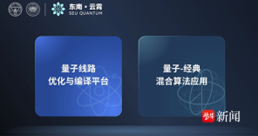
“东南·云霄”桌面软件平台发布 有望打通量子算法大规模应用“关键一公里”
Ke Ji Ri Bao· 2025-10-12 23:58
Core Insights - Southeast University has launched the "Southeast·Cloud Sky," the first domestic desktop software platform for quantum circuit design optimization and compilation, which translates quantum algorithms into executable instructions for real quantum computers, ensuring data security and facilitating large-scale application of quantum algorithms [1][2] Group 1: Platform Features - The platform operates as desktop software, allowing users to complete the entire process of quantum circuit construction, optimization, and compilation locally, without uploading core data to the cloud, thus enhancing data security [1] - "Southeast·Cloud Sky" incorporates multi-level optimization strategies to effectively reduce the number of quantum gates and circuits, significantly improving computational efficiency [1][2] Group 2: Compatibility and Applications - A cross-architecture quantum computing adaptation interface has been developed, compatible with various mainstream quantum computing hardware systems such as ion traps, neutral atoms, and superconductors, which helps lower development costs and improve computational resource utilization [2] - The platform has been tested in various scenarios, achieving a significant increase in the generation rate of effective small molecule drug compounds from approximately 0.01% to 35.98% in the biomedicine field, and outperforming traditional models in SAR image classification and general image recognition tasks [2]
国内首款!东大发布量子计算线路设计优化与编译桌面软件平台
Yang Zi Wan Bao Wang· 2025-09-25 14:20
Core Insights - Southeast University has launched the first domestic integrated desktop software platform for quantum circuit design optimization and compilation, named "Southeast Cloud" [1] - The platform addresses key challenges in quantum computing applications, including data security, high technical barriers, and poor hardware compatibility [1] Group 1: Platform Features - "Southeast Cloud" enhances data security by allowing users to perform the entire quantum circuit process locally on their computers, thus avoiding data upload and mitigating risks of data leakage and cyberattacks [2] - The platform improves computational efficiency by incorporating multi-level optimization strategies that significantly reduce the number of quantum gates and circuit depth [2] - It achieves cross-hardware compatibility through the development of adaptable interfaces for various mainstream quantum computing hardware systems, enabling "one-time development, multi-architecture deployment" [2] Group 2: Application Potential - In the biomedicine sector, "Southeast Cloud" has increased the effective yield of small molecule drug candidates from approximately 0.01% to 35.98% [2] - In image recognition, its hybrid quantum-classical neural network model has outperformed traditional models in both SAR image classification and general image recognition tasks [2] - The platform efficiently solves complex optimization problems, such as the maximum cut problem, showcasing its capabilities in mathematical optimization [2] Group 3: Future Development - The research team at Southeast University aims to explore new models for integrating quantum technology with industry needs, focusing on lowering the barriers to quantum computing applications and promoting high-quality development of the quantum computing industry in China [3]